THE DIRECT ANSWER
What commercial EV charging costs in Medford
Two numbers set the budget. Hardware is published: single-connector units run about $300 to $1,500 for Level 1, $400 to $6,500 for Level 2, and $10,000 to $40,000 for DC fast charging. The installed price adds the electrical work between your service and the stalls, and that part is quoted from site conditions rather than a price list. Plan the operating side too: up to $400 per charger a year in maintenance, and over $800 a year for a DC fast charger extended warranty.
A site review has to settle spare panel capacity, the distance from the electrical room to each stall, whether pavement must be opened, and how many future ports the same run should be sized to carry.
THREE PATHS
Three ways to run charging at a commercial property
The operating question comes before the equipment question. How long does the vehicle actually sit? Level 2 runs on a 208 to 240-volt circuit and returns roughly 10 to 30 miles of range per hour, which fits anywhere a driver parks for several hours: workplaces, offices, hotels, multifamily, and retail with long dwell. DC fast charging works at much higher power and can add significant range in 20 to 45 minutes, which fits sites where vehicles stop briefly and leave. Federal guidance splits it the same way, pointing workplaces and multifamily toward Level 1 and Level 2, and public charging hosts toward Level 2 and DC fast. Choosing fast charging for a lot where cars sit all day buys electrical infrastructure the site will never use. That is the most expensive mistake available here, and it gets made long before anyone digs a trench.
THE LINE ITEMS
What belongs in the budget
A comparable quote keeps hardware separate from the work that reaches it. These are the lines that move most between two Medford properties buying the same charger.
HOW TO BUY IT
You are buying the install, not the charger
The charger is a catalog item. The install is not. Two things move an installed price more than anything else: distance and capacity. How far the stalls sit from the service, and whether the building has amps to spare. Stalls beside the electrical room with headroom in the panel connect quickly. Stalls at the far edge of a lot, fed from a panel with nothing left, pull in trenching, conduit, wire, restoration, and often panel or service work on top.
Bring the utility in during planning, not after the design is drawn. The utility confirms what the site can be fed today, what an upgrade would involve, and what rates and metering look like once chargers are running. That conversation changes the number more often than a hardware swap does.
Then decide whether the stations are networked. Networking is what enables payment, access control, and utilization data, and it is also what adds a recurring software line. If you only need employees or a fleet to plug in, the case is weaker. If you want the public to pay at the unit, that is the reason to buy one.
TWO SITES
What makes an install cheap or expensive
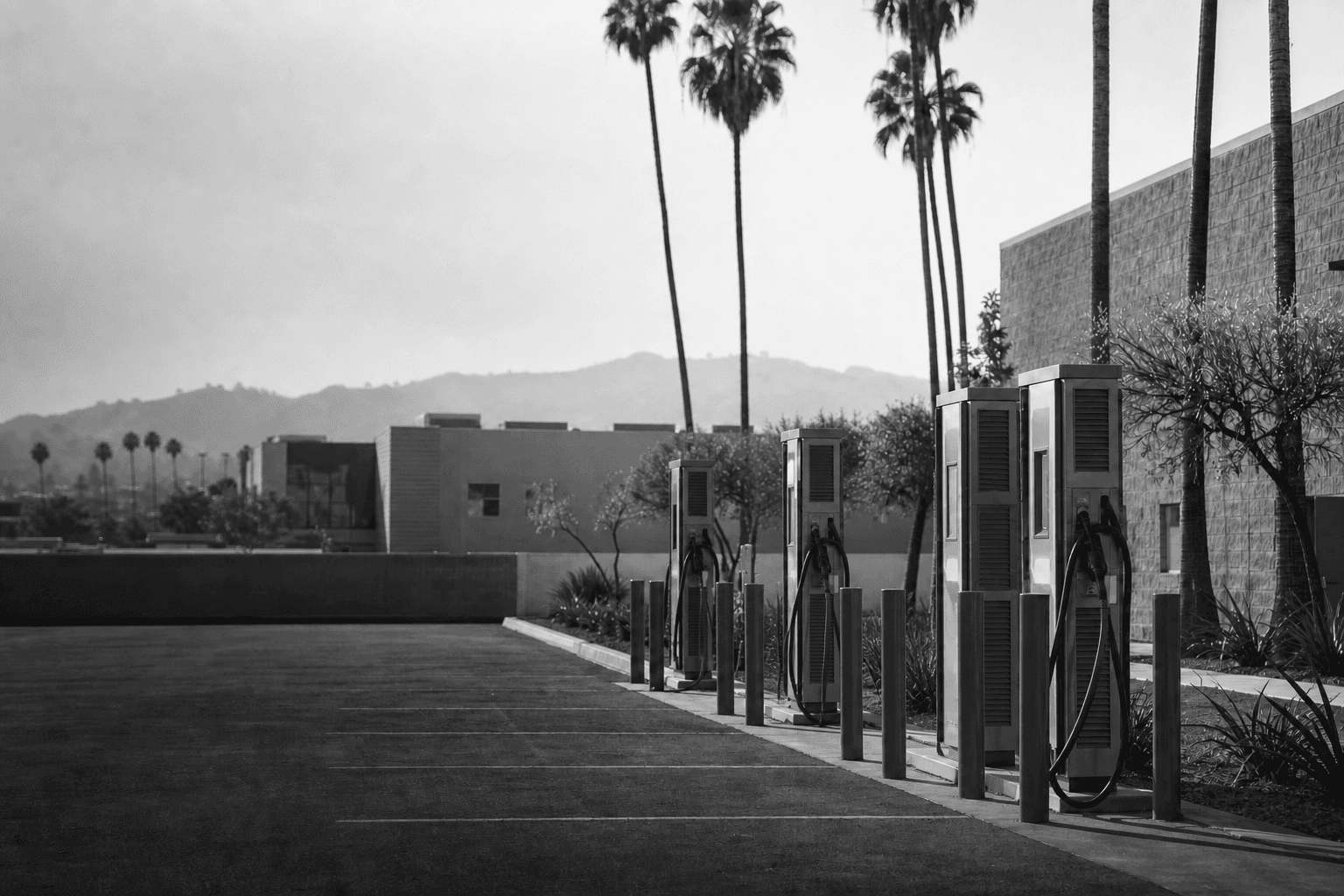
The same two chargers can land at very different prices a mile apart in Medford. The site decides, and most of the difference is visible before anyone quotes.
LOWER COMPLEXITY
Short run, spare capacity
Stalls near the electrical room, a panel with room left, a soft route for conduit, and Level 2 equipment. The scope is a branch circuit, a mount, and an inspection.
HIGHER COMPLEXITY
Long run, full panel
Stalls across the lot, pavement to cut and restore, no spare amps, and DC fast equipment. Now the project includes utility coordination, service work, and a longer schedule.
THE SITE REVIEW
What a walk has to settle before anyone prices it
A useful site review answers questions in a specific order. First, how many units and what type, both now and in a few years. Federal planning guidance treats near-term and long-term counts as one decision, because the conduit and panel you install today set the ceiling for everything added later.
Next, where the power is. Proximity to incoming electricity drives the run, and metering may need to change. If the stations are networked, wireless coverage at the stalls matters too, since a unit that cannot reach the network cannot take payment.
Then the conditions around the equipment: weather exposure, cable management, signage, and security. These read like small items on a quote, but they decide how the site looks and works after year one.
Finally, timing. Inspection requirements affect the project schedule, and utility coordination has its own lead time. Both belong in the plan before you commit to an opening date.
Ask this on the walk
How many ports do we want this trench and panel to support in five years? Sizing the run once is far cheaper than opening the same pavement twice, and it is the one decision you cannot revisit without spending the money again.
OREGON RULES
Permits run on a statewide protocol
Oregon handles EV charging permitting and inspection through a statewide rule, OAR 918-311-0065, rather than leaving it entirely to each city. Two practical points follow from that.
First, the permit is pulled by a licensed electrical contractor with a supervising electrician on record. This is not a permit an owner or a general contractor takes out.
Second, the permit path can depend on how the circuit is sized. As written, the rule lets a contractor use a minor installation label for a new branch circuit limited to 40 amps, while the broader minor-label rule allows up to three circuits limited to 60 amps and not more than 150 volts to ground. The state moved through rulemaking to align those two limits, and noted a minor label can cost less than a full electrical trade permit.
Settle the permit path during design
Ask your contractor which path your circuit falls under before the layout is locked. A 40-amp Level 2 circuit and a larger one can land on different permits with different costs, and the amperage limits have been under active alignment.
AFTER INSTALL
Who owns it, and what it costs to run
Two decisions shape the years after the ribbon cutting, and both are easier to make before the equipment is ordered. The first is ownership. The second is what the electricity itself costs once vehicles are actually plugged in, which is rarely a flat per-kilowatt-hour story on a commercial account.
OWNERSHIP
Own it or let the provider own it
Equipment you buy, install, and maintain costs less overall and gives full control. It also puts every repair on you once the warranty ends. Whichever way you go, name the responsible party in writing.
DEMAND CHARGES
The bill is not just kilowatt-hours
Commercial charging can carry demand charges based on the highest 15-minute average use in a billing period, and DC fast charging triggers them far more readily than Level 2. Ask the utility about time-of-use rates.
PHASING AND PROCUREMENT
Build the trench once, then add ports
The cheapest ports you will ever install are the ones added to infrastructure that already exists. Oversizing conduit and panel space on the first project costs a fraction of what a second trench costs later, so decide the five-year port count now and pour once.
Work the incentives while the budget is still open, not after the invoices land. Federal, state, local, and utility programs all sit in the planning stage of the standard checklist for a reason. One line has changed: the federal 30C refueling property credit covered up to 30 percent of purchase and installation costs at qualifying locations, but it closed to property placed in service after June 30, 2026. If your equipment was energized before that date it is still a filing question for your accountant. If you are budgeting a new Medford project today, do not count on it.
Finally, treat maintenance as a contract term, not an afterthought. A service agreement should state a response time, a repair time, and an uptime requirement. Without those three numbers, a broken charger is only a problem you discover from a customer complaint.
QUOTE CHECKLIST
Five things a comparable quote shows
If two quotes cannot be lined up item by item, one of them is hiding scope. These five lines make the comparison honest.
01
Hardware, by unit and level
Make, model, connector count, and price per unit. Level 2 and DC fast should never be blended into one line.
02
The run to the stalls
Measured distance, trenching or core work, conduit and wire sizing, and who restores the pavement and striping.
03
Service and panel scope
Existing capacity, what is added, metering changes, and what the utility has confirmed versus what is assumed.
04
Permit path and inspections
Which permit the licensed contractor pulls, how many inspections, and the schedule impact of each.
05
Ongoing costs in writing
Network fees, warranty term, annual maintenance, and the response, repair, and uptime commitments behind them.
Keep planning locally
Related EV charging pages in Medford
Get a defensible number
Price the equipment and the building together.
Send the address, operating target, and target opening date. Flux will identify what must be verified before the project can be priced.
Price my chargersQuestions
Straight answers.
How much is the charger itself?
Single-connector equipment runs roughly $300 to $1,500 for Level 1, $400 to $6,500 for Level 2, and $10,000 to $40,000 for DC fast charging. Installation is quoted separately, from your site conditions.
Why do two Medford quotes differ so much?
Almost always distance and capacity. A charger beside the electrical room on a panel with spare amps is a short job. One across the lot from a full panel adds trenching, restoration, and service work.
Who pulls the permit in Oregon?
A licensed electrical contractor with a supervising electrician on record. Oregon runs a statewide permitting and inspection protocol for EV charging systems, so this is not an owner-pulled permit.
Do I need networked chargers?
Only if you need payment, access control, or utilization data. Networks add annual fees. More than 20 percent of public charging is still free to use, and fleets often track usage through the network instead.
Is the federal charger tax credit still available?
The 30C credit covered up to 30 percent of purchase and installation at qualifying locations, but it closed to property placed in service after June 30, 2026. Treat it as historical unless your equipment was energized earlier.
Sources used for this guide
- [1]afdc.energy.gov — Alternative Fuels Data Center: Procurement and Installation for Electric Vehicle Charging Infrastructure
- [2]irs.gov — IRS Alternative Fuel Vehicle Refueling Property Credit
- [3]photoelectricllc.com — Commercial EV Charging Station Installation | PhotoElectric
- [4]afdc.energy.gov — Alternative Fuels Data Center: Operation and Maintenance for Electric Vehicle Charging Infrastructure
- [5]afdc.energy.gov — U.S. DOE AFDC Electric Vehicles for Fleets
- [6]oregon.gov — Notice of Rulemaking Hearing