THE NUMBER
What a commercial charging project costs
Budget in two parts: hardware and the electrical work behind it. Single-connector Level 2 units run $400 to $6,500 each. DC fast chargers run $10,000 to $40,000 before installation. The electrical work for a Level 2 circuit commonly adds $500 to $1,500 per port when the panel already has room. DC fast projects cost more than that because the service feeding them is a different class of work.
A site review has to confirm spare panel capacity under a load calculation, the distance from the electrical room to the stalls, and whether the pavement between them has to be opened.
THE FIRST DECISION
Match the charging level to how long vehicles sit
The first decision is not how many ports. It is how long vehicles sit. Level 1 and Level 2 fit workplaces, multifamily parking, and fleet yards where vehicles stay for hours. DC fast charging fits public sites and short-turnaround duty, where a driver needs 80 percent of a battery in well under an hour.
That choice sets almost everything downstream. Level 2 runs on a 240-volt circuit and is treated as a continuous load, so a 48-amp charger needs a 60-amp circuit and 6 AWG copper. DC fast charging needs service capacity that most existing buildings do not have sitting idle, and it is far more likely to trigger demand charges, which are billed on the highest 15-minute average use in a billing period.
Pick the level that matches dwell time, then price it. Buying a level to look impressive is the most expensive mistake in this category.
THE LINE ITEMS
What belongs in the number
Every honest quote has the same skeleton. What changes between bidders is which of these lines they priced and which they quietly left for a change order.
COMPARING BIDS
How to read two quotes that are far apart
Two contractors can walk the same lot and hand you numbers that look unrelated. Usually neither one is lying. One assumed the existing panel has room, and the other ran a load calculation and found it does not. A service upgrade is the single biggest swing in a Virginia quote, and whether it sits inside the number changes everything else about the comparison.
The second gap is distance. The run between the electrical room and the stalls is real construction: trench, conduit, wire, and putting the surface back. Past the first 25 feet, each additional 10 feet typically adds $75 to $150 in labor and material. That sounds small until the stalls you want are on the far side of the lot.
The third gap is the port itself. Charging equipment is treated as a continuous load, so a 48-amp charger needs a 60-amp circuit and 6 AWG copper. A bidder who sized the circuit to the charger's nameplate instead of the code requirement produced a cheaper number for work that will not pass inspection. Ask every bidder to show the load calculation, the conduit route, and the circuit sizing before you compare totals.
SITE CONDITIONS
What separates an easy site from a hard one
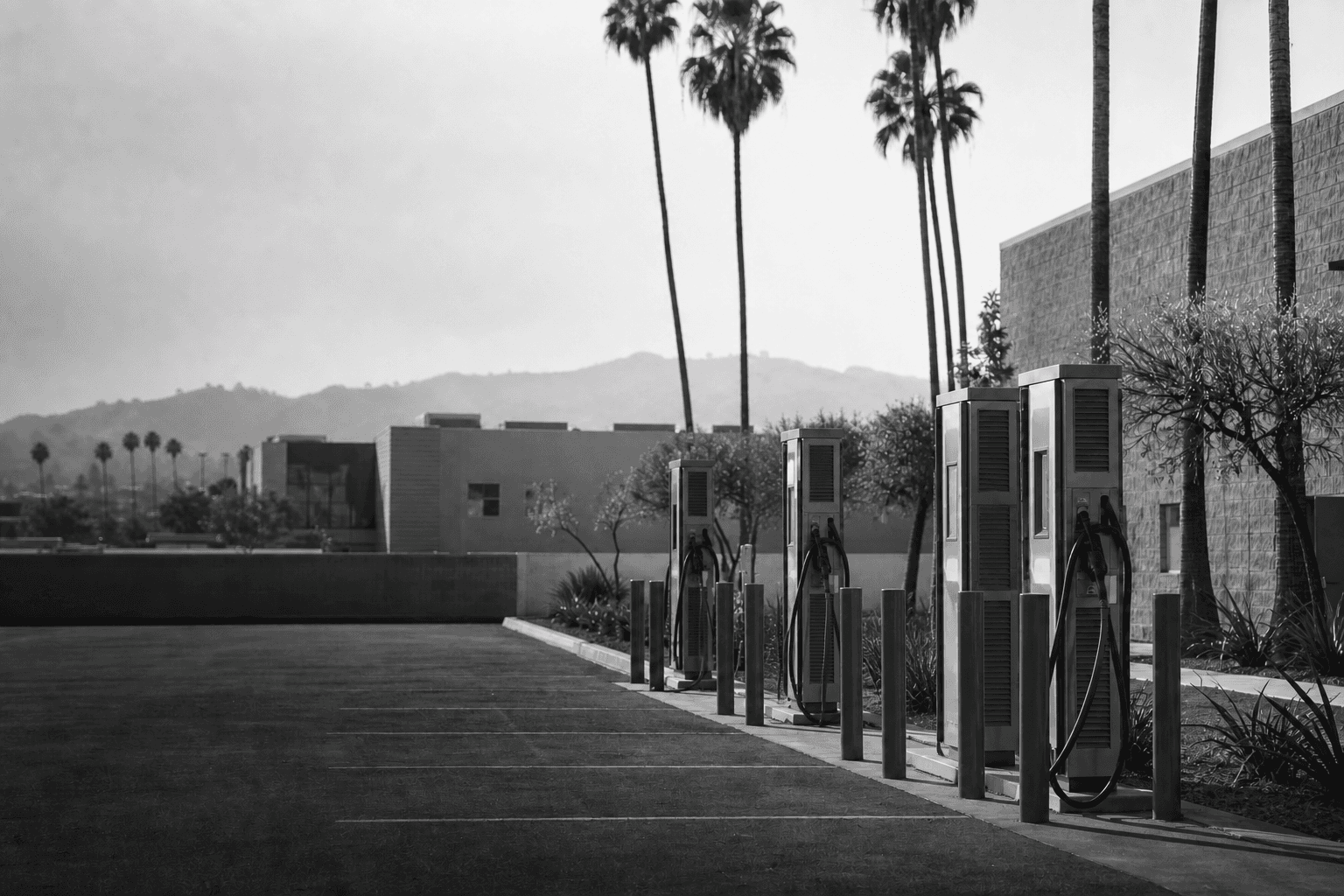
The same charger costs very different money depending on what sits between it and the building's service. Two sites, same equipment, very different totals.
LOWER COMPLEXITY
Short runs and spare capacity
Stalls near the electrical room, a panel with headroom under a load calculation, and a route that stays in landscaping or an existing chase. Level 2 ports, no service upgrade, no pavement to cut and restore.
HIGHER COMPLEXITY
Distance, full panels, and fast charging
A panel already at its limit, stalls across the lot, and DC fast equipment that needs new service capacity. Add trenching, surface restoration, utility coordination, and a longer permit and inspection window.
SCOPING
What a real site review actually looks at
Nobody can price this from a photo. A useful site visit starts at the electrical room, not the parking lot. The contractor should open the panel, read the existing loads, and run a load calculation to decide whether the building can carry the chargers you want or needs a new panel or a service upgrade. That answer sets the ceiling on everything else.
Then the walk goes outside. How far are the stalls, and what is between them? Landscaping is cheap to cross. Asphalt is not. The visit should also cover where power enters the site, whether the chargers need their own meter, whether a wireless signal reaches the stalls if the ports will be networked, and where a second phase of ports would go.
Bring the utility in early. Utility coordination sets both the cost of service work and a large share of the schedule. Ask about incentives on the same visit: in Virginia, Dominion Energy's EV programs are the first place to check, and the federal 30C credit depends on census tract eligibility and the placed-in-service date, so confirm both before counting either in a budget.
Ask before the walk ends
Get three things in writing from the site visit: the load calculation result, the measured conduit route with its surface types, and confirmation that the utility has been contacted. A quote missing any of the three is a placeholder, not a price.
OPERATING DECISIONS
Two choices made at purchase that are hard to undo
Capital cost is the part buyers study hardest. The operating decisions underneath it are the ones people regret. Two of them get locked in at purchase: who owns the equipment, and whether the stations are networked.
Ownership decides who pays when a charger breaks. Buying the equipment lowers overall cost and gives you full control, and it makes every repair yours. Letting the equipment or network provider own it trades margin for someone else's responsibility. Either way, put the maintenance terms in the contract: a response time, a repair window, and an uptime requirement. Warranty pricing varies by manufacturer, and repairs on a charger that is out of warranty get expensive fast.
OWNERSHIP
Buy it or let the provider own it
Owned equipment costs less overall and stays fully under your control, but you carry every repair. Provider-owned equipment shifts that burden and the cost with it. Settle who handles warranty claims before signing.
NETWORKING
What networked ports add and cost
Networking enables payment, access control, and usage data, and it separates charging load from the rest of your electricity use. It also adds a subscription. Non-networked ports can still collect payment through RFID, an app, or an attendant.
PHASING AND LIFETIME COST
Build the infrastructure once, add ports later
The cheapest second charger is the one you planned for while the trench was still open. Conduit and panel capacity are the expensive parts of this project, and both get much cheaper per port when they are built once for the site you expect in five years instead of the one you have today. Decide the near-term and long-term port count in the same meeting, then install today's chargers on tomorrow's infrastructure.
Lifetime cost is the other half of the picture. Plan on up to $400 per charger per year for maintenance, and know that annual extended warranties for DC fast chargers can run over $800 per charger. Networked stations add a subscription on top. Demand charges deserve a hard look before you commit to fast charging, because they are billed on your highest 15-minute average use, and a single fast-charging session can set that number for the whole month. Some utilities offer time-of-use rates that soften it.
If you plan to recover cost, decide the pricing model early, whether by kWh, by session, by time, or by subscription, because it changes the hardware and network you buy. More than 20 percent of public charging is still free to use, and that is a legitimate choice when the ports exist to serve tenants or employees.
THE CHECKLIST
Five things a comparable quote should show
Bids only compare if they cover the same work. Ask every contractor to break the number into these five lines, then read the differences instead of the totals.
01
The load calculation
Existing building load, the added charger load, and whether a panel or service upgrade is included in the price.
02
The conduit route
Measured distance from panel to stalls, with surface types and any pavement cutting and restoration priced.
03
Circuit sizing per port
Charger amperage, breaker size, and conductor size, sized as a continuous load.
04
Permits and utility coordination
Who pulls permits, who talks to the utility, and what each adds to the schedule.
05
Ongoing costs
Network subscription, warranty term, and who pays for repairs once that term ends.
Keep planning locally
Related EV charging pages in Lynchburg
Get a defensible number
Price the equipment and the building together.
Send the address, operating target, and target opening date. Flux will identify what must be verified before the project can be priced.
Price my chargersQuestions
Straight answers.
How much does one commercial Level 2 port cost?
Hardware for a single-connector Level 2 unit runs $400 to $6,500. The electrical work commonly adds $500 to $1,500 per port when the panel has spare capacity. Distance from the panel and any service upgrade are what push a project past that range.
Why is DC fast charging so much more expensive?
The hardware alone runs $10,000 to $40,000 per unit, and the service feeding it is a different class of electrical work. Fast charging is also far more likely to trigger demand charges, which are billed on your highest 15-minute average use in a billing period.
What is the biggest variable in a quote?
Panel capacity. A load calculation decides whether the job needs a service upgrade, and that is the single biggest swing in a Virginia quote. Conduit distance is second: past the first 25 feet, each additional 10 feet typically adds $75 to $150.
What does it cost to run the chargers after installation?
Plan on up to $400 per charger per year for maintenance, plus any network subscription. Annual extended warranties for DC fast chargers can run over $800 per charger. Repairs on a unit that is out of warranty get expensive quickly.
Who should install commercial charging equipment?
Use an electrical contractor certified for EV charging work, and confirm they handle permits, inspection, and utility coordination. Ask for the load calculation and the conduit route in writing so every bid is priced against the same scope.
Sources used for this guide
- [1]afdc.energy.gov — Alternative Fuels Data Center: Procurement and Installation for Electric Vehicle Charging Infrastructure
- [2]irs.gov — IRS Alternative Fuel Vehicle Refueling Property Credit
- [3]evchargeracademy.com — EV Charger Installation Cost in Virginia: 2026 Price Guide | EVCharger Academy
- [4]norvaelectric.com — EV Charging Station Installation Hampton Roads VA | Norva Electric
- [5]afdc.energy.gov — Alternative Fuels Data Center: Operation and Maintenance for Electric Vehicle Charging Infrastructure
- [6]afdc.energy.gov — U.S. DOE AFDC Electric Vehicles for Fleets