THE NUMBER
What commercial EV charging costs per port
Most Longmont projects price out per port. Level 2 charging hardware runs about $400 to $6,500 per unit, depending on connectors, networking, and enclosure. Installed — hardware plus the electrical work, permits, and restoration — a commercial Level 2 port typically lands between $3,500 and $18,000. DC fast charging is a different class: $10,000 to $40,000 for the equipment alone, and $75,000 to $350,000 per dispenser installed.
A site review has to confirm spare panel capacity, the distance from the electrical room to the stalls, and whether the pavement between them has to be opened.
THE FIRST DECISION
Three ways to run charging on a commercial site
The charging level is not a hardware preference. It is a decision about how long vehicles sit still. Workplaces and multifamily buildings, where cars park for a shift or a night, are usually well served by Level 1 and Level 2. Public-facing sites, where drivers stop briefly, need Level 2 and DC fast charging for the parking stall to earn its keep. Fleets sit in between: a Level 2 unit will fill a typical battery overnight, which is why depot yards rarely need fast charging at every stall.
There is also a cheaper path most buyers never hear about. Instead of setting a pedestal at every parking space, you can install 120/240-volt receptacles and hand portable Level 1 or Level 2 units to drivers. That lowers project cost, adds flexibility, and makes a failed charger a quick swap instead of a service call. It does not fit everywhere — paid public charging still wants fixed, networked equipment — but for a fleet yard it is worth pricing before you commit to pedestals.
THE LINE ITEMS
Where the money actually goes
The charger is rarely the biggest number on the quote. Most of the spread between a cheap install and an expensive one lives in three lines: the distance from power to the stall, the capacity of the existing panel, and how much pavement has to be cut and put back.
BUYING GUIDANCE
How to buy this without overpaying
Start with the site, not the catalog. The cheapest single decision you can make is putting the first chargers close to the incoming electrical service, because every extra foot of that run is trench, conduit, wire, and pavement you pay for twice — once to open and once to close. Walk the lot with the panel schedule in hand before anyone quotes hardware.
Bring the utility in early too. They confirm what your existing service can carry, what an upgrade would cost, and which rate your charging load lands on. That conversation also surfaces lead times, which are usually the reason projects slip, not the construction.
Then settle two questions that change the price of everything downstream: who owns the equipment, and whether it needs to be networked. Owning the hardware outright lowers overall cost and gives you full control, but it also puts every repair, warranty claim, and replacement on you. Networking adds a monthly fee per port, and it is what makes payment, access control, and utilization data possible. If you never intend to charge for a session and only need to know the units are working, you may not need it. If you plan to bill drivers or report on usage, you do — and it is far cheaper to specify at the start than to retrofit later.
TWO SITES, TWO PRICES
What makes a site cheap or expensive
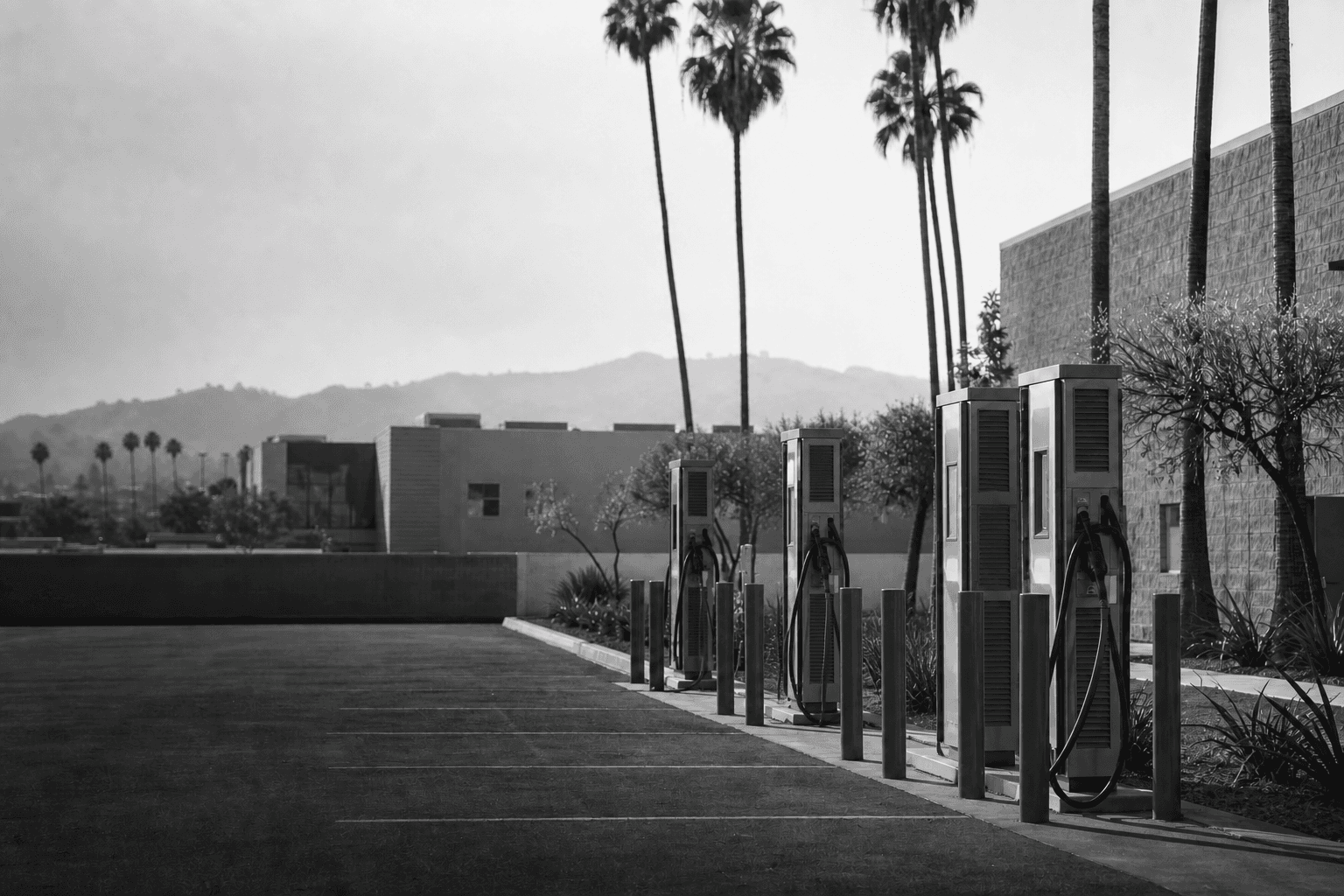
Two buildings can buy the same charger and get quotes that differ by a factor of three. The difference is almost never the hardware. It is what stands between the electrical room and the parking stall.
LOWER COMPLEXITY
Short run, spare capacity
Stalls sit near the electrical room. The existing panel has spare amps. Conduit runs along a wall or through landscaping instead of under pavement. Level 2 ports here land near the bottom of the range, and the permitting path is straightforward.
HIGHER COMPLEXITY
Long run, full panel, fast charging
The chargers sit across the lot, so the run crosses drive aisles and paved parking. The panel is full, so the project adds capacity or a new service. Add DC fast charging and the utility side becomes both the schedule and the budget.
BEFORE YOU QUOTE
What a site review has to answer
A useful site review is not a walk-around. It is a short list of measurements that decide the number.
The first is capacity: what the service is rated for, what the building already draws at peak, and what is genuinely spare. The second is distance and path — not just how far the stalls are from the service, but what the conduit has to cross. Landscaping is cheap. A drive aisle is not. The third is the port count you actually want, near-term and later. Pulling extra conduit while the trench is already open costs far less than opening it a second time in three years.
Then the details that quietly add scope: whether there is wireless signal at the stalls for networked equipment, whether metering has to change, where signage and striping go, and how weather exposure affects the equipment you choose and where it sits. Ask about inspection requirements at the same time, because inspection sequencing often determines when you can energize.
Anyone who quotes a per-port price before answering those questions is quoting a price list, not your project.
The five things to measure first
Service rating and spare capacity, the distance and surface between the service and the stalls, the near-term and future port count, wireless coverage for networked units, and any metering change. Those five answers move the price more than the hardware you pick.
AFTER IT IS ENERGIZED
Two decisions that outlive the install
The install ends. The operating bill does not. Two decisions made during procurement set what the next decade costs, and both are far easier to get right on paper than to renegotiate later.
Maintenance is the first. Routine care is genuinely light — store cables so they do not get damaged, check parts periodically, keep the units clean — but a broken charger out of warranty gets expensive fast. Plan on up to $400 per charger per year, and more for DC fast, where annual extended warranties can run over $800 per charger. Whatever contract you sign should name a response time, a repair window, and an uptime requirement. The second decision is what happens to the electricity bill, which is where most owners get surprised.
OWNERSHIP
Who owns and who repairs
Equipment you own is purchased, installed, and maintained by you. That lowers overall cost and gives you full control, but every repair and warranty claim is yours. Provider-owned models move that responsibility off your books at a price. Get repair responsibility named in writing either way.
OPERATING COST
Demand charges and what triggers them
Electricity billing commonly includes a demand component tied to the highest 15-minute average use in a billing period. DC fast charging trips it far more readily than Level 1 or Level 2. Ask your utility about time-of-use rates and other rate options before you size anything.
PHASING AND PROCUREMENT
Build for the stalls you will need later
The most expensive version of this project is the one you do twice. Trenching, conduit, and pavement restoration do not get cheaper the second time, so the standard move is to size the underground work for where you expect to be in five years, then add hardware as demand shows up. Spare conduit pulled while the trench is open is the cheapest future capacity you will ever buy.
On procurement, decide early whether you need a formal solicitation. Public agencies and larger organizations often do, and an RFP adds months, so it belongs in the schedule from the start rather than as a surprise. Either way, price the incentive stack before you commit. Utility make-ready programs typically pay for the part that hurts — the panels, conduit, wiring, and trenching between the service and the stall — and they do not pay backward, so applications go in before construction starts.
One piece of that stack is gone. The federal 30C credit covered property placed in service through June 30, 2026, at 6 percent of cost for business property in an eligible census tract, capped at $100,000 per item. Projects energized by that date still claim it at filing. Anything you build now cannot, so treat any quote that nets it out as out of date and ask for the number again.
COMPARING QUOTES
Five things every quote should show
Two quotes for four Level 2 ports can differ by tens of thousands of dollars and both be honest. The only way to compare them is to make each one show the same lines. Ask for these five in writing before you choose.
01
Cost per port, hardware separated from labor
Equipment, mounting, and activation fees on their own lines, not folded into a single installed price.
02
The electrical run, priced in detail
Trench length, conduit, wire, and what it costs to cut and restore pavement versus running through landscaping.
03
The capacity finding
What the existing service and panel can carry today, and the cost of the upgrade if they cannot carry the load.
04
Permits, inspections, and utility coordination
Who files, who schedules, and what review and inspection timeline the price assumes.
05
Ongoing cost and responsibility
Network fees per port, the maintenance plan's response time and uptime commitment, and who owns repairs after the warranty.
Keep planning locally
Related EV charging pages in Longmont
Get a defensible number
Price the equipment and the building together.
Send the address, operating target, and target opening date. Flux will identify what must be verified before the project can be priced.
Price my chargersQuestions
Straight answers.
How much does one commercial Level 2 port cost installed in Longmont?
Plan on $3,500 to $18,000 per port installed. The hardware itself is $400 to $6,500. The rest is the electrical run, any panel work, permits, and restoration, which is why site conditions decide the number rather than the charger you pick.
Why is DC fast charging so much more expensive?
The equipment alone runs $10,000 to $40,000, and installed cost commonly lands between $75,000 and $350,000 per dispenser. The electrical service behind it is a different class of work, and it is far more likely to trigger demand charges once it is running.
Can I still claim the federal 30C tax credit?
Not on new work. The credit applied to property placed in service through June 30, 2026, at 6 percent of cost for business property in an eligible census tract, capped at $100,000 per item. Projects energized by that date still claim it at filing; anything built after cannot.
What should I budget for after the chargers go live?
Electricity including any demand charge, network software at roughly $15 to $40 per port per month, and maintenance of up to $400 per charger per year. Annual extended warranties for DC fast chargers can exceed $800 per charger.
What makes a site cheap to install on?
Spare capacity in the existing panel and stalls close to the electrical room. Distance and a full panel are the two conditions that turn a small project into a large one.
Sources used for this guide
- [1]afdc.energy.gov — Alternative Fuels Data Center: Procurement and Installation for Electric Vehicle Charging Infrastructure
- [2]irs.gov — IRS Alternative Fuel Vehicle Refueling Property Credit
- [3]winsparking.com — Fleet EV Charging in Denver, CO | Wins Parking
- [4]winsparking.com — EV Charging Station Installation in Tampa, FL | Wins Parking
- [5]afdc.energy.gov — Alternative Fuels Data Center: Operation and Maintenance for Electric Vehicle Charging Infrastructure
- [6]afdc.energy.gov — U.S. DOE AFDC Electric Vehicles for Fleets