THE NUMBER
What commercial EV charging costs in Jurupa Valley
Budget the charger first. Single-connector equipment runs about $400 to $6,500 for Level 2 and $10,000 to $40,000 for DC fast charging. In Southern California, a Level 2 station lands near $1,500 to $1,700 installed with labor, wiring, and permit fees included — that is one unit on a short run. If the building needs a service panel upgrade, add several thousand dollars before any of that.
A site review confirms the real number: spare panel capacity, distance from the electrical room to the stalls, whether pavement has to be cut, and how much power the utility can deliver without a service upgrade.
PICK THE JOB FIRST
Three ways commercial charging gets used
The right charger is decided by how long vehicles sit still, not by how fast the hardware can go. Workplaces and multifamily buildings have long dwell times, so Level 1 and Level 2 fit and cost the least to install. Public-facing sites — retail, hospitality, anywhere a driver stops for an hour or less — need Level 2 and, in some cases, DC fast charging. Fleet yards fall in between: a Level 2 unit will fill a typical EV battery overnight, which is usually all a depot needs.
Get this order right and the budget follows. Choosing DC fast charging for a site where vehicles park for eight hours buys electrical work you pay for twice — once in construction and again in demand charges.
WHERE THE MONEY GOES
The lines a Jurupa Valley charging budget carries
A charging quote is one equipment line and several site lines. The equipment is the part you can price from a catalog. Everything else depends on what the walk-through finds.
BUYING GUIDANCE
How to keep the install from outgrowing the chargers
The chargers are rarely what breaks a budget. The path between the electrical service and the parking stalls is. That path decides how much conduit gets pulled, how much pavement gets opened, and whether the building needs a new panel. So the cheapest useful move on any Jurupa Valley site is to put the first chargers where the power already is, even if that is not the most visible corner of the lot.
There is a second lever most owners miss. Instead of setting a pedestal at every stall, you can install 120- or 240-volt receptacles and use portable Level 1 or Level 2 units. That lowers project cost, and it makes failures cheap — a bad portable unit gets swapped instead of serviced in place, so a stall does not sit dead waiting on a repair visit.
Size the trench for more than you are building today. Pulling extra conduit and setting a larger panel while the ground is already open costs a fraction of coming back. Most owners who regret their first charging project regret the capacity they left out, not the ports they installed.
TWO SITES, TWO PRICES
What makes one lot cheap and another expensive
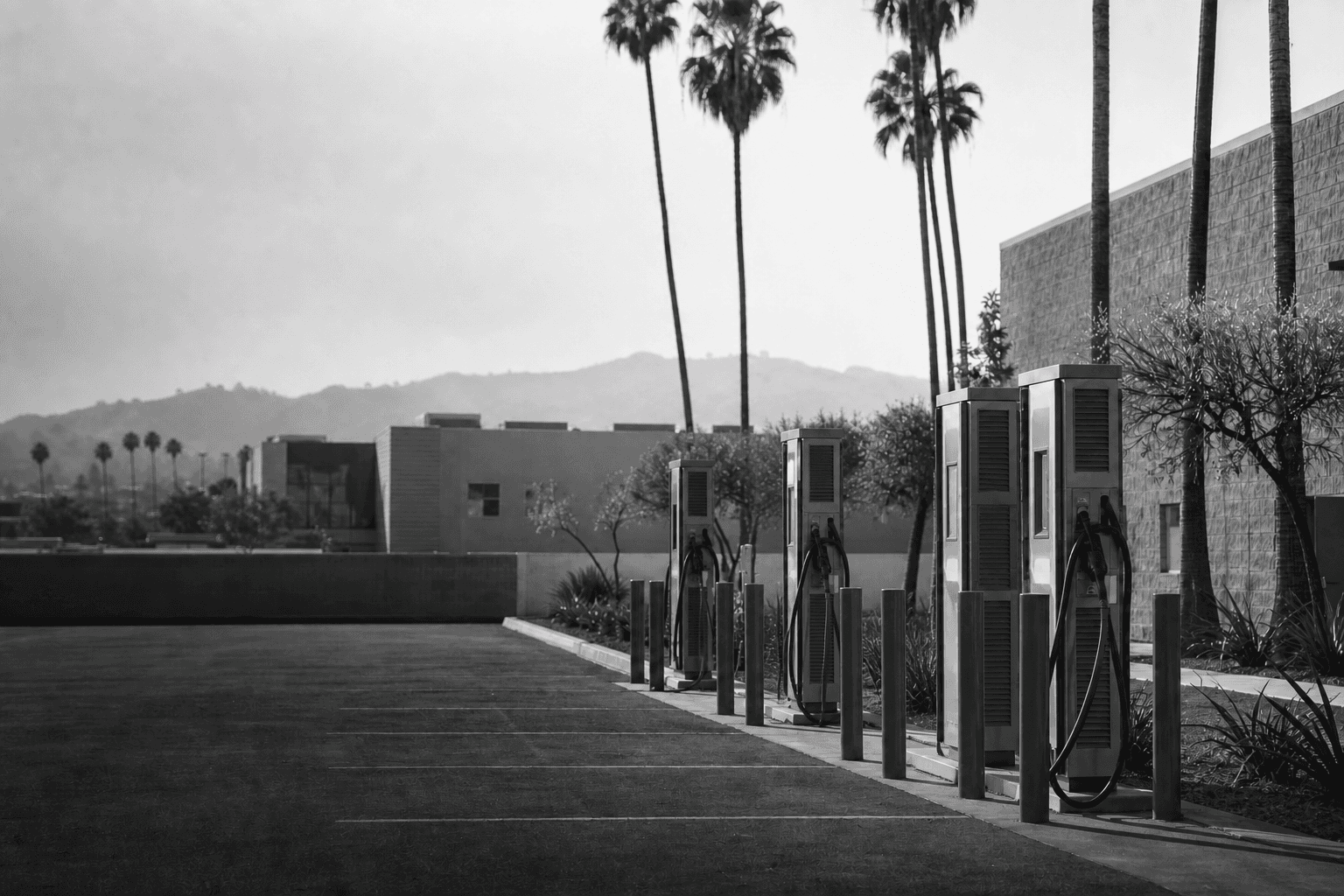
Two buildings can buy identical chargers and get quotes that are not close. The difference is almost always the electrical service and the distance to the stalls.
LOWER COMPLEXITY
Power is already close
Stalls sit near the electrical room, the panel has spare amps, and the run stays on landscaped ground or an existing conduit path. Permits are routine and no service upgrade is needed.
HIGHER COMPLEXITY
The service has to grow
Chargers land across the lot from a full panel. The job adds a new panel or a utility service upgrade, cut-and-patch paving, and a longer coordination window before anything gets energized.
BEFORE YOU BUY
What a real site review checks
A useful estimate starts with a walk, not a phone call. The reviewer confirms available capacity at the panel, measures the run from the service to each proposed stall, and looks at what sits between them — asphalt, curb, landscaping, or an existing conduit that can be reused. That measurement is what turns a hardware price into a project price.
The utility conversation happens at the same time. Your serving utility has to confirm what the site can draw today and what an upgrade would take, and that answer often sets the schedule more than construction does. Permitting and inspection requirements get identified in the same pass, because inspection timing decides when the chargers can actually be energized.
The last piece is planning for what comes next. The review should note where a second phase of stalls would go, how much conduit and panel space it would need, and whether adding that now is cheaper than adding it later. Weather exposure, signage, striping, and security get called out here too, since they are small lines that surprise people when they show up after the fact.
Ask for the capacity number in writing
Before you compare quotes, get the available panel capacity and the measured distance from service to stalls documented. Two bids that assume different answers to those two questions are not comparable, no matter how similar the hardware line looks.
JURUPA VALLEY CONTEXT
What the local process adds to the schedule
Nothing about the hardware changes because a site is in Jurupa Valley. The sequence does. Utility coordination, permitting, and inspection all sit on the critical path, and each one has to start before construction rather than alongside it. A project that orders equipment before the utility confirms available service is a project that stores chargers in a warehouse.
Two local realities belong in the plan. Inland Southern California heat is real load on outdoor equipment and cable management, so weather exposure is a siting decision, not a later complaint. And a lot of the commercial inventory here is large-lot industrial and distribution property, which makes long runs between the electrical room and the stalls common. That distance is a cost driver, and it is why a phased layout usually beats scattering ports across the property.
Start the utility conversation first
Confirm what your service can deliver and what an upgrade would require before you pick equipment or commit to a construction schedule. That one answer sets your budget, your timeline, and whether DC fast charging is even practical at the site.
AFTER THE INSTALL
Two costs that live past the ribbon cutting
Capital cost is the number everyone negotiates. Operating cost is the number that decides whether the project still looks smart in year three. Two decisions drive it. The first is who owns the equipment and who is responsible when it breaks — the site host, the installer, or the network provider. The second is how you are billed for the electricity the chargers move, which is not just a per-kilowatt-hour question. Both are far easier to settle before installation than to renegotiate after, and both belong in the written scope rather than in a conversation.
OWNERSHIP
Who owns and who fixes
Equipment you own costs less overall and gives you full control, but you carry every repair once the warranty ends. A maintenance contract should name a response time, a repair window, and an uptime requirement.
ELECTRICITY
Demand charges and rates
Per-kilowatt-hour charges are often driven by the highest 15-minute average use in a billing period, and DC fast charging triggers them far more readily than Level 2. Ask about time-of-use rates before you size anything.
THE LONG VIEW
Phasing, incentives, and the ten-year number
Sequence the money the way the work happens. Federal, state, local, and utility programs get explored during planning, before a contractor is selected, because most of them will not pay for work that is already finished. The federal charger credit is worth understanding but not counting on: it is limited to eligible census tracts and tied to the date the property is placed in service, and it applied to property placed in service on or before June 30, 2026. A Jurupa Valley project starting now should be budgeted without it, with any remaining state or utility support treated as the live layer.
Then run the ten-year number instead of the install number. Maintenance runs up to $400 per charger per year, and an extended warranty on a DC fast unit can pass $800 per charger per year by itself. Networking fees are annual. Electricity is the largest recurring line and the one most sensitive to how the site was configured.
Phasing keeps all of that manageable. Build the first bank of ports where power already reaches, oversize the conduit and panel while the trench is open, and add stalls as utilization justifies them. If your organization requires a formal solicitation, write the future phases into it so round two is a change order, not a new project.
COMPARING BIDS
Five things a quote has to show
Bids only compare if they describe the same site conditions. Ask every contractor to break out these five items, in dollars, on the same page.
01
Equipment, itemized by port
Make, model, connector count, and unit price for each charger, listed separately from labor.
02
The electrical run
Measured distance, trench length, conduit and wire, plus pavement cutting and restoration.
03
Panel and service work
Whether a panel or utility service upgrade is included, and what it would cost if it is not.
04
Permits, inspection, and utility coordination
Who files, what it costs, and how long each step is expected to take.
05
Recurring costs for year one
Network fees, warranty terms, maintenance response time, and the uptime commitment.
Keep planning locally
Related EV charging pages in Jurupa Valley
Get a defensible number
Price the equipment and the building together.
Send the address, operating target, and target opening date. Flux will identify what must be verified before the project can be priced.
Price my chargersQuestions
Straight answers.
How much does one commercial Level 2 charger cost in Jurupa Valley?
Equipment runs about $400 to $6,500 per Level 2 connector. In Southern California, a Level 2 station installs for roughly $1,500 to $1,700 with labor, wiring, and permit fees on a straightforward run. Long trenches or panel work push it higher.
Why does DC fast charging cost so much more?
The hardware alone runs $10,000 to $40,000 per unit, and the electrical service behind it is a different class of work. DC fast charging also triggers demand charges far more readily than Level 2, so the operating cost climbs too.
Can I still claim the federal charger tax credit?
The federal credit is tied to eligible census tracts and to the date the property is placed in service, and it applied to property placed in service on or before June 30, 2026. Budget a new project without it and confirm your position with your tax advisor.
What does it cost to keep commercial chargers running?
Plan on up to $400 per charger per year for maintenance, plus networking fees. An extended warranty on a DC fast charger can run over $800 per charger per year, and electricity is usually the largest recurring line.
What makes a site cheap to build on?
Spare capacity at the panel and stalls close to the electrical room. Distance and a full panel are the two conditions that turn a small charging project into a construction project.
Sources used for this guide
- [1]afdc.energy.gov — Alternative Fuels Data Center: Procurement and Installation for Electric Vehicle Charging Infrastructure
- [2]irs.gov — IRS Alternative Fuel Vehicle Refueling Property Credit
- [3]winsparking.com — Fleet EV Charging in Denver, CO | Wins Parking
- [4]promatcher.com — EV Charging Station Cost - Los Angeles, California
- [5]afdc.energy.gov — Alternative Fuels Data Center: Operation and Maintenance for Electric Vehicle Charging Infrastructure
- [6]afdc.energy.gov — U.S. DOE AFDC Electric Vehicles for Fleets