THE NUMBER
What commercial EV charging costs in Indio
Hardware is the part with a published range. Single-connector units run about $400 to $6,500 for Level 2 and $10,000 to $40,000 for DC fast charging. Installation is the part that moves. Reported California pricing puts a straightforward Level 2 station near $1,500 to $1,700 with labor, wiring, and permit fees included. At the other end, depots built to serve 10 to 100 vehicles have installed between $250,000 and $4,500,000.
A site review has to confirm three things: how many spare amps the panel really has, how far the power must travel to reach the stalls, and whether pavement between them has to be opened. Those answers set the install number.
PICK THE JOB FIRST
Three ways to run commercial charging
The equipment should follow the job, not the other way around. Department of Energy guidance splits it cleanly: workplaces and multifamily buildings should look at Level 1 and Level 2, while public-facing hosts should look at Level 2 and DC fast charging. Fleets sit in their own category, because a truck parked in your yard all night does not need speed. It needs enough ports.
Decide which of these you are before you price anything. A workplace that buys DC fast charging pays for power it will never use. A customer-facing site that installs only Level 2 gives drivers a reason to leave before they finish. And the choice drives the rest of the budget, because faster equipment needs heavier service behind it, and DC fast charging is far more likely to trigger demand charges than Level 1 or Level 2 ever will.
THE LINE ITEMS
Where the money actually goes
A complete quote carries more lines than hardware. These are the ones that move between two buildings holding the same charger on the drawing, and the ones worth asking a contractor to break out separately.
BUYING GUIDANCE
How to compare charging quotes
The fastest way to tell two quotes apart is to look at what sits between the electrical service and the stall. That run — trench, conduit, wire, and the asphalt or concrete put back afterward — is where identical chargers turn into very different projects. A contractor who walked the site prices it honestly. A contractor who did not will either guess low and change-order later, or pad it and lose the bid. Ask every bidder to show that work as its own line.
Second, check what each quote assumes about capacity. Federal guidance is direct on this point: engage the utility early to identify installation needs and costs, including upgrades to electrical service and equipment. That coordination is not a formality. It decides whether your project is a few days of electrical work or a service upgrade with a lead time attached to it. Start it before you sign, not after.
Third, look at what a quote leaves out. Signage, striping, security, and the wireless connection a networked charger needs are all real scope. So is ownership. Equipment you own is equipment you maintain, and that trade is worth pricing on purpose rather than inheriting it from whichever vendor got there first.
TWO SITES
What makes a site cheap or expensive
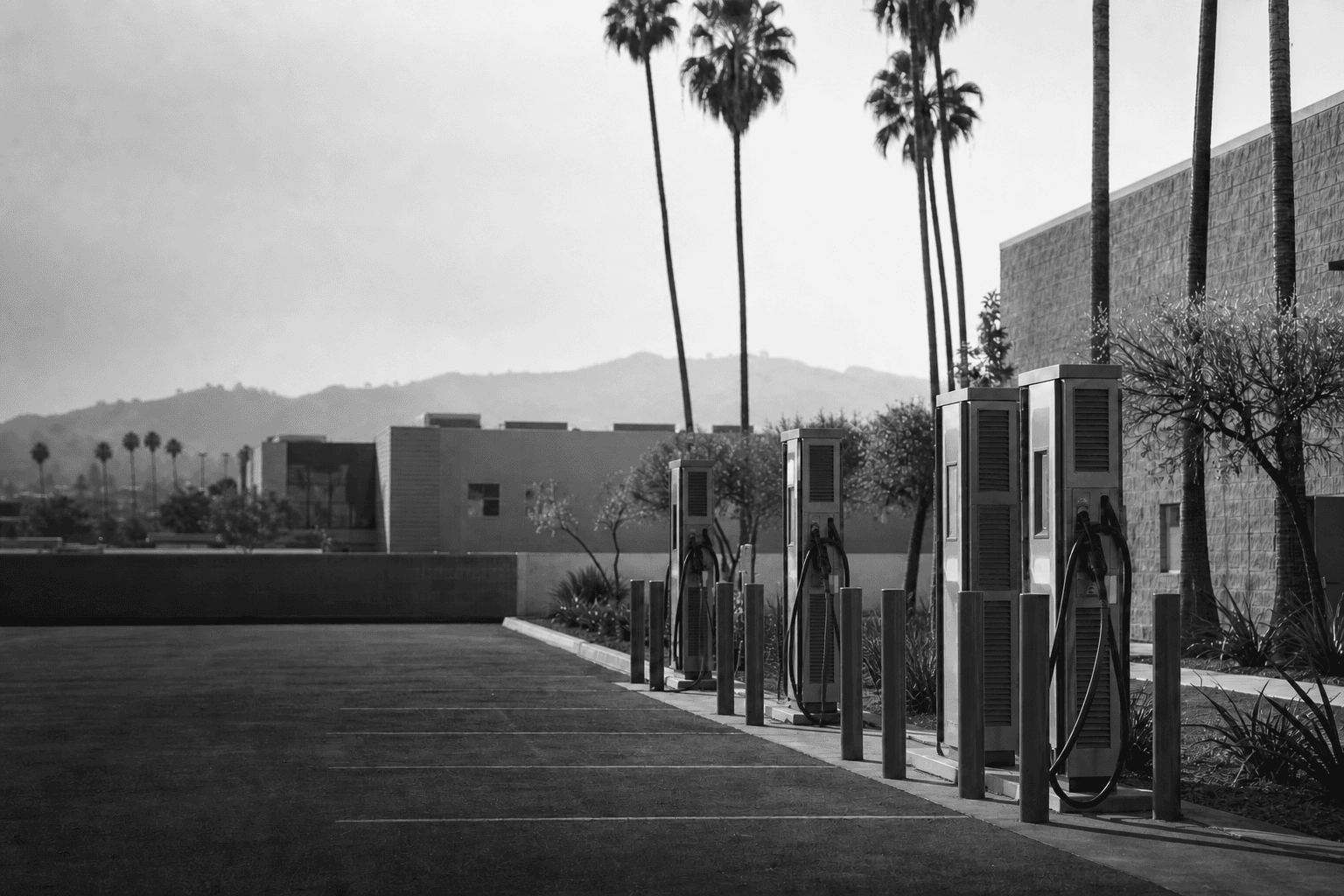
Two buildings can buy the same charger and receive quotes that are not close. The difference is almost always physical: how far the power has to travel, and whether there is room in the panel once it gets there. Everything else is smaller than these two.
LOWER COMPLEXITY
Short run, spare capacity
Stalls sit near the electrical room. The panel has room to spare. Conduit follows an existing wall or a landscaped edge instead of crossing a drive aisle. The work stays inside the building's current service, and permits are routine.
HIGHER COMPLEXITY
Long run, full panel
The stalls are on the far side of the lot. Reaching them means cutting pavement, trenching, and restoring the surface. The panel is full, so the job now includes new distribution or a service upgrade with utility lead time behind it.
THE SITE REVIEW
What a walk-through has to settle
A useful site review answers questions in order, and the order matters because each answer changes the next one. Start with how many ports you need now and how many you expect to need later. Federal siting guidance puts near-term and long-term unit count first for good reason: conduit and capacity installed while the trench is open cost a fraction of what they cost as a second project.
Next comes location. That checklist is short and physical — proximity to incoming electricity, whether metering has to change, whether a wireless connection reaches the equipment, and how weather will treat the hardware. In a hot climate that last item is not a footnote. Cabinets, cables, and connectors live outdoors every day of the year.
Then the utility. Confirm your charging requirements and pricing with them, including how the new load affects your rate and what electrical upgrades the site needs. Ask specifically about time-of-use rates. Some utilities offer them to charging infrastructure owners, and on a workplace or fleet site where you control when vehicles plug in, the rate structure can matter more than which charger you picked.
Finally, settle responsibility in writing. Decide whether the site host, the charging network, or the installer owns maintenance, and make sure the contract names a response time, a repair window, and an uptime requirement.
Ask this before the drawings
Two questions decide most of the budget: how many amps are genuinely free in the panel today, and what it takes to move power from there to the stalls. Get both answered on site, in writing, before anyone prices equipment.
AFTER INSTALL
Two decisions that outlive the install
A charging site opens a second budget the day it turns on. Electricity is the obvious half, and it is not only kilowatt-hours. Demand charges are typically based on the highest 15-minute average use recorded in a billing period, and DC fast charging is far more likely to trigger them than Level 1 or Level 2. Maintenance is the quieter half. Routine upkeep is modest — store cables so they do not get damaged, check parts periodically, keep the equipment clean. The expensive scenario is a broken charger sitting outside its warranty term. Both of these are decisions, not surprises, and both are cheaper to settle before equipment is ordered.
OWNERSHIP
Who owns the equipment
Equipment you own is equipment you maintain. Owning it outright reduces overall cost and gives you full control of the site, but every repair, warranty gap, and replacement lands on you. Provider-owned hardware shifts that, and shifts the economics with it.
REVENUE
Whether you charge for it
You can price by kWh, by session, by length of time, or by subscription. Networks handle payment for you, and non-networked sites can use RFID, an app, or an attendant. More than 20 percent of public charging is still free to use.
PHASING
Build for the ports you will need
Most charging projects are underbuilt in the same direction. The owner prices the ports needed today, installs exactly that, then pays a second mobilization two years later to add four more. The expensive parts of a charging install — trenching, conduit, and capacity — are the parts you want to buy once. Pulling spare conduit while the trench is open costs a fraction of reopening it. Sizing the panel for phase two costs less than replacing it later.
Procurement deserves the same forward look. Federal guidance recommends deciding early whether stations will be networked, whether you will collect utilization data, and whether payment capability is required, because those answers narrow which equipment and which providers are even on the table. If your organization requires a formal solicitation, that timeline belongs in the schedule from day one, not after the site walk.
Lifetime cost is usually where fleets find their case. Light-duty all-electric operation and maintenance averages 6.1 cents per mile, and electricity prices move less than gasoline or diesel, which makes a multi-year fuel budget easier to trust. Lower off-peak rates can improve that further where you control plug-in times. None of it changes your install quote. It changes whether the install is worth signing.
THE CHECKLIST
Five things every quote should show
Two bids are only comparable when they price the same scope. Ask for these five as separate lines, and the differences between contractors stop being a mystery.
01
Equipment, by unit and connector
Make, model, connector count, charging level, and whether mounting and activation fees are inside the price.
02
The electrical run, on its own line
Trench length, conduit, wire, and pavement restoration — separated from hardware so it can be compared bid to bid.
03
Capacity work and utility scope
Panel, distribution, or service upgrades, plus exactly what the utility is doing and what it charges for it.
04
Permits, inspection, and schedule
Which permits get pulled, who pulls them, and what inspection timing does to your turn-on date.
05
Networking, maintenance, and warranty
Annual software fees, who owns repairs, response time, repair window, and the uptime commitment.
Keep planning locally
Related EV charging pages in Indio
Get a defensible number
Price the equipment and the building together.
Send the address, operating target, and target opening date. Flux will identify what must be verified before the project can be priced.
Price my chargersQuestions
Straight answers.
How much does one commercial Level 2 charger cost in Indio?
Single-connector Level 2 equipment runs about $400 to $6,500 depending on the unit. Reported California pricing puts a straightforward Level 2 station near $1,500 to $1,700 installed, with labor, wiring, and permit fees included. That figure assumes simple work at a panel with capacity. Long runs across a lot, pavement cuts, or panel upgrades push it well above that.
Why does DC fast charging cost so much more?
The hardware alone runs $10,000 to $40,000 per unit, against $400 to $6,500 for a Level 2 connector. The electrical service behind it is a different class of work, and DC fast charging is far more likely to trigger demand charges, which are based on your highest 15-minute average use in a billing period. Extended warranties are heavier too, at over $800 per charger per year.
What should I budget for maintenance and repairs?
Plan on up to $400 annually per charger, and more if the equipment is networked and the provider sells a maintenance plan. Routine upkeep is light. The costly case is repairing a charger after its warranty ends. Name the responsible party in the contract, and require a response time, a repair window, and an uptime commitment rather than a general promise of support.
Are there incentives that lower the installed cost?
Explore federal, state, local, and utility programs before construction begins, because most do not pay backward. The federal 30C credit can cover up to 30 percent of the cost of purchasing and installing charging infrastructure, but eligibility depends on the placed-in-service date and on the property sitting in a qualifying census tract. Confirm its current status with your tax advisor before you count it.
What does a full fleet depot cost?
Reported installed costs for depots serving roughly 10 to 100 vehicles span $250,000 to $4,500,000. The range is that wide because port count, charging level, and the electrical service driving them vary enormously. Start with dwell time: if vehicles sit overnight in your yard, Level 2 charges a typical battery by morning, and you are buying ports and capacity rather than speed.
Sources used for this guide
- [1]afdc.energy.gov — Alternative Fuels Data Center: Procurement and Installation for Electric Vehicle Charging Infrastructure
- [2]irs.gov — IRS Alternative Fuel Vehicle Refueling Property Credit
- [3]winsparking.com — Fleet EV Charging in Denver, CO | Wins Parking
- [4]promatcher.com — EV Charging Station Cost - Los Angeles, California
- [5]afdc.energy.gov — Alternative Fuels Data Center: Operation and Maintenance for Electric Vehicle Charging Infrastructure
- [6]afdc.energy.gov — U.S. DOE AFDC Electric Vehicles for Fleets