THE NUMBER
What commercial EV charging costs in Denton
Most commercial Level 2 ports in the Dallas–Fort Worth market install for $3,500 to $18,000 each. DC fast dispensers run $75,000 to $350,000 apiece once the electrical work behind them is real. The hardware is the smaller half of that: Level 2 units cost $400 to $6,500, and DC fast units $10,000 to $40,000. Everything between your electrical service and the stall is what actually moves the total.
These are planning benchmarks, not a Denton quote. Panel capacity, trench distance, pavement restoration, and whether the utility requires a service upgrade can move any of these numbers by a wide margin.
PICK THE JOB FIRST
Three ways commercial charging gets used
Cost follows use, not the other way around. Before anyone prices hardware, decide how long vehicles will sit and who is paying for the electricity. A car parked eight hours needs far less power than one parked twenty minutes, and power is the expensive part.
Level 2 covers most commercial sites because dwell time is long. Employees, tenants, and overnight fleets all charge fine on it. DC fast charging exists for short dwell: highway-adjacent retail, public sites, and duty cycles that cannot wait. It buys speed with a much larger electrical service, and that service is where the budget goes.
Most owners land on one of the three patterns below. Choosing early keeps you from paying for a service upgrade your traffic will never use.
THE LINE ITEMS
Where a Denton charging budget actually goes
A charging quote is one hardware line and several construction lines. The two that decide the total are the run and the panel, and they are also the two most often estimated loosely. Read them first. If a bid shows a single lump sum, you cannot tell whether the trenching was scoped or guessed.
HOW TO BUY IT
Reading a commercial charging quote
The fastest way to understand a charging quote is to separate what you own from what you dig. Hardware is a catalog decision with a published price. Everything else — the trench, the conduit, the wire, the panel work, the pavement you cut and put back — is a site decision, and it is priced by conditions no catalog knows. Two buildings on the same street can quote thousands apart because one has spare amps in the right room and the other does not.
That is why an installed range as wide as $3,500 to $18,000 per Level 2 port is honest rather than evasive. The low end describes stalls close to an existing panel with capacity to spare. The high end describes a long run across a parking field, a pavement cut, and new distribution equipment. Ask any bidder which end of that range your site sits on and why.
Networking is the other fork. A non-networked port costs less to buy and less to run, but it cannot bill drivers, meter usage separately, or tell you when it went offline. If you plan to charge for electricity or track utilization, buy networked from the start. Retrofitting that decision means touching hardware you already paid to install.
SITE CONDITIONS
What makes a Denton site cheap or expensive
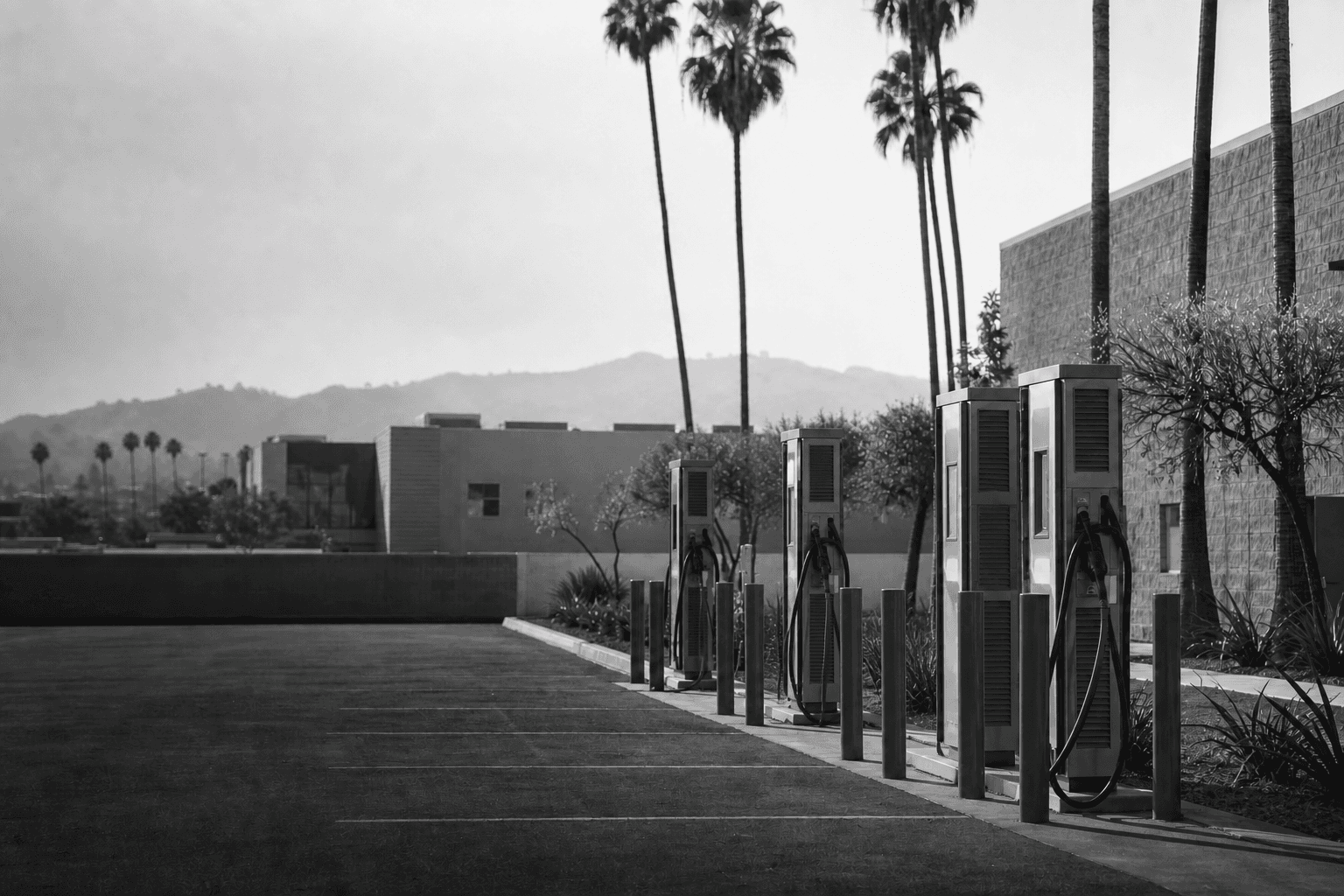
Nothing about the charger changes between these two sites. The building does. Walk your property with the two lists below before you ask anyone for a number, because most of what separates them is visible from the parking lot without a single tool.
LOWER COMPLEXITY
Short runs, spare capacity
Stalls within sight of the electrical room. A panel with unused amps. Landscape or gravel routing instead of finished pavement. Two to four Level 2 ports. Projects like this stay near the bottom of the installed range.
HIGHER COMPLEXITY
Long runs, new service
Stalls across a parking field from the service entrance. A panel already loaded. Concrete or asphalt that has to be cut and restored. Any DC fast charging, which usually means new distribution equipment and a longer utility conversation.
BEFORE YOU BID
Scope the site before you price the hardware
A useful quote starts with a site walk, not a product page. The walk answers four questions: where is the electrical service, how many spare amps does it have, how far is it to the stalls you want, and what is in the way. Answer those and the price stops being a range.
Bring the utility into the conversation early. The serving utility confirms what your service can carry, whether an upgrade is required, and what that upgrade will cost and take. This matters more than most owners expect, because utility work sits on the critical path. In this metro, commercial site plan and electrical permitting commonly runs 10 to 18 weeks, and the full path from contract to energized chargers typically runs four to nine months, longer when a service upgrade is involved.
Decide your near-term and long-term port count in the same conversation. The trench you open for four ports costs almost the same as the trench you open for eight. Sizing conduit and panel space for the second phase while the ground is already open is the cheapest expansion you will ever buy.
What to have ready for the site walk
Panel schedules or a recent load study, the stalls you want charged, your current utility account and rate, your expected vehicle count in year one and year three, and whether you intend to bill drivers. Five answers, and most quotes tighten immediately.
DENTON SPECIFICS
What North Texas changes about the number
Denton sits inside the Dallas–Fort Worth metro, and that shapes three things on a charging budget. Demand is real: Texas EV registrations grew 47 percent year over year in 2025, with more than 100,000 battery-electric vehicles in DFW. That supports utilization assumptions a quieter market would not.
Permitting here is a schedule item, not a formality. Commercial site plan and electrical permits across this metro commonly run 10 to 18 weeks, and neighboring jurisdictions do not review on the same clock.
Service territory in North Texas varies by address, so confirm which utility serves your meter early. That answer drives both the upgrade cost and the rebate path. Texas heat belongs in the hardware spec too. Equipment sits outdoors through full North Texas summers, so cabinet ratings and cable management should be specified, not assumed.
Confirm the utility before you budget
Make-ready and rebate programs follow whichever utility serves your address. The federal 30C charger credit no longer applies to new projects placed in service after June 30, 2026, so utility and state programs, including Texas Emissions Reduction Plan grants, now carry the incentive stack. Confirm current terms before counting either one.
OWNERSHIP AND OPERATIONS
Two decisions that outlive the install
Capital cost is one number. The cost of running chargers for ten years is a different number, and it is largely decided by two choices made during procurement.
The first is who owns the equipment. Buying outright costs more up front but gives you full control and no third party between you and the hardware. Provider-owned models lower the entry cost and shift maintenance, and they also shift pricing control and revenue. Neither is wrong. They are different balance sheets.
The second is how you handle demand charges. Utility bills price the highest 15-minute average use recorded in a billing period, and DC fast charging triggers those charges far more readily than Level 2. Load management, staggered charging, and time-of-use rates are how sites keep that line from swallowing the revenue.
OWNERSHIP
Host-owned versus provider-owned
Owning the equipment lowers lifetime cost and gives full control, but you carry every repair and warranty gap. Provider-owned models trade that control for a smaller check up front and someone else on call.
OPERATING COST
Demand charges and network fees
Networked ports typically run $15 to $40 per port each month. Demand charges are usually the larger number, and they are set by peaks you can design around before the chargers are ever energized.
OVER TEN YEARS
Phase the build, not just the budget
The cheapest charging project is the one that only opens the ground once. Trenching, conduit, and pavement restoration are the lines that do not get cheaper the second time, so size them for where you expect to be in five years even if you only energize a few ports now. Empty conduit and spare panel space are the least expensive things on the whole bid.
Then plan for what the site costs to keep running. Maintenance is modest but real. Budget up to $400 per charger annually, and understand that extended warranties on DC fast chargers can run over $800 per charger per year. Repairs on out-of-warranty equipment are where owners get surprised, so settle in writing who is responsible: you, the charging network, or the installer. A maintenance contract should name a response time, a repair window, and an uptime requirement.
On the revenue side, retail charging in this metro commonly prices between $0.35 and $0.65 per kilowatt-hour, and utilization tends to climb through the first few years. That curve is the argument for phasing. You build the expensive infrastructure once, then add ports as the traffic shows up instead of betting on it.
QUOTE CHECKLIST
Five things a comparable quote shows
Bids that look far apart are usually scoped far apart. Ask every bidder to show these five things and the comparison becomes straightforward. Anything missing from this list is a cost that has not been priced yet, and it will find you later.
01
Hardware, line by line
Make, model, port count, connector type, and whether the units are networked.
02
The electrical run, measured
Trench distance, conduit size, wire, and the pavement or landscape restoration that follows.
03
Panel and service work
Existing capacity, what is being added, and who pays for any utility-side upgrade.
04
Permits, inspections, and schedule
Which permits, who files them, and a realistic date for energized chargers.
05
Year-one operating cost
Network subscription, warranty term, maintenance responsibility, and the demand-charge assumption behind it.
Keep planning locally
Related EV charging pages in Denton
Get a defensible number
Price the equipment and the building together.
Send the address, operating target, and target opening date. Flux will identify what must be verified before the project can be priced.
Price my chargersQuestions
Straight answers.
How much does one commercial Level 2 charger cost in Denton?
Plan on $3,500 to $18,000 installed per port. The hardware itself runs $400 to $6,500. The rest is trenching, conduit, panel work, and restoration, which is why the range is so wide.
Why is DC fast charging so much more expensive?
The dispensers alone cost $10,000 to $40,000, and installed cost commonly lands between $75,000 and $350,000 per dispenser because the electrical service behind them is a different class of work.
How long does a commercial charging project take here?
Four to nine months from contract to energized chargers is typical. Commercial site plan and electrical permitting alone commonly runs 10 to 18 weeks, and utility service upgrades extend it further.
Is the federal 30C charger tax credit still available?
No. It applied to property placed in service on or before June 30, 2026. Projects that met that date still claim it at filing, but new builds should budget around utility and state programs instead.
What should I budget after the chargers go live?
Network software at $15 to $40 per port monthly, maintenance up to $400 per charger annually, electricity including demand charges, and warranty coverage that can exceed $800 a year on DC fast units.
Sources used for this guide
- [1]afdc.energy.gov — Alternative Fuels Data Center: Procurement and Installation for Electric Vehicle Charging Infrastructure
- [2]irs.gov — IRS Alternative Fuel Vehicle Refueling Property Credit
- [3]santibanservicesgroup.com — Commercial EV Charging in Houston: 2026 Infrastructure & Installation Guide - Santiban Services Group
- [4]winsparking.com — EV Charging Station Installation in Dallas, TX | Wins Parking
- [5]afdc.energy.gov — Alternative Fuels Data Center: Operation and Maintenance for Electric Vehicle Charging Infrastructure
- [6]afdc.energy.gov — U.S. DOE AFDC Electric Vehicles for Fleets