THE NUMBER
What commercial EV charging costs in Cambridge
In the Boston–Cambridge–Newton market, a commercial Level 2 port typically lands between $3,500 and $18,000 installed. The hardware is the small part: single-connector Level 2 units run $400 to $6,500, and DC fast chargers run $10,000 to $40,000 before any electrical work. Installed, a DC fast dispenser in this metro usually falls between $75,000 and $350,000. The gap inside each range is site work, not brand.
These are planning benchmarks, not a Cambridge quote. Panel capacity, trench distance from the electrical room, pavement restoration, and utility service work move the number far more than the charger you pick.
PICK THE JOB FIRST
Three ways commercial charging gets used
Cost follows use, not the other way around. Before anyone prices hardware, decide who plugs in, how long the vehicle sits, and whether you need the electricity back as revenue. A car parked nine hours needs far less power than a car parked twenty minutes, and power is the expensive part.
Workplace and multifamily sites are the cheapest version of this project. Federal planning guidance points those hosts toward Level 1 and Level 2, because long dwell time does the work that expensive equipment would otherwise have to do. Public-facing sites are told to consider Level 2 and DC fast instead, since drivers there will not wait.
Fleets sit in between and have an option the others do not. Instead of a pedestal at every stall, a depot can install 120/240-volt receptacles and use portable Level 1 or Level 2 units, which lowers overall project cost and turns a failed charger into a swap rather than a service call.
THE LINE ITEMS
Where the money actually goes
A commercial charging quote is mostly labor, trench, and utility coordination. Sort your budget by how much each line can swing, because the volatile items decide whether the project comes in near the bottom of the range or the top of it.
HOW TO BUY IT
You are buying electrical capacity, not just a charger
The most useful thing you can do before collecting quotes is find out what your building can already feed. A load calculation on the existing service tells you whether four ports fit inside spare capacity or whether the first port triggers a service upgrade. That single answer separates a $3,500 port from an $18,000 port, and it costs almost nothing to get.
The second thing is distance. Measure from the electrical room to the stalls you actually want to use. Conduit and trench are priced by the foot, and every ten feet past the first twenty-five typically adds $75 to $150. Stalls forty feet closer to the switchgear can be worth more than any hardware discount. If the run has to cross drive aisles or finished pavement, restoration cost arrives with it.
Then size the circuits honestly. Code treats charging equipment as a continuous load, so a 48-amp charger needs a 60-amp circuit and 6 AWG copper. Two contractors quoting the same charger at different circuit sizes are not quoting the same job. Ask each one to show the load calculation and the conductor size, and the cheap bid usually explains itself.
SITE CONDITIONS
What makes a Cambridge site cheap or expensive
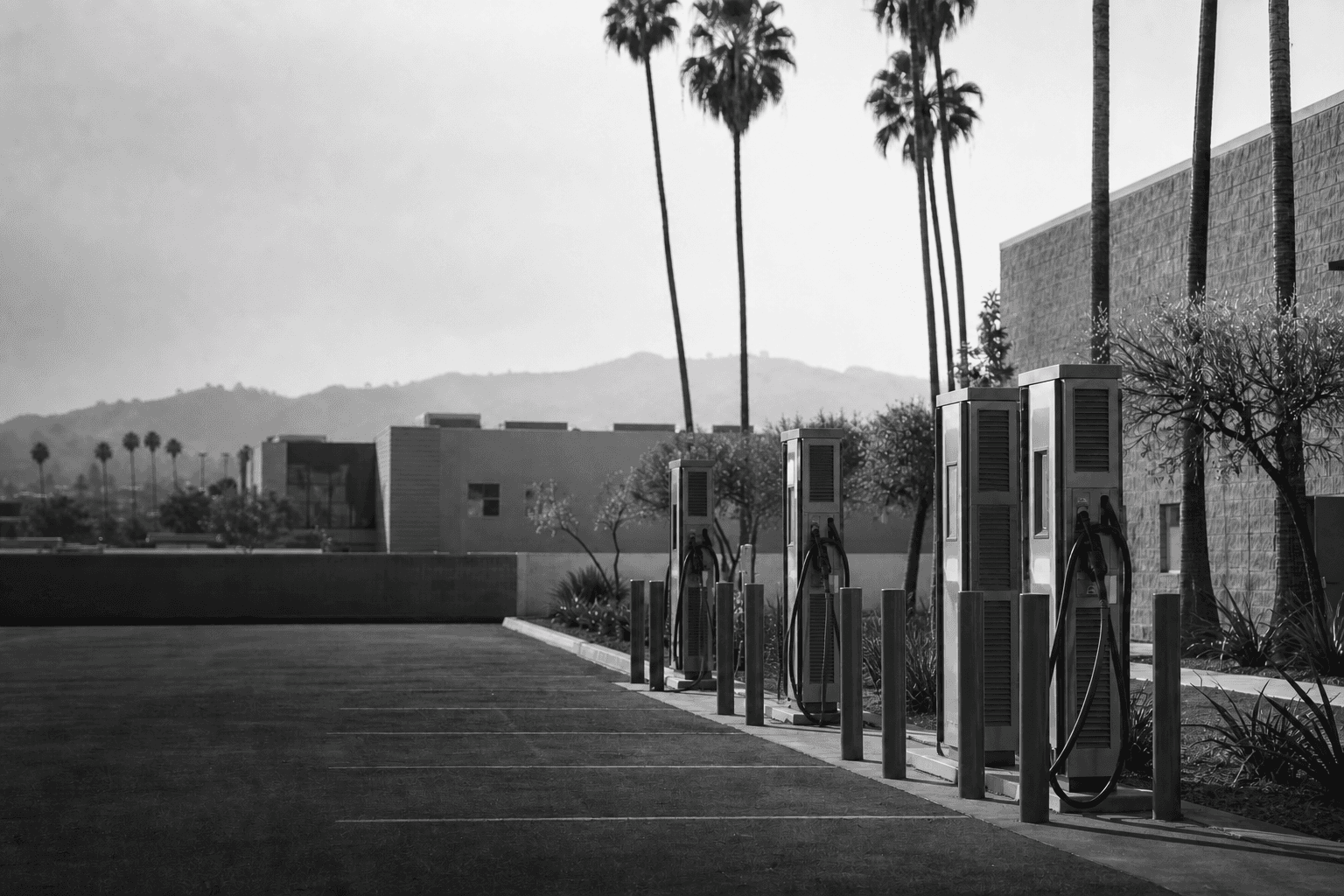
Nothing about the charger changes between these two buildings. The building changes. Before you set a budget, walk the lot and decide honestly which description fits yours.
LOWER COMPLEXITY
Short run, spare capacity
Stalls sit near the electrical room, the panel has room left after a load calculation, and the conduit path stays on existing surfaces. Permits are routine, the utility does not need to touch the service, and Level 2 ports land near the bottom of the installed range.
HIGHER COMPLEXITY
Long run, new service
Chargers sit across the lot, the panel is full, and the run crosses paved drive aisles that must be cut and restored. Add a service upgrade, utility service planning, and possible historic-district review, and commercial permitting in this metro can run 16 to 26 weeks.
SCOPING THE WORK
What a real site review should produce
A site review is not a walk-through with a tape measure. It should end with a document you could hand to a second contractor and get a comparable number back. That means the existing service size and measured spare capacity, the panels being used, exact stall locations, the conduit route with its length and surfaces, and the number of ports today versus the number the design leaves room for.
Federal planning guidance is blunt about sequence: engage the utility early to identify installation needs and costs, including upgrades to electrical service and equipment, before you settle a budget. Utility work is the longest lead item on most commercial projects, so a price that has not been through service planning is an estimate with a hole in it.
The same guidance says to decide up front whether stations need to be networked, whether you will collect utilization data, and whether drivers will pay. Those choices change the hardware, the data pathways in the conduit, and the operating cost, and they are much cheaper to answer before trenching than after.
Ask before you dig
Confirm three things before construction starts: the load calculation on your existing service, the utility's answer on whether that service needs upgrading, and every incentive application filed and approved. Programs do not pay backward, and a rebate discovered after the trench is closed is a rebate you lost.
IN CAMBRIDGE
What Cambridge adds to the schedule
Cambridge sits inside the Boston–Cambridge–Newton market, which is served by Eversource and National Grid depending on the address. Confirm which utility serves your meter before anyone quotes service work, because the two run separate service planning tracks.
Permit fees and inspection turnaround are set city by city across Massachusetts, and Cambridge is its own jurisdiction with its own timing. Commercial charging work in this metro commonly runs 16 to 26 weeks through permitting, stretched by dense utility queues, historic-district review, and a construction season that narrows in winter. Contract-to-energized timelines of four to nine months are normal here, and longer when the service has to be upgraded.
Demand is real: the metro carries more than 95,000 battery-electric vehicles, concentrated in Cambridge, Brookline, and the Route 128 belt. That supports utilization, and it also means your utility planner is busy.
Start the utility conversation first
On a Cambridge site, the utility and permitting calendar usually sets the schedule, not the contractor. Open service planning before you finalize hardware, and treat any timeline that assumes a quick interconnection as optimistic until the utility confirms it in writing.
AFTER THE INSTALL
Two decisions that outlive the build
Capital cost is the number everyone compares, but the operating structure is the one that shows up every month. Two choices set it: who owns the equipment, and how you pay for power.
Ownership decides who absorbs a failed unit. Equipment you own is equipment you maintain, which lowers overall cost and gives you full control, but it puts every repair on you once the warranty term ends. Either way, get maintenance responsibility written down with a response time, a repair window, and an uptime requirement rather than a phone number.
OWNERSHIP
Own it, or let a provider own it
Owning lowers overall cost and gives you control of pricing and access, but repairs are yours after the warranty term. Budget up to $400 per charger per year for maintenance, and over $800 per year for a DC fast extended warranty.
ELECTRICITY
Demand charges, not just kilowatt-hours
Commercial bills price the highest 15-minute average draw in a billing period, and DC fast charging is far more likely to trigger that than Level 2. Ask your utility about time-of-use rates before you set charging hours or session pricing.
OVER TIME
Phase it so the second charger is cheap
The expensive part of a charging project is the part you only want to do once. Trench, conduit, and service capacity are all cheaper per port when you build them for more ports than you are installing today. If the plan is four ports now and twelve later, size the conduit and the panel for twelve, pull spare capacity while the trench is open, and hang four chargers. The second phase then becomes hardware and terminations instead of a second construction project.
Sequence the money the same way. Incentives are approved before work starts rather than reimbursed after, so the application calendar has to run ahead of the construction calendar. The federal 30C credit is historical context for new projects now, since it ended for property placed in service after June 30, 2026; state and utility programs carry the weight on current builds. Charging equipment used in a business is still depreciable property, which matters at filing.
Finally, price the operating years, not just the install. Network fees, maintenance, warranty renewals, and demand charges compound. A site that costs less to build and more to run is often the worse deal by year three.
COMPARE FAIRLY
Five things a comparable quote shows
Bids that look far apart usually differ in scope, not price. Ask every contractor to show these five items, then compare them line for line. If one bid is missing a line, that line has not been priced out — it has been left for a change order.
01
The load calculation
Existing service size, measured spare capacity, and whether a panel or service upgrade is inside the price.
02
The conduit route and length
Measured footage from panel to stalls, the surfaces crossed, and who pays for pavement cutting and restoration.
03
Circuit sizing per port
Amperage, breaker size, and conductor gauge for each charger, sized as a continuous load.
04
Permits, inspection, and utility scope
Which fees are included, who files, and what the contractor assumes about utility service planning time.
05
Ongoing costs and incentives
Network fees per port per month, maintenance and warranty terms, and which incentives are applied for before construction.
Keep planning locally
Related EV charging pages in Cambridge
Get a defensible number
Price the equipment and the building together.
Send the address, operating target, and target opening date. Flux will identify what must be verified before the project can be priced.
Price my chargersQuestions
Straight answers.
How much does a commercial Level 2 charger cost in Cambridge?
Plan on $3,500 to $18,000 per port installed in this market. Sites with spare panel capacity and short conduit runs land near the bottom. Long runs, pavement cuts, and service upgrades push toward the top.
Why is DC fast charging so much more expensive?
The equipment alone runs $10,000 to $40,000, and installed cost in this metro commonly lands between $75,000 and $350,000 per dispenser. The difference is the electrical service behind it, plus the demand charges it triggers once it runs.
How long does a commercial charging project take here?
Four to nine months from contract to energized chargers is typical in the Boston–Cambridge–Newton market, with commercial permitting alone running 16 to 26 weeks. A utility service upgrade extends both numbers.
What incentives still apply to a Cambridge project?
MassEVIP charger incentives are the primary state program to check, and utility make-ready programs cover infrastructure work. The federal 30C credit ended for property placed in service after June 30, 2026, so it now applies only to projects already in service.
What ongoing costs should I budget after go-live?
Network software at $15 to $40 per port per month, electricity including demand charges, payment processing, and maintenance of up to $400 per charger per year. Extended warranties on DC fast units can exceed $800 per charger annually.
Sources used for this guide
- [1]afdc.energy.gov — Alternative Fuels Data Center: Procurement and Installation for Electric Vehicle Charging Infrastructure
- [2]irs.gov — IRS Alternative Fuel Vehicle Refueling Property Credit
- [3]evchargeracademy.com — EV Charger Installation Cost in Massachusetts: 2026 Price Guide | EVCharger Academy
- [4]winsparking.com — EV Charging Station Installation in Boston, MA | Wins Parking
- [5]afdc.energy.gov — Alternative Fuels Data Center: Operation and Maintenance for Electric Vehicle Charging Infrastructure
- [6]afdc.energy.gov — U.S. DOE AFDC Electric Vehicles for Fleets