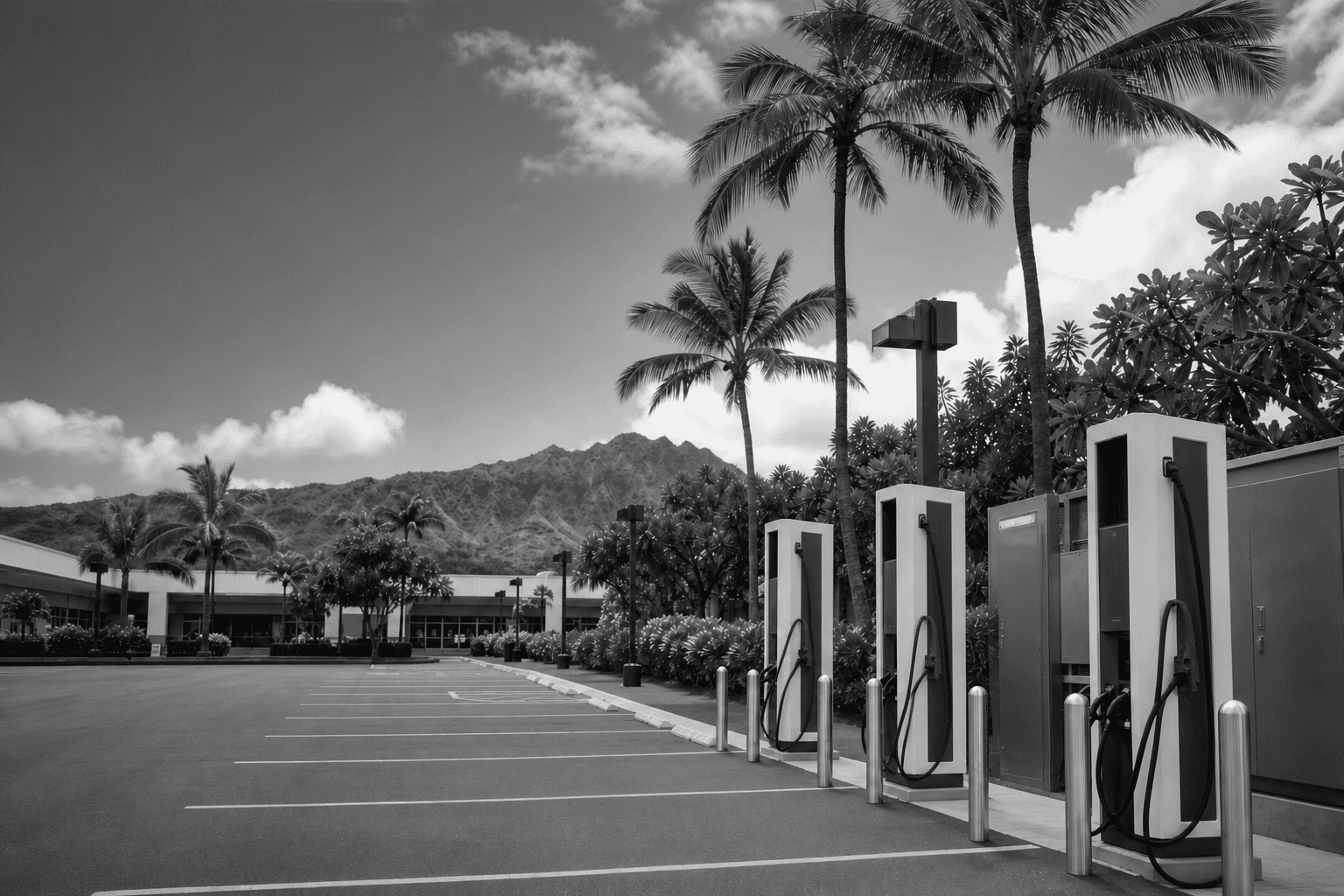
Direct answer
Two numbers, not one: the charger and the work behind it
Federal data puts single-connector equipment at roughly $400 to $6,500 for Level 2 and $10,000 to $40,000 for DC fast charging. Installation is separate. Workplace Level 2 installation averages near $2,500 per connector, while DC fast installation commonly runs about $20,000 to $60,000 per connector. Most commercial charging budgets go wrong on the second number, not the first.
A site review still has to confirm spare service capacity, the measured route from panel to stall, pavement conditions, and how many ports may draw full power at the same time.
Choose from the schedule
Level 2 and DC fast charging answer different operating problems
Level 2 charging runs on a 208 to 240 volt circuit and delivers roughly 10 to 30 miles of range per hour. That fits workplaces, office parking, retail lots, hotels, multifamily properties, and anywhere a driver stays parked for several hours. Federal guidance points workplaces and multifamily buildings toward Level 1 and Level 2 first, and most existing commercial buildings can carry that load without rebuilding the electrical service.
DC fast charging solves a different problem. It adds significant range in twenty to forty-five minutes, which suits high-traffic stops and vehicles that must get back to work the same day. The electrical demand is real. Most existing commercial buildings need a service evaluation, and possibly an upgrade, before a DC fast charger can be installed at all.
The wrong choice raises cost without improving the outcome. A property that installs DC fast charging where Level 2 would have served the same drivers has bought far more electrical infrastructure than the situation required. Start with daily miles and available parking hours, decide how many vehicles must charge at once, and pick the power level after that math is done.
Build the whole number
What belongs in a commercial charging budget?
A useful budget separates the equipment from the work required to power it and keep it running. That way a low charger price cannot hide an expensive electrical route or a parking lot that has to be opened and put back.
Do not buy the box first
Pick the hardware after the site and the schedule are settled
A product page cannot tell you whether the building has enough power, whether the vehicles will accept the advertised rate, or whether the stalls you want can be built without blocking daily operations. The federal planning checklist puts equipment selection after the site review, the utility conversation, and the networking decision, and that order exists for a reason. Buying first tends to produce units that are too powerful for the service, too slow for the schedule, or missing a feature the property turns out to need.
Compare more than nameplate power. Look at connector type, cable reach, pedestal or wall mounting, environmental rating, accessible stall requirements, communications, payment options, load-management support, warranty terms, and how easily a part gets replaced. A commercial unit stays in service for years, so someone has to answer who diagnoses a failure and how fast a cable, screen, modem, or whole charger can be swapped.
Settle the networking question in the same pass. Decide whether the site needs utilization data, whether drivers will pay at the unit, and who will own the equipment. Those three answers change the hardware short list more than any spec sheet comparison will.
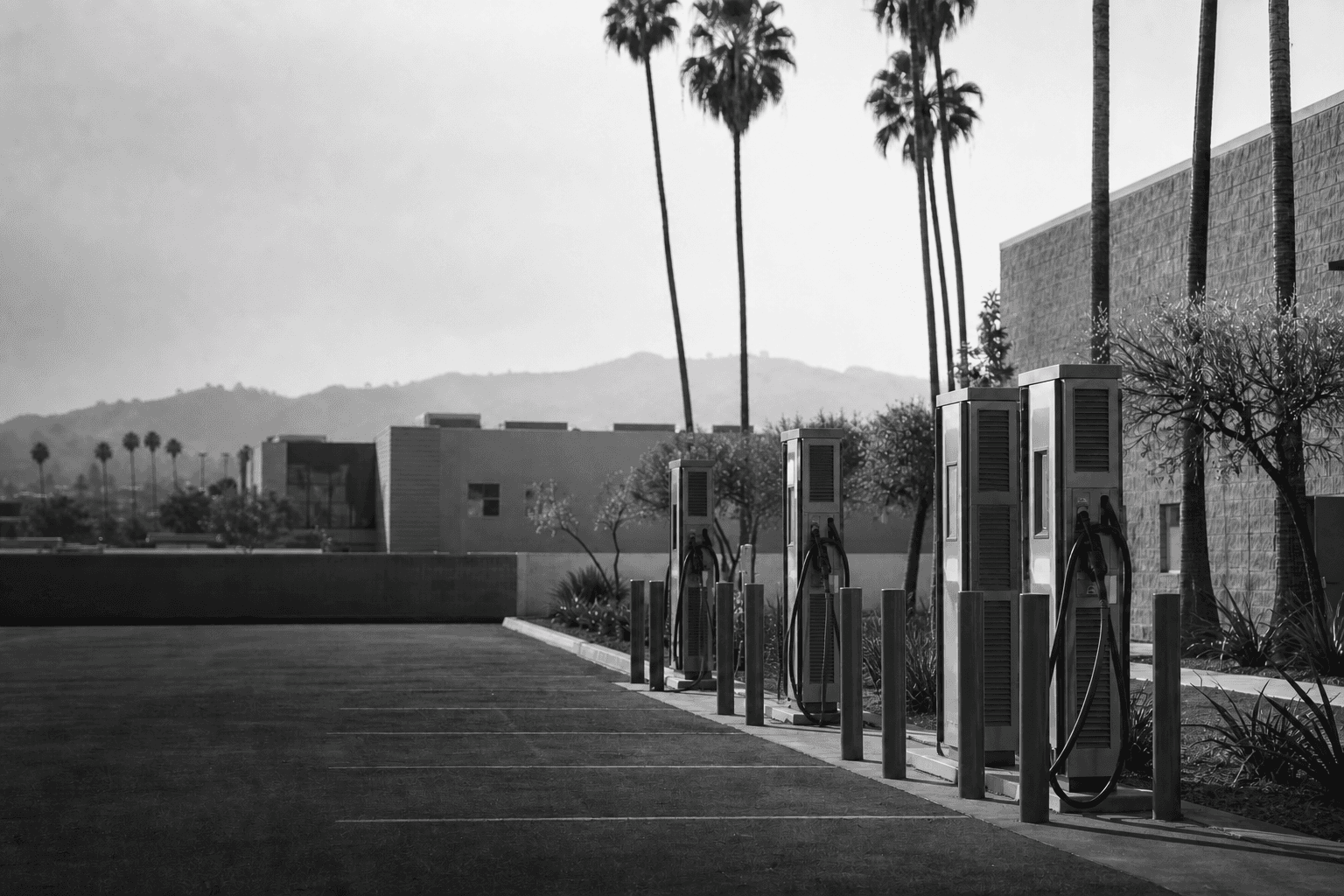
The expensive path
Why two Bend properties get very different numbers
Two buildings can buy identical chargers and receive quotes that are not close. Put the ports beside an electrical room with spare capacity and the run stays short. Move the same ports across a working parking lot and the project picks up trenching, traffic control, and pavement repair. The chargers did not change. The site did.
Lower-complexity site
Fewer building changes
• Spare breaker space and service capacity
• Short, accessible conduit route
• Stalls near existing power
• Little pavement to open and restore
Higher-complexity site
More infrastructure work
• Transformer or service upgrade
• Long underground run across the lot
• Boring under drive aisles or occupied areas
• DC fast charging with high peak demand
Replace guesses with site facts
A site walk should answer the expensive questions before design starts
The first visit is not a parking count. The reviewer should find the utility service, the transformer, the main gear, the distribution panels, the spare breaker positions, and the practical routes between power and parking. Nameplate ratings are only a starting point. Recent demand history, existing load calculations, and any planned building work help show whether apparent spare capacity is actually available for charging.
Outside, mark the proposed stalls and walk the route. Note accessible parking, pedestrian paths, vehicle circulation, drainage, bollard locations, irrigation, and pavement type. A straight line on an aerial photo can cross a fire lane, a storm line, a loading dock, or a slab nobody wants to cut. Weather exposure belongs on that list too, since federal siting guidance treats it as a real factor in equipment and placement choices.
The operating interview matters as much as the electrical one. Ask when vehicles arrive, how long they stay, whether drivers return to assigned stalls, what happens when a port is blocked, and who responds when charging fails. That is what turns a charger count into a system the building can actually run.
A remote estimate is a range, not a construction number
Photos, drawings, and utility bills narrow the problem, but a firm scope needs measured routes and verified electrical conditions. Any estimate you receive should list the assumptions that still need field confirmation, so you know what could still move.
Oregon planning
Oregon runs EV charging permits on one statewide protocol
Oregon sets the permitting and inspection path for EV charging systems at the state level rather than leaving each city to write its own. Only a licensed electrical contractor can pull that permit, and a supervising electrician has to be on record. For a Bend property owner, that shapes the project in two ways.
First, the permit belongs to the contractor doing the work, not to the facility team. Second, circuit size decides which path applies. A licensed contractor may use a minor installation label for a limited new branch circuit, which is a cheaper filing than a full electrical trade permit. The state has been aligning the amperage limits between those rules, and its own analysis said the change may lower permit cost for small installations. A multi-port commercial project sits well outside that limit and follows the full permit and inspection sequence.
The Bend takeaway
Ask which permit path your project uses and confirm the current amperage threshold before assuming the cheaper label applies. Inspection timing follows that choice, and it moves the schedule more than it moves the paperwork cost.
After construction
The installation quote is not the cost of owning chargers
Ownership decides who carries the cost after the chargers go live. Equipment the facility buys outright reduces overall cost and gives full control, but every repair, warranty question, and replacement part becomes the owner's problem. Equipment owned by a network or vendor shifts that risk, usually in exchange for a recurring fee and a longer contract.
Electricity is the other running number. Charging is billed per kilowatt-hour, and demand charges are typically set by the highest fifteen-minute average use recorded in a billing period. DC fast charging is far more likely to trigger those charges than Level 1 or Level 2. Some utilities offer time-of-use rates or other rate incentives for charging owners, which is worth asking about before the metering plan is final.
Year one
Commissioning and coverage
Commissioning, staff training, network activation, payment setup, and routine maintenance, which owners should budget at up to $400 per charger per year.
Later years
What keeps recurring
Electricity and demand, network renewals, preventive maintenance, damaged cables, and extended warranties that can run over $800 per charger per year on DC fast equipment.
Sequence the spend
Phase the project, but talk to the utility first
Utility coordination belongs near the front of the plan, not near the end. Federal guidance asks site hosts to confirm near-term and long-term charging requirements with the utility, along with pricing, rate impacts, and any electrical upgrades needed at the site. Incentive programs deserve the same early treatment, since most of them expect an application before construction rather than a receipt afterward. If your organization needs a formal solicitation, decide that early too, because an RFP adds weeks that no contractor can compress later.
A property does not have to energize every future port on day one. The disruptive work, meaning underground conduit, pull boxes, equipment pads, reserved panel space, and communication pathways, can be sized for the full build while only the ports that current demand supports get activated. That is worth the most where the parking area will be hard to reopen.
Fleets have a cheaper option worth pricing. Instead of a pedestal at every stall, 120 or 240 volt receptacles can support portable Level 1 or Level 2 units that ride in the vehicles. Portable units cost less up front and are simpler to swap when one fails, which cuts downtime as well as the first budget.
Before you compare bids
A useful quote shows the assumptions, not just the total
Ask every bidder to price the same ports, power level, conduit route, panel work, restoration, permitting, and commissioning. If one quote leaves out civil or utility work and another includes it, the two totals are not comparable and the lower one is usually the incomplete one.
01
The charging use case, vehicle dwell time, and energy needed per session
02
Existing service capacity and whether load management is being assumed
03
Exact stall locations and the measured electrical route to each one
04
Civil, permit, inspection, network, and commissioning work included
05
An expansion alternate so added ports do not mean reopening the lot
Keep planning locally
Related EV charging pages in Bend
Get a defensible number
Price the equipment and the building together.
Send the address, operating target, and target opening date. Flux will identify what must be verified before the project can be priced.
Price my chargersQuestions
Straight answers.
Do we have to involve the utility before installing chargers?
Yes, and early. Federal planning guidance puts utility coordination near the front of the checklist: confirm the charging load now and later, the pricing and rate impacts, and whether the service, metering, or equipment needs upgrading. Learning that after equipment is ordered is how schedules slip.
Should we charge drivers to use the chargers?
You can, and many hosts do. Common structures bill by kilowatt-hour, by session, by length of time, or through a subscription, and most networks will handle the transaction at the unit. More than twenty percent of public charging is still free to use, so decide first whether the chargers are an amenity, a cost-recovery tool, or a revenue line.
Can we still count on the federal charger tax credit?
Not for a project starting now. The credit depended on both the placed-in-service date and an eligible census tract, and property placed in service after June 30, 2026 no longer qualifies. Projects that reached service before that date still claim it at filing. Confirm your position with a tax advisor before putting any credit into a budget.
Who pays when a charger stops working?
Whoever the contract says, which is why federal guidance tells site hosts to settle it before installation instead of after the first failure. Responsibility can sit with the site host, the charging network, or the installer. Whichever it is, the maintenance agreement should name a response time, a time for a given repair, and an overall uptime requirement.
Sources used for this guide
- [1]afdc.energy.gov — Alternative Fuels Data Center: Procurement and Installation for Electric Vehicle Charging Infrastructure
- [2]irs.gov — IRS Alternative Fuel Vehicle Refueling Property Credit
- [3]oregon.gov — Notice of Rulemaking Hearing
- [4]photoelectricllc.com — Commercial EV Charging Station Installation | PhotoElectric
- [5]afdc.energy.gov — Alternative Fuels Data Center: Operation and Maintenance for Electric Vehicle Charging Infrastructure
- [6]afdc.energy.gov — U.S. DOE AFDC Electric Vehicles for Fleets