THE SHORT ANSWER
What a commercial HVAC replacement actually covers
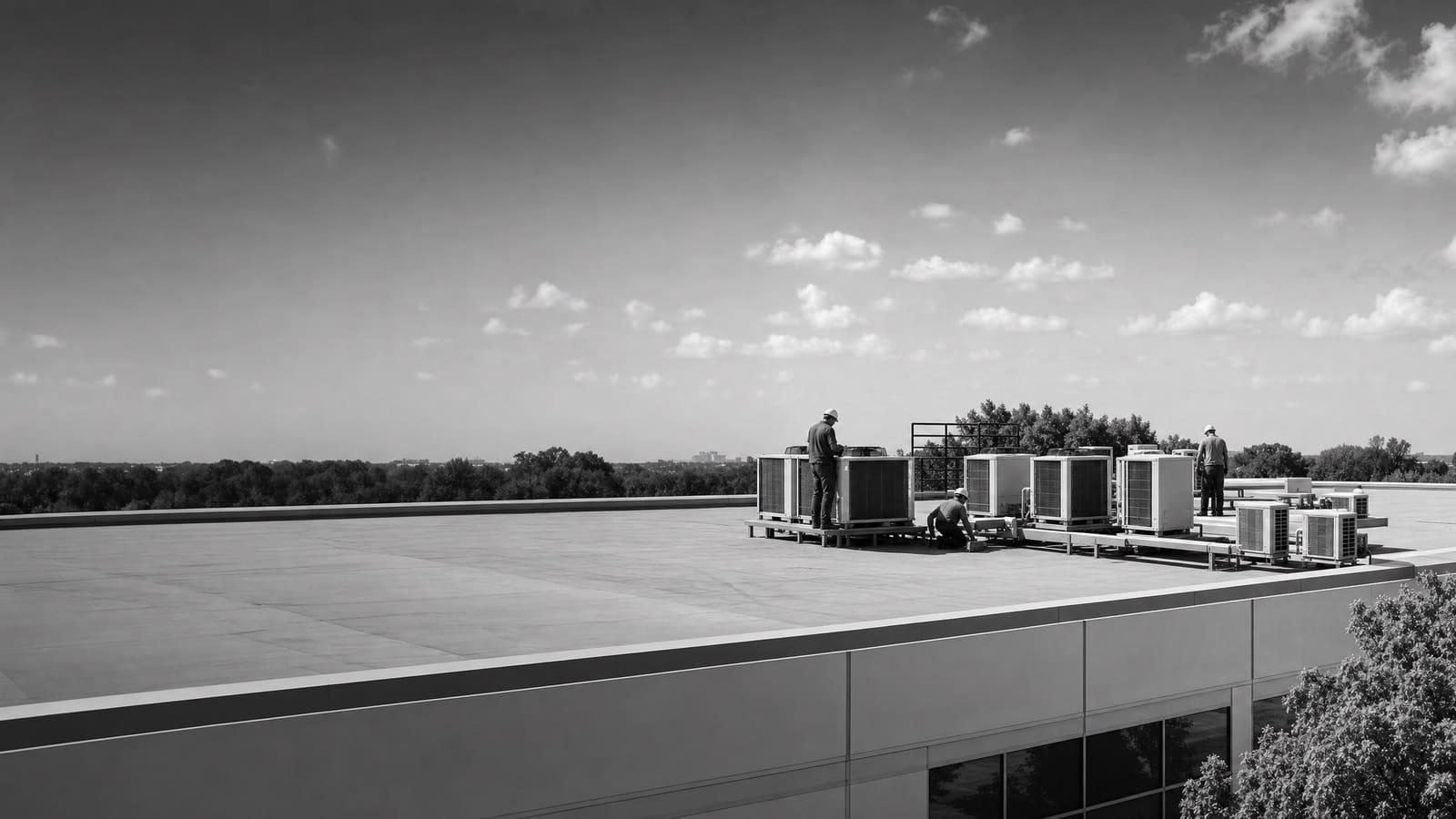
A commercial HVAC installation is a full project: confirm the load, select equipment against real lead times, rig and set the unit, reconnect power and fuel, integrate controls, then commission it. Replacement beats another repair once a rooftop unit passes fifteen years, loses capacity, or needs service every season. Old, inefficient units waste roughly $900 to $3,700 each per year, so a failing unit is already costing money before it quits.
A site review still has to verify tonnage against how the space is used today, curb and roof structure, available electrical capacity, gas line status, and crane reach. Those five answers decide whether a quoted price holds.
THREE PATHS
Three ways to replace a commercial rooftop unit
Packaged rooftop units condition close to half of all commercial floor space in the country, so the replacement decision is fairly standard. It usually comes down to three paths.
The first is a like-for-like air conditioning unit: same tonnage, same curb, same fuel. The second is a high-efficiency unit in the same footprint. Manufacturers now build to a performance specification designed to cut energy use by up to half against the older baseline, and more than twenty models exceed it. The third is a heat pump rooftop unit, which is mechanically similar to a standard unit but adds reverse-cycle heating.
Heat pump units come in three forms: dual fuel, all-electric, and cold climate. Heating efficiency drops as outdoor temperatures fall, so a building with long, cold winters usually looks at dual-fuel or cold-climate equipment rather than a straight all-electric swap. Electrical capacity is the gate. If the panel cannot carry electric heat, that upgrade belongs in the budget before anything is ordered.
WHAT MOVES THE NUMBER
Where a commercial HVAC quote gains or loses money
Two quotes for the same building can differ by a wide margin and both be honest. The difference is almost always in what each one included. These are the lines that move the number most, and the ones worth reading closely on every bid.
IN PRACTICE
Deciding before the unit decides for you
Most commercial HVAC replacement happens under pressure. A unit fails in July, the building needs cooling, and whatever is on a truck wins. That is the most expensive way to buy equipment. Units past fifteen years old waste real money every month they keep running, which means the units most likely to fail are also the ones already draining the operating budget.
The alternative is boring and cheaper. Walk the roof once a year, record the age and service history of every unit, and decide in advance which one gets replaced next and what it gets replaced with. The failure then becomes a scheduling problem instead of a design problem.
Planning ahead also buys the option of the better unit. A proactive replacement lets you compare a high-efficiency model or a heat pump against a straight swap, run the numbers against your own utility rates, and check what incentives apply before the order goes in. Under emergency conditions none of that happens. You take the unit that is available. If a unit is over fifteen years old, needs attention every season, or cannot hold the space on the hottest days, treat it as a replacement candidate now rather than an emergency later.
COMPLEXITY CHECK
One-morning job or a real project
The same words on a proposal can describe two very different projects. Complexity is not about tonnage alone. It is about how much changes between the old unit and the new one: footprint, fuel, structure, and controls.
LOWER COMPLEXITY
Same size, same fuel, open roof
The replacement matches the existing curb, the heating fuel stays the same, the electrical service already carries the load, and the crane has a clear shot at the roof. Permits are typically mechanical and electrical, and the set happens in a morning.
HIGHER COMPLEXITY
New fuel, new load, or tight access
Going all-electric, adding tonnage, or landing on a curb that no longer fits. Any one of those pulls in structural review, service capacity work, or a larger crane and a longer closure. The engineering is real and the schedule stretches from days into weeks.
SITE REVIEW
What a site review has to confirm
A price written from a nameplate photo is a starting number, not a quote. It tells you the tonnage and the fuel and nothing about what it will take to get a new unit onto that roof.
A real review starts with load. Twenty years changes occupancy, plug loads, lighting, and sometimes the envelope, so the old nameplate is a data point rather than an answer. Then it moves to the physical constraints: curb size and condition, roof structure under the new weight, clearances around neighboring units, and how the existing ductwork meets the unit. Those constraints are what turn a simple swap into a curb adapter, a structural letter, or a redesigned transition.
The last part is infrastructure and access. Electrical capacity decides whether an electric heating option is even on the table, and spare breaker space matters as much as service size. The gas line has to be extended, capped, or removed depending on the path chosen. Crane reach, staging space, and the hours the lot can stay closed decide the rigging cost. None of this is exotic. It just has to happen before someone quotes a number you plan to hold them to.
The five answers that hold a price together
Confirmed tonnage against current use, curb and structural fit, available electrical capacity, gas line disposition, and a workable crane path. If a proposal does not show that someone checked all five, expect a change order once the crane is already on site.
AFTER THE INSTALL
Two questions that outlast the installation
A rooftop unit installed this year will still be running in the mid-2040s if it is maintained. That makes two questions worth settling before the crane is booked, because both of them shape which equipment path actually makes sense.
The first is who carries the cost and who collects the benefit. The second is who services the unit afterward. Contractor familiarity is a genuine selection factor, especially with heat pump equipment and newer refrigerants, and it is easier to confirm before purchase than after the first failed startup.
OWNERSHIP
Who pays and who benefits
In a leased building, the party buying the unit is often not the party paying the utility bill. That split is why efficiency upgrades stall. Settle it before scoping the project, because it changes which of the three equipment paths is financially rational.
SERVICE
Who keeps it running
Refrigerant in stationary commercial equipment is federally regulated for handling, recovery, and recycling, and those rules follow the unit for its whole life. Confirm your service provider is comfortable with the refrigerant and the controls in the unit you are buying.
PORTFOLIO PLANNING
Replacing on a schedule instead of on failure
If you run more than a handful of units, the strongest version of this is a replacement schedule rather than a run of emergencies. Rank every unit by age, service cost, and how much comfort trouble it causes. Replace the worst one or two per budget cycle. Standardize on a platform your service provider knows so parts and controls stay consistent across the roof.
A schedule also lets you use the option that is not full replacement. On a unit with real life left, retrofitting advanced controls can be the better financial call, and it keeps capital available for the units that are genuinely done. The right answer is whichever produces more savings per dollar in that specific building.
This approach has a track record. A long-running national campaign that closed out in the last decade upgraded more than forty-three thousand rooftop units across roughly two hundred organizations, and those upgrades saved a combined thirty-seven million dollars a year on energy bills. That was planned replacement and retrofit work, not emergency response. It is also worth checking available incentives before the order is placed, because rebate paperwork usually has to be started before the equipment is installed, not after.
ON THE QUOTE
Five things a comparable quote should show
Bids are only comparable when they show the same scope. Ask every contractor for these five lines in writing, and differences in price stop being a mystery.
01
Exact model, tonnage, fuel, and efficiency rating
Not a tonnage range and not "or equal." The specific unit, its heating type, and its rated efficiency.
02
Equipment lead time in writing
Availability sits next to the price. A cheaper unit eight weeks out is not the same offer as one in regional stock.
03
Curb, structural, and roofing work
Curb adapter, any structural review, and who patches and warrants the roof penetration afterward.
04
Rigging, access, and lot closure
Crane size, staging plan, closure hours, and whether permits and inspections are inside the installed price.
05
Commissioning and refrigerant handling
Documented startup, charge, airflow, and controls verification, plus compliant recovery of the old unit's refrigerant.
Keep planning locally
Related mechanical pages in Yonkers
Get a defensible number
Price the equipment and the building together.
Send the address, operating target, and target opening date. Flux will identify what must be verified before the project can be priced.
Get a free estimateQuestions
Straight answers.
When is replacement better than one more repair?
Past fifteen years, the math usually turns. Old rooftop units waste roughly $900 to $3,700 each per year in energy alone, and that runs alongside rising repair costs and comfort complaints. If a unit needs service every season or cannot hold the space on peak days, budget for replacement rather than the next fix.
Should the new unit be a heat pump?
It depends on winter heating hours, electrical capacity, and your utility rates. Heat pump rooftop units heat efficiently in mild-to-moderate cold and lose efficiency as temperatures fall, which is why dual-fuel and cold-climate versions exist. Check panel capacity first, because a service upgrade can cost more than the equipment difference.
How long does a rooftop replacement take?
The set itself is usually one morning to two days once the unit is on site. Equipment lead time is the real variable and should appear on the quote next to the price. Curb adapters, structural work, or an electrical service upgrade extend the schedule well beyond the crane day.
Will a new unit use a different refrigerant?
New commercial equipment ships on current-generation refrigerants, and handling, recovery, and recycling are federally regulated for the life of the unit. Day-one operation is unaffected. It matters for service planning on a mixed roof, so confirm your provider stocks and services what the new unit uses.
Can existing units be upgraded instead of replaced?
Sometimes, yes. On units with useful life remaining, retrofitting advanced controls can deliver a better return than a full replacement and frees capital for the units that are genuinely finished. Compare both options per unit rather than applying one policy across the whole roof.
Sources used for this guide
- [1]betterbuildingssolutioncenter.energy.gov — DOE Advanced Rooftop Unit Replacement Guidance
- [2]betterbuildingssolutioncenter.energy.gov — DOE Commercial Heat Pump Rooftop Unit Replacement Guidance
- [3]betterbuildingssolutioncenter.energy.gov — DOE High-Efficiency Commercial Rooftop Unit Toolkit
- [4]energy.gov — DOE Efficient Commercial Rooftop Air Conditioner Program
- [5]epa.gov — EPA Stationary HVAC Refrigerant Management