The complete project
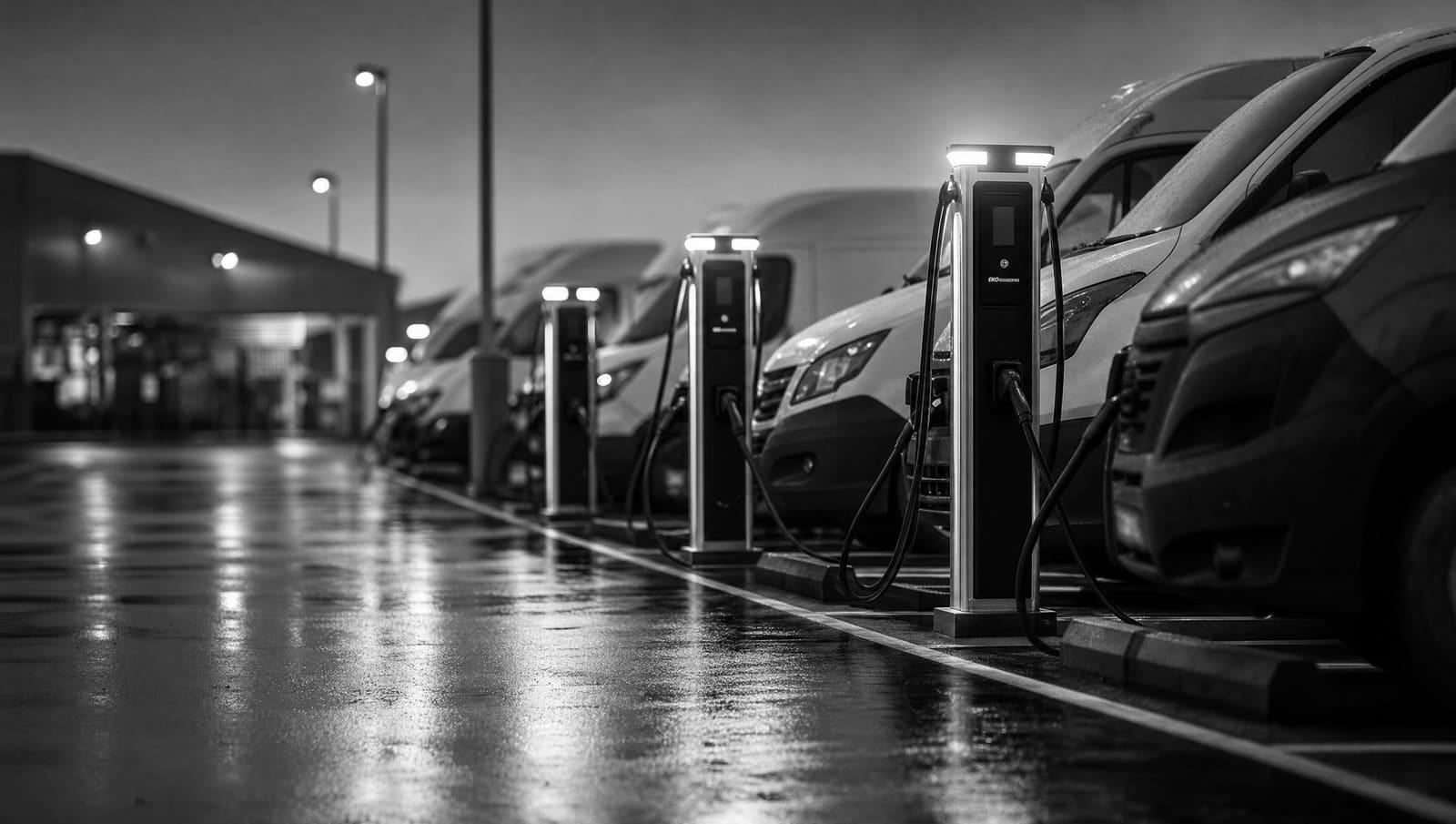
Commercial EV charger installation in Tustin.
A commercial installation starts with vehicle needs, parking use, electrical capacity, and equipment selection. It then moves through design, utility coordination, permitting, make-ready construction, charger installation, network setup, inspection, commissioning, and turnover. Level 2 usually serves vehicles parked for hours. DC fast charging supports faster turnover but can require a much larger electrical and utility scope.
The site review must verify usable capacity, charger locations, cable reach, conduit routes, accessibility needs, communications, and room for future stations.
Choose the operating model first
Three choices shape the installation
Do not begin with a charger catalog. Begin with the vehicles, their parking time, and the result each session must deliver. Workplace drivers may remain parked for much of the day. Fleet vehicles may return together and need to leave on a fixed schedule. Public charging may require payments, clear access rules, and dependable communications.
These differences affect charger power, port count, electrical demand, software, signage, and parking layout. They also affect whether charging can be shared across vehicles or must be available at a set time. Write the operating plan before design begins: who can charge, when they arrive, how long they stay, how much energy they need, and who handles a fault. That short plan gives the engineer and installer a real target.
Build a complete scope
What changes the project budget
Equipment is only one part of the quote. Electrical capacity, distance, civil work, utility requirements, networking, and future expansion can change the total scope.
Equipment selection
Level 2 and DC fast charging solve different jobs
Level 2 equipment uses AC power from the building, while the vehicle converts that power for its battery. It is often a practical fit when cars remain parked for hours. The design still needs proper circuiting, protection, mounting, cable reach, communications, and a plan for sharing available power.
DC fast equipment performs the power conversion outside the vehicle. It can deliver energy faster, but the installation is not simply a larger Level 2 circuit. The project may need substantial distribution equipment, dedicated switchgear, thermal management, a different utility review, and more space around the equipment. Higher demand can also make charging schedules and electricity-rate effects more important.
Choose the lowest charging power that reliably meets the operating goal. More nameplate power does not help if vehicles stay all day, cannot accept the full output, or must share limited site capacity. For a fleet, compare the energy each vehicle uses with its time at the facility. For employees, tenants, or visitors, compare likely dwell time with the access policy. Make the equipment follow those facts.

Complexity check
Is this a straightforward installation or an infrastructure project?
The charger count alone does not reveal project difficulty. Existing power, routing, parking conditions, communications, and utility work determine how much design and construction are required.
Lower complexity
Capacity and a short route already exist
The electrical system has verified capacity, chargers sit near distribution equipment, trenching is limited, communications are available, and the parking plan can support the required spaces.
Higher complexity
Power or construction must be added
The site needs new distribution, long underground routes, pavement restoration, utility upgrades, DC fast equipment, payment systems, or construction phasing around active operations.
Site assessment
Turn charging goals into a buildable design
A useful site review begins at the electrical service and ends at each proposed charging space. The reviewer should record service and panel information, existing loads, likely spare capacity, meter locations, equipment space, possible conduit routes, and underground or surface conditions. Parking observations should cover stall dimensions, traffic flow, cable reach, protected mounting locations, accessibility needs, signage, lighting, and security.
The review must also test the operating plan. Confirm how many vehicles may arrive together, how long they remain, how much energy they need, and whether specific vehicles have priority. Identify who will use the stations and whether the system needs authentication, payment, usage data, remote control, or public listing.
The output should be more than field notes. Ask for a recommended charger type and quantity, a preliminary single-line concept, proposed equipment locations, construction assumptions, utility questions, communications needs, and expansion options. Unverified conditions should be labeled clearly. That gives bidders the same basis and reduces the chance that a low proposal is simply missing work.
Ask what was verified
A serious proposal separates observed conditions from assumptions. Panel labels, spare breaker spaces, or an empty equipment area do not by themselves prove that usable electrical capacity exists.
Ownership and operation
Decide who controls the stations after turnover
Charging equipment becomes part of facility operations. Before procurement, assign responsibility for electricity, user access, pricing, software administration, driver support, cleaning, inspections, repairs, and replacement planning. The right ownership model depends on how much control the facility wants and which ongoing duties it can support.
Networked equipment can provide access control, session records, payment functions, monitoring, and power management. Those features can be useful, but they may also depend on communications and continuing service agreements. Simple equipment can reduce software duties, yet it may provide less visibility when a station fails or demand grows. Review the full operating model, not only the hardware purchase.
Facility controlled
Own the equipment and operating decisions
The owner selects hardware, software, access rules, maintenance providers, and future changes while carrying the related management and replacement duties.
Service supported
Assign defined duties to outside providers
Contracts may cover networking, payments, monitoring, support, or maintenance. Confirm term length, data access, response scope, and exit conditions.
Procurement and phasing
Buy the first phase without blocking the next one
A phased project can control near-term spending, but only if the first design protects later expansion. Show the ultimate charger count on the concept plan even when the first build installs fewer ports. Evaluate panel space, transformer or service limits, conduit capacity, equipment pads, communications, parking layout, and paths for future conductors. Installing empty conduit or reserving distribution space may reduce future disruption, but it should follow a defined expansion plan rather than a guess.
Compare bids on the same basis. A low number may exclude engineering, utility work, trenching, surface repair, network activation, signs, testing, training, or closeout records. It may also rely on allowances that move risk back to the owner. Review commercial EV charging cost factors beside the proposed scope so hardware and construction are not mistaken for the complete project.
Consider lifetime duties as well. Ask about software terms, communications, warranties, replacement parts, inspection routines, remote monitoring, service response, and who diagnoses a failed charging session. Commissioning should test every port, access method, network function, payment function when used, and power-management rule. Turnover should include approved drawings, equipment records, settings, warranties, training materials, and clear support contacts.
Quote comparison
Five things every comparable quote should show
Give each bidder the same operating plan and site information. Then check that each proposal defines these five items instead of hiding them in exclusions or broad allowances.
01
A defined charger schedule
List quantities, ports, power, connectors, mounting, cable management, networking, and included software.
02
A complete electrical scope
Identify panels, protection, conductors, conduit, load controls, metering, switchgear, and service assumptions.
03
Civil and parking work
Show trenching, pads, bollards, striping, signs, restoration, accessibility work, and traffic protection.
04
Approvals and project duties
Assign design, utility coordination, permit submittals, inspections, equipment delivery, and schedule management.
05
Commissioning and turnover
Require functional tests, network activation, training, closeout documents, warranties, support contacts, and exclusions.
Keep planning locally
Related EV charging pages in Tustin
Get a defensible number
Price the equipment and the building together.
Send the address, operating target, and target opening date. Flux will identify what must be verified before the project can be priced.
Price my chargersQuestions
Straight answers.
What does a commercial EV charger installation include?
A complete installation includes needs planning, a site and electrical assessment, charger selection, design, utility coordination when needed, permits, electrical and civil construction, mounting, wiring, network activation, inspection, commissioning, training, and closeout documents. The proposal should state which party owns every task.
Should a Tustin commercial property install Level 2 or DC fast chargers?
Choose from vehicle use, not location alone. Level 2 is often suited to vehicles parked for hours. DC fast charging is intended for quicker turnover or demanding fleet schedules, but it can require much more electrical infrastructure. A charging and load study should confirm the needed power before equipment is selected.
How do we know whether the existing electrical service can support charging?
An electrical assessment must review service ratings, distribution equipment, existing loads, demand patterns, equipment condition, and the proposed charging load. An open breaker position does not prove capacity. The study should also test whether managed charging can keep demand within a practical limit.
What is managed charging?
Managed charging controls how available power is shared across connected vehicles. It may reduce output when several vehicles plug in, prioritize vehicles with earlier departures, or schedule charging for selected periods. It can help a site serve more ports within a defined power limit, but the design must still meet operational needs.
Does commercial charging equipment need a network?
Not always. A network may be useful for access control, payment, usage records, monitoring, remote support, and power management. It also introduces communications needs and ongoing service terms. Decide which functions the facility truly needs, then confirm data ownership, fees, support, and options if the provider changes.
How should we compare commercial EV charger installation bids?
Compare charger quantities and power, electrical equipment, trenching, restoration, mounting, networking, design, approvals, utility duties, commissioning, training, warranties, maintenance, exclusions, and allowances. Each bidder should price the same operating goal and site assumptions. Otherwise, the lowest bid may simply contain the least complete scope.
Should we install all planned chargers at once?
Not necessarily. Phasing can work when the first design preserves space and pathways for later equipment. Show the long-term port count, then evaluate distribution capacity, conduit, pads, communications, and parking layout. Avoid installing unused infrastructure without a clear expansion basis.
Are commercial EV charging incentives available in August 2026?
Incentives and tax rules are time-sensitive and may depend on the exact address, ownership, equipment, labor, and project dates. Verify current eligibility with the responsible program and tax professionals before including any benefit in the budget. Do not treat an older program description or screening result as an award.
What should happen during commissioning?
The team should energize and test every port, complete real charging sessions, verify access and payment functions when used, confirm communications and power-management settings, record equipment information, and train the responsible staff. The owner should receive closeout documents, warranties, settings, and support contacts.
Sources used for this guide
- [1]afdc.energy.gov — Alternative Fuels Data Center: Procurement and Installation for Electric Vehicle Charging Infrastructure
- [2]betterbuildingssolutioncenter.energy.gov — DOE Better Buildings Commercial EV Charging Infrastructure Guide
- [3]driveelectric.gov — Public electric vehicle charging infrastructure playbook · Joint Office of Energy and Transportation
- [4]energy.gov — DOE Federal Workplace Charging Program Guide