THE SHORT VERSION
What a commercial HVAC replacement actually includes
A commercial HVAC installation is four things: a load check, an equipment selection with real lead times, a rigging and permit plan, and a documented startup. Replacement beats another repair once running cost, not the repair bill, is the real expense. An old, inefficient rooftop unit wastes roughly $900 to $3,700 a year in energy, and units past fifteen years are usually the ones worth planning around instead of waiting out.
A site review still has to confirm tonnage against how the space is used now, plus curb and roof structure, panel capacity, and crane access, before any of that becomes a real number.
THREE WAYS TO GO
Three replacement paths for a commercial roof
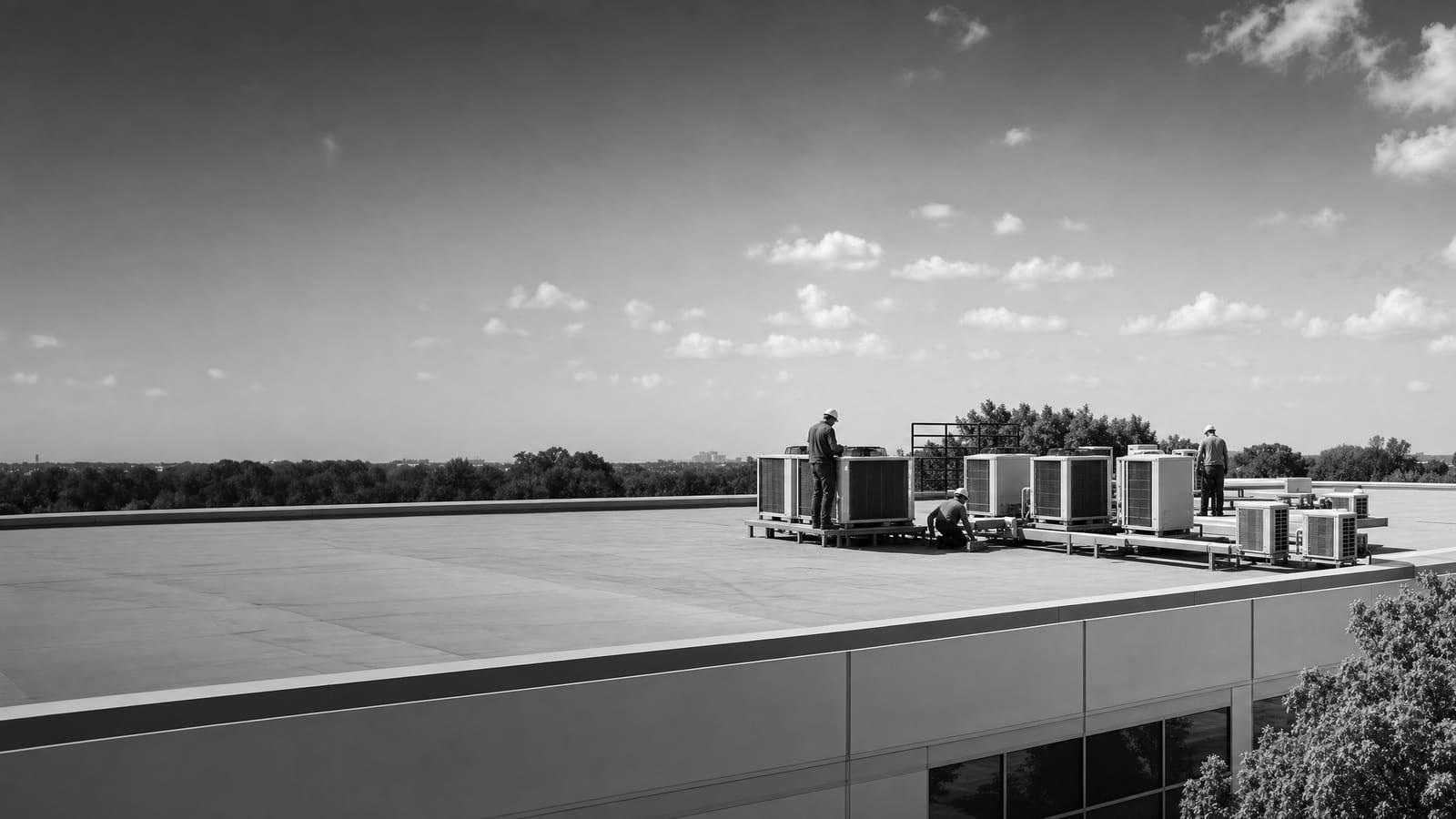
Most commercial buildings cool with packaged rooftop units, which condition close to half of all commercial floor space in the country. That makes the replacement decision fairly narrow: keep the same fuel and layout, step up the efficiency tier, or move heating into the equipment itself with a heat pump unit.
The choice is not only about the equipment. It is about electrical capacity, gas lines, physical constraints on the roof, and what your contractor can actually service. Those four items decide more replacement outcomes than efficiency ratings do.
Heating climate matters too. Heat pump rooftop units lose efficiency as outdoor temperatures fall, so they fit best where winters are mild to moderate. Across most of the South and West, today's units can handle most or all of the winter heating demand, which puts a building here in the group where the electric option deserves a real evaluation rather than a reflex no.
WHAT MOVES THE NUMBER
Where a rooftop replacement budget actually goes
The unit itself is rarely the line that surprises anyone. The surprises live in what the roof, the panel, and the schedule demand once the old equipment is off. Ask for these as separate lines so you can see which ones are firm and which ones are still estimates.
IN PRACTICE
How to choose the unit before the crane is booked
Start with the load, not the nameplate. A unit that has been on the roof for twenty years was sized for a building that may no longer exist in the same form. Occupancy changed, plug loads changed, lighting changed, and sometimes the walls moved. Carrying the old tonnage forward carries the old mistake forward with it, and oversized equipment short-cycles, dehumidifies poorly, and wears itself out early.
Then select against availability. Equipment lead time is a selection criterion, not a footnote. A unit you can get in weeks and a unit you can get in months are different projects, and if the building is running on a failed compressor in August, the faster unit may simply be the right unit. Ask for two or three options priced side by side with their real lead times attached.
Efficiency tier is the last call, and run hours decide it. A unit that runs most of the year pays back a higher tier faster than one serving a space occupied part-time. Old, inefficient units are the ones burning $900 to $3,700 a year each, so the tier question is really a question about how many of those years you plan to own.
SCOPE CHECK
What makes one changeout simple and another complicated
Two buildings can order the same tonnage and get very different projects. The difference is almost never the equipment. It is what the roof, the panel, and the parking lot allow.
LOWER COMPLEXITY
Same size, same fuel, open access
The existing curb fits or takes a standard adapter. The space is used the way it was when the last unit was sized. Fuel stays the same, the panel has headroom, and the crane has a clear place to set up away from tenant traffic.
HIGHER COMPLEXITY
New load, new fuel, or tight access
Tonnage or footprint grows and the roof needs structural review. Moving from gas heat to electric means confirming service capacity first. Add a tight lot, a long crane reach, or a membrane near end of life, and the planning outweighs the install.
THE SITE REVIEW
What a real site review has to confirm
A site review is where the quote stops being a guess. Most of the risk lives on the roof, so the visit should end with photographs and measurements rather than impressions.
Four infrastructure items carry the most weight. Electrical capacity decides whether the panel can feed a larger or all-electric unit without a service upgrade. Physical constraints, meaning curb size, roof structure, clearances, and how close the unit sits to a parapet or its neighbor, decide the rigging plan. Gas lines decide whether a fuel change is a simple cap or a piping project. And how familiar your contractor is with the equipment you are considering decides how the first cold morning goes after startup.
Access is the item people forget until the crane bid comes back. The reach required, where outriggers can set, how many stalls close, and for how long are all site facts, and together they can swing the price more than a step up in efficiency tier does.
The review should also confirm what the space needs today. If comfort complaints have been running for years, the answer may be in sizing or distribution, and replacing the box alone will not settle them.
Ask for this before you sign
A written scope naming tonnage and model, panel capacity confirmed on site, the curb or adapter plan, the crane and lot closure window, and who carries permits and inspections. If any of those are blank, the price is still an estimate.
SANTA CLARITA SPECIFICS
Permits and roof sequencing in Santa Clarita
Santa Clarita sits in the part of the country where winter heating demand stays mild, and that matters more to this decision than it first looks. Heat pump rooftop units lose efficiency as outdoor temperatures drop, so they fit best in mild-to-moderate heating climates. Across most of the South and West, current units can carry most or all of the winter heating load, which means an electric replacement here earns a genuine evaluation instead of an automatic pass.
Permits are the other local item to settle early. California permit lists treat mechanical upgrades and repairs as permitted work, and re-roofing, whether overlay or tear-off, is permitted separately from the mechanical scope. Confirm the exact submittal set and inspection sequence with the local building division before equipment is ordered, because inspections, not the crane, usually set the finish date.
Sequence the roof and the unit together
If the membrane is within a few years of replacement, plan the roof and the changeout as one project. Cutting a fresh membrane for a curb a year later costs more than coordinating it once, and it is two separate permits either way.
OWNERSHIP
Two decisions that outlive the install day
Two things follow you long after the crane leaves. The first is what the new unit means for your service program. The second is whether you keep replacing equipment one failure at a time or start replacing it on a schedule you control.
Replacing on failure is the most expensive way to buy equipment. It takes away your leverage on lead time, on price, and on efficiency tier, because whatever is available becomes the decision. Replacing an inefficient unit proactively is usually the better business move, and it often beats a like-for-like swap made under pressure at the end of a unit's service life.
SERVICE PLANNING
Refrigerant follows the unit
Federal rules govern how refrigerant is handled and recycled in stationary cooling and heat pump equipment, so the old charge is recovered properly when the unit comes off. If your roof ends up running more than one refrigerant, say so in the service contract and in the spare-parts plan.
FLEET TIMING
Own the calendar
Once you know the age of every unit on the roof, replacement becomes a budget line instead of an emergency. Units past fifteen years belong on a plan, with the worst performer scheduled first and the rest sequenced across the next budget cycles.
OVER TIME
Phasing a fleet instead of chasing failures
Fleet replacement works better staged than done all at once. Rank the units by age, run hours, and complaint history, then replace the worst one first and let it teach you something. The first project reveals the real cost of curb adapters on your roof, the real crane access constraints, and the real lead time your equipment line carries. Those facts price the next three units far more accurately than a spreadsheet will.
Scale supports the approach. Under a national rooftop unit campaign, more than 200 public and private organizations upgraded over 43,000 units and cut a combined $37 million a year from their energy bills. None of them did it in a single weekend.
There is also a floor under your downside. A federal efficiency standard finalized in December 2015 raised the minimum for commercial rooftop units, so even a baseline replacement today performs better than what is coming off. The question is rarely whether replacement pays. It is how far above the minimum to go, and how many units you can sensibly do per budget year. Where a unit still has real service life, upgraded controls are a legitimate middle step while the replacement waits its turn.
THE QUOTE
Five things a comparable quote has to show
A quote you can actually compare against another quote is specific in five places. If one bidder is vague where another is exact, you are not looking at the same project, and the cheaper number is usually the less complete one.
01
Equipment identity
Manufacturer, model, tonnage, and efficiency tier written out, not just a line that says new rooftop unit.
02
Lead time in writing
The actual availability date for the unit quoted, plus what changes to the schedule and price if it slips.
03
Roof and curb scope
Curb adapter, any structural work, and how the membrane gets cut, patched, and warranted afterward.
04
Crane and access plan
Rigging plan, staging area, how many stalls close, and the hours the lot is affected.
05
Permits and startup
Who pulls permits, who meets inspectors, and a documented commissioning report handed over at closeout.
Keep planning locally
Related mechanical pages in Santa Clarita
Get a defensible number
Price the equipment and the building together.
Send the address, operating target, and target opening date. Flux will identify what must be verified before the project can be priced.
Get a free estimateQuestions
Straight answers.
When does replacement beat one more repair?
Once running cost is bigger than the repair bill. An old, inefficient rooftop unit can waste roughly $900 to $3,700 a year in energy alone, and units past fifteen years are the usual candidates. If the unit is old, struggling, and already on its second major repair, that repair is buying time on an expense that keeps growing.
Should a gas rooftop unit be replaced with a heat pump?
It is worth a genuine evaluation here. Heat pump rooftop units suit mild-to-moderate heating climates, and across most of the South and West they can carry most or all of the winter heating load. The gate is electrical. Confirm panel capacity and available service before the equipment gets selected.
Does a commercial rooftop changeout need a permit?
Plan on it. California permit lists cover mechanical upgrades and repairs, and re-roofing is permitted separately from the mechanical work. Confirm the submittal set and inspection sequence with the local building division early, because inspections often set the finish date.
What actually sets the project schedule?
Equipment lead time first, then permits, then weather. The crane set is the short, visible part of the job. Everything ahead of it determines your date, which is why availability belongs on the quote right next to the price.
What happens to the refrigerant in the old unit?
Federal rules govern how refrigerant is handled and recycled in stationary cooling and heat pump equipment, so the charge is recovered by certified technicians when the unit comes off. If the new unit uses a different refrigerant than the rest of your fleet, note it in the service contract and parts plan.
Sources used for this guide
- [1]betterbuildingssolutioncenter.energy.gov — DOE Advanced Rooftop Unit Replacement Guidance
- [2]betterbuildingssolutioncenter.energy.gov — DOE Commercial Heat Pump Rooftop Unit Replacement Guidance
- [3]betterbuildingssolutioncenter.energy.gov — DOE High-Efficiency Commercial Rooftop Unit Toolkit
- [4]energy.gov — DOE Efficient Commercial Rooftop Air Conditioner Program
- [5]epa.gov — EPA Stationary HVAC Refrigerant Management
- [6]californiacity-ca.gov — HVAC Permits