The direct answer
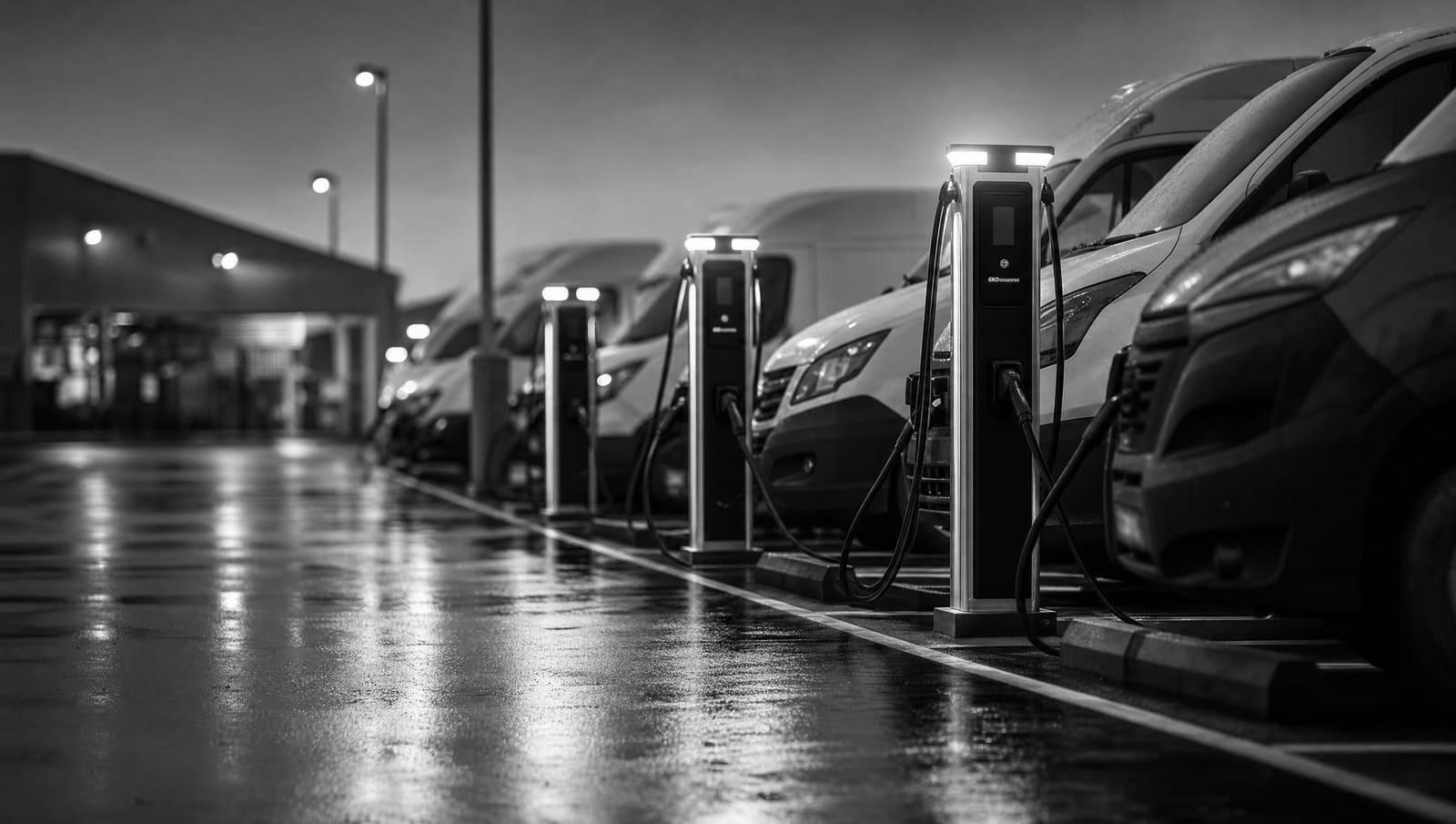
Commercial EV charger installation in San Leandro.
A commercial EV charger installation starts with a site and electrical assessment. It then moves through equipment selection, utility coordination, design, permitting, construction, inspection, commissioning, and turnover. Level 2 charging often connects through commercial distribution equipment. DC fast charging can require much larger service, switchgear, conversion equipment, cooling, and utility work.
The site review must verify electrical capacity, parking use, cable routes, communications, accessibility needs, charger protection, and space for later expansion.
Start with operations
Make three choices before selecting a charger
The charger should follow the operating plan. First, identify who will charge and how long each vehicle normally stays. Employees, tenants, visitors, and fleet vehicles can have very different needs. Second, decide whether drivers need free access, controlled access, or paid charging. That choice affects networking, account setup, data collection, and ongoing fees. Third, set a realistic expansion plan. The first phase may have only a few ports, but conduit, panels, and equipment space can be planned for later growth.
These choices shape the electrical design and the construction scope. They also prevent a common buying error: selecting hardware before anyone checks whether its power level, cable layout, software, and connector arrangement fit the site. Write down the charging goal in plain terms before requesting proposals. A clear goal gives every bidder the same problem to solve.
Scope the whole project
The budget is more than charger hardware
Compare the full installed scope. A low equipment price does not show whether the site needs new distribution gear, long conduit runs, pavement work, communications, or utility changes. See the broader commercial EV charging cost factors before comparing totals.
Equipment fit
Level 2 and DC fast charging create different projects
Level 2 charging commonly fits vehicles that remain parked for hours. The vehicle converts incoming AC power for its battery, so the site equipment is usually smaller and simpler than a DC fast charger. This can work well for employee, tenant, visitor, or overnight fleet charging when the available dwell time meets the charging goal. The design still needs dedicated circuits, safe cable reach, suitable mounting, communications where required, and a plan for controlling the combined load.
DC fast charging moves the power conversion outside the vehicle. That changes the project. The equipment is larger, its demand on the electrical system is much higher, and the design may need substantial distribution or utility work. It is best considered when vehicles need short stops, repeat turns, or dependable energy within a limited operating window.
Do not compare these options only by the speed printed on a product sheet. A vehicle may accept less power than a charger can deliver, and charging performance changes with the vehicle and battery condition. Compare the charging session the operation actually needs. Then check whether the building, utility connection, parking plan, and project schedule can support it.

Complexity check
What makes an installation straightforward or demanding?
Complexity comes from the relationship between the desired charging load and the site. Two projects using similar chargers can require very different engineering, construction, and coordination.
Lower complexity
Power and parking are already close
The electrical system has usable capacity, stalls are near the distribution point, routing is clear, equipment can be protected, and the selected charging level fits normal dwell time.
Higher complexity
The project changes the site
The plan needs service upgrades, new switchgear, long underground routes, pavement restoration, new communications, major parking changes, or high-power charging coordinated with utility work.
Site assessment
What a useful site review should settle
A site review should connect the charging plan to real field conditions. The reviewer needs the electrical service and meter locations, panel ratings, existing loads, available equipment space, and the proposed charging area. The route between power and parking should be walked, not estimated from an aerial image. Walls, landscaping, vehicle lanes, existing utilities, and finished pavement can all affect the route.
The parking review should cover stall use, vehicle direction, cable reach, mounting locations, protection from impact, signage, lighting, security, and accessible use. Networked equipment also needs a dependable communications plan. A weak signal discovered after installation can delay activation or leave important features unavailable.
Bring operating information too. Useful inputs include vehicle types, arrival and departure windows, daily travel, expected users, access rules, and likely growth. For a fleet, the key question is whether every required vehicle will receive enough energy before departure. For shared parking, the question is how long drivers will stay and whether spaces can turn over. The result should be a written basis of design that bidders can price.
Ask for assumptions in writing
The assessment should state the planned port count, power per port, expected simultaneous load, electrical source, route, network needs, construction exclusions, and future-phase assumptions.
Ownership and operation
Decide who controls the equipment after turnover
Commercial charging continues to create work after construction ends. Someone must manage users, pricing or reimbursement, software accounts, station status, repairs, and vendor support. Ownership can also be separated across the charger, network service, and electrical infrastructure. Those responsibilities belong in the buying decision because they affect access to data, ongoing fees, repair choices, and the ability to change providers.
Ask how the station behaves if its network connection fails. Confirm who receives fault alerts, who answers driver calls, how replacement parts are obtained, and whether software service is required for basic operation. These details are easier to settle before procurement than after the equipment is mounted.
Facility controlled
Own the assets and operating policy
This can provide more control, but the facility must assign responsibility for accounts, pricing, monitoring, maintenance, and vendor relationships.
Third-party supported
Buy defined operating services
Clarify service term, fees, response duties, data access, hardware restrictions, renewal terms, and what happens when the agreement ends.
Procurement and phasing
Build the first phase without blocking the next one
A phased project can control the initial commitment while preserving a sensible path to growth. The first phase should install the ports supported by current demand. The design can still reserve panel space, equipment area, and conduit pathways for a later phase. Spare pathways may reduce repeated disruption, but every future allowance should be tied to a stated expansion case. Oversizing everything without a plan can spend money in the wrong place.
Load management can also be part of phasing. Network controls may divide available power among several ports or adjust charging when other building loads are high. That can help a site serve more vehicles within a defined electrical limit. It does not create new energy or remove the need for sound engineering. The proposal should explain the maximum site load, the minimum service expected at each port, and what happens when every space is occupied.
Evaluate lifetime obligations along with construction. Review network charges, payment processing, communications, inspections, preventive maintenance, warranty terms, replacement parts, and support response. Check current incentive and tax-credit eligibility before relying on it in the budget. Eligibility can depend on location and other rules, and time-sensitive programs should be verified when the project is ready to proceed.
Comparable proposals
Five things every installation quote should show
Give each bidder the same operating goal and request the same breakdown. A comparable quote should make assumptions, exclusions, dependencies, and recurring charges easy to find.
01
A defined charging result
Show port count, charger type, power, users, access plan, and the operating need being met.
02
A complete electrical basis
Identify the source panel, load assumptions, new distribution equipment, conductor route, metering, and utility dependencies.
03
A clear construction scope
List mounting, trenching, boring, concrete, restoration, striping, signage, protection, communications, and work-hour assumptions.
04
Approvals, testing, and turnover
Assign design, permit, inspection, activation, test-session, training, warranty, and closeout-document responsibilities.
05
Price boundaries and schedule risks
Separate allowances, exclusions, recurring fees, lead times, utility work, incentives, and conditions that can change the total.
Keep planning locally
Related EV charging pages in San Leandro
Get a defensible number
Price the equipment and the building together.
Send the address, operating target, and target opening date. Flux will identify what must be verified before the project can be priced.
Price my chargersQuestions
Straight answers.
What is included in commercial EV charger installation?
A complete project can include assessment, charging design, electrical engineering, utility coordination, permits, equipment procurement, conduit and wiring, civil work, mounting, networking, inspection, commissioning, training, and closeout documents. The proposal should assign each responsibility instead of hiding it under a broad installation line.
Should a commercial property choose Level 2 or DC fast charging?
Choose from the vehicle schedule. Level 2 often fits vehicles parked for hours. DC fast charging fits operations that need shorter sessions or frequent vehicle turns, but it can create a much larger electrical and utility scope. Some sites use both for different groups.
Can chargers be added without upgrading the electrical service?
Sometimes. The answer requires a load review of the service, panels, existing demand, charger settings, and expected simultaneous use. Load management may keep charging within a defined limit, but it must still provide enough energy for the operating schedule.
When should the utility be involved?
Utility coordination should begin early when the desired load may affect service capacity, metering, transformers, or other utility-owned equipment. Waiting until chargers are ordered can expose the project to redesign, added scope, or schedule delays.
Do commercial chargers need a network?
Not every use case needs one. Networking can support access control, payments, pricing, energy management, utilization data, alerts, and remote service. Confirm which functions are essential, what happens during an outage, and which fees continue after installation.
How should a facility plan for future chargers?
Define a realistic later port count and power need. Then evaluate reserved panel space, conduit pathways, equipment area, communications, and managed charging. The future plan should appear on the drawings and in the load assumptions, not only in sales language.
What should happen during commissioning?
Commissioning should verify electrical safety, equipment settings, communications, access controls, payment functions where used, cable reach, fault reporting, and a charging session at each port. The owner should receive account access, training, warranties, and final documents.
How do we compare commercial EV charging bids?
Compare the charging result and scope before the total. Check equipment, power assumptions, electrical upgrades, civil work, utility responsibilities, permits, networking, commissioning, exclusions, recurring fees, warranties, lead times, and expansion provisions. Equal-looking totals may cover very different work.
Sources used for this guide
- [1]afdc.energy.gov — Alternative Fuels Data Center: Procurement and Installation for Electric Vehicle Charging Infrastructure
- [2]betterbuildingssolutioncenter.energy.gov — DOE Better Buildings Commercial EV Charging Infrastructure Guide
- [3]driveelectric.gov — Public electric vehicle charging infrastructure playbook · Joint Office of Energy and Transportation
- [4]energy.gov — DOE Federal Workplace Charging Program Guide