Direct answer
Commercial EV charger installation in Rancho Cucamonga.
A complete commercial installation includes a site and electrical assessment, charger selection, utility coordination, design, permitting, construction, inspections, network setup, commissioning, and turnover. Level 2 often suits vehicles parked for hours. DC fast charging serves shorter stops or tight fleet schedules, but it can require a more demanding electrical and utility plan.
The site review must verify available power, charging demand, cable routes, parking use, communications, accessibility needs, and room for future stations.
Start with operations
Make three choices before selecting equipment
The right charger is the one that supports the vehicles and the way the property runs. Start with who will charge, how long vehicles stay, and what must happen before they leave. Then decide who may use each station, whether drivers will pay, and what information the owner needs.
These choices affect charger power, port count, electrical demand, network service, signage, and parking controls. They also shape the construction plan. A workplace may favor more Level 2 ports because cars remain parked for hours. A fleet with short turnaround windows may need higher power, firm charging schedules, or DC fast charging. A public host may need payment tools, reliable communications, driver instructions, and a plan for support. Write the operating rules before requesting bids so each contractor prices the same outcome.
Quote structure
The charger is only one budget line
Ask for a scope that separates equipment from the work needed to deliver power, restore the site, activate the stations, and keep them operating.
Equipment choice
Level 2 and DC fast charging solve different problems
Level 2 equipment supplies AC power to the vehicle, where onboard hardware converts it for the battery. It is often a good fit when employees, tenants, visitors, or fleet vehicles remain parked for hours. A project may serve more spaces at moderate power, especially when charging sessions can be scheduled or managed. The design still needs suitable circuits, cable routes, mounting, communications, signage, and a clear access policy.
DC fast equipment converts power outside the vehicle and delivers DC power to the battery. It can support public charging or fleets that need faster turnaround. The installation plan can be much more involved because the site may need greater electrical capacity, added distribution equipment, utility work, equipment pads, protective barriers, and careful traffic flow.
Do not compare charger labels alone. Confirm the usable output, compatible connectors, number of simultaneous sessions, cable reach, network functions, warranty, service process, and future availability of replacement parts. The vehicle also limits the charging rate, so the charger's maximum output is not a promise that every vehicle will accept that power.
Project complexity
What makes an installation simpler or harder?
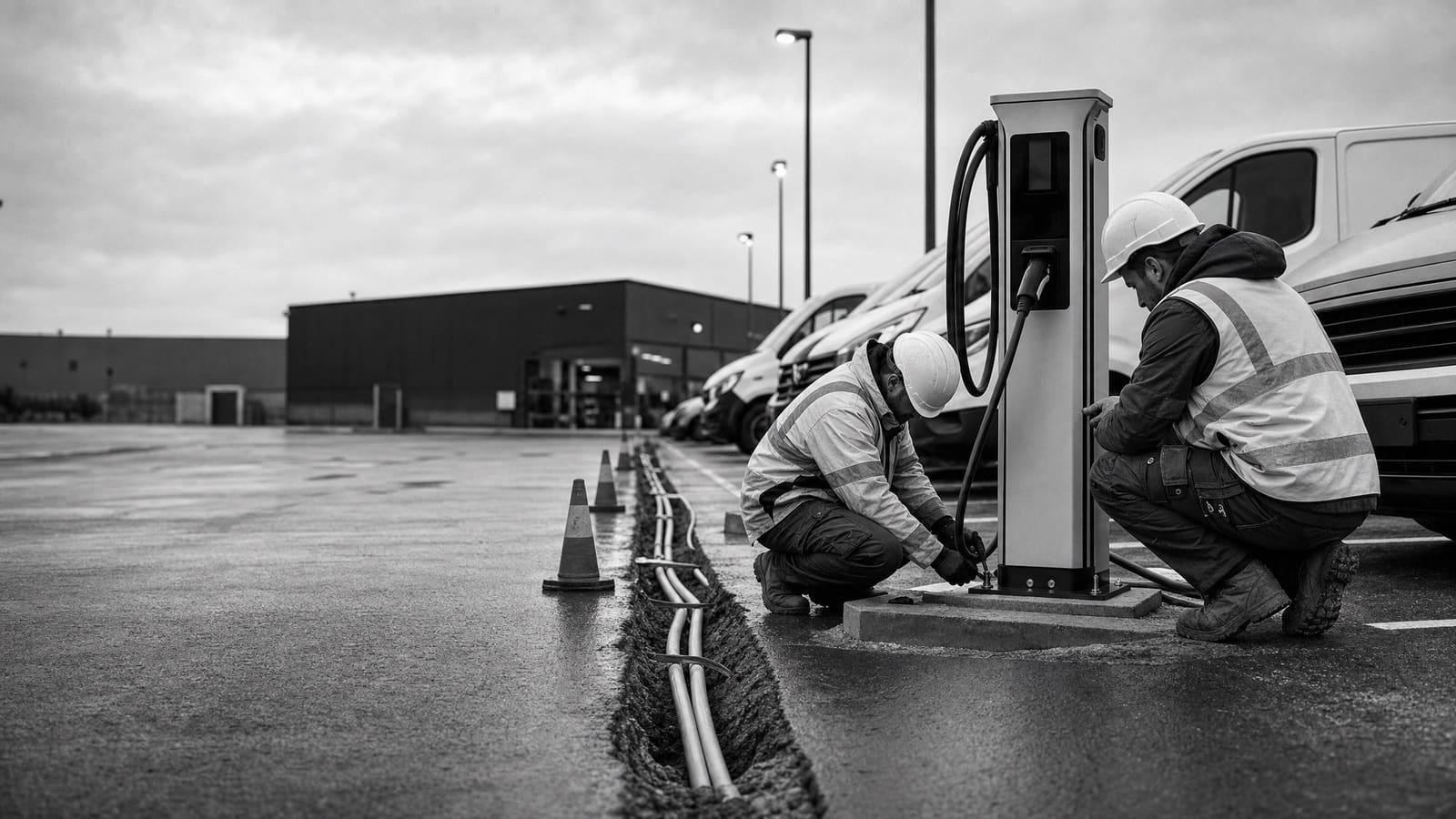
Two projects using similar chargers can require very different work. Existing capacity and the physical route to the stalls often matter more than the equipment count.
Lower complexity
Power and parking are close together
The building has verified capacity, the distribution equipment can accept new circuits, the cable route is short, communications are available, and construction avoids major pavement or service changes.
Higher complexity
The site needs new capacity or long civil routes
Service work, added switchgear, long trenching, difficult surface restoration, DC fast charging, new metering, or major parking changes can add design steps, dependencies, and schedule risk.
Site assessment
Turn the site walk into an installation basis
A useful site review begins at the electrical service and ends at each proposed charging space. The reviewer should record service and distribution details, identify possible connection points, check space for new equipment, and map realistic conduit routes. The review should also note pavement, landscaping, drainage paths, walls, occupied areas, security concerns, wireless coverage, and how construction could affect daily operations.
The operating review is just as important. List the vehicles or driver groups, arrival and departure patterns, expected parking time, required energy, and likely growth. Decide whether charging is public, restricted, assigned, shared, or scheduled. Note whether the owner needs payments, access controls, utilization reports, energy records, or remote alerts.
These findings become the basis for design and pricing. They help the project team estimate electrical demand, compare Level 2 with DC fast charging, discuss utility needs, and reserve practical routes for expansion. If important conditions remain hidden behind locked rooms, incomplete records, or unknown underground paths, the proposal should identify those assumptions instead of presenting them as settled facts.
Ask for assumptions in writing
The site report should identify verified conditions, open questions, owner decisions, utility dependencies, and exclusions. That makes later proposals easier to compare.
Ownership and operation
Decide who owns the work after energization
Commercial charging is an operating system, not just installed hardware. Before purchase, assign responsibility for the chargers, electrical infrastructure, network account, payment account, driver support, software administration, cleaning, inspections, repairs, and warranty claims.
Also decide how performance will be reviewed. Useful records may include station availability, charging sessions, energy use, access failures, payment issues, and recurring faults. The selected network and ownership model should provide the controls the facility team will actually use. If a vendor or third party owns part of the system, the agreement should explain data access, response duties, fees, equipment replacement, and what happens when the term ends.
Owner-operated
More control, more responsibility
The property controls equipment and operating policy but must assign staff or service partners for software, driver issues, maintenance, warranties, and repairs.
Third-party involvement
Clarify every boundary
State who owns each asset, collects revenue, controls data, pays recurring fees, handles outages, replaces failed equipment, and manages the end of the agreement.
Procurement and phasing
Build the first phase around a credible expansion plan
A first phase does not need to serve every future vehicle, but it should avoid blocking the next phase. Ask the designer to show the initial chargers, the expected full buildout, and which infrastructure is sized for each stage. Future-ready work may include reserved electrical space, planned conduit routes, spare pathways, equipment locations, communications capacity, and parking layouts that can grow without undoing completed work.
Do not treat future ports as free capacity. The design must explain how later charging demand would be supplied and managed. That may involve additional distribution equipment, utility coordination, or a charging control strategy. Keep assumptions about future vehicles, dwell time, and simultaneous charging visible.
For procurement, compare the full ownership period rather than the charger purchase alone. Review network subscriptions, payment processing, warranties, parts availability, communications, preventive maintenance, repair response, and software support. If incentives or tax credits may affect the decision, verify current eligibility, location rules, deadlines, documentation, and tax treatment with the responsible program and qualified advisers before relying on them. See commercial EV charging cost factors for a broader budget framework.
Comparable bids
Five items every installation quote should show
Give each bidder the same operating goals and site information. Then require these five items so scope gaps do not hide inside a low total.
01
Defined equipment and performance
List models, ports, power, connectors, mounting, cables, communications, warranties, and included accessories.
02
Complete electrical and civil scope
Show connection points, panels, protection, conduit, conductors, trenching, pads, barriers, restoration, and stated assumptions.
03
Utility, design, permit, and inspection duties
Name who prepares documents, submits applications, pays fees, answers comments, schedules inspections, and closes approvals.
04
Schedule with dependencies
Separate design, review, procurement, utility work, construction, inspection, activation, and owner decision dates.
05
Commissioning and turnover package
Require tested ports, network activation, settings, training, manuals, warranties, final records, support contacts, and unresolved-item tracking.
Keep planning locally
Related EV charging pages in Rancho Cucamonga
Get a defensible number
Price the equipment and the building together.
Send the address, operating target, and target opening date. Flux will identify what must be verified before the project can be priced.
Price my chargersQuestions
Straight answers.
What is included in commercial EV charger installation?
A complete scope normally covers site and electrical assessment, charging strategy, equipment selection, utility coordination, design, permitting, electrical and civil construction, mounting, network activation, inspections, commissioning, training, and turnover records. The proposal should say exactly which party owns every task.
Should our commercial property use Level 2 or DC fast charging?
Base the choice on parking time and the energy vehicles need before departure. Level 2 often fits vehicles parked for hours. DC fast charging can fit short public stops or fleet turnarounds, but it may create a larger electrical, utility, equipment, and civil scope.
How do we know whether the existing electrical service can support chargers?
An electrical assessment must review the service, distribution equipment, connection options, available capacity, existing loads, and planned charging demand. The design team can then compare added capacity, managed charging, phased deployment, or other project approaches. Do not rely on a panel label or a quick visual check alone.
When should the utility become involved?
Utility coordination should begin during planning when the project may affect service, metering, rates, or utility-owned equipment. Early coordination helps identify requirements and dependencies before equipment is ordered or construction dates are promised.
Do commercial chargers need networking?
Not every use case needs the same network features. Networking may support access control, payments, utilization data, energy records, remote settings, and fault alerts. Confirm the required functions, communications method, recurring fees, data access, and support terms before selecting hardware.
What should happen during commissioning?
Each port should be energized, configured, connected where applicable, and tested through a real or suitable test session. Turnover should include operating settings, network access, manuals, warranties, training, support contacts, final project records, and a list of any open items.
How can we prepare for more chargers later?
Document the expected full buildout during the first design. Reserve practical equipment locations and pathways, and explain how later electrical demand will be served. A phased plan should distinguish infrastructure installed now from capacity that still requires future equipment or utility work.
What creates the biggest schedule risk?
Common dependencies include incomplete site information, owner decisions, design review, permits, utility work, equipment availability, underground conditions, inspections, and network activation. A useful schedule names these dependencies and assigns responsibility instead of giving only a construction start date.
Can incentives or tax credits reduce the project cost?
Programs and tax rules are time-sensitive and may depend on location, equipment, labor, ownership, placed-in-service dates, and documentation. Verify current eligibility with the responsible program and qualified tax advisers before including any benefit in the approved budget.
How should we compare commercial EV charger proposals?
Compare equipment, verified site assumptions, electrical and civil work, utility responsibilities, permits, exclusions, schedule dependencies, recurring fees, warranties, commissioning, training, and maintenance. Normalize those items before comparing totals. A lower quote may simply leave important work with the owner.
Sources used for this guide
- [1]afdc.energy.gov — Alternative Fuels Data Center: Procurement and Installation for Electric Vehicle Charging Infrastructure
- [2]betterbuildingssolutioncenter.energy.gov — DOE Better Buildings Commercial EV Charging Infrastructure Guide
- [3]driveelectric.gov — Public electric vehicle charging infrastructure playbook · Joint Office of Energy and Transportation
- [4]energy.gov — DOE Federal Workplace Charging Program Guide