Direct answer
What commercial EV charger installation includes
A complete commercial installation starts with vehicle needs, parking time, electrical capacity, and charger placement. It then covers equipment selection, utility coordination, design, permits, construction, charger mounting, network setup, inspections, testing, and turnover. Level 2 often serves vehicles parked for hours. DC fast charging changes the plan because it can require larger electrical equipment and more utility involvement.
The site review must verify available power, charging demand, cable routes, parking access, communications, drainage conflicts, and room for later expansion.
Operating plan
Make three choices before selecting hardware
Start with the job the chargers must do. Workplace drivers may stay parked for much of a shift. Fleet vehicles may return in groups and need to leave at set times. Public users may expect simple access, visible instructions, and payment options. Those patterns determine how many ports you need, how quickly each vehicle must charge, and whether power can be shared.
Next, decide who may charge and who pays. A private employee or fleet system can use access controls without public payment. A visitor-facing system may need networking, pricing rules, transaction records, and support for drivers. These features affect equipment, communications, and recurring fees.
Finally, set a realistic expansion plan. Installing every charger now is not always necessary. The first phase can include electrical capacity, conduit, panels, or space for later ports. The design should separate what must be built now from what can be added when use grows.
Project budget
What belongs in the installation budget
The charger price is only one part of the project. Compare the full installed scope, including construction, approvals, startup, and ongoing operation.
Equipment choice
Level 2 and DC fast charging solve different problems
Level 2 charging uses AC power, while the vehicle converts that power for its battery. It is a practical starting point when cars remain parked long enough to recover the energy they need. Common commercial uses include employee, resident, visitor, and overnight fleet charging. A network can also share available power among several ports, record use, control access, and support payment when those functions are needed.
A DC fast charger performs the AC-to-DC conversion outside the vehicle. It is designed for shorter stops or vehicles that must return to service quickly. That faster operating goal can bring a larger electrical load, added power equipment, greater cooling needs, and more utility coordination. It should be chosen because the operating schedule requires it, not simply because it is faster.
Connector support, vehicle compatibility, cable reach, output, warranty terms, communications, and service access should all be checked before ordering. The best charger is the one that fits the vehicles, parking pattern, electrical design, and operating policy as one system. Hardware selected too early can force an expensive redesign or leave drivers with features they cannot use.
Project complexity
What makes one installation simpler than another
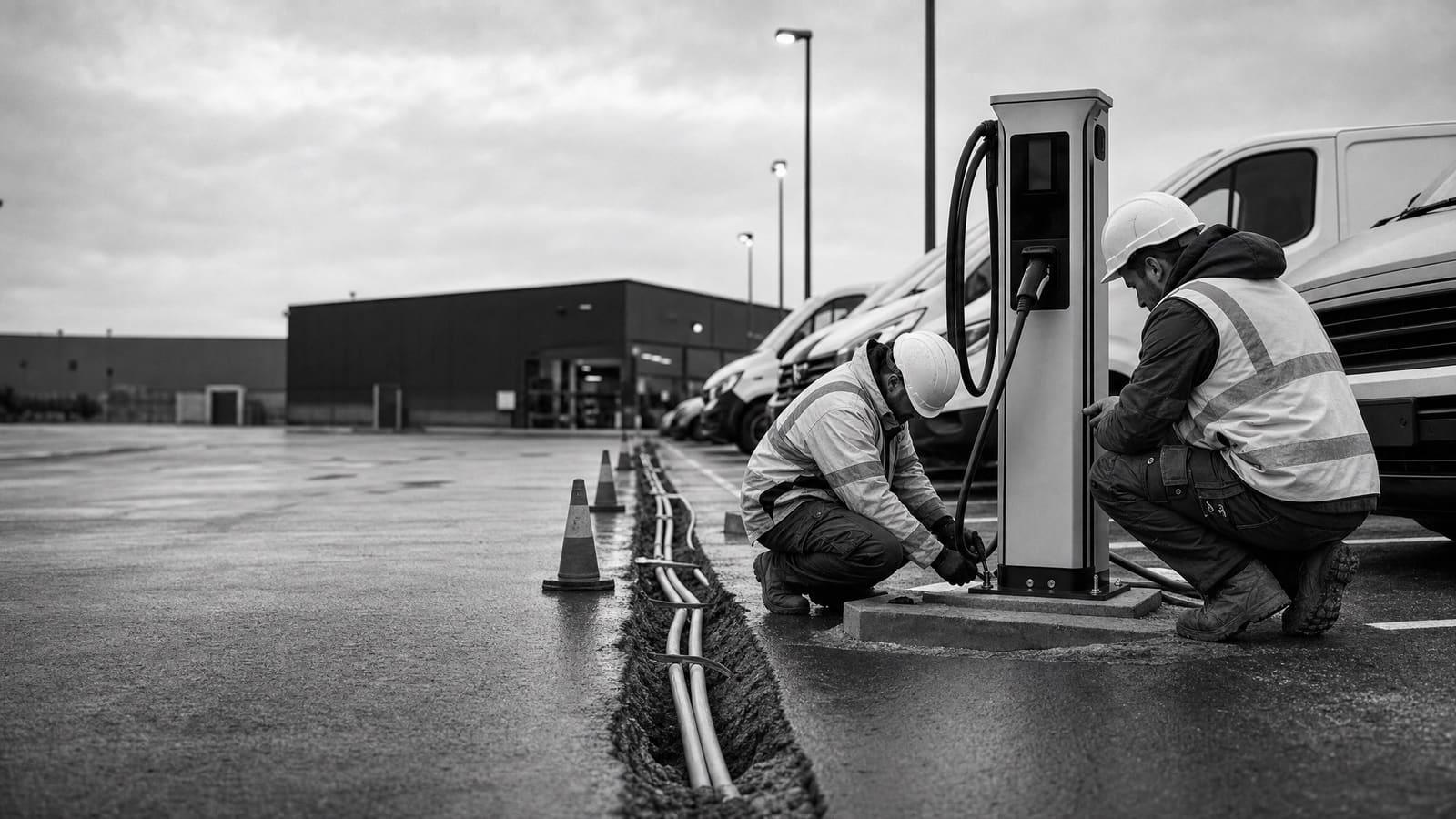
Two sites using similar chargers can require very different work. The key difference is usually the electrical and physical path needed to serve the parking spaces.
Lower complexity
Capacity and parking are already aligned
The electrical system has usable capacity, chargers sit near distribution equipment, routing is open, communications are available, and the first phase does not disturb large paved areas.
Higher complexity
The site needs new supporting infrastructure
The plan requires service changes, long underground routes, pavement restoration, new distribution equipment, DC fast charging, difficult shutdowns, or phased work around daily operations.
Site assessment
Build the scope from field conditions
A useful site review connects the charging goal to the real building. The team should document the service, meters, main distribution, panel capacity, equipment condition, and possible connection points. It should also trace workable routes to the proposed spaces and note pavement, landscaping, walls, occupied areas, security zones, and other obstacles.
The parking review matters just as much. Charger locations should support cable reach, safe movement, signage, vehicle circulation, and future ports. The team should also identify where bollards, wheel stops, equipment pads, or protective measures may be needed. Networked chargers need a dependable communication plan rather than an assumption that a signal will be available at the curb.
The assessment should end with decisions, not just photos. It should identify the preferred charger area, proposed electrical source, likely civil work, open questions, and items that need confirmation from the utility or permitting authority. If existing capacity is limited, the next step is to compare load management, phased charging, operating schedules, and a service upgrade before committing to one path.
Ask for the assumptions
A proposal should state the assumed charger load, simultaneous use, route length, surface restoration, available capacity, communications method, utility work, and excluded conditions.
Ownership and operation
Decide who controls the chargers after turnover
Commercial charging is an operating service, even when it is offered only to employees or fleet drivers. Before procurement, assign responsibility for pricing, access, driver support, software accounts, energy reporting, inspections, cleaning, cable care, fault alerts, warranty claims, and repairs.
Ownership can also change the proposal. The facility may buy the equipment and contract separately for networking and maintenance. Another arrangement may bundle equipment, software, or service. Compare the full term, data access, support duties, replacement rights, and exit conditions. A low first invoice can become restrictive if the owner cannot change networks, obtain service, or keep useful charging records.
Facility-owned
More control, more assigned duties
The owner selects equipment and operating vendors but must define who manages accounts, faults, warranties, fees, software, and replacement decisions.
Bundled service
Simpler administration, added contract terms
Review recurring charges, service levels, data rights, hardware ownership, network dependence, renewal terms, and what happens when the agreement ends.
Procurement and phasing
Buy the system in the right order
Define the charging need before issuing a request for equipment. The procurement package should describe vehicles, arrival and departure patterns, parking control, user groups, payment needs, uptime goals, available site information, and planned growth. This gives bidders the same problem to solve and makes their proposals easier to compare.
Do not place a large equipment order while utility requirements, connection capacity, or the construction route remain uncertain. Confirm lead times and logistics, but tie purchasing decisions to a design that can actually be built. If substitutions are allowed, require the replacement to meet the same electrical, connector, network, mounting, warranty, and service needs.
Phasing can protect cash and reduce disruption. A first phase may install active ports plus selected make-ready elements for later growth. Those future elements should follow a written expansion plan. Empty conduit without a known route, capacity allowance, pull strategy, or endpoint may offer little value. Compare initial construction with the full commercial EV charging cost, including software, energy management, maintenance, repairs, and later expansion. The right plan limits repeat excavation while avoiding hardware that sits unused.
Quote comparison
Five things every comparable quote should show
Require each bidder to organize the proposal around the same five items. If one is missing, the apparent total may not represent a complete, working installation.
01
Defined basis of design
List vehicles, use pattern, charger quantity, output, connectors, networking, access rules, and expansion assumptions.
02
Complete electrical and civil scope
Show connection point, panels, protection, conduit, trenching, pads, mounting, restoration, signage, and equipment protection.
03
Approval and utility responsibilities
Assign drawings, permit submissions, corrections, inspections, utility applications, fees, and required owner information.
04
Startup and acceptance plan
Include network activation, test sessions, fault checks, account setup, training, documentation, and final acceptance.
05
Exclusions and lifecycle terms
State allowances, unknown conditions, recurring fees, warranties, maintenance options, response duties, and change-order rules.
Keep planning locally
Related EV charging pages in Queen Creek
Get a defensible number
Price the equipment and the building together.
Send the address, operating target, and target opening date. Flux will identify what must be verified before the project can be priced.
Price my chargersQuestions
Straight answers.
How does a commercial EV charger installation project begin?
It begins with the charging goal and a site assessment. The installer should review vehicles, parking time, user access, electrical capacity, metering, equipment locations, cable routes, communications, and growth plans. That information supports the design, utility discussion, permit scope, construction plan, and equipment choice.
Should our Queen Creek property use Level 2 or DC fast chargers?
Choose from the operating need. Level 2 usually fits vehicles that remain parked for hours, such as employee cars or overnight fleet vehicles. DC fast charging fits shorter stops or tight fleet turnaround. It can also require a larger electrical and utility scope, so faster equipment is not automatically the better investment.
Can load management avoid an electrical service upgrade?
It may help, but the answer depends on measured or calculated building demand, charger loads, vehicle schedules, and the existing distribution system. Load management can limit or share power among ports. The design team should compare that approach with reduced charger output, scheduled charging, phasing, and a service upgrade.
What permits or utility approvals will the project need?
Requirements must be confirmed for the specific property and design. A complete proposal should identify who prepares drawings, submits permit documents, answers review comments, schedules inspections, coordinates with the electric utility, and supplies any information required from the property owner.
When should chargers be ordered?
Order after the basis of design, electrical connection, site route, utility needs, and required features are sufficiently defined. Lead times should be checked earlier, but buying hardware before the installation path is known can create storage costs, substitutions, redesign, or equipment that does not fit the finished system.
What happens during commissioning?
Commissioning confirms that each port is installed, energized, configured, and able to complete a charging session. It should also cover network activation, access or payment rules, fault reporting, labels, staff training, warranty records, approved drawings, equipment manuals, and a clear process for reporting problems.
How can we compare commercial EV charging bids fairly?
Give every bidder the same vehicle, parking, access, payment, uptime, and expansion requirements. Then compare equipment, electrical work, civil work, approvals, utility coordination, commissioning, exclusions, recurring fees, warranties, and maintenance. A bid that omits trenching, networking, restoration, or startup is not directly comparable.
Should we install infrastructure for future chargers now?
Consider it when future demand is credible and the added work avoids reopening the same route later. The plan should identify future port locations, electrical capacity, conduit endpoints, panel space, communications, and the trigger for expansion. Make-ready work is useful only when it supports a defined later phase.
Sources used for this guide
- [1]afdc.energy.gov — Alternative Fuels Data Center: Procurement and Installation for Electric Vehicle Charging Infrastructure
- [2]betterbuildingssolutioncenter.energy.gov — DOE Better Buildings Commercial EV Charging Infrastructure Guide
- [3]driveelectric.gov — Public electric vehicle charging infrastructure playbook · Joint Office of Energy and Transportation
- [4]energy.gov — DOE Federal Workplace Charging Program Guide