The direct answer
Commercial EV charger installation in Pueblo.
A complete commercial installation covers the site and electrical assessment, charger selection, utility coordination, design, permitting, construction, inspection, network setup, testing, and turnover. Level 2 charging often connects through commercial panels for vehicles parked for hours. DC fast charging brings greater power needs and may require larger electrical equipment, service work, and deeper utility involvement.
The site review must verify usable capacity, power-to-parking distance, charger duty, communications, accessibility needs, and a practical path for expansion.
Choose the operating model
Start with vehicles and parking time, not charger labels
The right installation begins with a clear operating goal. Ask who will charge, how long each vehicle stays, how much energy it must receive, and when it must leave. A workplace can often spread charging across a long parking window. A fleet may need charging assigned by route and departure time. A public site may need payment, driver support, and faster turnover.
These answers shape the charger type, port count, electrical load, software, and parking design. They also prevent a common buying mistake: selecting powerful equipment before checking whether the site can support it or whether drivers need that speed. Plan the first phase around real use, then preserve a sensible route for later growth.
Build a complete budget
The charger is only one part of the quote
A useful budget separates equipment from the work needed to deliver safe, usable power at each space. These lines should be visible instead of buried in one allowance.
Equipment choice
Level 2 and DC fast charging create different projects
Level 2 equipment sends AC power to the vehicle, where onboard hardware converts it for the battery. Commercial units commonly connect to an electrical subpanel. This approach often fits workplaces, multifamily properties, and other sites where vehicles remain parked for meaningful periods. The design still needs dedicated circuits, safe cable reach, suitable mounting, communications where required, and a plan for sharing available capacity.
DC fast equipment performs power conversion outside the vehicle. It can support shorter charging stops, but the charger is only the visible part of a larger power system. The design may involve more substantial distribution equipment, cooling, switchgear, service changes, and utility coordination. Higher equipment output also does not guarantee that every vehicle will receive that full rate; charging depends on the vehicle and battery condition.
Do not compare the two choices by speed alone. Compare the energy each vehicle needs with the time it will remain connected. A slower station used through a long dwell period may meet the goal cleanly. Faster equipment earns its added complexity when vehicle turnover or route timing truly requires it.
Complexity check
What makes one installation simpler than another?
Two projects using similar chargers can require very different work. The dividing line is usually the fit between the existing electrical system, the parking layout, and the intended charging load.
Lower complexity
Power and parking already align
Usable capacity is confirmed, charging spaces sit near distribution equipment, routing is open, communications are available, and the first phase leaves a clear expansion path.
Higher complexity
The site needs new infrastructure
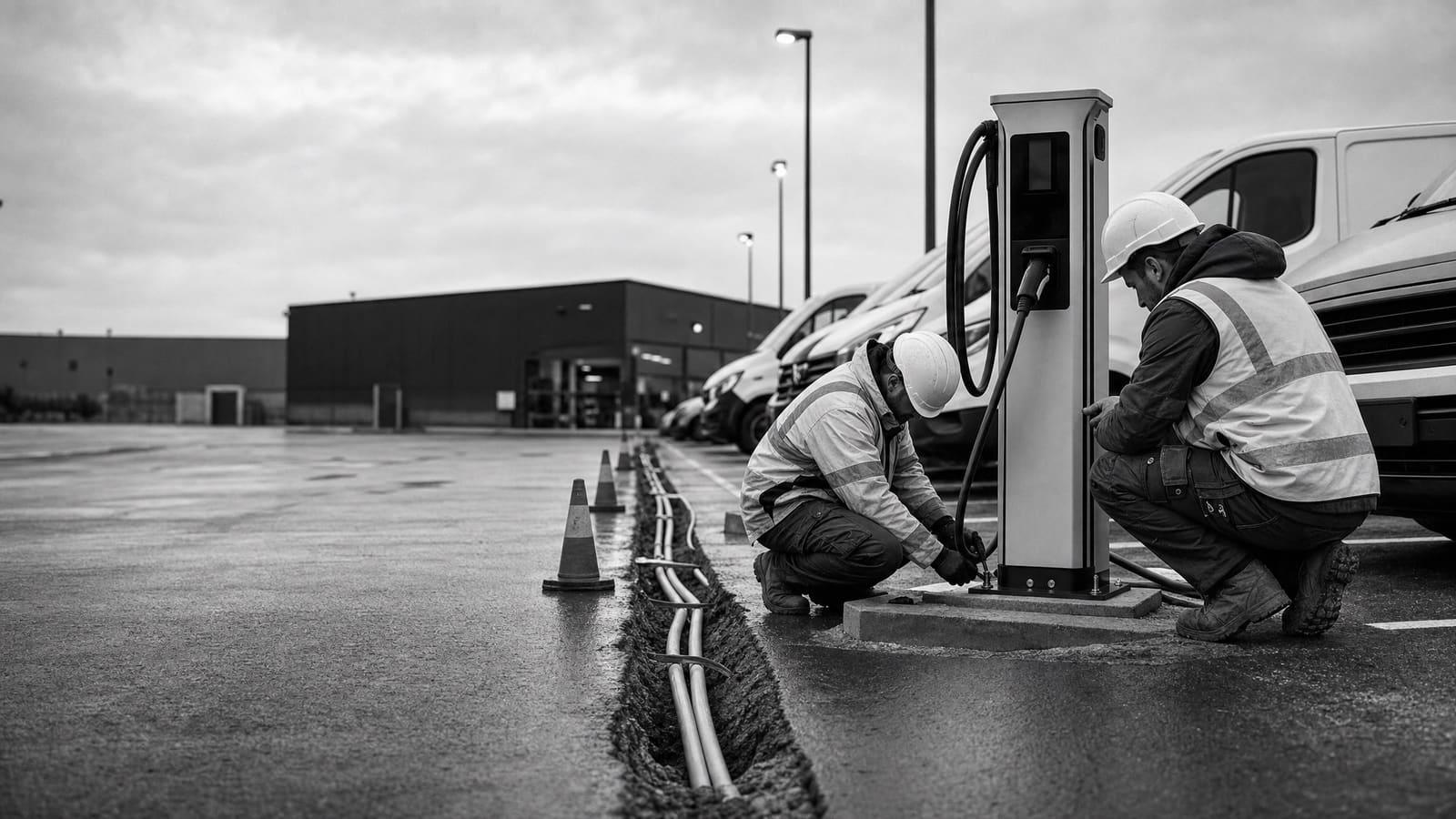
Long underground routes, pavement restoration, limited capacity, added electrical equipment, multiple meters, or high-power charging create more design, coordination, and schedule exposure.
Site assessment
Turn the walk-through into an installation plan
A commercial site review should follow the full path from incoming power to the charging spaces. At the electrical equipment, document service information, panels, breakers, metering, physical space, and known building loads. A qualified electrical professional can then determine what capacity is actually available and what further study is needed.
In the parking area, mark proposed spaces, mounting points, cable reach, traffic movement, and the route for conduit. Note where trenching, boring, wall penetrations, concrete work, or pavement restoration may be needed. Check whether networked chargers can obtain a reliable communications connection. Include signage, lighting, security, and accessible use in the layout discussion rather than treating them as late additions.
The assessment should also record the desired port count now and later. That allows the designer to compare a complete build with a phased plan. Installing spare conduit or reserving distribution space may reduce disruption during a later phase, but those choices should be priced openly. The result should be a written basis of design, not just a charger recommendation.
Ask for an assumptions log
The proposal should identify verified conditions, items still awaiting confirmation, owner responsibilities, utility dependencies, allowances, exclusions, and the decisions that could change price or schedule.
Operations after turnover
Decide who controls charging and who keeps it working
Installation decisions continue after the stations are energized. Networked equipment can support access rules, payment, usage data, and managed charging, but it can also bring communications needs and recurring fees. Simple equipment may reduce software duties while offering less control.
Ownership matters too. The facility may buy the equipment and manage operations, or another party may own or operate parts of the system. Put responsibilities in writing before procurement. The agreement should address accounts, pricing policy, driver support, software administration, warranty claims, repairs, data access, and responsibility for electrical infrastructure. These choices affect both the initial scope and the long-term workload for facility staff.
Access and data
Networked or simple
Choose networking when the facility needs payment, user controls, utilization records, remote visibility, or coordinated power. Confirm fees and communications before purchase.
Responsibility
Owner-operated or managed
Name the party responsible for station administration, driver questions, warranty work, maintenance, repairs, software, and recurring service costs.
Phasing and procurement
Build for the first phase without blocking the next one
A phased project can control initial spending, but only if the first design considers future demand. Estimate near-term use from the vehicles, users, and schedules you can identify. Then show where later chargers could sit, how conductors would reach them, and whether panels, conduit, communications, and service equipment can support expansion. Future capacity should be an engineered choice, not a vague promise.
For procurement, define performance before naming hardware. State the use case, number of ports, required connector support, mounting style, networking functions, payment needs, warranty, service expectations, and delivery assumptions. If several products can meet the requirements, compare them on the same basis. A low equipment price can lose value if software fees, proprietary service, weak support, or replacement delays raise operating costs.
Review total ownership duties alongside the installation budget. Include network subscriptions, communications, inspections or service visits, replacement parts, support, and staff time where they apply. If you also need a budget framework, see commercial EV charging cost factors. Treat grants, incentives, and tax credits as separate, time-sensitive items that require current eligibility review before they enter the approved budget.
Compare proposals
Five things every comparable quote should show
A proposal is easier to judge when scope, assumptions, and responsibility are explicit. Ask each bidder to answer the same five questions.
01
What equipment and output are included?
List charger models, ports, connectors, mounting, accessories, warranties, software, and recurring fees.
02
What electrical and civil work is included?
Show panels, breakers, conduit, conductors, trenching, concrete, restoration, bollards, signage, and tested route lengths.
03
Who handles coordination and approvals?
Assign design, utility communication, permit documents, submittals, inspections, network activation, and closeout.
04
What can change price or schedule?
Identify allowances, exclusions, lead times, concealed conditions, utility dependencies, and owner-supplied work.
05
How will the system be accepted?
Require energized testing, charging sessions, configuration records, training, warranties, manuals, and final documentation.
Keep planning locally
Related EV charging pages in Pueblo
Get a defensible number
Price the equipment and the building together.
Send the address, operating target, and target opening date. Flux will identify what must be verified before the project can be priced.
Price my chargersQuestions
Straight answers.
What is included in commercial EV charger installation?
A complete scope typically includes site assessment, electrical evaluation, charger and parking design, utility coordination, permit documents, equipment procurement, electrical and civil construction, inspection support, network activation, testing, training, and closeout documents. The proposal should state which party owns every task.
Should a Pueblo commercial property use Level 2 or DC fast charging?
Choose from the vehicle schedule. Level 2 often fits vehicles parked for hours, including workplace and tenant charging. DC fast charging is better considered when short stops or firm fleet turnaround times require more energy quickly. Confirm electrical capacity and utility needs before selecting high-power equipment.
Can existing electrical service support commercial chargers?
Only a load assessment can answer that for the site. The review should examine service and panel information, current building demand, charger load, operating schedule, and future expansion. Managed charging may help coordinate available power, but it should be designed around the facility's real operating limits.
Do commercial EV chargers need networking?
Not always. Networking is useful for payment, access control, usage records, remote monitoring, and coordinated charging. It also requires compatible equipment, communications, administration, and often recurring fees. A private fleet or controlled workplace may have different needs from a public charging site.
When should the utility become involved?
Bring the utility into planning when the project may affect service capacity, metering, rates, or utility-owned equipment. Higher-power and expanding projects can require more coordination. Do not order equipment on the assumption that needed power will be available by the desired opening date.
How should incentives be handled in the project budget?
Treat every incentive and tax credit as time-sensitive. Verify the site, equipment, applicant, labor, filing, and placed-in-service requirements against current program rules before relying on funds. Keep the base project scope visible so the installation decision remains clear if eligibility or timing changes.
What should happen during commissioning?
Commissioning should confirm that each port energizes and completes a charging session, network and access settings work, labels and signage are installed, and responsible staff receive instructions. Turnover should include manuals, warranties, configuration records, inspection closeout, and service contacts.
Sources used for this guide
- [1]afdc.energy.gov — Alternative Fuels Data Center: Procurement and Installation for Electric Vehicle Charging Infrastructure
- [2]betterbuildingssolutioncenter.energy.gov — DOE Better Buildings Commercial EV Charging Infrastructure Guide
- [3]driveelectric.gov — Public electric vehicle charging infrastructure playbook · Joint Office of Energy and Transportation
- [4]energy.gov — DOE Federal Workplace Charging Program Guide