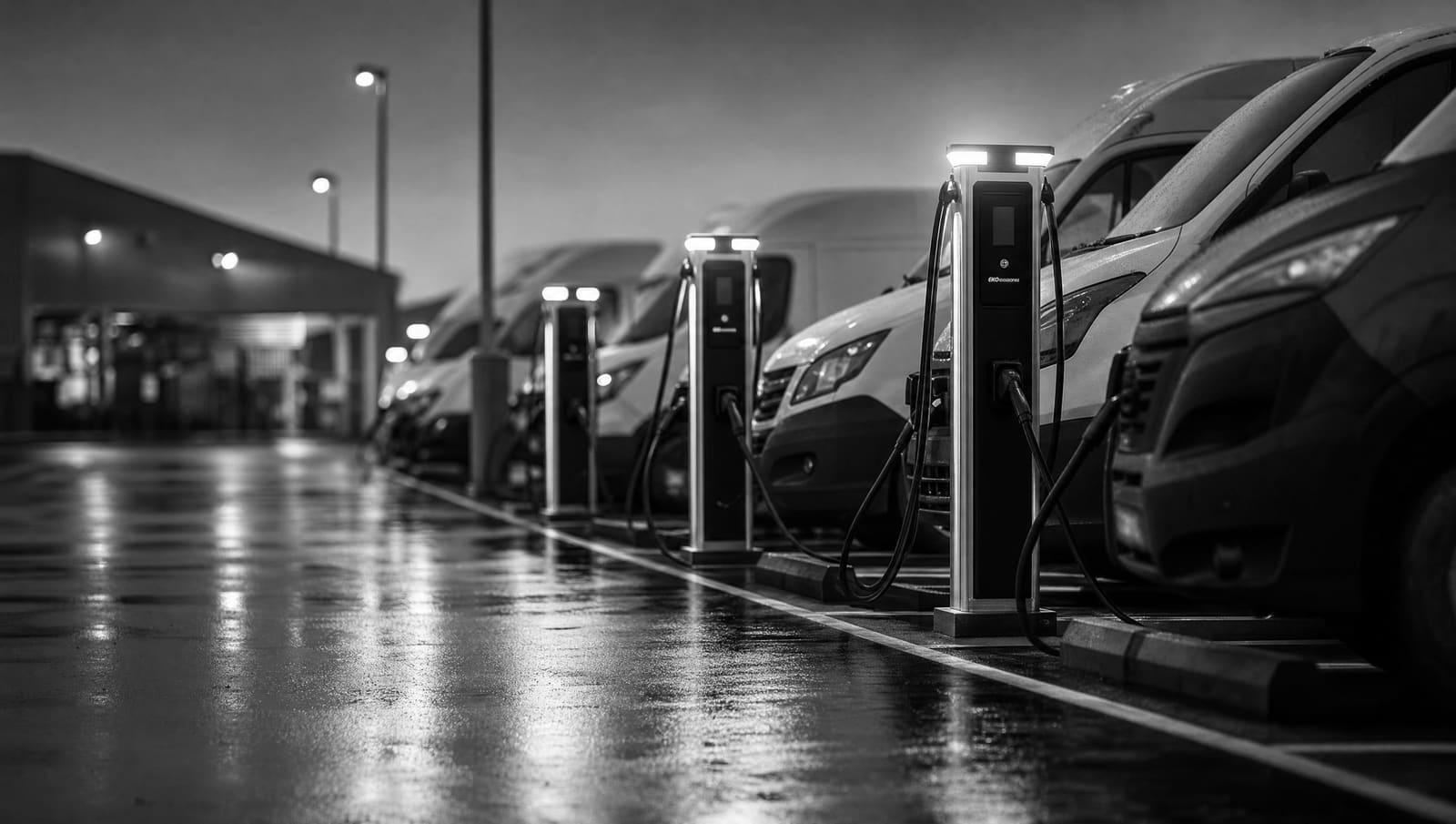
A complete installation
Commercial EV charger installation in Lee'S Summit.
Commercial EV charger installation starts with a site and electrical assessment. It then covers charger selection, utility coordination, design, permitting, construction, network setup, testing, and turnover. Level 2 charging often serves vehicles parked for hours. DC fast charging supports shorter stops but can require a much larger electrical and utility scope.
A site review must verify electrical capacity, equipment locations, cable reach, parking use, communications, accessibility needs, and the path from power to each charging space.
Start with operations
Make three choices before selecting a charger
A charger should fit the way vehicles use the property. Begin with who will charge, how long each vehicle stays, and how the stations will be managed. Workplace drivers may have hours to charge. Fleet vehicles may return together and need enough energy before their next route. Public drivers may expect a short, simple session and clear payment rules.
These answers shape the charger type, port count, power level, network features, and electrical design. They also help prevent two costly errors: buying more charging speed than the operation needs or installing too little infrastructure for the next phase. Define the operating plan first, then ask vendors to quote the same result.
Scope before price
The budget lines a serious proposal should separate
Equipment is only one part of an installation. Ask for a clear breakdown so you can see which site conditions create risk and whether competing proposals include the same work.
Choose the right equipment
Level 2 and DC fast charging solve different problems
Level 2 equipment supplies AC power to the vehicle, where onboard hardware converts it for the battery. It is commonly considered for workplaces and other properties where vehicles remain parked. Several ports may share available capacity through network controls, which can help a facility serve more spaces without allowing every charger to draw its maximum power at once.
DC fast charging performs the conversion outside the vehicle. It can serve public charging or commercial fleets that need faster turnover, but it changes the project around it. The design may need more service capacity, larger conductors, substantial switchgear, utility coordination, equipment pads, cooling clearance, and stronger protection from vehicle traffic. The electrical demand can also affect operating costs.
Do not compare the two choices only by advertised charging speed. Ask how much energy each vehicle needs, how long it remains parked, how many vehicles may connect together, and when they must leave. A slower port used for several hours can be a better operating fit than a faster unit that raises construction and demand requirements. Connector compatibility, cable reach, network support, warranty service, and replacement planning also belong in the equipment decision.

Complexity check
What makes an installation straightforward or demanding
The charger count alone does not reveal project difficulty. Power availability, routing, civil work, communications, and utility involvement usually explain why two projects with similar equipment can have very different scopes.
Lower complexity
Existing capacity and a short power route
A project is simpler when suitable distribution is nearby, conduit routing is direct, communications are reliable, and the work avoids major pavement cuts or service changes.
Higher complexity
New capacity, long routes, or fast charging
Service changes, extensive trenching, new switchgear, equipment pads, utility work, multiple construction phases, or DC fast chargers add coordination and schedule risk.
Site review
Inspect the electrical room and parking field together
A useful assessment follows the entire path from incoming service to the charging connector. In the electrical room, review service information, panels, breakers, distribution equipment, metering, and the loads already serving the building. The goal is to understand what capacity may be available and what further engineering or utility review is needed.
Outside, confirm where vehicles can park, how charging cables will reach them, and how conduit can travel between the building and the stations. Note pavement, landscaped areas, curbs, drainage features, traffic paths, equipment clearances, lighting, signage, security, and locations where chargers could be struck. Networked stations also need a dependable communication plan.
The review should cover both the first installation and likely expansion. Spare conduit, reserved panel space, or a larger pathway may be worth considering during initial construction. That does not mean buying every future charger now. It means avoiding needless demolition when demand grows. Findings should become a written basis of design that every bidder can use.
Bring operating data to the walkthrough
Share vehicle types, arrival and departure times, daily energy needs, parking rules, expected users, growth plans, and any need for payment or utilization reports.
Ownership and operation
Decide who controls the stations after turnover
Commercial charging continues to create work after construction ends. Someone must manage driver access, pricing or reimbursement, station data, software accounts, support calls, maintenance, and damaged equipment. These duties can stay with the property owner or be shared with a charging provider, but the contract should make the division clear.
Networked charging can support access controls, payment, monitoring, and utilization data. It can also add recurring fees and dependence on software services. Simpler equipment may reduce those obligations but provide less control. Select the operating model with the hardware, not after installation.
Owner controlled
Keep policy and service decisions in-house
Confirm who monitors faults, answers drivers, approves repairs, manages software, and keeps station information current.
Provider supported
Define every included service
Review fees, response expectations, data access, payment handling, warranty support, software terms, and what happens if the service changes.
Procure the full outcome
Compare lifetime obligations, not just charger prices
A low equipment price does not prove that a proposal has the lowest project cost. Confirm whether the quote includes design, approvals, utility coordination, distribution equipment, trenching, pavement repair, protection, networking, activation, testing, training, warranties, and closeout documents. Exclusions should be specific enough that you can price or assign them before signing.
Plan phasing around parking and business operations. The proposal should show which spaces will close, where equipment will be staged, how pedestrians and vehicles will move safely, and whether electrical shutdowns are expected. Long-lead electrical or charging equipment should be identified before the construction date is promised.
Look beyond installation day. Consider software subscriptions, payment processing, electricity use, maintenance, replacement parts, warranty administration, and the staff time needed to operate the program. If you are building in stages, define the trigger for adding ports, such as sustained use or a fleet expansion. For a broader breakdown of project cost categories, review commercial EV charging costs. Any incentive or tax-credit assumption should be verified for the property, equipment, labor rules, eligibility date, and current program terms before it enters the budget.
Quote checklist
Five items every comparable installation quote should show
Give each bidder the same operating goals and site information. Then require these five items in writing so differences in scope do not hide behind one total.
01
Defined charger schedule
List models, power, ports, connectors, mounting, cables, network features, and accessories.
02
Complete electrical and civil scope
Show panels, breakers, conductors, conduit, trenching, pads, protection, restoration, and excluded work.
03
Approval and utility responsibilities
Assign design, submittals, permits, inspections, utility coordination, fees, and required owner documents.
04
Milestones and dependencies
State equipment lead times, approvals, shutdowns, construction phases, commissioning, and causes of schedule change.
05
Turnover and operating terms
Include testing, training, warranties, manuals, software fees, support, maintenance, and expansion provisions.
Keep planning locally
Related EV charging pages in Lee S Summit
Get a defensible number
Price the equipment and the building together.
Send the address, operating target, and target opening date. Flux will identify what must be verified before the project can be priced.
Price my chargersQuestions
Straight answers.
What does commercial EV charger installation include?
A complete scope can include the site assessment, load review, equipment plan, engineering, utility coordination, permits, electrical and civil construction, charger mounting, network activation, inspections, test sessions, training, and closeout documents. The proposal should clearly assign every task and fee.
Should our business install Level 2 or DC fast chargers?
Choose from the vehicle schedule, not speed alone. Level 2 often fits vehicles parked for hours. DC fast charging can fit short stops or fleet turnover, but it may require a larger electrical and utility scope. Daily energy needs and simultaneous use should guide the final design.
Can our existing electrical service support EV charging?
That requires a site-specific load assessment. Review existing distribution, current building loads, proposed charger demand, and future phases. Managed charging may control how much power multiple stations use together, but its suitability must be confirmed in the design.
When should the utility become involved?
Involve the utility during planning when the project may affect service capacity, metering, rates, or utility-owned equipment. Early coordination is especially important for higher-power charging. Do not order major equipment based on an assumed utility solution.
Do commercial chargers need networking?
Not always. Networking is useful when the owner needs access controls, payments, usage data, remote monitoring, or managed charging. It can also create recurring costs. A private fleet with separate operating controls may value different features than a public charging site.
How should we plan for more chargers later?
Set a buildout concept during the first design. Consider future port locations, conduit paths, distribution space, communications, and the expected total load. You can prepare selected infrastructure now without buying all future charging equipment at once.
What should happen during commissioning?
Each port should be energized, configured, and tested with a charging session. Confirm network communication, access rules, payment functions when used, labeling, emergency information, and fault reporting. Turnover should include manuals, warranties, account access, and final project records.
Are incentives or tax credits available for a Lee's Summit project?
Programs and eligibility rules are time-sensitive and can depend on the exact property, equipment, location, labor requirements, and installation date. Verify current terms with the administering authority and a tax professional before treating any incentive or credit as committed funding.
Sources used for this guide
- [1]afdc.energy.gov — Alternative Fuels Data Center: Procurement and Installation for Electric Vehicle Charging Infrastructure
- [2]betterbuildingssolutioncenter.energy.gov — DOE Better Buildings Commercial EV Charging Infrastructure Guide
- [3]driveelectric.gov — Public electric vehicle charging infrastructure playbook · Joint Office of Energy and Transportation
- [4]energy.gov — DOE Federal Workplace Charging Program Guide