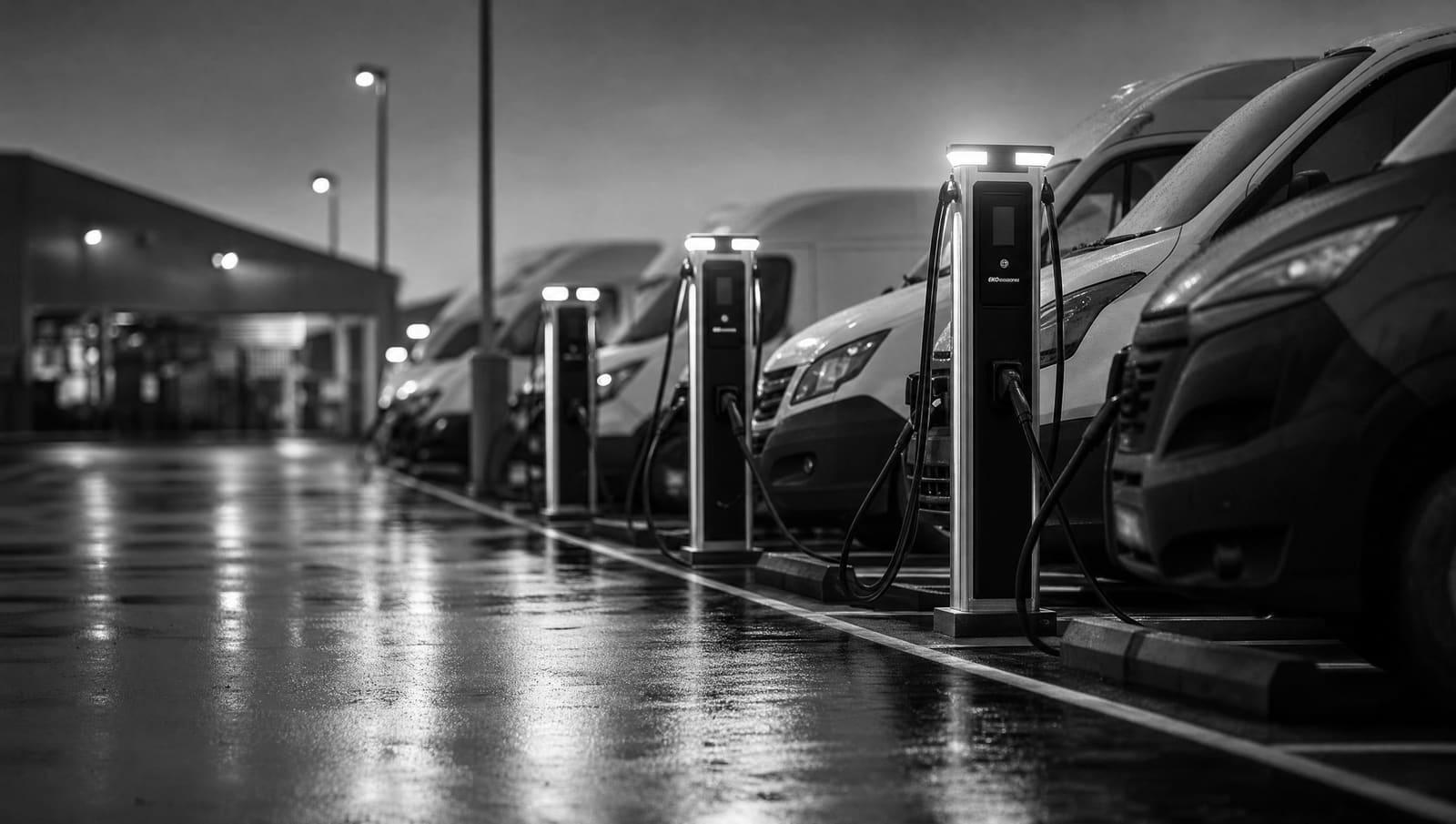
Direct answer
Commercial EV charger installation in Greenville.
A commercial installation starts with a site and electrical assessment. It then moves through charger selection, utility coordination, design, permitting, construction, equipment setup, inspection, commissioning, and turnover. Level 2 charging often connects through building distribution equipment. DC fast charging can require larger service, switchgear, transformers, and closer utility involvement.
The site review must verify vehicle needs, dwell time, available electrical capacity, cable routes, parking access, communications, and room for expansion.
Operating plan
Make three choices before selecting hardware
Start with the vehicles and how the property will use charging. Employees who park for several hours have a different need than fleet vehicles that must return to service quickly. Public charging adds another layer because drivers may need payment, clear access rules, reliable networking, and visible instructions.
Next, decide how many vehicles need energy at the same time. The answer may not equal the number of charging ports. Network controls can share available power across several stations, but the operating plan must still deliver enough energy before each vehicle leaves.
Finally, define who owns daily operation. Someone must manage access, pricing or reimbursement, station data, support calls, software accounts, maintenance, and repairs. These choices affect the electrical design and the equipment specification, so they belong in the project scope before bids are compared.
Project scope
The budget is larger than the charger
A useful budget separates equipment from the electrical and civil work needed to energize it. Ask bidders to show these lines instead of giving one unexplained total. For broader planning guidance, review commercial EV charging cost.
Equipment choice
Level 2 and DC fast charging solve different jobs
Level 2 equipment sends AC power to the vehicle, where onboard equipment converts it for the battery. It is often a practical fit when vehicles remain parked for hours. Common examples include employee parking, overnight fleet parking, and destinations with longer visits. The installation still requires a load review, dedicated electrical work, safe mounting, cable reach, and a plan for access and networking.
DC fast equipment converts power outside the vehicle and delivers DC power to the battery. It supports shorter stops or faster fleet turnaround, but the supporting infrastructure can be much larger. The project may involve substantial distribution equipment, cooling needs, utility work, and a carefully planned equipment area. Charger output alone does not prove that a site or vehicle can use the full rating.
Do not begin by asking which charger is fastest. Begin with daily miles, arrival charge, dwell time, departure time, vehicle compatibility, and simultaneous demand. Then choose the system that meets the operating need without adding unused capacity.

Complexity check
What makes one installation simpler than another?
The same number of ports can produce very different projects. Existing electrical capacity, the route to parking, charging power, communications, and future plans determine how much work sits behind the equipment.
Lower complexity
Capacity and parking align
The building has usable electrical capacity, charging spaces sit near distribution equipment, conduit routes are accessible, communications are available, and Level 2 power meets the vehicle schedule.
Higher complexity
New infrastructure is needed
The project needs service work, long underground routes, pavement restoration, major distribution equipment, DC fast charging, payment systems, or construction that must be phased around active operations.
Site assessment
A site walk should turn assumptions into a buildable scope
The assessment starts at the electrical service, not at the parking space. The contractor should document service and distribution equipment, available capacity, existing loads, meter location, proposed charging loads, and possible routes for conduit and conductors. Equipment labels, field conditions, and operating records may all help the design team understand what is present.
The parking review should confirm stall use, traffic flow, cable reach, mounting positions, protection from vehicle contact, signs, lighting, security, and access needs. It should also identify where trenching or boring may cross pavement, landscaping, sidewalks, or active work areas. Networked stations need a dependable communications plan rather than an assumption that a nearby signal will work.
The review must also look forward. A facility may install a first phase now while placing conduit, reserving panel space, or sizing parts of the distribution system for later ports. That choice should follow a written expansion plan. Oversizing everything without a plan wastes money, while ignoring expansion can force the owner to disturb the same area twice.
Bring operating data to the walk
Provide vehicle types, daily miles, arrival and departure times, parking maps, planned port count, access rules, and future phases. Better inputs lead to a clearer design.
Control and responsibility
Decide how power and ownership will be managed
Commercial charging becomes part of the facility's electrical and operating system. The owner must decide whether stations run at fixed power or use controls that respond to building limits. Managed charging may help several ports share capacity, but it depends on compatible hardware, software, communications, and a charging schedule that can tolerate changing power levels.
Ownership also changes the buying decision. A facility can own equipment and manage vendors directly, or use a service structure that assigns more work to another party. Either way, the contract should state who holds software accounts, receives data, handles driver support, pays network fees, approves pricing, schedules repairs, and owns the equipment at the end of the term. Review these terms before selecting a charger because software and service choices may limit later options.
Electrical control
Fixed or managed charging
Fixed output is straightforward but reserves more simultaneous load. Managed charging can distribute available power when the vehicle schedule and equipment support it.
Commercial control
Owner-run or service-supported
Compare equipment ownership, software control, data access, payment handling, maintenance duties, recurring fees, contract length, and exit terms.
Procurement
Buy a working charging system, not separate parts
A charger quote is incomplete if it omits the work needed to make the station usable. The proposal should connect design, utility coordination, approvals, equipment delivery, electrical construction, civil restoration, networking, inspection, and commissioning under a clear responsibility chart. If the owner must hire separate parties, the bid should identify every handoff.
Confirm equipment compatibility before purchase. Check the vehicles and connectors the site must support, station power, network features, payment needs, mounting method, cable length, warranty, service access, replacement parts, and software terms. Equipment lead time should be tied to the construction schedule so hardware is not delivered too early or discovered late.
Evaluate lifetime operation as well as installation. Electricity rates, network subscriptions, payment processing, inspection or service visits, repairs, vandalism exposure, and replacement planning may continue after turnover. Incentives or tax credits should be treated as a separate, time-sensitive review. Verify current eligibility, location rules, qualifying costs, deadlines, and tax treatment with the program administrator and qualified advisers before using any benefit in the approved budget.
Bid comparison
Five things every comparable quote should show
Ask each bidder to use the same operating assumptions and show exclusions. A lower total may simply leave work for the owner or another contractor.
01
Defined charging outcome
List vehicle use, port count, station power, access, networking, payment, and expansion assumptions.
02
Complete design responsibility
Identify load calculations, drawings, equipment schedules, utility coordination, permits, inspections, and required professional services.
03
Detailed construction scope
Show panels, switchgear, conduit, conductors, trenching, mounting, protection, signs, restoration, and responsibility boundaries.
04
Activation and acceptance test
Include network setup, test charging, payment testing when used, labeling, training, closeout documents, and warranty start.
05
Schedule, allowances, and exclusions
State milestones, equipment lead times, utility dependencies, shutdowns, owner tasks, allowances, change-order rules, and recurring fees.
Keep planning locally
Related EV charging pages in Greenville
Get a defensible number
Price the equipment and the building together.
Send the address, operating target, and target opening date. Flux will identify what must be verified before the project can be priced.
Price my chargersQuestions
Straight answers.
What is included in commercial EV charger installation?
A complete scope can include site assessment, load review, charger selection, electrical design, utility coordination, permits, equipment procurement, conduit and wiring, trenching, mounting, protection, networking, inspections, commissioning, training, and closeout documents. The quote should state exactly which party owns each task.
Should our Greenville facility install Level 2 or DC fast charging?
Choose from the vehicle schedule. Level 2 is often suitable when vehicles remain parked for hours. DC fast charging may fit short stops or fleet routes that demand quick turnaround, but it can require much larger electrical and utility infrastructure. A load study and charging analysis should confirm the choice.
Can we add chargers without upgrading electrical service?
Possibly. The answer depends on measured or calculated building loads, available distribution capacity, charger power, simultaneous use, and the operating schedule. Managed charging may distribute available power among ports. It does not create capacity, so the design still needs to prove that required charging can be completed safely.
When should the electric utility become involved?
Utility coordination should begin during planning when the proposed load may affect service, metering, rates, transformers, or other utility equipment. Early review helps reveal dependencies before the owner purchases chargers or commits to a construction date.
Do commercial chargers need networking?
Not every station needs a network. Networking can support access control, payment, utilization data, remote status, pricing, and power management. It also introduces communications requirements, software administration, and recurring fees. Choose it for a defined operating purpose.
How should we plan for more charging ports later?
Create a phased plan showing the expected port count, power needs, parking areas, conduit routes, distribution space, and control strategy. Compare the cost of installing selected future-ready infrastructure now with the cost and disruption of reopening finished areas later.
What happens during commissioning?
The project team verifies electrical installation, station configuration, communications, access controls, and payment functions when used. Each port should complete a test session. Turnover should include equipment records, settings, warranties, software access, training, inspection closeout, and a clear process for reporting faults.
Are incentives available for a commercial project?
Programs and tax rules can change, and eligibility may depend on the exact address, project type, equipment, qualifying costs, and completion date. Check current official terms before approval. Treat any expected benefit as conditional until eligibility and documentation requirements are confirmed.
Sources used for this guide
- [1]afdc.energy.gov — Alternative Fuels Data Center: Procurement and Installation for Electric Vehicle Charging Infrastructure
- [2]betterbuildingssolutioncenter.energy.gov — DOE Better Buildings Commercial EV Charging Infrastructure Guide
- [3]driveelectric.gov — Public electric vehicle charging infrastructure playbook · Joint Office of Energy and Transportation
- [4]energy.gov — DOE Federal Workplace Charging Program Guide