The short answer
Commercial EV charger installation in Gainesville.
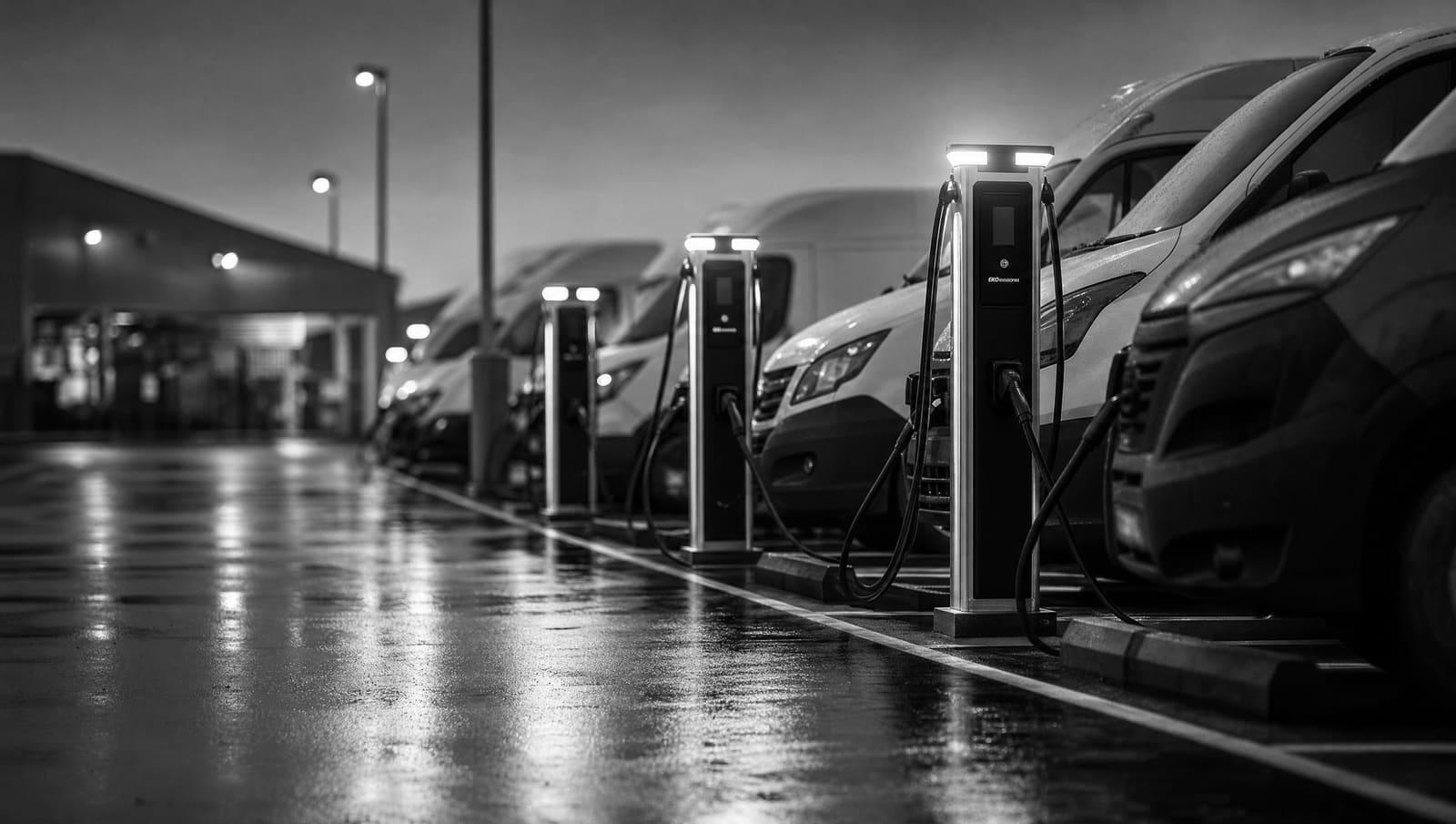
A complete commercial installation covers the site and electrical assessment, charging plan, utility coordination, design, permitting, construction, equipment setup, inspection, commissioning, and turnover. Level 2 charging often connects through the building distribution system. DC fast charging can require much larger service, switchgear, utility, and civil work. The right plan begins with vehicles and parking time, not a charger catalog.
The site review must verify electrical capacity, equipment locations, cable reach, routing, communications, accessibility needs, utility involvement, and room for future stations.
Choose the operating model first
Three choices shape the entire installation
Begin with who will charge, how long each vehicle stays, and what must happen before it leaves. Those answers set the needed charging speed, port count, access rules, and electrical load. A workplace may serve cars parked for hours. A fleet may need every assigned vehicle ready before its next route. A public site may need payment, driver support, clear signs, and reliable communications.
Do not choose charging power by assuming faster is always better. Higher power can change the service, equipment, construction, and utility scope. It may also provide little added value when vehicles remain parked all day. Match the station to the shortest dependable dwell time. Then decide whether power can be shared among ports and whether the first phase should include spare pathways for later growth.
The operating model should be written before design starts. It gives the engineer and installer a clear basis for load calculations, station placement, networking, metering, and commissioning.
Scope before price
What belongs in the installation budget
A useful budget separates the charger from the work needed to deliver power, connect the site, protect the equipment, and keep it operating.
Equipment fit
Level 2 and DC fast charging solve different problems
Level 2 equipment supplies AC power, and the vehicle converts it for the battery. Commercial Level 2 equipment described by the Department of Energy connects at 208 to 240 volts and may range from 5 to 19.2 kilowatts. It is often a strong fit when vehicles remain parked for hours. The installation may use wall-mounted or pedestal equipment, dedicated circuits, local panels, and network controls that share available power.
DC fast equipment performs power conversion outside the vehicle. That changes far more than the charging session. The design may need larger conductors, major distribution equipment, cooling, protective systems, concrete equipment areas, and closer utility coordination. It fits a use case where faster vehicle turnaround creates real operating value.
Connector support, vehicle limits, and software compatibility also matter. A station's rated output does not guarantee that every vehicle will accept that full power. Ask vendors to show compatibility with the vehicles expected on site and explain how adapters or changing connector standards will be handled. For either charging type, compare warranty coverage, parts availability, remote diagnostics, payment needs, data ownership, and network fees. Select the charging system only after the site and operating requirements are clear.

Complexity check
What makes one installation simpler than another
Charger count alone does not define project difficulty. Existing power, distance to parking, surface conditions, communications, and the required charging speed can create very different scopes.
Lower complexity
Capacity and parking align
The building has verified capacity, charging spaces sit near suitable distribution equipment, routing is direct, communications are available, and the first phase leaves a planned path for expansion.
Higher complexity
Power or routing must change
The project needs service work, long underground routes, pavement restoration, new switchgear, major civil protection, difficult communications, or utility equipment before the chargers can operate.
Site assessment
A good site review turns assumptions into design inputs
The review should begin at the electrical service and end at each proposed charging space. The team should document service and panel information, existing loads, available breaker space, equipment condition, meter locations, and likely connection points. A load assessment then tests whether the proposed charging plan fits the existing system or needs power management, new distribution, or utility work.
The parking walk is just as important. Confirm equipment clearances, cable reach, mounting points, vehicle paths, drainage, protection from impacts, and the route for conduit or trenching. Note surfaces that must be opened and restored. If stations need a network, test the practical communications options instead of assuming a signal will reach the parking area.
The review should also cover the future. Identify the likely final port count, even if only the first phase will be installed now. Compare spare conduit, larger raceways, reserved panel space, or other expansion provisions while the site is already under construction. This does not mean buying every charger at once. It means avoiding repeat excavation or replacing work that could have been sized correctly the first time.
Ask for a written basis of design
It should state users, vehicles, dwell times, port count, charging power, demand strategy, communications, expansion assumptions, and the conditions that could change the scope.
Control and accountability
Decide who owns the equipment experience
Commercial charging creates ongoing work after construction ends. Someone must control access, answer driver questions, manage payments when used, review utilization, maintain signs, update software, and respond when a port fails. Those duties may sit with the facility team, a charging network, a service contractor, or a combination.
Ownership terms should be reviewed with the same care as electrical scope. Confirm who owns the equipment and operating data, who sets prices or access rules, and what happens if the network agreement ends. Ask whether the stations can still provide basic charging during a communications outage. Understand which features require a subscription and which settings the facility can control directly.
Maintenance planning should name the first contact, remote diagnostic process, parts path, warranty administrator, and expected response method. Staff should also know how to safely take a damaged station out of service. These choices belong in procurement because hardware, software, warranty, and support are often linked.
Facility controlled
More direct authority
The owner keeps close control of access, policy, data, and service decisions but must assign staff or contractors to manage them.
Provider supported
More delegated operation
A provider may handle software and driver functions, but the agreement should make fees, data rights, support, portability, and exit terms clear.
Procurement and phasing
Buy a working charging system, not disconnected parts
Use the operating plan and site assessment to write a comparable request for proposals. State the required result, proposed port count, target users, parking schedule, communications needs, payment or access rules, expected expansion, and known site constraints. Ask each bidder to identify exclusions, allowances, owner-furnished work, utility dependencies, and recurring fees. A low number is not useful if major civil work, activation, or closeout is missing.
Phasing can control risk when demand is still developing. Build the first group of stations, measure use, and use that record to guide later equipment purchases. The permanent design should still consider the likely final layout. Shared power controls may let several ports operate within a set site limit, while spare pathways can make the next phase less disruptive. The control strategy must also protect the building's other electrical needs.
Compare lifetime obligations along with construction. Review network subscriptions, payment charges, warranty length, replacement parts, service labor, software support, and the process for adding ports. Review commercial EV charging cost factors as a full system rather than treating charger hardware as the whole budget. Before ordering equipment, confirm utility requirements, design acceptance, site logistics, delivery timing, and who carries the risk if field conditions differ from the proposal.
Quote checklist
Five items every comparable quote should show
Put proposals side by side only after each bidder has defined the same result. These five items expose missing scope and unclear responsibility.
01
A documented charging plan
Show users, vehicles, dwell time, port count, output, access rules, networking, and future-phase assumptions.
02
A defined electrical scope
Name connection points, panels, circuits, load controls, service assumptions, metering, utility work, and design responsibility.
03
A complete site-work scope
List routing, trenching, concrete, pavement repair, mounting, equipment protection, signs, communications, and restoration.
04
A clear path to operation
Assign permits, inspections, utility coordination, activation, test charging, staff training, documents, and final turnover.
05
Ongoing costs and support
State subscriptions, payment fees, warranties, maintenance options, data access, parts responsibility, and service contacts.
Keep planning locally
Related EV charging pages in Gainesville
Get a defensible number
Price the equipment and the building together.
Send the address, operating target, and target opening date. Flux will identify what must be verified before the project can be priced.
Price my chargersQuestions
Straight answers.
What is included in commercial EV charger installation?
A complete scope normally includes the site assessment, load review, charging plan, design, utility coordination, permitting, electrical and civil construction, equipment mounting, network activation, inspections, commissioning, training, and closeout documents. The proposal should state who owns every task.
Should our Gainesville facility use Level 2 or DC fast charging?
Choose from the vehicle schedule. Level 2 often fits vehicles parked for several hours. DC fast charging fits cases where quick turnaround has clear operating value. The faster option can require much more electrical, utility, and civil infrastructure, so confirm that the use case justifies it.
Can the existing electrical service support commercial chargers?
Only a load assessment can answer that for the site. Review service information, existing demand, panel condition, breaker space, and the proposed charging schedule. Power-sharing controls may keep charging within a defined limit, but they must be designed around the building and vehicle needs.
When should the utility become involved?
Engage the utility during planning when the project may affect service capacity, metering, rates, transformers, or other utility equipment. Early coordination helps define dependencies before equipment is ordered or construction dates are promised.
Do commercial chargers need a network?
Not every station needs one. Networking can support access control, payments, utilization records, remote monitoring, and load management. It can also create subscriptions and communications dependencies. Decide which functions are required, who owns the data, and how charging behaves if connectivity fails.
How should we plan for more chargers later?
Define a likely final port count during the first design. Consider the full parking layout, electrical demand strategy, panel space, raceway capacity, and future equipment areas. Installing expansion pathways during initial civil work can reduce later disruption without requiring every charger to be purchased now.
What should happen during commissioning?
Commissioning should verify safe energization, station configuration, communications, access or payment functions, power controls, and a real charging session at each port. Turnover should include settings, warranties, test records, manuals, training, support contacts, and final project documents.
How do we compare commercial EV charging proposals?
Make bidders price the same operating result and disclose assumptions. Compare electrical and civil scope, charger specifications, utility dependencies, permits, activation, commissioning, exclusions, recurring fees, warranty support, maintenance, and future expansion—not hardware price alone.
Sources used for this guide
- [1]afdc.energy.gov — Alternative Fuels Data Center: Procurement and Installation for Electric Vehicle Charging Infrastructure
- [2]betterbuildingssolutioncenter.energy.gov — DOE Better Buildings Commercial EV Charging Infrastructure Guide
- [3]driveelectric.gov — Public electric vehicle charging infrastructure playbook · Joint Office of Energy and Transportation
- [4]energy.gov — DOE Federal Workplace Charging Program Guide