The direct answer
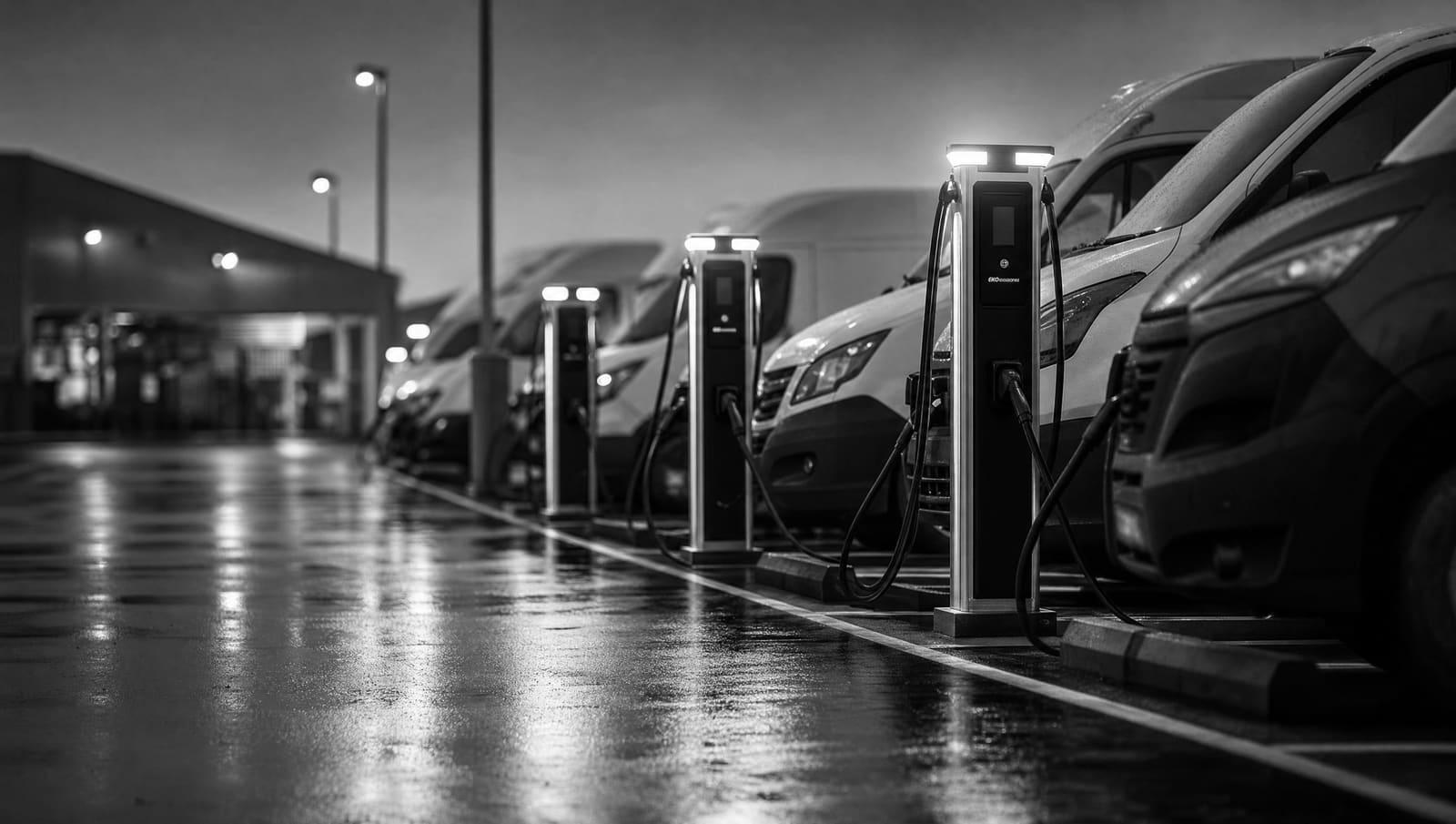
Commercial EV charger installation in Elgin.
A complete commercial installation covers the site and electrical assessment, charger selection, utility coordination, design, permits, construction, inspection, network setup, commissioning, and turnover. Level 2 charging often connects through commercial distribution equipment. DC fast charging places much greater demands on service capacity, switchgear, utility infrastructure, equipment space, and cooling.
The site review must verify electrical capacity, parking dwell time, cable routes, communications, accessibility needs, utility involvement, and room for later chargers.
Operating choices
Choose the charging plan before choosing the charger
The best charger is the one that serves the vehicles during the time they are parked. Begin with daily energy needs, arrival patterns, departure deadlines, and the number of vehicles that may charge at once. A workplace with long parking periods has a different need from a fleet with short turnaround windows.
Next, decide who may use the stations. Employee, tenant, fleet, visitor, and public charging can require different access rules, payment tools, reporting, and support. These choices affect hardware and network subscriptions.
Finally, set a growth plan. Installing conduit, panel space, or foundations for later ports can reduce future disruption. That does not mean buying every charger now. It means designing the first phase so the next phase does not require rebuilding completed work.
Scope control
The lines that shape the installation budget
A useful budget separates the chargers from the work required to supply, protect, connect, mount, and operate them. That makes design assumptions and price risks visible.
Equipment selection
Level 2 and DC fast charging create different projects
Level 2 equipment supplies AC power to the vehicle, which performs the conversion needed by its battery. It often fits workplaces, tenant parking, and other settings where vehicles remain for hours. The design still has to address circuit capacity, simultaneous charging, cable reach, mounting, networking, and the path from the electrical room to the spaces.
DC fast equipment performs power conversion outside the vehicle. It serves operations where drivers need substantial energy during a shorter stop. That speed can require more service capacity, larger conductors, added switchgear, utility work, dedicated equipment space, and careful heat management. The charger footprint is only one part of the layout.
Do not select charging speed from a product label alone. Calculate how much energy each vehicle must receive, how long it can charge, and how many sessions overlap. Managed charging may spread available power among several ports. It can be valuable where departure times allow flexibility, but it cannot replace the energy vehicles need before leaving.

Project complexity
What makes one installation simpler than another?
Two projects with the same port count can require very different work. The dividing line is often existing capacity, electrical distance, civil conditions, and the amount of utility infrastructure involved.
Lower complexity
Capacity and parking already align
The service has usable capacity, the charging spaces are near distribution equipment, communications are available, and construction can avoid major pavement or building disruption.
Higher complexity
The site needs new infrastructure
The design requires service changes, transformer or switchgear work, long underground routes, extensive restoration, or DC fast equipment with greater power and space demands.
Site assessment
A useful site review turns operating needs into a buildable scope
Begin at the vehicles, not the catalog. Record vehicle types, daily miles or energy use, arrival windows, parking duration, departure deadlines, and expected growth. For shared stations, estimate how drivers will move vehicles and whether access must be controlled.
The electrical review should document the service, meter, panels, transformers, major loads, available distribution space, and the proposed charging load. It should also trace a realistic route to the parking area. Walls, finished interiors, fire-rated assemblies, pavement, drainage, landscaping, and other utilities can affect that route.
Outside, confirm charger placement, cable reach, mounting protection, lighting, signage, snow and water exposure, communications, and safe movement around the equipment. Public or shared charging also needs a clear plan for accessible use and driver support.
The result should be a basis of design: port count, charging power, load approach, preliminary layout, utility questions, permit path, civil work, communications, and expansion provisions. That document gives bidders the same target and makes proposals easier to compare.
Ask for assumptions in writing
If available capacity, trench length, utility work, restoration, or network requirements remain assumptions, the quote should identify them and explain how changes will be priced.
Illinois requirement
Installer certification belongs in the Elgin procurement check
Illinois requires vendors that install EV chargers to comply with Illinois Commerce Commission certification requirements. The state information also says certified installers must meet training and insurance requirements and update the serving electric utility before and after installation.
For an Elgin commercial buyer, installer qualification and utility communication should therefore be confirmed before award. Ask the bidder to identify who holds the required certification, who will contact the serving utility, and which notices or records are included. Permit and inspection requirements should be confirmed for the final site and design rather than assumed from another project.
Treat incentives as time-sensitive
Illinois and federal charging programs can change, close, or depend on location and project type. Verify current eligibility, funding status, deadlines, and tax treatment before using an award in the budget.
Ownership and operation
Decide who owns the risk after energization
A charger remains an operating asset after the construction crew leaves. The owner needs a clear answer for station access, electricity recovery, software accounts, payment processing, driver support, repairs, warranties, replacement parts, and data ownership.
Simple equipment can reduce recurring software needs, but it may offer less control and reporting. Networked equipment can support access rules, usage records, payment, remote monitoring, and managed charging. It also creates subscription, communications, and vendor-dependency questions. Review these tradeoffs before approving hardware. A low equipment price can lose its advantage if the operating model does not fit the property.
Owner-operated
More direct control
The facility controls the equipment and policies but must assign staff or vendors to manage accounts, drivers, maintenance, warranties, and service interruptions.
Third-party services
More delegated responsibility
A service provider may handle selected operating tasks. The agreement should define fees, uptime response, data access, term length, and exit conditions.
Procurement and phasing
Buy a working charging system, not separate parts
A commercial charging project crosses electrical design, utility service, civil construction, equipment supply, software, inspection, and operations. Assign responsibility for the gaps. The contract should say who confirms charger compatibility, submits utility information, answers plan-review comments, coordinates deliveries, restores disturbed surfaces, activates the network, and resolves failed test sessions.
Phasing can protect cash and reduce operating disruption. A first phase may install the ports needed now while preparing selected pathways or electrical space for later work. Expansion provisions should follow a demand plan, not a vague promise that the site is future-ready. State what is included: spare capacity, empty conduit, pull boxes, panel positions, foundations, communications, or only reserved physical space.
Compare lifetime obligations as well as installation scope. Include network subscriptions, payment fees, communications, inspections, preventive care, repairs, parts availability, warranty labor, and the effect of charging on the facility's utility bill. For a separate discussion of pricing structure, see commercial EV charging installation cost.
Quote comparison
Five things every comparable proposal should show
Give bidders the same operating plan and site information. Then compare exclusions, assumptions, responsibilities, and recurring obligations along with the total price.
01
Defined charging outcome
Show port count, power, users, access rules, vehicle schedule, and expected expansion.
02
Complete electrical and civil scope
List distribution equipment, routing, trenching, protection, mounting, signage, and restoration.
03
Utility and approval responsibilities
Name who handles utility communication, drawings, permits, comments, inspections, and closeout.
04
Equipment and operating obligations
Identify hardware, software, communications, warranties, subscriptions, payment fees, and support.
05
Testing and turnover standard
Require successful charging sessions, network activation, training, records, and final documentation.
Keep planning locally
Related EV charging pages in Elgin
Get a defensible number
Price the equipment and the building together.
Send the address, operating target, and target opening date. Flux will identify what must be verified before the project can be priced.
Price my chargersQuestions
Straight answers.
What is included in commercial EV charger installation?
A complete scope can include site assessment, load review, charger selection, electrical and civil design, utility coordination, permits, construction, equipment mounting, wiring, network activation, inspections, commissioning, staff training, and turnover documents. The proposal should state each responsibility and exclusion.
Should an Elgin commercial property use Level 2 or DC fast charging?
Choose from the vehicle schedule. Level 2 often fits vehicles parked for hours. DC fast charging fits shorter turnaround needs but can require much more electrical and utility infrastructure. Calculate required energy, dwell time, and overlapping sessions before selecting equipment.
Can load management avoid an electrical service upgrade?
It may help when vehicles can share available power and still receive enough energy before departure. It is not an automatic substitute for capacity. A load study must compare building demand, charging demand, operating limits, and future growth.
Does Illinois require a certified EV charger installer?
Illinois requires EV charger installation vendors to comply with Illinois Commerce Commission certification requirements. Confirm the bidder's certification, training and insurance responsibilities, and required utility updates before awarding commercial work.
How should we compare commercial EV charging quotes?
Compare the same port count, power, electrical route, civil restoration, utility scope, permits, equipment, networking, commissioning, warranties, and recurring fees. A low bid may simply exclude work that another proposal includes.
Are EV charging incentives available for an Elgin project?
Potential federal or Illinois programs must be checked at the time of application. Eligibility can depend on location, applicant, charger type, public access, project timing, and current funding. Do not treat a credit, rebate, or grant as approved until its active rules and award status are confirmed.
What should happen before chargers are ordered?
Confirm the operating plan, site layout, electrical capacity, utility needs, permit path, charger specifications, communications, lead times, and who carries compatibility risk. Ordering too early can lock the project into equipment that does not fit the approved design.
Sources used for this guide
- [1]afdc.energy.gov — Alternative Fuels Data Center: Procurement and Installation for Electric Vehicle Charging Infrastructure
- [2]betterbuildingssolutioncenter.energy.gov — DOE Better Buildings Commercial EV Charging Infrastructure Guide
- [3]driveelectric.gov — Public electric vehicle charging infrastructure playbook · Joint Office of Energy and Transportation
- [4]energy.gov — DOE Federal Workplace Charging Program Guide
- [5]afdc.energy.gov — Alternative Fuels Data Center: Illinois Laws and Incentives