THE DIRECT ANSWER
What a commercial HVAC replacement actually includes
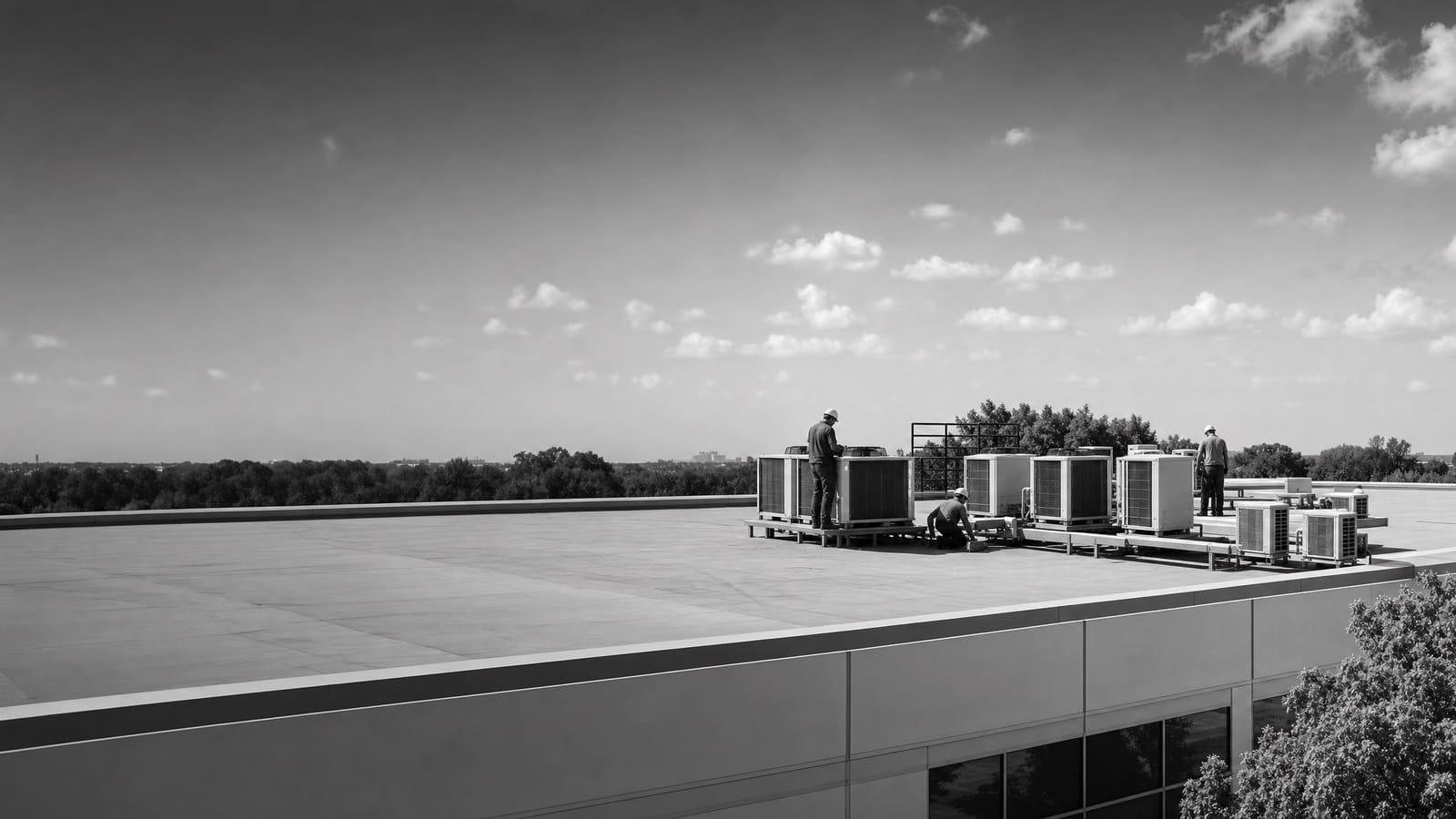
A commercial HVAC replacement is four jobs sold as one: confirm the load the building carries today, select equipment against real availability, set and connect the unit, and commission it against spec. Replacement usually beats another repair once a unit passes about fifteen years. DOE puts the yearly waste from an old, inefficient rooftop unit at $900 to $3,700 per unit, and that cost keeps running whether the unit is working well that week or not.
A site review still has to verify the real load, the curb and roof structure, crane reach across your lot, and whether the electrical service can carry the unit you want. Those four move the price most.
THREE WAYS TO GO
The three replacement paths worth pricing
Most rooftop replacements come down to three choices, and they are not equally good in every building.
The first is like-for-like: same tonnage, same fuel, same curb where possible. It is the fastest way back to conditioned air and the cheapest to engineer, and it carries forward whatever sizing mistake the old unit had.
The second is a high-efficiency unit of the same type. DOE's High-Performance Rooftop Unit Challenge asked manufacturers for units that cut energy use up to 50% against the standard in place at the time, and more than twenty models now exceed that specification. On a building that runs long hours, that difference shows up on the bill every month for the life of the unit.
The third is a heat pump rooftop unit. It is a close cousin of an air-conditioning unit but adds reverse-cycle heating, and it comes in dual-fuel, all-electric, and cold-climate versions. DOE's guidance treats today's heat pump rooftop units as an appropriate solution across most of the South and West, where they can handle most or all of the winter heating demand.
WHAT MOVES THE NUMBER
Where a rooftop replacement budget actually goes
There is no honest universal installed price for commercial HVAC, because tonnage, roof access, and infrastructure swing the same nominal unit by a wide margin. What is stable is the list of lines a real quote contains. If one of these is missing, it has not been priced. It has been deferred.
IN PRACTICE
How to choose between another repair and a replacement
The honest test for repair versus replacement is not the size of the last invoice. It is whether the unit can still hold the building at design conditions on the worst day of the year, and what it costs to do that.
Rooftop units condition close to half of all commercial floor space in the country, and most of them get replaced the same way: on failure, in season, at whatever the market charges that week. DOE's guidance is blunt about the cost of that habit. Units past about fifteen years waste substantial energy against newer models, and facility managers usually wait until the unit no longer conditions the space, needs constant service calls, or quits outright. Replacing proactively with a more efficient unit often beats both replacement-on-failure and a like-for-like swap at the end of the old unit's service life.
The practical version for a Birmingham building: if the unit is young and the failure is one component, repair it and put the unit on a watch list. If it is past fifteen years, needs a compressor or a coil, and serves a space with complaints it has never been able to fix, you are being asked to pay a large repair bill to extend a system that already loses money every month. Price the replacement before you approve the repair.
COMPLEXITY CHECK
What makes one roof simple and the next one hard
Two buildings can ask for the same tonnage and get quotes that are not close to each other. The gap is almost always access and infrastructure, not the box itself.
LOWER COMPLEXITY
Same unit, open roof, clear lot
Matching tonnage and fuel, the existing curb reused or a simple adapter, service capacity already adequate, and a crane position with room to set up. This is a planned morning: cone the stalls, set the unit, commission it, done.
HIGHER COMPLEXITY
New load, new fuel, tight site
The load changed because the space did, so tonnage moves and the curb no longer matches. Add an electrical service question, a gas line decision, structural review, or a crane that has to reach over an occupied entrance, and both the schedule and the price stretch.
BEFORE YOU BUY
The site review that decides your options
A useful site review answers the questions that decide equipment, not just the ones that decide price. DOE's own checklist for rooftop decisions runs the same list a good contractor walks: the heating load, the projected utility bill impact, the building type and how it is used, what equipment can actually be delivered, the infrastructure on site, and whether contractors nearby know the technology being proposed.
Infrastructure is where projects break, and three things get verified. First, electrical capacity. An all-electric unit with resistance backup heat can ask more of the service than the gas unit it replaces, and that gets checked at the panel rather than assumed. Second, physical constraints: curb footprint, clearances, structural capacity, and whether a crane can reach the position at all. Third, gas lines, which are kept, capped, or removed, and that is a scope decision with a cost either way.
The last item on the list matters more than it looks. Equipment that nobody nearby is comfortable servicing is a maintenance problem you buy on day one, and it belongs in the decision next to the efficiency numbers.
What to require before selection
Ask for the load calculation, the available capacity at the electrical panel, the curb dimensions, and a crane position marked on your lot plan. A proposal that arrives without those is a guess with a price attached.
OWNERSHIP ANGLE
Two decisions that outlive the install
Two choices on a rooftop replacement follow the building long after the crane leaves, and both are far easier to get right before the purchase order than after.
The first is timing. Replacement-on-failure feels like it defers cost, but it hands you the equipment that happens to be available instead of the equipment you chose, at the worst point in the season, with emergency labor attached. The second is fleet consistency. A roof running mismatched units, mismatched controls, and mismatched refrigerants costs more to maintain than the same roof standardized, and that difference compounds across the full service life of the equipment.
Neither one shows up on a single quote. Both show up in the operating budget.
TIMING
Plan it, or the season plans it
Proactive replacement lets you compare options, confirm the load, and schedule the crane on a slow day. A failure in August gives you whatever is in stock and a rush rate. DOE's guidance makes the same point about waiting for total failure.
FLEET
One platform beats four
Where the roof allows it, standardize tonnage, controls, and refrigerant across the units you replace. Refrigerant in the old equipment has to be recovered and handled under EPA Section 608 rules on the way out, and a mixed roof means mixed service planning for years.
PHASING AND PROCUREMENT
Phasing a multi-unit roof without buying it twice
Most commercial roofs do not have one unit. They have a row of them installed within a few years of each other, which means they will reach the end of their lives within a few years of each other too. Phasing is how that stops being one enormous capital request.
Rank the units by age, service history, and the hours each one runs. The unit serving the space with the longest operating schedule is usually where a high-efficiency replacement earns back the most, so it goes first even when it is not the oldest unit on the roof. Units on short-hour spaces can often wait, or take advanced controls instead of new equipment. DOE's rooftop campaign treats efficient replacement and controls retrofits as two legitimate answers, chosen by which one makes better financial sense for that unit.
Procurement is the other half of the plan. Equipment availability changes what is realistically installable this quarter, so availability belongs on the quote next to the price rather than in a phone call after the purchase order. Check incentives before you sign, because program offers change and are usually tied to the efficiency tier you specify. And settle your refrigerant position once, for the whole roof, so the service contract and the spare-parts strategy are not quietly managing three platforms.
QUOTE CHECK
Five things a comparable quote shows
Two quotes are only comparable when they cover the same work. Ask each one to state these five items in writing, and the cheaper number usually explains itself.
01
The load calculation
The tonnage and efficiency tier selected, plus the calculation behind them, not the old nameplate copied forward.
02
Curb, adapter, and structure
Whether the existing curb is reused, an adapter is fabricated, and whether the roof needs structural review.
03
Crane, rigging, and lot plan
Who owns the rigging plan, how many stalls close, for how long, and on which day.
04
Infrastructure scope
Electrical work, gas line handling, refrigerant recovery, and any code-triggered items the replacement brings with it.
05
Commissioning and handoff
Startup, charge, airflow, and control settings verified against spec and documented, plus permits, inspections, and warranty registration.
Get a defensible number
Price the equipment and the building together.
Send the address, operating target, and target opening date. Flux will identify what must be verified before the project can be priced.
Get a free estimateQuestions
Straight answers.
When does replacement beat another repair?
Once a unit is past roughly fifteen years and needs a major component, the repair is buying time on a system that is already losing money. DOE puts the annual waste from an old, inefficient rooftop unit at $900 to $3,700, and it notes that replacing proactively often beats waiting for the unit to fail.
Is a heat pump rooftop unit a real option for a commercial building?
Often yes. Heat pump rooftop units are technically similar to air-conditioning units but add reverse-cycle heating, and DOE's guidance treats them as appropriate across most of the South and West, capable of handling most or all of the winter heating demand. The gating question is infrastructure: electrical capacity, physical constraints, and what happens to the gas line.
How much does a commercial HVAC replacement cost?
There is no honest universal installed price, because tonnage, curb work, crane access, and electrical scope move the same nominal unit by a wide margin. Ask for the line items instead: equipment and tier, curb and structure, crane day, infrastructure, and commissioning. A quote that shows all five can be compared to another one.
Should we replace like-for-like or resize the unit?
Confirm the load either way. If the space and its use have not changed, like-for-like is usually right and it is the fastest path back in service. If occupancy, equipment, or the envelope changed, a like-for-like swap carries the old sizing mistake forward for another fifteen years.
What happens to the refrigerant in the old unit?
It gets recovered and handled under EPA Section 608 rules, which govern the handling and recycling of refrigerants in stationary air-conditioning and heat pump equipment. It is a small line on the quote, but it should be on there, and a roof running several different refrigerants complicates service planning.
Sources used for this guide
- [1]betterbuildingssolutioncenter.energy.gov — DOE Advanced Rooftop Unit Replacement Guidance
- [2]betterbuildingssolutioncenter.energy.gov — DOE Commercial Heat Pump Rooftop Unit Replacement Guidance
- [3]betterbuildingssolutioncenter.energy.gov — DOE High-Efficiency Commercial Rooftop Unit Toolkit
- [4]energy.gov — DOE Efficient Commercial Rooftop Air Conditioner Program
- [5]epa.gov — EPA Stationary HVAC Refrigerant Management