Direct answer
Commercial EV charger installation in Auburn.
A complete commercial installation covers the site and electrical assessment, charger selection, engineering, utility coordination, permits, construction, network setup, testing, and turnover. Level 2 often connects through building distribution equipment. DC fast charging can require much larger service, transformer, switchgear, civil, and utility scopes. The right plan starts with vehicles and parking time, then works backward to power.
The site review must verify usable electrical capacity, equipment locations, cable reach, trench routes, communications, access, drainage, and room for later chargers.
Operating plan
Make these three choices before selecting hardware
Begin with the people or vehicles that will use the chargers. A workplace where cars remain parked for hours has a different need than a fleet with fixed departure times or a public site built for quick turnover. Estimate how many vehicles must charge, when they arrive, how long they stay, and how much energy each one needs.
Next, set the access policy. Decide whether charging is for employees, tenants, fleet drivers, customers, or the public. That choice affects payment, authentication, signage, networking, support, and parking enforcement.
Finally, decide what the first phase must support and what should be prepared for later. Spare conduit, panel space, communications pathways, and planned equipment locations can make expansion less disruptive. Do not assume every future port needs full power at once. A designer can evaluate power sharing or managed charging against the operating schedule and available service.
Project scope
The budget lines a serious quote should separate
Commercial EV charging is more than buying stations. Ask for a clear breakdown so equipment, construction, utility work, software, and owner responsibilities do not disappear inside one allowance.
Equipment choice
Choose Level 2 or DC fast charging from the duty cycle
Level 2 charging usually fits vehicles that remain parked for a meaningful part of the day or night. The vehicle converts AC power for its battery, so the station and building connection are generally less demanding than a comparable fast-charging project. It can work well when the goal is to restore energy during a normal parking period, not to refill a vehicle as quickly as possible.
DC fast charging performs the AC-to-DC conversion outside the vehicle. It serves drivers or fleets that need shorter stops, but the installation plan changes with that speed. The design may need greater service capacity, dedicated distribution equipment, larger conductors, equipment pads, cooling clearances, protective gear, and deeper utility review. Charger output alone does not prove that a site can deliver that power.
Do not compare equipment only by the number on its nameplate. Ask how power will be shared, which vehicles and connectors must be supported, whether payment is required, how drivers will authenticate, what happens when communications fail, and who responds to faults. A lower-power design that reliably meets the operating schedule can be better than unused capacity with higher infrastructure and demand exposure.
Complexity check
What separates a simple installation from a major infrastructure project
The charger count does not tell the whole story. Existing capacity, distance to parking, surface conditions, communications, and utility involvement can change the design and schedule.
Lower complexity
Capacity and parking are already aligned
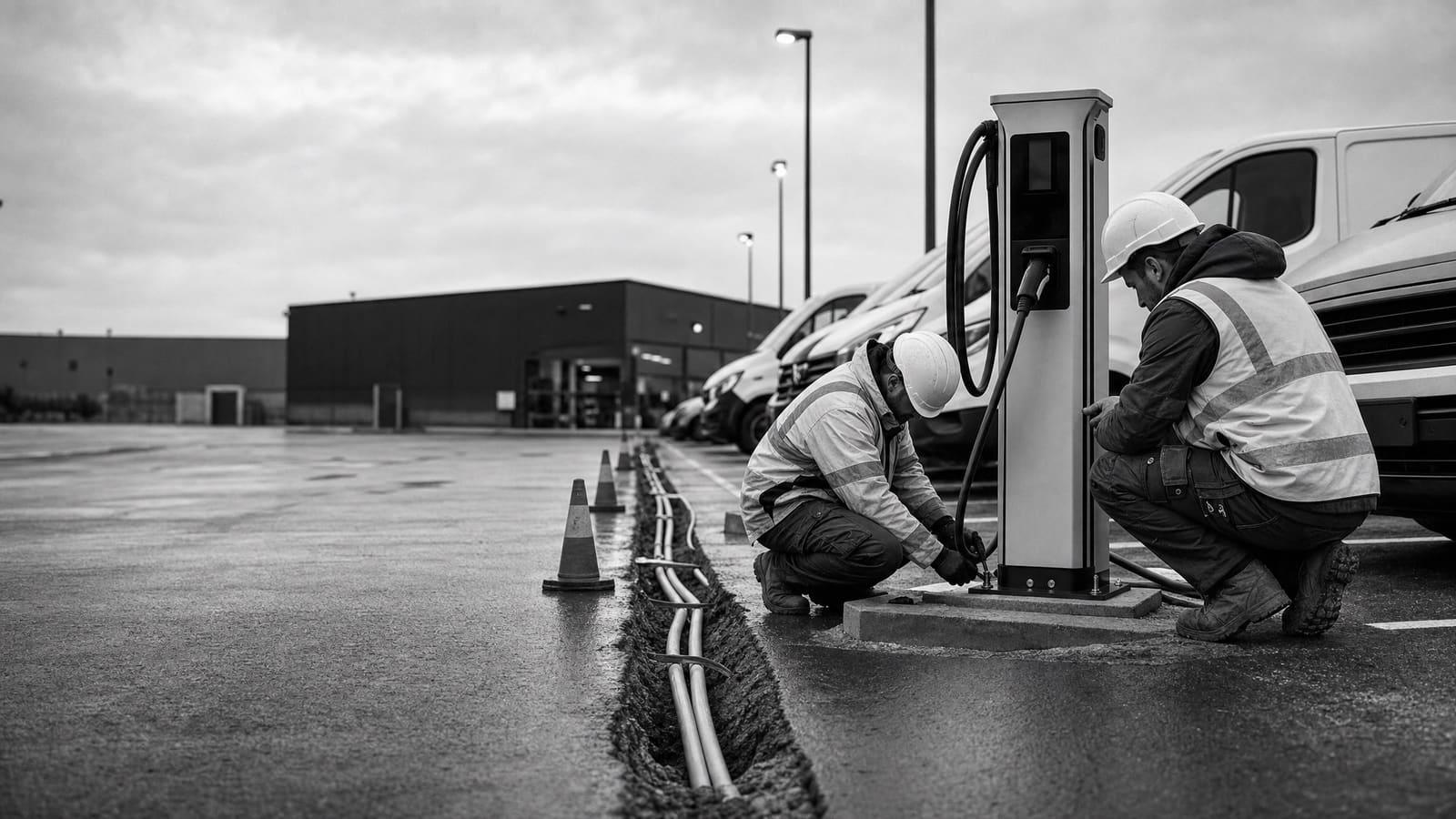
Usable panel capacity is near the stalls, conduit routes are short, communications are reliable, and the work avoids major pavement or service changes. Permits, inspections, commissioning, and safe access still belong in the scope.
Higher complexity
Power or construction must reach farther
A service upgrade, transformer, switchgear, long trench, pavement restoration, difficult equipment placement, or fast-charging load adds coordination. Utility milestones and equipment lead times may control the schedule.
Site assessment
A site walk should turn assumptions into design inputs
The assessment should begin at the electrical service, not at the preferred parking space. Record service and distribution equipment, ratings, known loads, available breaker positions, meter arrangement, and the practical path to the chargers. Existing labels are helpful, but they do not replace the load analysis and field verification needed for design.
At the parking area, review stall layout, accessible routes, vehicle movement, cable reach, bollard needs, equipment clearances, lighting, signage, drainage, and possible impact points. Trace whether conduit can pass through landscaped areas or must cross pavement. Note underground utility conflicts that may require locating or redesign before excavation.
The review should also test operations. Confirm the vehicles, arrival windows, dwell time, daily energy need, growth forecast, access rules, and the consequences of an unavailable port. Check cellular or other network coverage where connected stations will sit. These findings allow the designer to compare dedicated circuits, power sharing, phased capacity, and service upgrades on the same operating basis. They also create a cleaner utility request and a quote with fewer hidden assumptions.
Bring useful records
Provide electrical drawings, utility bills, parking plans, fleet schedules, vehicle details, planned construction, access rules, and expansion goals when available. Missing records can be verified during design.
Alabama funding context
Treat old program rules as history, not available funding
Alabama’s FY 2024 state-funded charging guidance tied eligibility and scoring to public access, charging type, and distance from a federally designated charging corridor. That funding round is historical by August 2026. Its former rules should not be placed in an Auburn budget or operating plan as though they remain open.
Before procurement, check the current program notice, eligible applicants, site requirements, public-access terms, corridor rules, equipment standards, application date, and whether construction may begin before an award. Also screen the address with the federal 30C eligibility locator, then have a qualified tax adviser confirm current eligibility and documentation. An incentive should reduce an approved project budget; it should not be the only reason the project works.
Keep the base project viable
Request a base quote without unconfirmed incentives and a separate funding scenario. That makes the decision usable if program terms, deadlines, awards, or tax treatment change.
Ownership and operation
Decide who owns the charger experience after turnover
A commercial charger becomes an operating asset. Someone must manage users, pricing, station status, software accounts, warranty claims, damaged cables, firmware, payment issues, and repair calls. Put those duties in writing before the stations go live.
Ownership also affects data and recurring expense. A networked station may provide authentication, billing, remote status, session records, and control features, but it can bring software and service fees. A simpler station may reduce those dependencies, yet offer less control and visibility. The right model depends on whether the site needs public payment, employee allocation, tenant reporting, fleet scheduling, or basic private charging. Confirm who owns the equipment, electrical infrastructure, network account, charging revenue, and session data.
Owner operated
More control, more responsibility
The facility controls equipment and policy but must assign staff or service partners for accounts, pricing, uptime, warranties, repairs, and driver support.
Managed arrangement
Defined service with contract limits
A provider may handle selected operating tasks. Compare term, fees, response commitments, data access, equipment restrictions, renewal terms, and the exit process.
Procurement
Buy a working system, not a collection of parts
A complete procurement package should join the electrical design, charger hardware, network plan, civil work, utility scope, permits, testing, training, and support. If these pieces come from separate vendors, name the party responsible for each handoff. The owner should not have to settle a dispute between the electrician, equipment supplier, network operator, and utility after energization.
Plan procurement around approved design information. Buying chargers before confirming power, connector needs, mounting, network compatibility, and utility requirements can lock the project into the wrong equipment. For a formal solicitation, give every bidder the same site information, performance goals, assumptions, and turnover requirements. Ask them to identify exclusions instead of hiding them.
Consider lifetime operation as well as initial construction. Review expected software charges, payment processing, warranties, replacement parts, preventive care, field response, energy-rate effects, and the process for adding ports. If capital is limited, phase the visible chargers while preparing only the infrastructure that has a clear future use. The commercial EV charging cost guide can help organize those cost categories, but the Auburn site assessment must define the actual scope.
Quote comparison
Five things every comparable installation quote should show
Normalize bids before comparing totals. Each proposal should use the same charging goal, site assumptions, equipment count, construction limits, and turnover standard.
01
Design basis
Vehicles, dwell time, energy need, charger power, port count, load assumptions, and expansion plan.
02
Complete construction scope
Panels, protection, conduit, wiring, trenching, pads, mounting, bollards, signage, restoration, and accessibility work.
03
Utility and permit responsibility
Applications, drawings, fees, inspections, service work, milestones, allowances, and tasks left to the owner.
04
Equipment and software terms
Exact models, connectors, networking, payment features, subscriptions, warranties, lead times, and approved substitutions.
05
Commissioning and support
Port testing, network activation, training, closeout records, warranty contacts, maintenance options, and response expectations.
Keep planning locally
Related EV charging pages in Auburn
Get a defensible number
Price the equipment and the building together.
Send the address, operating target, and target opening date. Flux will identify what must be verified before the project can be priced.
Price my chargersQuestions
Straight answers.
What does commercial EV charger installation include?
A complete scope includes the site survey, electrical load review, charger and network selection, engineering, utility coordination, permits, equipment procurement, civil and electrical construction, inspections, activation, testing, training, and closeout documents. The quote should state which party owns every step.
Should an Auburn business install Level 2 or DC fast chargers?
Choose from the vehicle schedule. Level 2 usually fits cars parked for hours. DC fast charging fits short stops or fleet turnaround that requires more energy in less time. Fast charging can also require much larger electrical and utility infrastructure, so confirm the duty cycle before requesting hardware.
Can the existing electrical service support EV charging?
Only a site and load review can answer that. The contractor should inspect service and distribution equipment, study current loads, and model the proposed charging demand. Managed charging or power sharing may help fit more ports within a defined limit, but it must still meet the vehicles’ departure needs.
When should the electric utility become involved?
Engage the utility during planning when the project may affect service capacity, metering, rates, a transformer, or other utility equipment. Early coordination helps define responsibilities and milestones before equipment is ordered. DC fast-charging projects commonly need deeper utility review than modest Level 2 installations.
Do commercial charging stations need networking?
Not always. Networking is useful for payment, authentication, remote status, session data, access control, and some power-management functions. A private site with simple operating needs may need fewer features. Compare recurring fees, communications coverage, data access, offline behavior, and contract exit terms.
What should happen during commissioning?
Commissioning should verify safe energization, protective devices, every charging port, connector operation, communications, user access, payment settings when used, power-sharing behavior, and fault reporting. Turnover should include approved drawings, equipment records, warranties, account access, training, and support contacts.
Are EV charging incentives available in Auburn in August 2026?
Do not assume an older Alabama program or federal tax provision applies. Check current state notices and the federal 30C eligibility locator for the exact address, then confirm deadlines, applicant rules, eligible costs, construction timing, and tax treatment with the proper program administrator and tax adviser.
How can a facility prepare for more chargers later?
Define a realistic expansion phase during design. Evaluate panel space, service capacity, conduit routes, communications, equipment locations, and power management before paving or restoring the site. Prepare only the infrastructure supported by a clear future plan, and document what the next phase will require.
Sources used for this guide
- [1]afdc.energy.gov — Alternative Fuels Data Center: Procurement and Installation for Electric Vehicle Charging Infrastructure
- [2]betterbuildingssolutioncenter.energy.gov — DOE Better Buildings Commercial EV Charging Infrastructure Guide
- [3]driveelectric.gov — Public electric vehicle charging infrastructure playbook · Joint Office of Energy and Transportation
- [4]energy.gov — DOE Federal Workplace Charging Program Guide
- [5]adeca.alabama.gov — adeca.alabama.gov