The direct answer
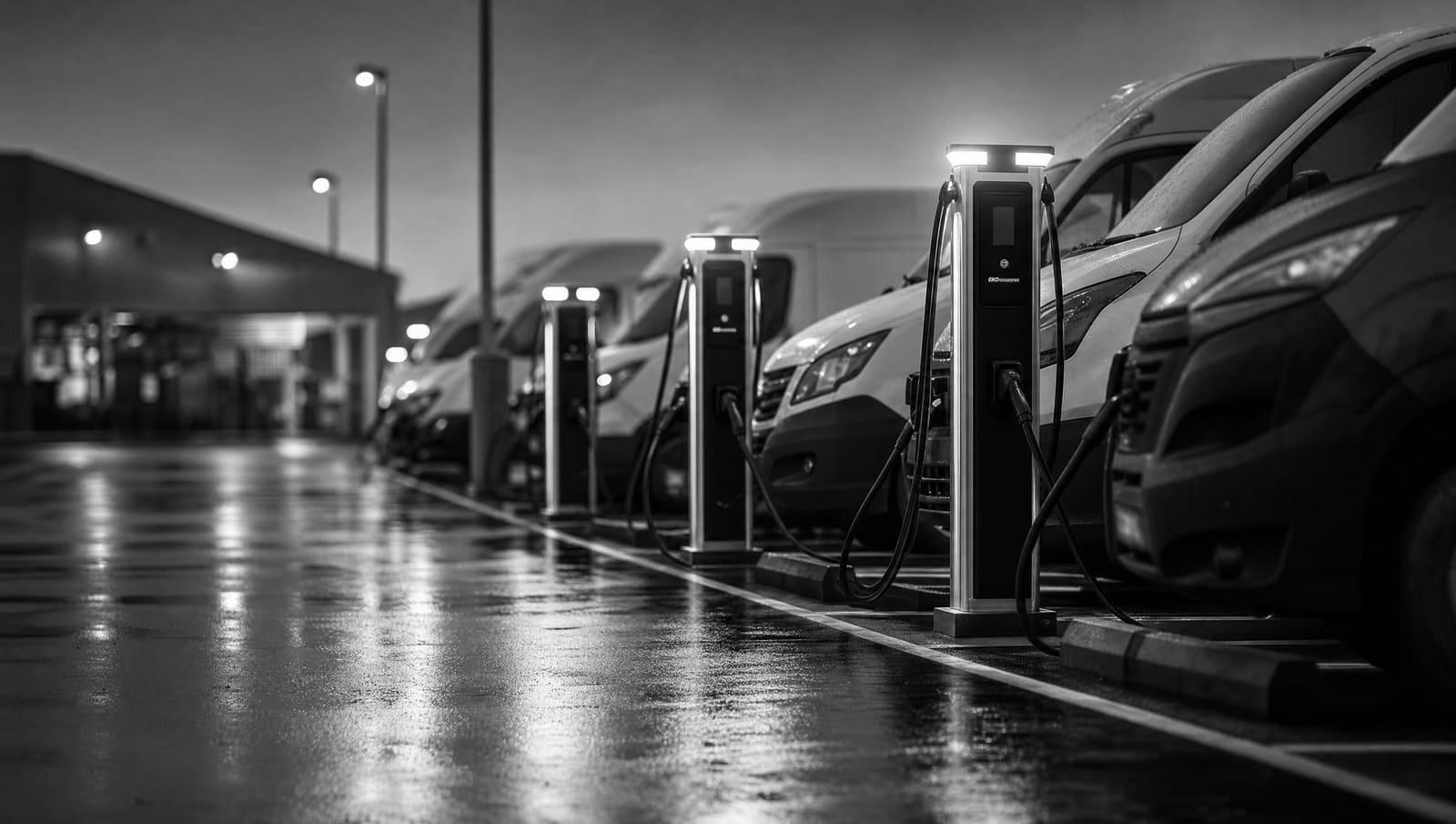
Commercial EV charger installation in Athens.
A complete commercial installation covers the site and electrical assessment, charger selection, utility coordination, design, permitting, construction, inspections, network setup, testing, and turnover. Level 2 charging often connects through commercial electrical distribution equipment. DC fast charging places much larger demands on service capacity, utility equipment, switchgear, space, and project planning.
The site review must verify vehicle needs, parking time, available power, panel space, cable routes, communications, accessibility needs, and room for expansion.
Set the operating plan
Make three choices before selecting chargers
Start with the vehicles and the time they remain parked. A workplace may need steady charging over several hours. A fleet may need each vehicle ready before a fixed departure. A public site may need access controls, payments, clear signs, and reliable support for drivers who have never visited before.
Next, decide who may charge and who pays. Charging can be limited to employees, tenants, fleet drivers, customers, or approved users. A networked system can support access rules, session data, and payment features, but it also adds software decisions and ongoing fees.
Finally, choose the first phase and the long-term buildout together. Installing every charger now is not always necessary. Designing the electrical path, panel strategy, conduit, and parking layout for later ports can reduce disruption when demand grows.
Build a complete scope
The budget is larger than the charger
A useful proposal separates equipment from the work needed to deliver power, protect the installation, activate service, and keep it operating.
Choose the charging level
Level 2 and DC fast charging create different projects
Level 2 equipment supplies AC power to the vehicle, where onboard hardware converts it for the battery. The reviewed commercial-building guidance describes Level 2 equipment operating at 208 to 240 volts, with listed power levels from 5 to 19.2 kW. It fits many commercial situations where vehicles remain parked long enough to charge over time. The installation may still require new panels, feeders, trenching, communications, and parking work.
DC fast equipment performs power conversion outside the vehicle. That changes the project. Higher electrical demand can require more extensive distribution equipment, utility study, service work, cooling, equipment space, and protective hardware. It should be chosen because vehicles need faster turnaround, not simply because it is the more powerful option.
Do not compare chargers only by their maximum rating. The vehicle may accept less power, and shared electrical capacity may limit simultaneous output. Compare the charging result the operation needs: which vehicles use each port, how long they stay, when they depart, and how much energy must be delivered during that window.

Know the complexity
What makes installation easier or harder
The same charger can lead to a very different construction scope at two facilities. Power availability and the route to parking usually explain the difference.
Lower complexity
Capacity and parking align
The existing distribution system has usable capacity, charger spaces sit near the electrical source, communications are available, and the work avoids major trenching or service changes.
Higher complexity
Power or routing must change
The plan needs service upgrades, new switchgear, long underground routes, pavement restoration, utility equipment, managed charging, or construction beside active traffic and occupied parking.
Start with evidence
What a commercial site review should produce
A site review should do more than count parking spaces. The team should inspect the electrical service, meter, main distribution equipment, panels, breaker space, and likely feeder routes. Available drawings help, but field conditions should be checked before the scope is priced.
The operating review should identify vehicle types, daily energy needs, arrival and departure patterns, parking duration, peak charging periods, and expected growth. For public or shared charging, it should also cover access, payment, signs, security, communications, and the person responsible for driver support.
The result should be a clear basis of design. It should state the planned port count, charging level, assumed output, electrical approach, equipment locations, construction route, network functions, and future phase. It should also name open items that require utility, permitting, engineering, or underground investigation. That record gives bidders the same problem to solve and makes later changes easier to explain.
Ask for one drawing that connects power to parking
It should mark electrical sources, charger spaces, equipment locations, conduit routes, protected areas, accessible charging provisions, communications, and planned expansion.
Assign responsibility
Decide who owns the equipment and the operating work
Commercial charging continues after construction. Someone must control user access, answer driver questions, manage payment rules, review station data, update software, and arrange repairs. Put those duties into the buying decision.
Ownership also affects procurement. A facility may buy the chargers and contract separately for networking and service, or use another arrangement that combines equipment and operating support. Compare the full term, not only the purchase price. Confirm who controls the data, whether the network can change, what happens if service ends, and how replacement parts and warranty labor are handled.
Facility-controlled
Own the assets and policies
The owner gains direct control but must assign staff or vendors to manage access, software, maintenance, billing, and replacement planning.
Service-supported
Bundle operating help
A provider may handle more daily work, but the agreement should explain fees, data rights, support levels, contract changes, and exit terms.
Procure for the full term
Compare lifetime value, not a hardware discount
A lower equipment price can lose its advantage if the charger requires costly software, weak support, difficult replacement parts, or a construction design that cannot expand. Compare installation, networking, communications, payment processing, inspection, maintenance, warranty coverage, energy management, and future replacement as one operating system.
Ask whether managed charging can keep the combined load within an approved limit. This may allow the system to share available capacity across ports, but the control strategy must still deliver the energy vehicles need before departure. The proposal should explain both the assumed limit and what drivers will experience when several vehicles connect at once.
Treat incentives as a separate, time-sensitive review. The federal Alternative Fuel Infrastructure Tax Credit has location and eligibility rules, and any buyer considering it should verify the property, equipment, labor, filing requirements, and current law with qualified tax advisers before placing an order. Do not reduce the contract price with an unconfirmed credit. The project should remain workable if an incentive changes, expires, or cannot be claimed.
Compare proposals
Five things every comparable quote should show
Give each bidder the same operating plan and site information. Then require these five items so omissions, allowances, and risk are visible.
01
A defined basis of design
Show port count, power, locations, vehicles served, network functions, and expansion assumptions.
02
A complete electrical scope
List panels, switchgear, feeders, conduit, conductors, load controls, metering, and utility-side assumptions.
03
Civil and parking work
Identify trenching, boring, concrete, restoration, equipment protection, signs, striping, and site access.
04
Approvals and schedule ownership
Assign design, utility coordination, permits, inspections, equipment lead times, and energization tasks.
05
Commissioning and operating support
Include test sessions, network activation, training, records, warranties, maintenance options, and exclusions.
Get a defensible number
Price the equipment and the building together.
Send the address, operating target, and target opening date. Flux will identify what must be verified before the project can be priced.
Price my chargersQuestions
Straight answers.
What does commercial EV charger installation include?
It should include site and electrical assessment, equipment planning, utility coordination, design, permitting, make-ready construction, charger mounting and wiring, inspections, network activation, testing, training, and turnover documents. The quote should state any excluded work.
Should our Athens facility install Level 2 or DC fast charging?
Choose from the operating need. Level 2 often fits vehicles parked for longer periods. DC fast charging fits cases where rapid turnaround is necessary, but it can require a much larger electrical and utility scope. A mixed design may serve different vehicle groups.
Can our existing electrical service support commercial chargers?
A load assessment must answer that question. It should review present building demand, distribution capacity, planned charger output, simultaneous use, and future growth. Managed charging may help control the combined load, but it must still meet vehicle departure needs.
When should the utility become involved?
Engage the utility during planning when the proposed load may affect service capacity, metering, rates, transformers, or other utility equipment. Early coordination helps identify studies, upgrades, responsibilities, and schedule dependencies before equipment is purchased.
Do commercial chargers need a network?
Not every charger needs one. Networking can support access control, session data, payment, monitoring, and load management. It also brings communications requirements, software terms, and recurring fees. Select it only after defining who will charge and how the stations will be managed.
How should we plan for more chargers later?
Create a long-term port plan before building the first phase. Review future electrical load, panel and switchgear space, conduit capacity, equipment locations, communications, and parking layout. The quote should separate work needed now from infrastructure reserved for expansion.
How is the installation commissioned?
Commissioning should verify electrical safety, charger operation, network communication, access rules, payment functions when used, and successful charging at every port. Turnover should include settings, warranties, inspection records, training, support contacts, and maintenance responsibilities.
Are tax credits or incentives available for an Athens project?
Programs and tax rules are time-sensitive. Federal infrastructure credit eligibility can depend on location and other requirements. Verify current law, property eligibility, qualifying costs, deadlines, and filing treatment with the proper program authority and qualified tax advisers before relying on savings.
Sources used for this guide
- [1]afdc.energy.gov — Alternative Fuels Data Center: Procurement and Installation for Electric Vehicle Charging Infrastructure
- [2]betterbuildingssolutioncenter.energy.gov — DOE Better Buildings Commercial EV Charging Infrastructure Guide
- [3]driveelectric.gov — Public electric vehicle charging infrastructure playbook · Joint Office of Energy and Transportation
- [4]energy.gov — DOE Federal Workplace Charging Program Guide