Start with the complete scope
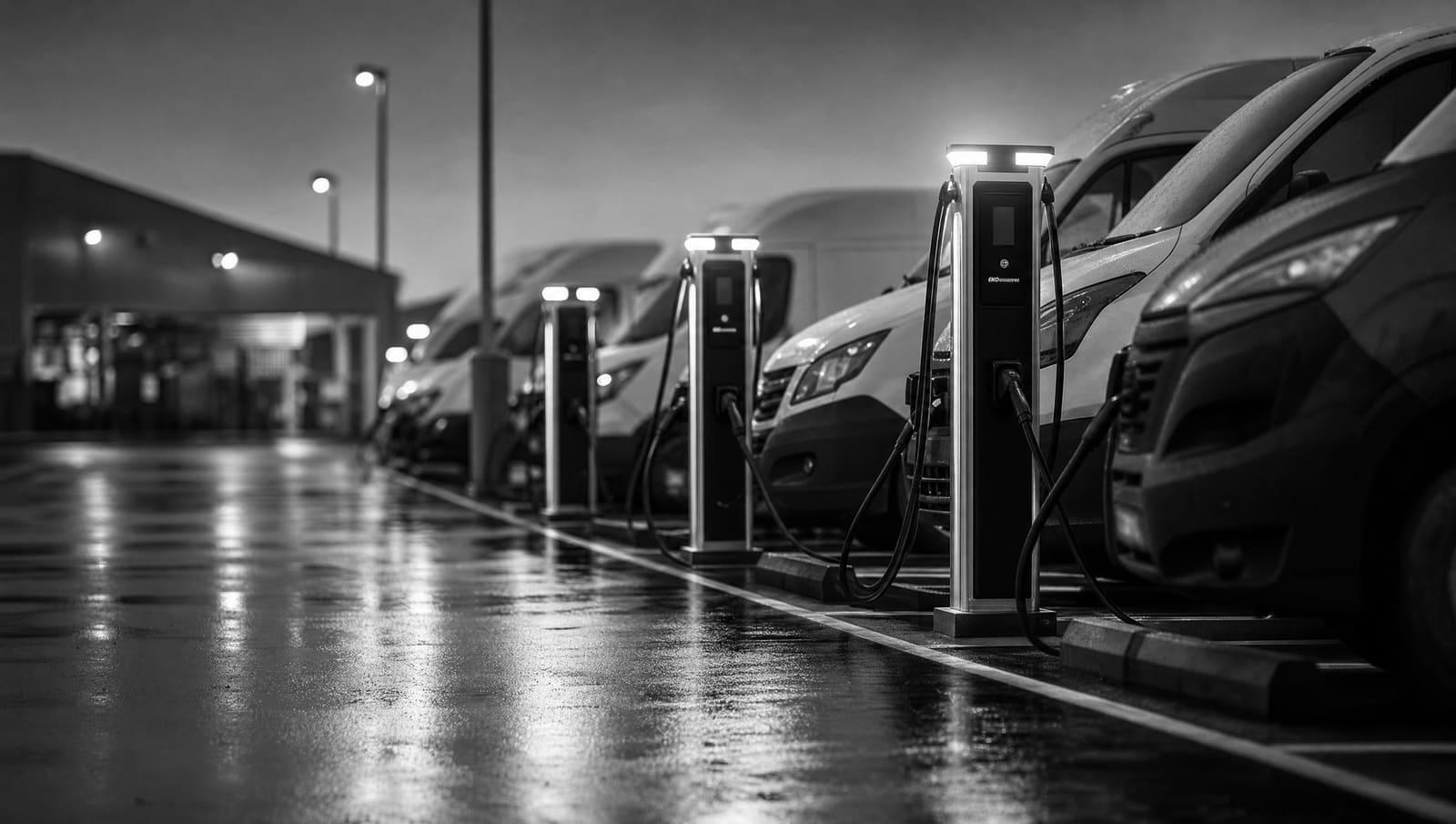
Commercial EV charger installation in Asheville.
A commercial installation should cover the site and electrical assessment, charger selection, design, utility coordination, permits, construction, inspections, network activation, commissioning, and turnover. Level 2 charging often serves vehicles parked for hours. DC fast charging supports shorter stops but can require a much larger electrical and utility scope.
The site review must verify usable electrical capacity, charging demand, equipment locations, cable routes, parking access, communications, and room for future stations.
Define the operating plan first
Three choices shape the installation
The charger should follow the way the property will use it. Begin with the vehicles, their arrival times, how long they remain parked, and how much energy they need before departure. Then decide who may charge and whether drivers will pay.
A workplace may favor steady Level 2 charging across a long parking period. A fleet may need charging scheduled around routes and shift changes. A public site may need payment tools, clear signage, reliable communications, and faster turnaround. These are operating decisions, but they change the electrical design. They affect charger quantity, power per port, networking, metering, access control, and the ability to share available capacity.
Write these rules before requesting equipment prices. Otherwise, bidders may quote different charging outcomes while appearing to quote the same project.
Read the scope behind the total
What changes the installation budget
Charger hardware is only one line. Compare the electrical, civil, utility, communications, and operating scope behind every total. For a deeper budget discussion, see commercial EV charging cost.
Equipment follows the use case
Level 2 and DC fast charging create different projects
Level 2 equipment connects to the building’s AC electrical system, while the vehicle handles conversion for battery charging. It is often a strong fit when drivers remain parked for hours. That can include employee, tenant, guest, or overnight fleet parking. A project may use several ports with power managed across them instead of giving every port its maximum output at once.
DC fast equipment performs the power conversion outside the vehicle. It can deliver energy more quickly, but the installation is usually more demanding. The design must account for larger electrical loads, power-conversion equipment, cooling, switchgear, protective devices, utility involvement, and possible service changes. The site also needs a traffic plan that supports shorter charging visits.
Do not choose between these options from charger speed alone. Calculate how much energy each vehicle needs and divide that need across the real parking window. Check which vehicles and connectors must be supported. Then test the resulting load against the building’s distribution system. A mixed design can make sense when most vehicles have long dwell times but a smaller group needs quicker recovery.

Complexity starts at the site
What separates a simpler project from a harder one
Two properties buying similar chargers can have very different scopes. The dividing line is often the condition of the electrical system and the path between available power and the parking spaces.
Lower complexity
Capacity and access are already close
The existing distribution system can support the planned load, parking is near the power source, communications are available, and construction avoids major surface removal or utility changes.
Higher complexity
The site needs new infrastructure
The project adds distribution equipment, long underground routes, pavement restoration, utility service work, payment systems, several construction phases, or a larger fast-charging load.
Site review before procurement
What the field assessment should settle
A useful site review starts at the electrical service and ends at each proposed charging space. The reviewer should record service and panel information, existing loads, spare breaker positions, equipment condition, metering, and the physical route for new feeders. The parking review should cover stall dimensions, charger mounting, connector reach, vehicle movement, protection from impact, signage, lighting, and access for construction.
The review should also test the operating assumptions. Count the vehicles expected now and later. Record their parking windows and energy needs. Identify whether charging is assigned, shared, public, or fleet-controlled. Confirm whether the site needs user authentication, payment, utilization records, remote monitoring, or integration with another system.
Communications deserve an early check. Networked stations may rely on cellular or other connectivity, and weak service at the proposed location can become an activation problem. The result should be a written basis of design. That document gives the owner, engineer, utility, equipment supplier, and installer the same target before drawings and purchasing begin.
Ask for assumptions in writing
The assessment should state the planned port count, power per port, operating schedule, load strategy, electrical route, communications method, expansion allowance, and unresolved site conditions.
Decide who owns each responsibility
Hardware ownership and charging operations are separate choices
A facility can own the charging equipment while using another provider for network services, or it can use a different ownership and operating arrangement. The right structure depends on who controls pricing, driver access, maintenance, data, and equipment replacement.
Review the agreement as closely as the charger specification. Learn what happens if network service ends, fees change, communications fail, or the property changes operators. Confirm who receives driver payments and utilization data. Ask whether essential charging functions continue during a network interruption. The proposal should also identify who handles troubleshooting, software support, parts, field service, and warranty claims.
A charger is a working facility asset, not a one-time electrical purchase. Ownership terms can affect operating freedom long after construction is complete.
Owner control
Know what the property can change
Confirm control over access rules, pricing, data, software providers, equipment replacement, and expansion before accepting a long-term operating model.
Service accountability
Give uptime a named owner
Assign responsibility for monitoring, driver support, remote resets, repairs, replacement parts, warranty work, and response after a failed charging session.
Build for operation, not opening day
Use phasing and load management with care
A phased project can install the ports needed today while preparing a practical route for later growth. That may mean reserving panel space, sizing selected equipment for the planned buildout, or placing spare conduit where future excavation would be disruptive. The drawings should separate installed work from future allowances so every bidder prices the same scope.
Load management can distribute available power among connected vehicles. It may help a site serve more ports within a defined electrical limit, especially when vehicles remain parked longer than they need to charge. It does not create electrical capacity. The design still needs a supported control method, communication plan, fail-safe behavior, and an operating rule for periods when many vehicles connect together.
Compare lifetime obligations during procurement. Include network subscriptions, payment processing, connectivity, inspection and maintenance work, replacement parts, warranties, and the labor needed to keep stations usable. Incentives or tax treatment may affect the budget, but eligibility is time-sensitive and location-specific. Verify any current program and its requirements before treating it as committed funding. Do not let an uncertain incentive carry the business case.
Make bids comparable
Five things every installation quote should show
A usable quote connects the equipment, construction, approvals, and turnover work. Ask bidders to list exclusions and allowances beside the included scope so hidden gaps are visible before award.
01
Charging basis
Port count, charger type, output, connectors, users, dwell time, and expansion plan.
02
Electrical and civil work
Panels, protection, conductors, conduit, trenching, pads, mounting, barriers, and surface restoration.
03
Design and coordination
Engineering responsibility, utility coordination, permit work, inspections, submittals, and required owner decisions.
04
Activation and turnover
Networking, payment setup, test sessions, training, labels, records, warranties, and closeout documents.
05
Commercial terms
Schedule assumptions, allowances, exclusions, change process, software fees, maintenance, and service responsibility.
Keep planning locally
Related EV charging pages in Asheville
Get a defensible number
Price the equipment and the building together.
Send the address, operating target, and target opening date. Flux will identify what must be verified before the project can be priced.
Price my chargersQuestions
Straight answers.
What does commercial EV charger installation include?
A complete scope includes site assessment, load review, equipment planning, electrical design, utility coordination, permitting, procurement, civil and electrical construction, inspections, network activation, commissioning, training, and turnover documents. The quote should say who owns each task.
Should our Asheville property install Level 2 or DC fast chargers?
Choose from vehicle dwell time and required energy. Level 2 is often practical when vehicles remain parked for hours. DC fast charging serves shorter stops or demanding fleet schedules, but it can require a larger electrical system, more utility coordination, and a more complex site plan.
Can chargers share the building’s existing electrical capacity?
Sometimes. A load study must compare the planned charging demand with the service and distribution system. Managed charging can limit or distribute power among ports, but it does not replace missing capacity or correct unsuitable electrical equipment.
When should the utility become involved?
Engage the utility during planning when the project may change service, metering, transformer needs, rates, or future demand. Early coordination is especially important for DC fast charging. Do not order major equipment based on an unconfirmed utility assumption.
Should we buy chargers before design is complete?
Usually, equipment selection should follow a defined use case and a verified site concept. Confirm output, connectors, mounting, networking, communications, payment needs, warranties, lead times, and electrical requirements before releasing the purchase.
How should we compare commercial EV installation bids?
Give each bidder the same basis of design. Compare charger quantities and output, electrical and civil work, utility and permit responsibilities, networking, commissioning, schedule assumptions, exclusions, recurring fees, warranties, maintenance, and future expansion provisions.
What happens after the chargers are energized?
Each port should complete a test session. The team should confirm access rules, payment or authentication, network reporting, labels, and driver instructions. Turnover should include warranties, equipment records, settings, training, maintenance duties, and a clear support path.
Sources used for this guide
- [1]afdc.energy.gov — Alternative Fuels Data Center: Procurement and Installation for Electric Vehicle Charging Infrastructure
- [2]betterbuildingssolutioncenter.energy.gov — DOE Better Buildings Commercial EV Charging Infrastructure Guide
- [3]driveelectric.gov — Public electric vehicle charging infrastructure playbook · Joint Office of Energy and Transportation
- [4]energy.gov — DOE Federal Workplace Charging Program Guide