Direct answer
Commercial EV charger installation in Arvada.
A complete commercial installation covers the site and electrical assessment, charger selection, engineering, utility coordination, permits, construction, equipment setup, testing, and turnover. Level 2 charging often serves vehicles parked for hours. DC fast charging supports shorter stops but can require a larger service, added electrical equipment, and deeper utility involvement.
The site review must verify available power, parking behavior, cable routes, network needs, accessibility, equipment space, and room for later expansion.
Start with operations
Choose charging around how the property works
The right charger is not simply the unit with the highest power rating. Start with the vehicles, their daily energy needs, and how long they remain parked. A workplace may need many moderate-power sessions during the day. A fleet may need every vehicle ready before a fixed departure. Public charging may require payment, driver support, clear access rules, and dependable network service.
These decisions shape the electrical design. They affect the number of ports, power assigned to each port, charging schedule, communications, signage, and ownership model. They also determine whether managed charging can keep the project within existing site capacity. Set the operating plan before choosing hardware so the charger supports the property instead of forcing the property to adapt.
Budget structure
What should appear in the installation budget
Ask for a budget organized by work package. This makes scope gaps easier to find and helps you compare proposals without treating the charger price as the full project price.
Equipment choice
Level 2 and DC fast charging lead to different projects
Level 2 equipment supplies AC power to the vehicle, where onboard equipment converts it for the battery. It is a practical fit when employees, tenants, visitors, or fleet vehicles remain parked long enough to charge gradually. The design may support several ports, with software sharing available power among active sessions. This can make better use of the building’s electrical system while serving more parking spaces.
DC fast equipment converts power outside the vehicle and sends DC power to the battery. It is better suited to short stops or vehicles that must return to service quickly. The equipment and its supporting electrical system can be much larger. The plan may need dedicated switchgear, transformer work, cooling clearances, protective barriers, and close utility coordination.
Do not compare the two only by charging speed. Compare the work each vehicle must complete, how long it can stay, and how much energy it needs before departure. Then confirm connector compatibility, network features, warranties, replacement parts, and service support. The best equipment is the equipment that meets the operating goal without adding unused power or avoidable complexity.
Complexity check
What makes one installation simpler than another
Two projects with the same number of chargers can require very different work. Existing capacity and the path between the electrical equipment and parking usually matter more than the product photo.
Lower complexity
Capacity and parking line up
The site has usable panel capacity, a short power route, suitable equipment space, clear communications, and little surface restoration.
Higher complexity
The site needs new infrastructure
Service changes, long trenching routes, pavement repair, utility equipment, restricted work hours, or fast charging can expand design and coordination.
Site assessment
A useful site review connects parking needs to electrical facts
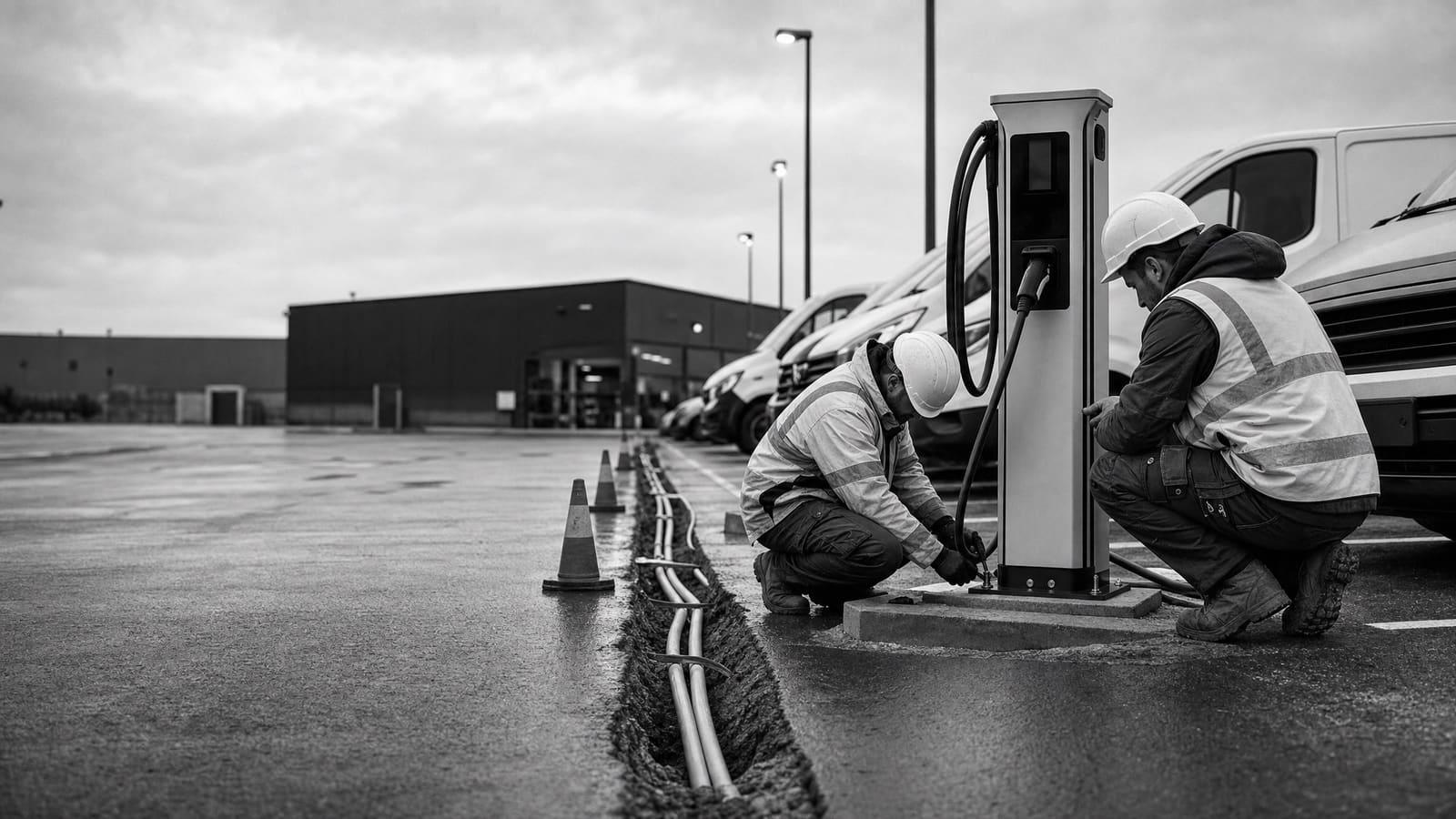
The review should begin at the electrical service and end at the proposed charging spaces. The contractor should document service and panel information, existing loads, usable breaker space, meter locations, and potential equipment locations. The review should also trace realistic conduit paths rather than measuring a straight line across the property.
At the parking area, confirm stall use, vehicle orientation, cable reach, protective barriers, drainage conflicts, communications coverage, signage, security, and accessibility needs. Note where trenching crosses pavement, landscaping, sidewalks, or active traffic. These details affect both construction and daily use.
The assessment should then test the charging plan against available power. If the requested load does not fit, compare managed charging, lower power per port, staged activation, and an electrical upgrade. Each option should state how it changes charging performance. The result should be a written basis of design that identifies the intended users, port count, charger type, estimated electrical demand, construction route, approval needs, and expansion strategy.
Ask for an expansion-ready design
Future capacity may be supported through planned panel space, equipment placement, conduit pathways, and controls. The quote should separate work needed now from infrastructure reserved for later.
Ownership and operation
Decide who controls the stations after construction
Commercial charging continues to create work after energization. Someone must manage access, pricing, software accounts, driver questions, repairs, and reporting. Ownership can stay with the property, sit with a charging provider, or be divided through a service agreement. Review the full arrangement, including ongoing fees and control of operating data.
Networked equipment can provide payment tools, session records, remote monitoring, and power management. It can also create subscriptions and dependence on software support. Non-networked equipment can be simpler, but it may not meet a property that needs billing, permissions, or detailed use records. Choose the operating model before signing the equipment order.
Property controlled
More direct control
The owner sets access and operating rules but must assign responsibility for software, maintenance, driver support, and replacement planning.
Service supported
More outside help
A provider may handle key operating tasks, but the agreement should define fees, data access, uptime duties, and exit terms.
Procurement and phasing
Buy the system, not just the charging stations
Procurement should follow the approved operating plan and basis of design. Confirm that proposed equipment works with the vehicles, electrical design, communications method, payment plan, and mounting location. Review lead times before setting the construction schedule. A substitute charger may change breaker sizes, conductors, mounting details, software, or connector support, so substitutions need technical review.
For a growing program, phase the project deliberately. The first phase can build the backbone and activate only the ports needed now. Later phases can add stations as use grows. That approach works only when the early design reserves useful capacity and pathways. Empty conduit without a clear endpoint or electrical plan may offer little value.
Compare lifetime obligations as well as construction scope. Include network subscriptions, transaction charges, communications, preventive maintenance, repair response, warranty limits, replacement parts, and staff time. Managed charging may reduce peak demand or avoid unnecessary infrastructure, but it must still deliver the energy vehicles need. For a separate discussion of project pricing, see commercial EV charging costs.
Quote comparison
Five things every comparable quote should show
A clear quote states assumptions, exclusions, and responsibilities. If one proposal leaves out civil work, utility coordination, networking, or commissioning, its total is not comparable.
01
Defined charging outcome
Port count, power, users, parking time, access rules, and future phase.
02
Complete electrical scope
Load basis, panels, protection, conduit, conductors, metering, and service assumptions.
03
Civil and parking work
Trenching, restoration, pads, mounting, barriers, signage, striping, and accessibility scope.
04
Approvals and coordination
Engineering, permit tasks, inspections, utility responsibilities, schedule dependencies, and stated exclusions.
05
Activation and turnover
Network setup, test sessions, training, warranties, documents, maintenance options, and acceptance criteria.
Keep planning locally
Related EV charging pages in Arvada
Get a defensible number
Price the equipment and the building together.
Send the address, operating target, and target opening date. Flux will identify what must be verified before the project can be priced.
Price my chargersQuestions
Straight answers.
What does a commercial EV charger installation include?
A complete project includes site assessment, electrical load review, charger selection, design, utility coordination, permit work, electrical and civil construction, equipment installation, network setup, inspection, commissioning, training, and turnover documents. The contract should state who owns every task.
Should our property use Level 2 or DC fast charging?
Use parking time and required energy to decide. Level 2 often fits vehicles parked for hours. DC fast charging fits short stops or tight fleet turnarounds, but it can require much larger electrical infrastructure. A mixed site may use both.
Can chargers fit on our existing electrical service?
Possibly, but a load assessment must confirm it. The design can compare available capacity with charger demand and building loads. Managed charging, scheduled charging, reduced port power, or phased activation may help before a service upgrade is considered.
What causes commercial EV installation costs to vary?
Major variables include available electrical capacity, equipment power, charger count, distance to parking, trenching and restoration, switchgear or transformer needs, network features, accessibility work, approvals, and future expansion. See the [commercial EV charging cost guide](/arvada-co/ev-charging/cost/) for a focused budget discussion.
Does the utility need to be involved?
Utility coordination may be needed when the project changes service, metering, transformers, or site demand. The installation team should identify this need during planning, define who submits information, and show utility work as a schedule dependency.
Should we buy networked chargers?
Choose networked equipment when you need payment, user permissions, session data, remote monitoring, or managed power. Review software fees, communications, data access, support, and what happens if the network agreement ends. Simpler equipment may work when those features are not needed.
How should we plan for more chargers later?
Set a future port count during design, then reserve practical electrical capacity, equipment space, conduit routes, communications, and control features. The proposal should distinguish installed work from future-ready work and explain what later construction will still be required.
What happens during commissioning?
Commissioning should verify installation, protection, communications, software settings, access rules, and charging at every port. Turnover should include test results, equipment records, warranties, account access, operating instructions, and a clear process for service calls.
Sources used for this guide
- [1]afdc.energy.gov — Alternative Fuels Data Center: Procurement and Installation for Electric Vehicle Charging Infrastructure
- [2]betterbuildingssolutioncenter.energy.gov — DOE Better Buildings Commercial EV Charging Infrastructure Guide
- [3]driveelectric.gov — Public electric vehicle charging infrastructure playbook · Joint Office of Energy and Transportation
- [4]energy.gov — DOE Federal Workplace Charging Program Guide