The direct answer
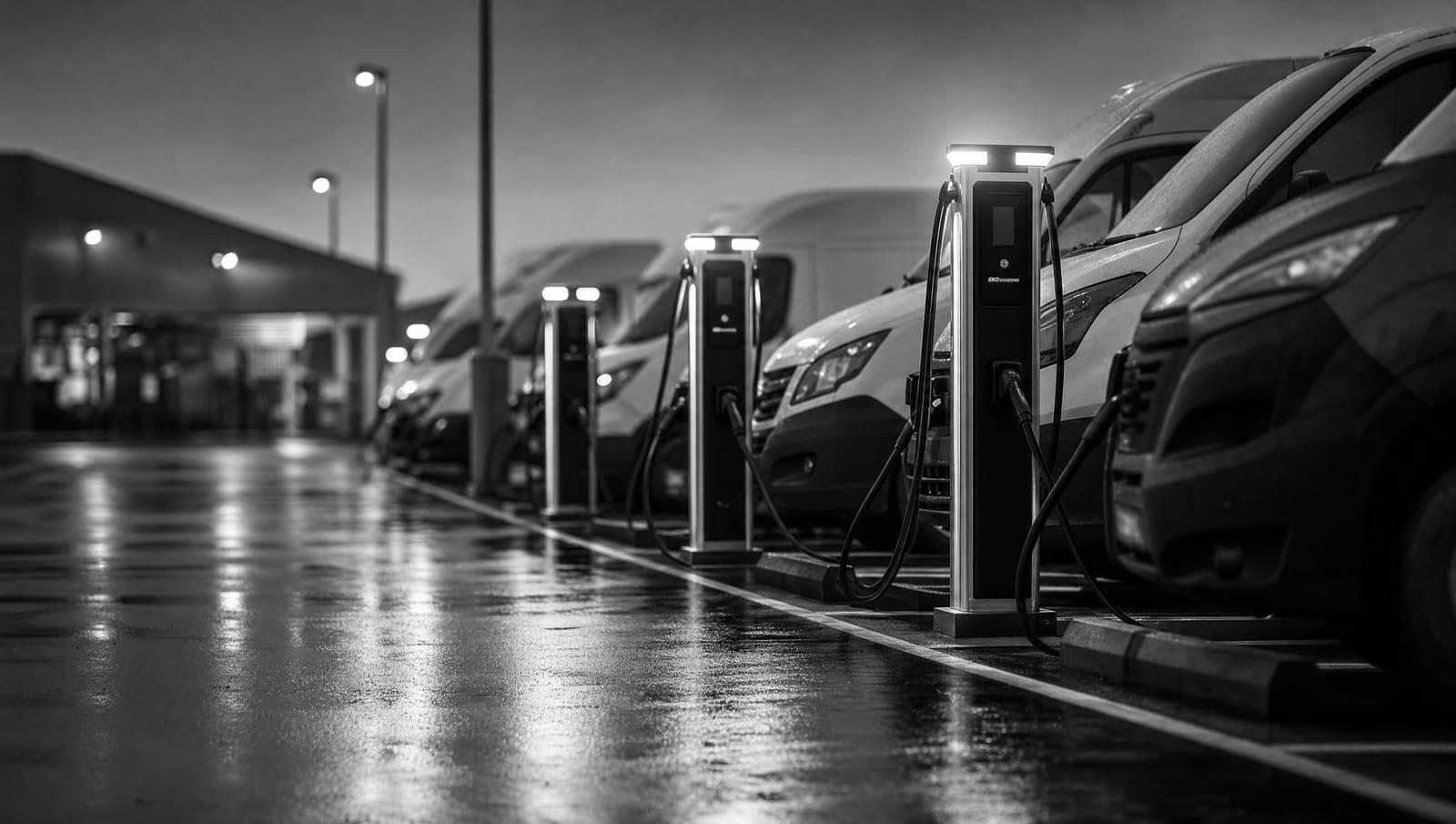
Commercial EV charger installation in Antioch.
A complete commercial installation covers the site and electrical assessment, charger selection, utility coordination, design, permitting, construction, inspection, network setup, commissioning, and turnover. Level 2 charging often connects through commercial distribution equipment. DC fast charging places much greater demand on the service, so utility equipment and electrical upgrades may become major parts of the plan.
The site review must verify electrical capacity, charging demand, cable routes, parking use, communications, accessibility needs, and room for future ports.
Start with operations
Choose charging around vehicles, not product brochures
The right station is the one that delivers enough energy before a vehicle must leave. Begin with who will charge, when vehicles arrive, how long they remain parked, and how much energy they need. A workplace may have many hours to complete a session. A fleet vehicle may return with a low battery and need to leave again on a fixed schedule. Public charging may need access controls, payment, driver support, and clear parking rules.
These details affect charger power, port count, electrical demand, software, and ownership. They also determine whether charging can be shared across vehicles or must be available at assigned spaces. Define the operating model before equipment is ordered. Otherwise, the property may pay for speed it does not need or install too little capacity for the actual schedule.
Quote structure
Where project uncertainty enters the budget
A useful budget separates equipment from the work needed to serve it. Review these lines before comparing totals or reading more about commercial EV charging costs.
Equipment choice
Level 2 and DC fast charging create different projects
Level 2 equipment sends AC power to the vehicle, where onboard hardware converts it for the battery. It commonly fits workplaces, multifamily properties, fleets with long parking windows, and visitor spaces where drivers remain for hours. The design still must account for simultaneous demand, circuiting, cable reach, communications, and future expansion.
DC fast equipment performs the AC-to-DC conversion outside the vehicle. That changes more than charging speed. Higher power can affect the service, transformer, switchgear, protective equipment, equipment pad, cooling, and utility coordination. A buyer should not select DC fast charging until the team has tested the required energy against vehicle dwell time and site capacity.
Connector support also matters. Confirm the vehicles that will use each port, any adapter policy, cable length, and how equipment changes could be handled later. For a mixed vehicle population, write compatibility requirements into procurement documents instead of relying on a salesperson's general assurance.
Project complexity
What makes one installation simpler than another
Charger count alone does not define project difficulty. Existing capacity, the distance to parking, construction surfaces, communications, operating hours, and utility involvement can change the scope.
Lower complexity
Capacity and parking are already aligned
The distribution system has usable capacity, charging spaces sit near electrical equipment, routing is direct, communications are available, and the planned load fits operations.
Higher complexity
Power or routing needs major work
The project needs service changes, long underground routes, substantial pavement restoration, new distribution equipment, phased shutdowns, or extensive utility coordination before chargers can operate.
Site assessment
A good site review answers the expensive questions first
The assessment should document the electrical service, meters, panels, major loads, available space, and the route from power to parking. The team should compare existing demand with the proposed charging load instead of relying only on equipment nameplates. It should also identify where new breakers, panels, switchgear, transformers, or metering could fit.
In the parking area, review stall use, circulation, cable reach, mounting locations, protection from vehicles, signage, lighting, security, and the work needed to restore finished surfaces. Confirm whether stations need cellular service, wired data, or another reliable connection. Public or shared stations may also need payment, user authentication, pricing rules, and a process for driver support.
The result should be a written basis of design. It should state the vehicle assumptions, charging window, required energy, proposed port count, power per port, expected simultaneous load, expansion plan, and unresolved risks. That document gives the designer, utility, equipment supplier, and installer the same target.
Ask for two layouts when routing is uncertain
A shorter electrical route may conflict with parking operations. Comparing practical alternatives early can expose tradeoffs in trenching, shutdowns, cable reach, visibility, and future expansion.
Operating model
Decide who owns the equipment and who runs the service
Commercial charging continues to create work after construction. Someone must set access rules, watch station status, answer driver questions, manage payment if used, arrange repairs, and review energy use. The property can own and operate the system, hire outside support, or divide responsibilities.
Put the chosen model in the procurement documents. Identify who controls pricing and data, who holds network accounts, what happens if a software service ends, and how station access transfers if the operator changes. Ownership should not depend on an account that the facility cannot administer.
Property controlled
The facility owns the customer relationship
This can preserve control over access, pricing, data, and hardware decisions, but the owner needs clear maintenance and support responsibilities.
Service supported
An outside provider handles defined operations
This may reduce daily administration, but contract terms should cover fees, data access, response times, account transfer, and the end of service.
Phasing and procurement
Build the first phase without trapping the second
A phased project can limit the first purchase while preparing the site for more vehicles. Future-ready work may include space in electrical equipment, planned panel locations, spare pathways, larger conduit where justified, pull points, reserved equipment pads, communications capacity, and parking layouts that can accept more ports. These items should follow a real expansion forecast, not an undefined promise to add chargers someday.
Before procurement, confirm whether the organization needs a formal solicitation. Write performance needs instead of naming features without a business reason. Include supported vehicles, required energy by departure, environmental rating, cable management, communications, payment, data export, warranty, parts availability, and service expectations. Confirm equipment logistics and delivery timing before construction sequencing is fixed.
Review lifetime cost as well as purchase price. Network fees, payment processing, electricity rates, maintenance, replacement parts, warranties, software support, and demand management can affect the operating result. Any incentive or tax credit should be checked for current eligibility at the facility's exact location before it enters the approved budget.
Design and construction
How the installation moves from concept to working ports
After the operating plan and site assessment are complete, the team develops the electrical and civil design. The utility should be engaged when the requested load may affect service capacity, metering, rates, or utility equipment. Equipment should not be released solely to protect a hoped-for schedule while major power questions remain open.
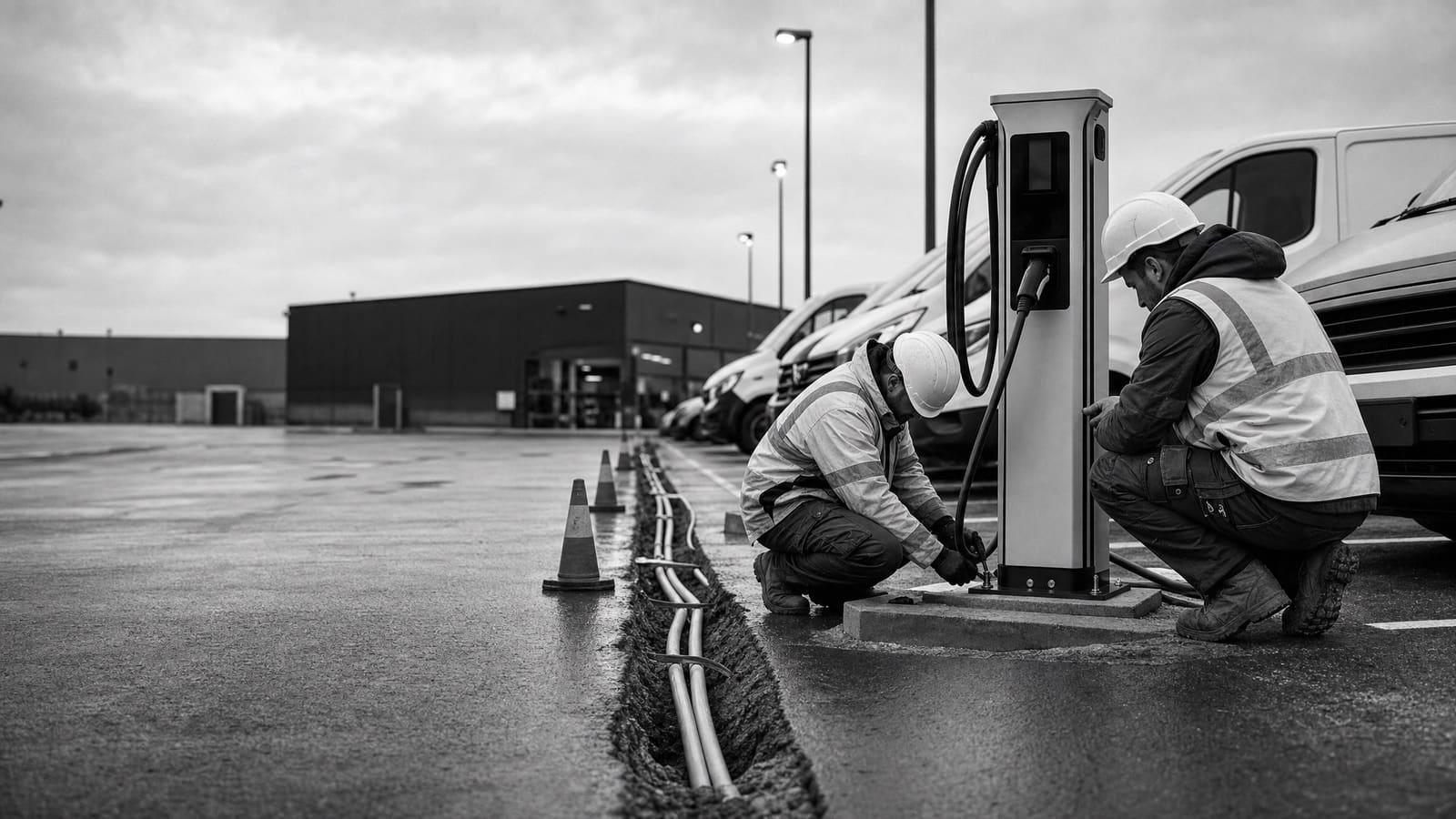
Permit documents are then submitted to the authority responsible for review. Comments, required revisions, inspections, and approval milestones should appear in the project schedule. Construction can include distribution equipment, conduit, conductors, trenching, concrete pads, mounting hardware, protective barriers, signage, communications, and pavement restoration. Work may need to be phased around building loads and parking access.
Once energized, every port should be commissioned. The team should verify safe operation, communication, user access, payment functions when provided, load controls, station labels, and test charging. Turnover should include approved drawings, equipment records, warranties, network credentials, training, maintenance instructions, and open-item ownership.
Utility review and permit review are separate tracks
A permit does not prove that utility capacity is ready. The schedule should show who owns each submission, what information is still needed, and which approval controls energization.
Comparable proposals
Five things every quote should show
Compare the same scope, assumptions, and exclusions—not just the bottom line. A credible proposal should make these five items easy to find.
01
A defined charging basis
Vehicle types, dwell times, required energy, port count, charger power, and simultaneous-load assumptions.
02
A complete scope boundary
Design, utility coordination, permits, equipment, construction, networking, commissioning, restoration, and turnover.
03
Named allowances and exclusions
Utility charges, concealed conditions, paving, network fees, service upgrades, and owner-furnished work.
04
A milestone schedule
Design, submissions, approvals, equipment delivery, shutdowns, construction, inspection, energization, and closeout.
05
Operating support
Warranty, monitoring, maintenance, response process, training, software terms, and account ownership.
Keep planning locally
Related EV charging pages in Antioch
Get a defensible number
Price the equipment and the building together.
Send the address, operating target, and target opening date. Flux will identify what must be verified before the project can be priced.
Price my chargersQuestions
Straight answers.
What does a commercial EV charger installation include?
A complete scope normally includes site assessment, load review, charger and software selection, design, utility coordination, permitting, electrical and civil construction, inspections, network activation, commissioning, training, and turnover documents. The proposal should say which party owns every step.
Should our facility install Level 2 or DC fast chargers?
Choose from the vehicle schedule. Level 2 often fits vehicles parked for hours. DC fast charging fits shorter stops or demanding fleet cycles, but it can require much more service capacity and utility coordination. Some properties need a mix.
Can chargers use our existing electrical service?
Possibly, but the answer requires a load assessment. The team should compare building demand and charging demand, then test charger power, port count, scheduling, and load management. If those measures cannot meet the operating goal, the design may need distribution or service upgrades.
What information should we prepare before a site assessment?
Gather electrical drawings if available, utility bills or demand records, parking plans, vehicle types, arrival and departure times, daily energy needs, expected growth, access rules, payment needs, and any limits on shutdowns or construction hours.
When should the utility become involved?
Engage the utility during planning when charging could affect service capacity, transformers, metering, rates, or other utility equipment. Early coordination helps identify required studies, information, costs, and schedule dependencies before equipment and construction commitments are made.
Do commercial chargers need networking?
Not every station needs it. Networking can support access control, payment, utilization data, remote monitoring, pricing, and load management. It also creates software fees and account responsibilities. Select it only when those functions serve the operating plan.
How should incentives be handled in the budget?
Treat every incentive and tax credit as time-sensitive. Verify the facility address, eligible costs, application timing, equipment rules, labor requirements, and current program status before counting any benefit. Keep the base project budget visible in case an application is delayed or denied.
What should happen during commissioning?
Every port should complete a test session. The team should verify electrical operation, communications, authentication, payment where used, load controls, labels, cable reach, and station status reporting. Turnover should include credentials, warranties, approved drawings, training, and maintenance instructions.
How can we prepare for more chargers later?
Define a realistic future port count and power need. Then evaluate spare equipment space, conduit, pull points, panel locations, communications, reserved pads, parking layout, and load controls. Future-ready construction is useful only when it supports a documented expansion plan.
How do we compare commercial EV installation proposals?
Normalize the charger count, power, construction route, utility assumptions, restoration, networking, commissioning, warranties, and exclusions. Check allowances carefully. A low total may leave utility work, paving, software, service upgrades, or closeout outside the quoted scope.
Sources used for this guide
- [1]afdc.energy.gov — Alternative Fuels Data Center: Procurement and Installation for Electric Vehicle Charging Infrastructure
- [2]betterbuildingssolutioncenter.energy.gov — DOE Better Buildings Commercial EV Charging Infrastructure Guide
- [3]driveelectric.gov — Public electric vehicle charging infrastructure playbook · Joint Office of Energy and Transportation
- [4]energy.gov — DOE Federal Workplace Charging Program Guide