THE DIRECT ANSWER
What a commercial HVAC replacement includes
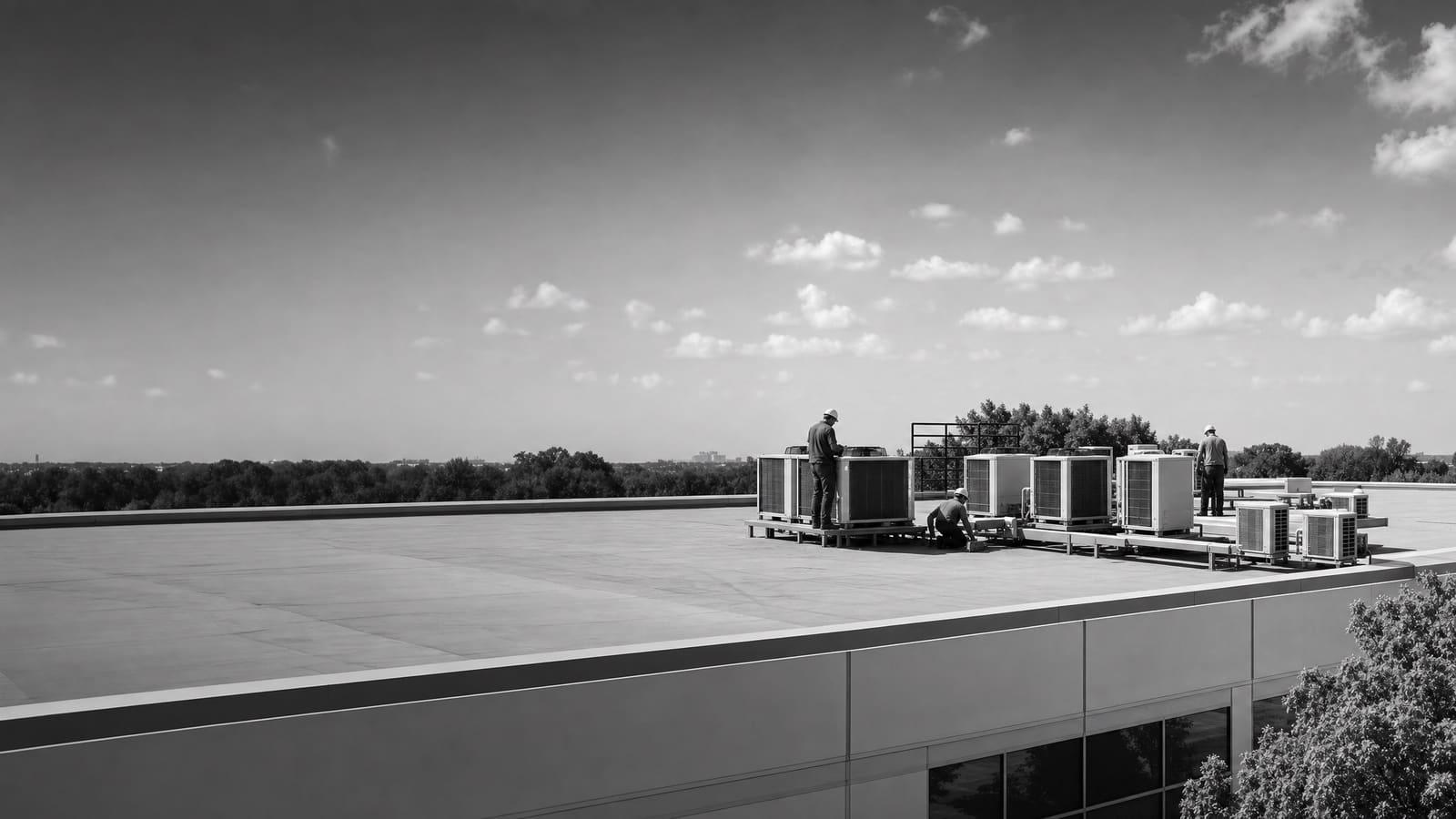
A commercial HVAC replacement covers a confirmed load calculation, equipment selected against real lead times, rigging and set, gas, electrical and refrigerant connections, controls integration, and documented commissioning. Replacement beats another repair once a unit is past roughly 15 years and needs frequent service. DOE puts the energy waste of an old, inefficient rooftop unit at $900 to $3,700 per unit each year, which is often larger than the repair invoice keeping it alive.
A site review still sets the number. It has to confirm tonnage against current use, curb fit and condition, crane access to the roof, and whether existing gas and electrical service supports the unit you want.
THREE WAYS TO PLAY IT
Run to failure, swap like-for-like, or upgrade
DOE's rooftop unit guidance frames this as three paths, and most buildings fall into the worst one by default. Replacing on failure means an in-season outage, emergency labor, and whatever unit a distributor happens to have that week. A planned like-for-like swap at the end of service life is calmer and cheaper to engineer, but it carries the old unit's sizing and efficiency tier forward for the life of the new equipment. Replacing an inefficient, underperforming unit before it quits is usually the stronger business move, because an old rooftop unit is already burning $900 to $3,700 a year on energy it does not need to use. Units past 15 years old are where that waste concentrates. The useful exercise is to price all three, put a date next to each one, and make the call in a budget cycle instead of on a phone call at six in the morning.
WHAT MOVES THE NUMBER
Where a commercial HVAC installation budget goes
There is no universal installed price for a commercial unit, and a quote that gives you one before seeing the roof is a guess. These are the lines that actually move, roughly in order of how much they swing between two buildings on the same street.
IN PRACTICE
Pick the equipment before you pick the price
Start with the load, not the nameplate. A unit installed twenty years ago was sized for the occupancy, lighting, and plug load that building had then, and almost none of those are the same now. A load calculation against current use tells you whether you are buying the same tonnage, less, or more, and that one answer moves the curb, the electrical, and the price.
Then decide the fuel. A heat pump rooftop unit is mechanically close to a standard air-conditioning unit but also heats by running the cycle in reverse. DOE sorts them into three families: dual fuel, all-electric, and cold climate. Heat pump heating efficiency falls as outdoor temperature drops, and toward the bottom of the range it converges with electric resistance heat. So the honest test is your building's winter heating load and design temperature, not a brochure. Dual fuel keeps gas heat as backup and is the low-risk answer when the heating hours are real.
Last, check availability before you commit to a model. Equipment lead time sets your install date far more often than the crane schedule does, so ask for a ship date in writing next to the price.
COMPLEXITY CHECK
What makes this a short job or a long one
Two replacements can carry identical tonnage and land weeks apart on the calendar. The difference is almost never the unit itself. It is what the unit touches: the curb, the fuel, the panel, and the path a crane has to take to reach the roof.
LOWER COMPLEXITY
Same footprint, same fuel
Matching tonnage on the existing curb, unchanged gas and electrical service, an open lot for the crane, and controls that already speak the same language. Permits stay mechanical and electrical, the set happens in a morning, and tenants see traffic cones instead of an outage.
HIGHER COMPLEXITY
New capacity, new fuel, tight access
More tonnage or a heavier unit brings structural review. Going all-electric can mean a larger feeder or panel work, and retiring gas heat means capping lines. Add a courtyard roof, a shared drive, or a night-only crane window and the schedule stretches past the equipment lead.
SCOPING THE WORK
What a site review has to settle before a price is real
A quote written from a nameplate photo is a starting point, not a price. Before anyone commits to a number, someone should be on the roof with a tape measure and a meter.
The curb comes first. Its dimensions decide whether an adapter is enough or the opening has to be reframed, and its condition decides whether the membrane gets patched or reworked around the new unit. Next is capacity in the building rather than the unit: available breaker space, feeder size, and panel condition tell you whether an all-electric option is a purchase or a project. Gas piping gets the same look, since dual fuel keeps it and all-electric retires it.
Then access. Crane reach from the nearest set-down point, lot closure hours, tenant loading times, and overhead lines determine the rigging plan and how much of the lot you give up for a day. Finally controls: how the existing system sequences, what it reports, and whether the new unit joins that system or replaces it.
Refrigerant gets settled here too. The old charge has to be recovered by a certified technician under federal rules before the unit ever leaves the roof.
Send these three things first
A photo of the existing curb with dimensions, a photo of the electrical panel showing available breaker space, and the crane set-down point marked on a lot plan. Those attachments turn a range into a price and head off most change orders.
AFTER THE SET
Two decisions that outlive install day
The installation is a few weeks of attention. The unit is a decade or more of operating decisions, and two of them get made at purchase whether you think about them or not.
The first is service. Refrigerant handling in commercial equipment is federally regulated. Recovery, leak repair, and recordkeeping fall under EPA Section 608, and the work belongs to certified technicians. A roof running two or three different refrigerants needs a service contract and a parts strategy that cover all of them.
The second is standardization. Every new model on the roof is another set of filters, belts, boards, and controller quirks your maintenance team has to learn. Buying whatever is cheapest each time is how a building ends up with a roof of one-offs and a parts shelf that fits none of them.
OPERATING
Plan for a mixed fleet
Most roofs get replaced one unit at a time, so mixed refrigerants and mixed control platforms are normal rather than a mistake. Put that in the service contract up front instead of discovering it on the first hot call of the season.
CAPITAL
Match the spend to the lease
A high-efficiency unit pays back through energy over years. If the tenant pays the utility bill and the lease has three years left, settle who captures that saving before you approve the upgrade tier.
PLANNING AHEAD
Phasing a roof full of units
If you own more than one unit, stop treating replacement as an event and start treating it as a schedule. Pull age, tonnage, and service history for every unit on the roof, then sort by age and repair spend. Two or three units usually account for most of the drama and most of the waste.
Phasing beats waiting for three reasons. You buy in a normal procurement window instead of an emergency one. You can standardize on a model line, so the second and third installs go faster and the parts shelf finally makes sense. And you can line the work up against a capital calendar instead of an outage.
The payoff is not theoretical. Through DOE's rooftop unit campaign, more than 200 organizations upgraded over 43,000 units and cut a combined $37 million a year from their energy bills. The high-efficiency designs that came out of the same program were specified to cut unit energy use by up to half against the older standard, and more than twenty models now exceed that specification.
For a single building, the practical version is simple: replace the oldest, hardest-working unit first, standardize on what you install, and let the rest follow a dated plan.
BEFORE YOU SIGN
Five things a comparable quote must show
Two quotes are only comparable when they show the same things. If any of these is missing, you are comparing a price to a guess. Ask for all five in writing.
01
The load basis
Whether the tonnage came from a current load calculation or the old nameplate, and which one you are buying.
02
Equipment and ship date
Model, efficiency tier, heating type, and a written lead time sitting next to the price.
03
Curb, structure, and roofing
Adapter or reframe, any framing work, and who patches the membrane around the new unit.
04
Rigging and lot plan
Crane size, set-down point, closure hours, and who coordinates tenants and traffic control.
05
Startup and closeout
Charge, airflow, economizer, and control sequences verified and documented, with permits and inspections included.
Keep planning locally
Related mechanical pages in Reno
Get a defensible number
Price the equipment and the building together.
Send the address, operating target, and target opening date. Flux will identify what must be verified before the project can be priced.
Get a free estimateQuestions
Straight answers.
When does replacement beat one more repair?
Once a unit is past about 15 years and needs frequent service, the repair invoice is only part of what you are paying. DOE puts the annual energy waste of an old, inefficient rooftop unit at $900 to $3,700. Compare the repair against that yearly number, not against the price of a new unit alone.
Should the new unit be a heat pump or a like-for-like gas unit?
It depends on your heating load and electrical capacity. Heat pump rooftop units come in dual fuel, all-electric, and cold climate versions, and heating efficiency drops as outdoor temperature falls. Dual fuel keeps gas heat as backup and is the low-risk answer. All-electric needs a check on breaker space and feeder size first.
How much does commercial HVAC installation cost?
There is no honest universal price, because tonnage, efficiency tier, curb work, electrical changes, and crane access all move it. Anyone quoting a flat number before seeing the roof is guessing. Get a site review, then a line-item price you can compare against a second bid on the same scope.
What sets the install date?
Equipment lead time, more often than crane scheduling or permits. Availability varies by model, tonnage, and configuration, so ask for the ship date in writing alongside the price. If a unit is down and the space is unusable, availability may matter more than the efficiency tier you wanted.
What happens to the refrigerant in the old unit?
It has to be recovered before the unit comes off the roof. EPA Section 608 rules govern handling, recovery, leak repair, and recordkeeping for stationary air-conditioning and heat pump equipment, and the work requires a certified technician. That step belongs in the quote, not as a surprise line later.
Sources used for this guide
- [1]betterbuildingssolutioncenter.energy.gov — DOE Advanced Rooftop Unit Replacement Guidance
- [2]betterbuildingssolutioncenter.energy.gov — DOE Commercial Heat Pump Rooftop Unit Replacement Guidance
- [3]betterbuildingssolutioncenter.energy.gov — DOE High-Efficiency Commercial Rooftop Unit Toolkit
- [4]energy.gov — DOE Efficient Commercial Rooftop Air Conditioner Program
- [5]epa.gov — EPA Stationary HVAC Refrigerant Management