The direct answer
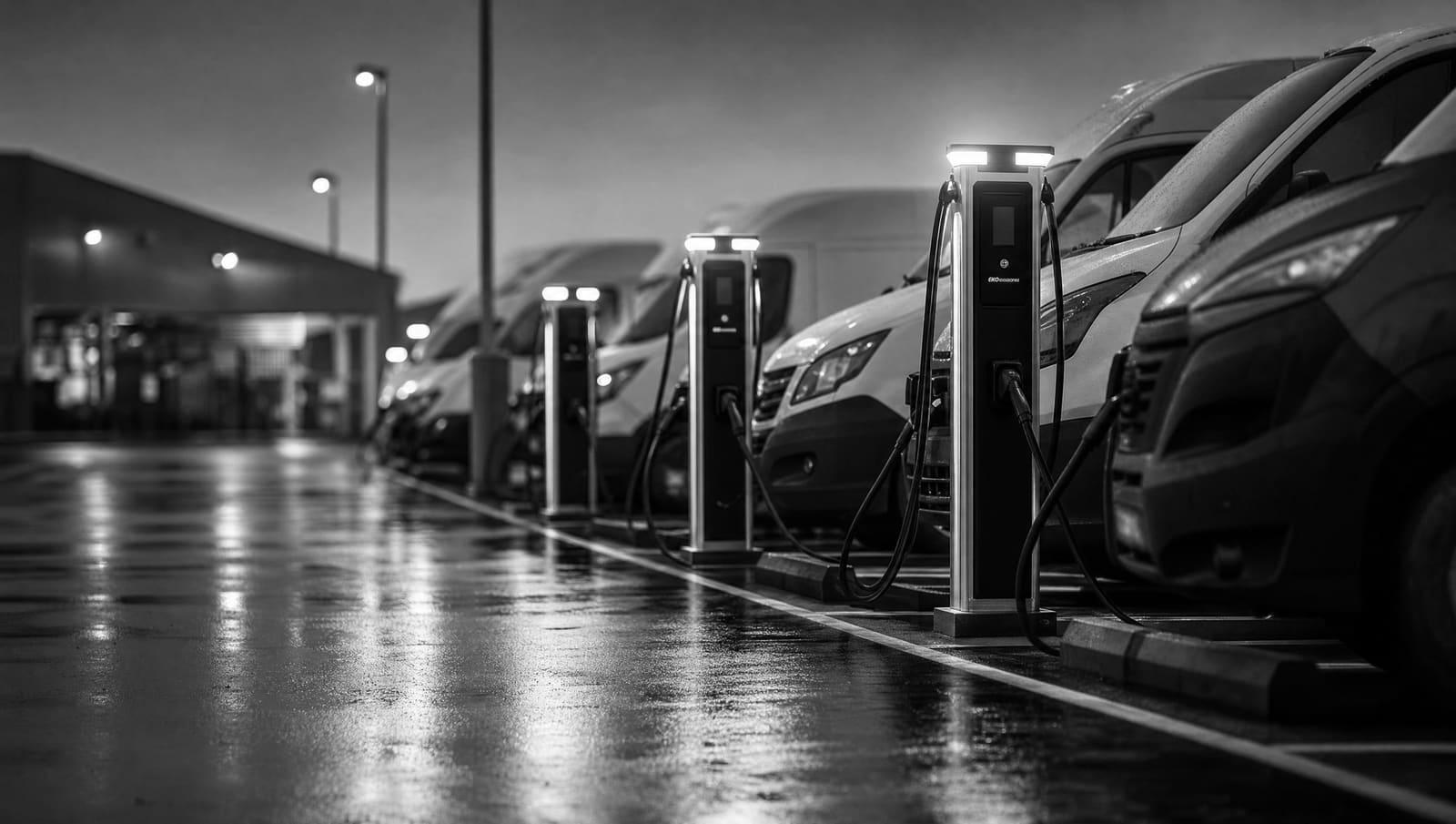
Commercial EV charger installation in Portland.
A commercial installation starts with vehicle needs, parking use, electrical capacity, and the route to each charging space. The full project then covers utility coordination, design, permits, equipment procurement, civil and electrical construction, inspections, network setup, test charging, and turnover. Level 2 often fits longer parking stays. DC fast charging requires a closer review of service capacity, utility work, and operating demand.
The site review must verify actual panel and service capacity, charger locations, cable reach, trenching, communications, accessibility needs, and space for future expansion.
Set the operating plan
Make three choices before selecting a charger
Start with the vehicles, not a product catalog. Ask who will charge, how long each vehicle stays, and how much energy it needs before leaving. A workplace with cars parked for hours has a different problem from a fleet that must return to service quickly. Public charging adds payment, access, signage, support, and driver communication decisions.
Next, decide whether every port must deliver full power at the same time. Network controls may share available capacity across several ports. That can change the electrical design, but it must still support the daily charging goal.
Finally, define who owns and operates the system. The owner may buy the chargers and network service, or another party may hold some operating duties. Put payment processing, data access, software fees, maintenance, warranties, and replacement duties in writing before procurement.
Scope before price
The installation budget is more than the chargers
A useful budget separates equipment from the work needed to supply, place, connect, approve, and operate it. For broader cost planning, see commercial EV charging costs.
Equipment fit
Choose Level 2 or DC fast charging from the operating need
Level 2 charging uses AC power, with the vehicle converting that power for its battery. It is often considered for workplaces and other settings where vehicles remain parked long enough to receive useful energy over time. Its lower power demand can make it easier to place several ports on a commercial property, especially when the design includes networked load controls.
DC fast charging converts power outside the vehicle and delivers DC power to the battery. It serves a different operating goal: moving more energy during a shorter stop. That benefit brings larger electrical loads, added equipment, and closer coordination with the utility. The project may need dedicated distribution equipment, a different service strategy, cooling considerations, protective equipment, and more space.
Do not compare Level 2 and DC fast charging only by nameplate power. Compare them by energy delivered during the real parking window. Also confirm which vehicles and connector protocols must be supported. A charger cannot solve a schedule mismatch, an incompatible vehicle interface, or an electrical design that assumes every vehicle will behave the same way.

Complexity check
What makes one installation simpler than another?
The same charger can sit inside very different construction scopes. The fastest way to understand the project is to trace power from the utility connection to the charging spaces.
Lower complexity
Existing capacity and a short route
A project is easier to plan when verified capacity is available, charging spaces sit near suitable distribution, trenching is limited, communications are reliable, and the first phase does not block later expansion.
Higher complexity
New capacity and major site work
Complexity rises when the service needs changes, power must cross finished pavement, DC fast charging adds large loads, parking must remain active during construction, or several owners control the affected property.
Site assessment
A good site review turns goals into a buildable scope
The review should begin with the operating target: vehicle count, arrival pattern, parking duration, energy needed, public or private access, and planned growth. The electrical team can then inspect available records and field conditions. It should identify the service, meters, switchboards, panels, protective devices, spare positions, equipment ratings, and likely path to the charging area. A load calculation is part of the design process; an empty breaker space alone does not prove usable capacity.
Outside the electrical room, review stall dimensions, charger mounting, cable reach, vehicle circulation, accessible use, signage, security, lighting, drainage, communications, and protection from vehicle impact. Trace the proposed conduit route and note every surface that may need to be opened and restored. Confirm where new electrical equipment could go without blocking access or future work.
The review should also record assumptions that cannot yet be confirmed. Utility capacity, underground conflicts, permit conditions, equipment lead times, and final network requirements may need later verification. A strong proposal names those open items instead of hiding them in a broad allowance.
Ask for a marked site plan
It should show charger positions, electrical equipment, conduit routes, trenching, protective features, affected parking, communications, and future expansion areas. That drawing makes competing scopes much easier to compare.
Portland planning
Check the current land-use and building rules before final siting
A 2023 Portland EV-ready planning document discussed how charging equipment could interact with a required five-foot perimeter landscape buffer. It recommended allowing equipment to occupy no more than two feet of that buffer. The document also discussed EV chargers in relation to upgrades for nonconforming development.
That record is useful design context, but it was a recommended draft. It does not, by itself, prove the rule in force in August 2026. Before freezing the parking layout, confirm the current zoning, landscape, building, electrical, accessibility, and permit requirements for the exact property. This matters when a charger, pedestal, cabinet, bollard, or new electrical enclosure is planned near a landscape edge or other regulated site feature.
Do not design from the historical draft alone
Have the current requirements confirmed for the property before ordering equipment or issuing construction drawings. A small siting change can affect cable reach, conduit length, parking use, and restoration.
After energization
Plan ownership and uptime before the system goes live
Commercial charging combines electrical equipment, software, communications, parking rules, and driver support. A construction handoff is not complete unless the owner knows who manages each part.
For networked stations, decide who controls user access, pricing, payment settings, notifications, reporting, and software accounts. Confirm what happens if cellular or internet service fails. Keep ownership of operating data and administrative credentials clear.
For all stations, set a process for inspections, cleaning, cable care, fault response, warranty claims, and replacement parts. Public and fleet charging may need faster response than employee charging because one unavailable port can disrupt customers or vehicle schedules. The operating plan should match that risk.
Commercial terms
Know what continues after construction
List network subscriptions, transaction charges, support plans, warranties, software renewal terms, data access, and any limits on changing providers or equipment settings.
Service plan
Assign fault response and maintenance
Name who receives alerts, performs remote checks, visits the site, supplies parts, handles driver reports, and confirms that a repaired port can complete a test session.
Build for the next phase
Phasing can protect capital without limiting growth
The first phase does not need to install every future charger. It should avoid making the next phase tear out finished work. During design, compare the near-term port count with the long-term parking and vehicle plan. Consider conduit capacity, panel space, equipment pads, communications, and routes that could serve later charging spaces. Future work still requires engineering and approval, but thoughtful make-ready work can reduce avoidable disruption.
Phasing also helps when usage is uncertain. Start with a defined group of drivers or vehicles, collect utilization and energy data, and compare results with the operating target. That evidence can guide the timing and size of the next phase. Do not let a pilot become an unplanned permanent system with no capacity for growth.
Procurement should follow the approved design. Confirm equipment ratings, mounting method, connector needs, network compatibility, environmental suitability, delivery terms, warranty support, and replacement options before release. If incentives or tax treatment matter to the decision, verify current eligibility and deadlines with the responsible program or tax adviser. Time-sensitive support should never be treated as secured until its current terms and site eligibility are confirmed.
Compare proposals
Five things every comparable quote should show
Compare scope, assumptions, exclusions, and operating duties—not only the total. Each bidder should price the same charger count, power plan, site route, and turnover requirements.
01
Design basis
Port count, charger type, power per port, load controls, vehicles, parking schedule, and future phase assumptions.
02
Electrical and civil scope
Service work, panels, conduit, conductors, trenching, pads, bollards, paving, striping, signage, and restoration.
03
Approvals and utility duties
Drawings, permit submittals, fees, inspections, utility applications, metering work, and responsibility for corrections.
04
Equipment and operating terms
Exact models, warranties, network features, subscriptions, payment costs, software access, support, and delivery assumptions.
05
Commissioning and turnover
Port-by-port test sessions, network activation, settings, training, records, warranties, closeout documents, and unresolved items.
Keep planning locally
Related EV charging pages in Portland
Get a defensible number
Price the equipment and the building together.
Send the address, operating target, and target opening date. Flux will identify what must be verified before the project can be priced.
Price my chargersQuestions
Straight answers.
What is included in commercial EV charger installation?
A complete scope normally covers site and electrical assessment, charging design, utility coordination, permits, equipment procurement, civil and electrical construction, inspections, network activation, test charging, and owner turnover. The proposal should clearly identify exclusions and work assigned to others.
Should our Portland property use Level 2 or DC fast charging?
Choose from parking time and required energy. Level 2 often fits vehicles parked for longer periods. DC fast charging fits shorter turnaround needs but creates a larger electrical and utility planning task. A charging schedule based on real vehicles is more useful than choosing by maximum charger power.
Can our existing electrical service support several chargers?
That requires a load review. The team must examine the service and distribution equipment, existing demand, proposed charger loads, and any load-management plan. Spare panel positions do not prove spare electrical capacity. Utility review may also be needed, especially for larger loads.
Can load management avoid an electrical service change?
Load management can limit or share charger demand and may help a design fit within available capacity. It is not an automatic substitute for an upgrade. The controls must still deliver enough energy during the available parking window, and the final electrical design must be approved.
What should happen during commissioning?
Each port should be energized, configured, and tested with a charging session. Networked stations should be checked for communications, access rules, payment settings, alerts, and reporting. Turnover should include administrative access, equipment records, warranties, training, and a list of unresolved items.
How should we compare commercial EV charging bids?
Give bidders the same design basis and compare exact equipment, electrical work, civil restoration, utility and permit duties, assumptions, exclusions, recurring fees, warranties, commissioning, and maintenance. A lower total may simply omit work another bidder included.
Sources used for this guide
- [1]afdc.energy.gov — Alternative Fuels Data Center: Procurement and Installation for Electric Vehicle Charging Infrastructure
- [2]betterbuildingssolutioncenter.energy.gov — DOE Better Buildings Commercial EV Charging Infrastructure Guide
- [3]driveelectric.gov — Public electric vehicle charging infrastructure playbook · Joint Office of Energy and Transportation
- [4]energy.gov — DOE Federal Workplace Charging Program Guide
- [5]portland.gov — exhibit_b_vol-1_ev_recommended_draft_w-pscletter.pdf