THE NUMBER
What commercial EV charging costs in Plantation
Equipment is the smaller half. A commercial Level 2 charger costs $400 to $6,500 for the unit itself, and DC fast charging hardware runs $10,000 to $40,000. Installed — hardware, trenching, wire, and labor together — a Level 2 port on a commercial Florida site commonly lands between $3,500 and $18,000, while DC fast dispensers are reported from roughly $75,000 to $350,000 each. The spread inside those ranges is the site, not the charger.
A site walk sets your actual number: spare capacity in the existing panel, the distance from the electrical room to the stalls, and whether that run crosses pavement someone has to cut and restore.
THE FIRST DECISION
Three ways to charge, three very different budgets
Pick the charging level from how long vehicles sit, not from how fast the charger sounds. Parking that holds a vehicle for hours does not need speed. It needs enough ports. Parking that turns over in twenty minutes needs power, and power is the expensive part.
Workplace lots and multifamily parking are usually Level 1 and Level 2 territory. Public-facing sites — retail, hospitality, anywhere a driver stops briefly — are where Level 2 and DC fast charging both earn a place. Fleet yards sit in their own category, because the vehicles come back to the same stalls on a schedule you control, and long dwell overnight is the cheapest kind of charging there is.
Port count matters more than most owners expect. Two fast chargers can cost more than a dozen Level 2 ports and still serve fewer vehicles a day if your drivers are already parked for three hours. Settle the duty cycle first, then price hardware against it.
THE LINE ITEMS
Where the money actually goes
A quote you can question is a quote broken into parts. Ask for these as separate lines rather than one installed price, so you can see which piece is driving the number and which piece a design change or a rebate could move.
BUYING GUIDANCE
Buy for the vehicles you have, wire for the ones you will
Start with the vehicles, not the catalog. Look at what parks on your property, how long it stays, and when. A workday of dwell time turns a modest Level 2 port into plenty of charge. A twenty-minute stop does not, and that is the only condition that justifies the jump to fast charging and the electrical service it requires.
The cheapest money in this project is spent before the trench closes. Opening pavement costs the same whether you pull wire for four ports or run conduit sized for twelve, so decide your five-year port count while the ground is open. Siting follows the same logic: stalls close to incoming power, close to a network connection if the stations will be networked, and out of the way of the traffic patterns that make a lot work.
Then decide whether the stations need to be networked at all. Networking buys you utilization data, payment collection, and access control, and it costs a monthly subscription per port forever. A fleet yard behind a gate may not need any of it. A public lot where you intend to charge drivers almost certainly does. Bring your utility and a certified electrical contractor into that conversation early, because both of them will tell you what your site can carry before you have paid anyone to design around a guess.
WHAT DRIVES THE SPREAD
Why two identical chargers price differently
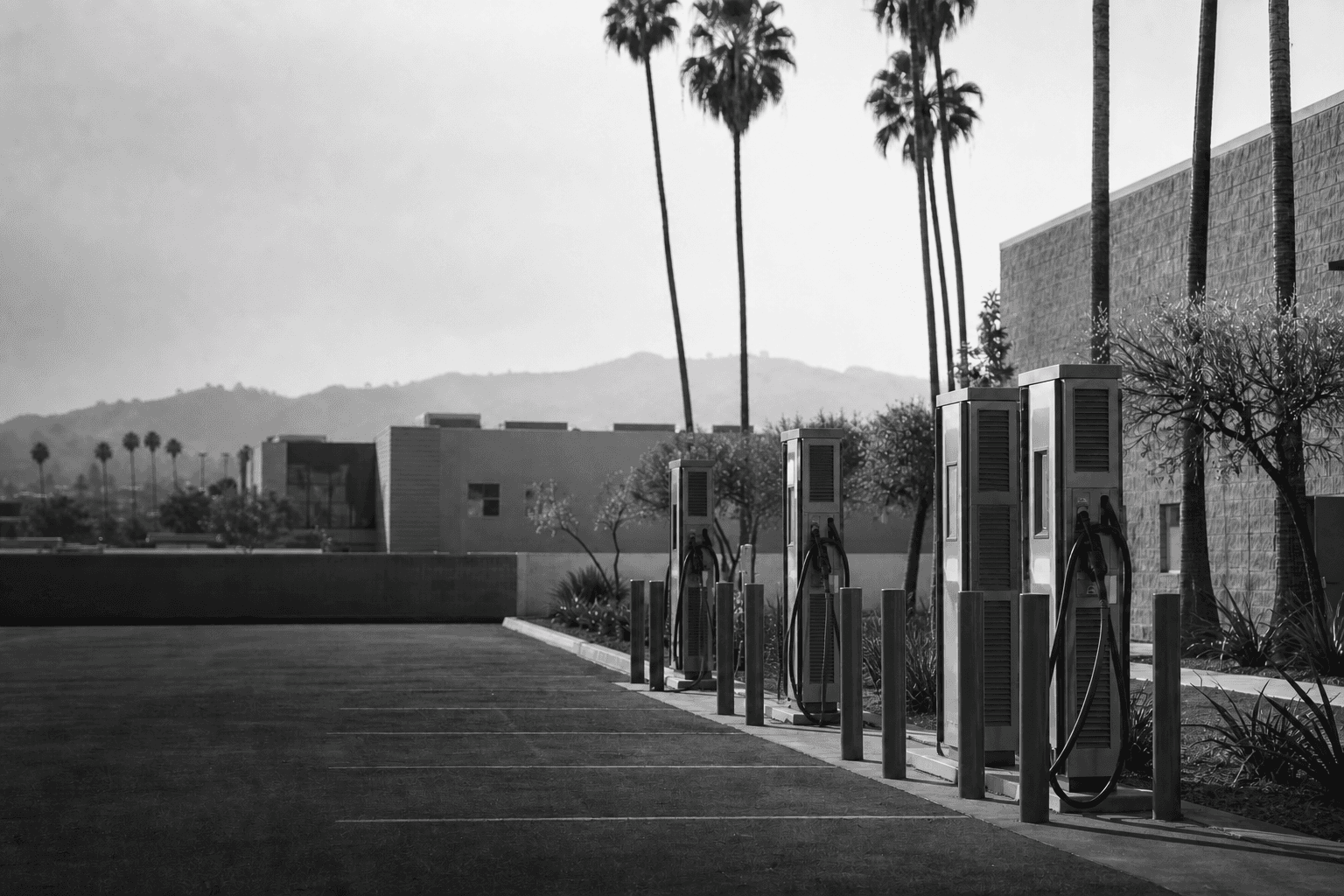
The same equipment, quoted at two Plantation properties a mile apart, can differ by several times over. Almost all of that difference comes from two questions: how far is the power, and is there any left.
LOWER COMPLEXITY
Stalls near the electrical room
The panel has spare capacity, the run is short, and the conduit follows a landscaped edge or an existing pathway instead of crossing drive aisles. Level 2 ports here sit at the bottom of the installed range, and the work is mostly a day of licensed electrical labor.
HIGHER COMPLEXITY
Across the lot, with a full panel
The run crosses paved drive aisles that must be cut, backfilled, and restored, and the building has no amps to spare. Now the project carries new panels or a service upgrade, utility coordination, and a longer approval path. This is where quotes multiply rather than creep.
SCOPING
What a real site review has to confirm
No one can price this job from a photo of your parking lot. A useful site review starts inside the building, at the service and the panel, and answers one question first: how many amps are actually available today, and at what voltage. Everything downstream of that answer is either a simple connection or a much larger project.
From there it is a measuring exercise. Where does conduit leave the building, what does it cross on the way to the stalls, and what has to be restored afterward. Whether the stations need a wireless connection where they will stand. Where metering will sit if charging load should be measured separately from the rest of the building. What signage, striping, and physical protection the stalls need so drivers do not back into a pedestal.
The review should also look forward. Future expansion, weather exposure, and how the stalls fit the way the lot is already used are all cheaper to solve on paper than after the concrete is back down. Get the required permits and inspection requirements identified in this same pass, because inspection scheduling has a way of setting the real completion date.
Bring the utility in before the design is final
Your utility can confirm what service the site can carry, what upgrades a larger install would require, and which rate structure your charging load will fall under. Those answers change the design, so getting them early is cheaper than redrawing around them later.
OPERATING MODEL
Two choices that outlive the install
The capital cost is a single event. The operating model is the part you live with, and it is worth deciding deliberately rather than defaulting to whatever the first vendor proposes.
Electricity is the ongoing line most owners underestimate. Charging load is billed per kilowatt-hour, and utilities commonly base demand charges on the highest fifteen-minute average use in a billing period, which is exactly the pattern fast charging creates. Time-of-use rates and other rate incentives exist in many territories, and they reward shifting charging to off-peak hours — something a fleet with overnight dwell can do easily and a public lot mostly cannot.
OWNERSHIP
Who owns the equipment
Equipment you buy and maintain yourself costs less overall and gives you full control, but every repair and warranty gap is yours. Provider-owned models shift that burden and that cost. Either way, settle in writing who answers when a charger goes down.
PRICING
Whether you charge for it
Fees can be structured by kilowatt-hour, by session, by time, or by subscription. Free charging is still common — more than twenty percent of public charging carries no fee — and for some properties the amenity value beats the revenue.
PHASING AND LIFETIME COST
Phase the ports, not the trench
The cleanest way to control this budget is to separate the infrastructure from the equipment. Trenching, conduit, wire, and panel capacity are the expensive, disruptive, hard-to-revisit parts. Chargers are comparatively easy to add later. Build the electrical backbone once for where you expect to be in five years, then energize ports in phases as demand and budget allow.
Incentives should be researched before construction starts, not after. Utility make-ready and state programs generally have to be applied for in advance, and a project already in the ground rarely qualifies retroactively. The federal credit under Section 30C is not something a new build can count on today — it always required the property to sit in an eligible census tract, and it applied to property placed in service through June 30, 2026. If your equipment was energized before that date, your tax advisor can still address it at filing.
On lifetime cost, keep three numbers in view: electricity including demand charges, network subscriptions at $15 to $40 per port monthly, and maintenance at up to $400 per charger a year. Warranty terms matter here more than the sticker suggests. Level 2 units often carry a fixed-length warranty at low cost, after which repairs land on you, while extended DC fast coverage can exceed $800 per charger annually. A maintenance agreement is worth having only if it names a response time, a repair window, and an uptime requirement.
COMPARING QUOTES
Five things a comparable quote shows
If two bids are hard to compare, it is usually because one of them is hiding a variable. Ask every bidder for the same five things, and the differences stop being mysterious.
01
Hardware, by model and port count
Make, model, power level, connector type, and whether the price includes mounting, activation, and network subscription.
02
The electrical run, measured
Actual footage from the source to the stalls, what surfaces get cut, and who restores them.
03
Service and panel work, stated plainly
Available capacity found on site, and the cost if a panel or service upgrade is required.
04
Permits, inspections, and utility coordination
Which approvals are included, who files them, and what they do to the schedule.
05
Year-one and year-five operating cost
Network fees, maintenance, warranty terms, and what happens to repair costs after coverage ends.
Keep planning locally
Related EV charging pages in Plantation
Get a defensible number
Price the equipment and the building together.
Send the address, operating target, and target opening date. Flux will identify what must be verified before the project can be priced.
Price my chargersQuestions
Straight answers.
How much does one commercial Level 2 charger cost in Plantation?
The unit itself runs $400 to $6,500. Installed, expect roughly $3,500 to $18,000 per port. Stalls near an electrical room with spare capacity land low; long runs across pavement and panel work push toward the top.
Why is DC fast charging so much more expensive?
The hardware alone is $10,000 to $40,000, and the electrical service behind it is a different class of work. Fast charging is also the equipment most likely to trigger utility demand charges once it is running.
What ongoing costs should I plan for after the chargers are live?
Electricity including demand charges, network software at about $15 to $40 per port per month if the stations are networked, payment processing on any fees, and maintenance of up to $400 per charger per year.
Can I lower the cost of charging a fleet at my own yard?
Often, yes. Installing 120/240-volt receptacles for portable Level 1 or Level 2 units, instead of a pedestal at every stall, reduces project cost and makes a failed charger easy to swap rather than a service call.
Should I install more capacity than I need right now?
Usually. Trenching and conduit are the disruptive, expensive parts, and reopening pavement later costs the same again. Size the backbone for your five-year port count, then add chargers in phases.
Sources used for this guide
- [1]afdc.energy.gov — Alternative Fuels Data Center: Procurement and Installation for Electric Vehicle Charging Infrastructure
- [2]irs.gov — IRS Alternative Fuel Vehicle Refueling Property Credit
- [3]santibanservicesgroup.com — Commercial EV Charging in Houston: 2026 Infrastructure & Installation Guide - Santiban Services Group
- [4]winsparking.com — EV Charging Station Installation in Tampa, FL | Wins Parking
- [5]afdc.energy.gov — Alternative Fuels Data Center: Operation and Maintenance for Electric Vehicle Charging Infrastructure
- [6]afdc.energy.gov — U.S. DOE AFDC Electric Vehicles for Fleets