THE SHORT VERSION
What a commercial HVAC replacement actually includes
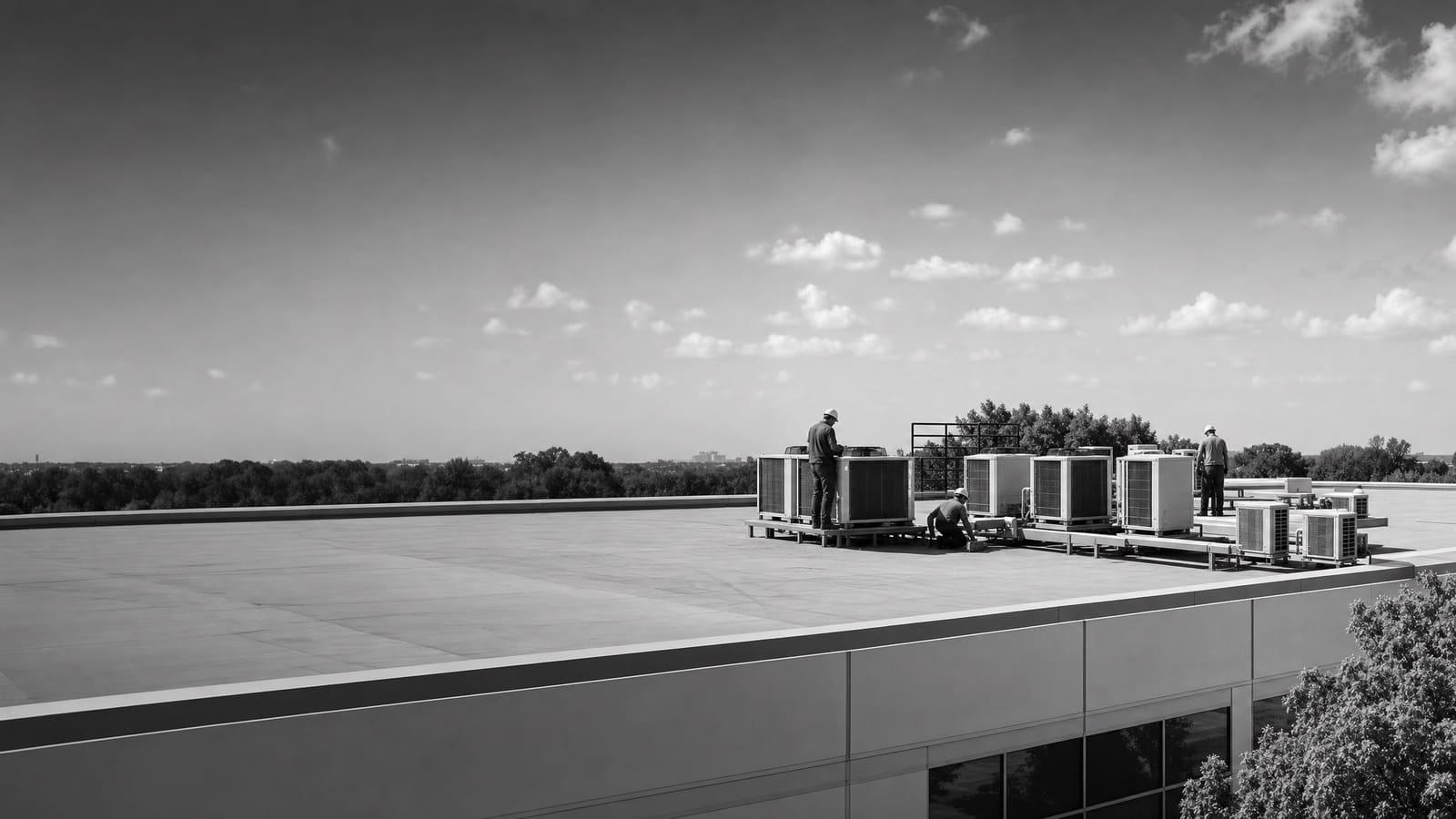
A commercial HVAC replacement is a load check, an equipment decision, a rigging and connection plan, and a commissioned startup. Replacement beats another repair once a unit is past about 15 years and service calls are stacking up — DOE puts the waste from old, inefficient rooftop units at $900 to $3,700 per unit every year. Rooftop equipment conditions close to half of U.S. commercial floor area, so this is usually a packaged-unit decision.
A site review still sets the number. It has to confirm tonnage against how the space is used now, curb and roof structure, electrical and gas capacity at the roof, and crane access on your lot.
THE REAL CHOICE
Three ways owners handle an aging rooftop unit
Most facilities default to the first option without ever deciding on it. DOE guidance is blunt about the cost: managers usually wait until a unit no longer conditions the space, needs constant service, or quits entirely. Replacing proactively with a more efficient unit is often the better business move than replacement-on-failure, or even than a like-for-like swap at the end of the old unit's service life.
The middle path is real too. If the cabinet and coils are sound, advanced controls on an existing unit can capture savings without a crane day. DOE's rooftop campaign framed it exactly that way — owners either commit to replacing old units with more efficient ones, or retrofit them with advanced controls, depending on which makes better financial sense.
The decision usually comes down to three things: how many summers and winters the unit still has in it, whether you get to pick your own shutdown window, and whether the space below can tolerate an unplanned outage in July.
WHAT MOVES THE NUMBER
The lines that separate two quotes
Nobody can price a commercial rooftop replacement from a phone call, and any number given before a roof visit is a guess. These are the items that make two bids for what looks like the same job land thousands apart. Ask each bidder to price them openly instead of burying them in one lump sum.
EQUIPMENT DECISION
Choosing between a gas unit and a heat pump
The biggest equipment question in a replacement today is not brand. It is whether the new unit heats with gas or with a reverse-cycle heat pump. DOE's heat pump rooftop guidance sorts that decision into a short list: climate and heating load, utility rates and bill impact, emissions goals, building type, equipment availability, on-site infrastructure, contractor familiarity, and incentives. Work down the list in order and the answer usually presents itself.
Climate does the heaviest lifting. Heat pump efficiency falls as outdoor temperature drops, and at the cold end it trends toward parity with electric resistance heat. That is why the guidance treats current units as a clean fit through most of the South and West, and why colder sites get steered toward dual-fuel or cold-climate models instead of a standard all-electric unit. Ask your contractor to look at heating hours at your actual design conditions rather than assuming either answer.
Infrastructure decides the rest. An all-electric unit needs the electrical capacity at the roof to support it, and a large service upgrade can outweigh the equipment difference on its own. A dual-fuel unit keeps the existing gas line as backup heat and is usually the lower-disruption path. Neither choice is automatically right, but the one picked without checking panel capacity is usually the expensive one.
SCOPE CHECK
What makes one replacement simple and another complicated
Two buildings on the same street can get very different numbers for the same tonnage. The difference is rarely the equipment. It is what the roof, the electrical panel, and the parking lot allow.
LOWER COMPLEXITY
Same footprint, same fuel
The new unit matches the existing curb, the space is used the way it always was, and gas and electric service at the roof are unchanged. Crane reach is clear from the lot. This is a one-morning set with a predictable scope and a price that holds.
HIGHER COMPLEXITY
New footprint, new fuel, or tight access
Tonnage changes, the unit is heavier, or you are moving to all-electric heat. Now you are looking at curb or structural work, a possible electrical service upgrade, and controls that have to be re-integrated. Add tight crane access or an occupied tenant space below and the schedule matters as much as the price.
BEFORE ANYONE QUOTES
What a site review has to settle
A useful site review is not a walk-around. It is a set of specific questions answered on paper, and those answers are what make two quotes comparable later.
Start with load. Sizing from the old nameplate carries forward whatever the last person got wrong, and twenty years changes occupancy, plug loads, lighting heat, and envelope. A unit that was correct when it was installed can be oversized for a space that now holds fewer people and less equipment heat. Oversizing shows up as short cycling and humidity complaints, not as an obvious line on a bill.
Then the physical items. Curb dimensions and roof structure. Confirmed electrical capacity at the roof, and the gas line if it is staying. Where the crane sets up, how much of the lot closes, and for how long. And the fact that refrigerant in the old unit has to be recovered by a certified technician under EPA rules.
Last, availability. Equipment lead time is a design input, not a footnote. DOE's heat pump guidance lists equipment availability and contractor familiarity next to cost for a reason: a technically ideal unit you cannot get for months is not the right unit for a building running on a failing compressor.
Ask for the load calculation, not just the tonnage
Any bidder can match a nameplate. Ask for the calculation behind the size they propose, and ask what it assumes about occupancy and operating hours. If nobody can produce it, you are buying the last owner's guess a second time.
AFTER THE LIFT
Two things owners underestimate once the unit lands
The install ends. The ownership does not. Two items shape the next decade more than purchase price does, and both are far easier to handle before the crane shows up than after.
The first is refrigerant. New commercial equipment ships on newer low-global-warming-potential refrigerants, and EPA's Section 608 rules govern how refrigerant is handled, recovered, and recycled in stationary air-conditioning and heat pump equipment. That touches the old unit on the way out and your parts and service planning on the way forward.
The second is fleet consistency. If you own several units, replacing them one at a time with whatever is on the shelf leaves you with mixed refrigerants, mixed controls, and a service agreement that gets more expensive every year. A written replacement sequence costs less than the same replacements made one panic at a time.
REFRIGERANT
Plan for a mixed fleet
The old unit's charge must be recovered under EPA Section 608 rules by a certified technician. The new unit runs a different refrigerant, so spare parts, technician training, and your service agreement all deserve a look before the next unit fails.
SEQUENCE
Decide the order once
Rank every unit by age, service history, and how badly the space it serves can afford to go down. That list becomes your capital plan and keeps the next replacement from being chosen by whichever compressor dies first.
THE LONGER MATH
Phasing, procurement, and lifetime cost
Purchase price is the smallest number in this decision. An old, inefficient rooftop unit wastes somewhere between $900 and $3,700 a year, so across a five-unit roof the operating gap against current equipment can rival a replacement in a handful of years. High-efficiency rooftop equipment developed under DOE's performance challenge was specified to cut energy use by up to half against the older standard, and the organizations that ran those upgrades at scale — more than 43,000 units — reported a combined $37 million in annual bill savings. Those are program-wide figures rather than a promise for your roof, but they show which direction the math runs.
Procurement is where owners give the advantage back. Ask for lead times in writing next to the price, and ask what the price does if the quoted unit slips. A contractor who has already checked availability answers that in one sentence.
Phasing helps when capital is tight. Replace the units serving the least tolerant spaces first, retrofit controls on the ones with life left, and keep the sequence written down so the plan survives a change in facilities staff. If incentives are part of the case, confirm current program terms and deadlines before building them into the budget — utility and federal offerings change on their own schedule.
QUOTE CHECKLIST
Five things a comparable quote has to show
Two quotes are only comparable when both show their work. Ask every bidder for these five items in writing, and the price differences stop being mysterious.
01
The load basis
The calculation behind the proposed tonnage, and what it assumes about occupancy, operating hours, and plug load.
02
Equipment and lead time
Model, efficiency tier, heating type, and a real availability date sitting next to the price.
03
Roof and curb scope
Adapter curb or new curb, any structural work, and who owns roof patching and flashing when the old unit comes off.
04
Access and downtime
Crane placement, lot closure hours, the shutdown window, and what happens if weather moves the day.
05
Startup and closeout
Commissioning of charge, airflow, and controls; refrigerant recovery from the old unit; and the documentation that keeps the warranty intact.
Keep planning locally
Related mechanical pages in Overland Park
Get a defensible number
Price the equipment and the building together.
Send the address, operating target, and target opening date. Flux will identify what must be verified before the project can be priced.
Get a free estimateQuestions
Straight answers.
When is replacing better than one more repair?
DOE guidance points at units past 15 years, which waste substantial energy and money compared with newer models. Owners who wait for total failure end up paying emergency pricing and taking whatever equipment is available. If repairs are stacking up on a unit that old, planned replacement is usually the better business decision.
Should the new unit be a heat pump or stay on gas?
Work DOE's list: heating load and climate, utility rates and bill impact, emissions goals, building type, equipment availability, electrical and gas infrastructure, and incentives. Heat pump efficiency drops as it gets colder and trends toward electric resistance at the low end, so colder sites usually land on dual-fuel or cold-climate models rather than a standard all-electric unit.
How much does a commercial rooftop replacement cost?
There is no honest universal price, and any number quoted before someone looks at the roof is a guess. Tonnage and efficiency tier set the baseline; curb and structural work, electrical capacity, crane access, and controls integration move it from there. What you can plan around is the operating side, where old and inefficient rooftop units waste $900 to $3,700 per unit per year.
Can we get efficiency without replacing the unit?
Sometimes. DOE's rooftop campaign treats advanced controls retrofits as a genuine alternative for units in sound condition, with owners choosing between replacement and retrofit based on which one pencils out. A controls retrofit does not reset service life, so it buys time rather than answering the end-of-life question.
What happens to the refrigerant in the old unit?
It has to be recovered and handled under EPA's Section 608 rules covering stationary refrigeration, air-conditioning, and heat pump equipment. Confirm the quote includes recovery by a certified technician, and plan for the new unit running a different refrigerant than the one coming off the roof.
Sources used for this guide
- [1]betterbuildingssolutioncenter.energy.gov — DOE Advanced Rooftop Unit Replacement Guidance
- [2]betterbuildingssolutioncenter.energy.gov — DOE Commercial Heat Pump Rooftop Unit Replacement Guidance
- [3]betterbuildingssolutioncenter.energy.gov — DOE High-Efficiency Commercial Rooftop Unit Toolkit
- [4]energy.gov — DOE Efficient Commercial Rooftop Air Conditioner Program
- [5]epa.gov — EPA Stationary HVAC Refrigerant Management