THE DIRECT ANSWER
What a commercial HVAC replacement actually includes
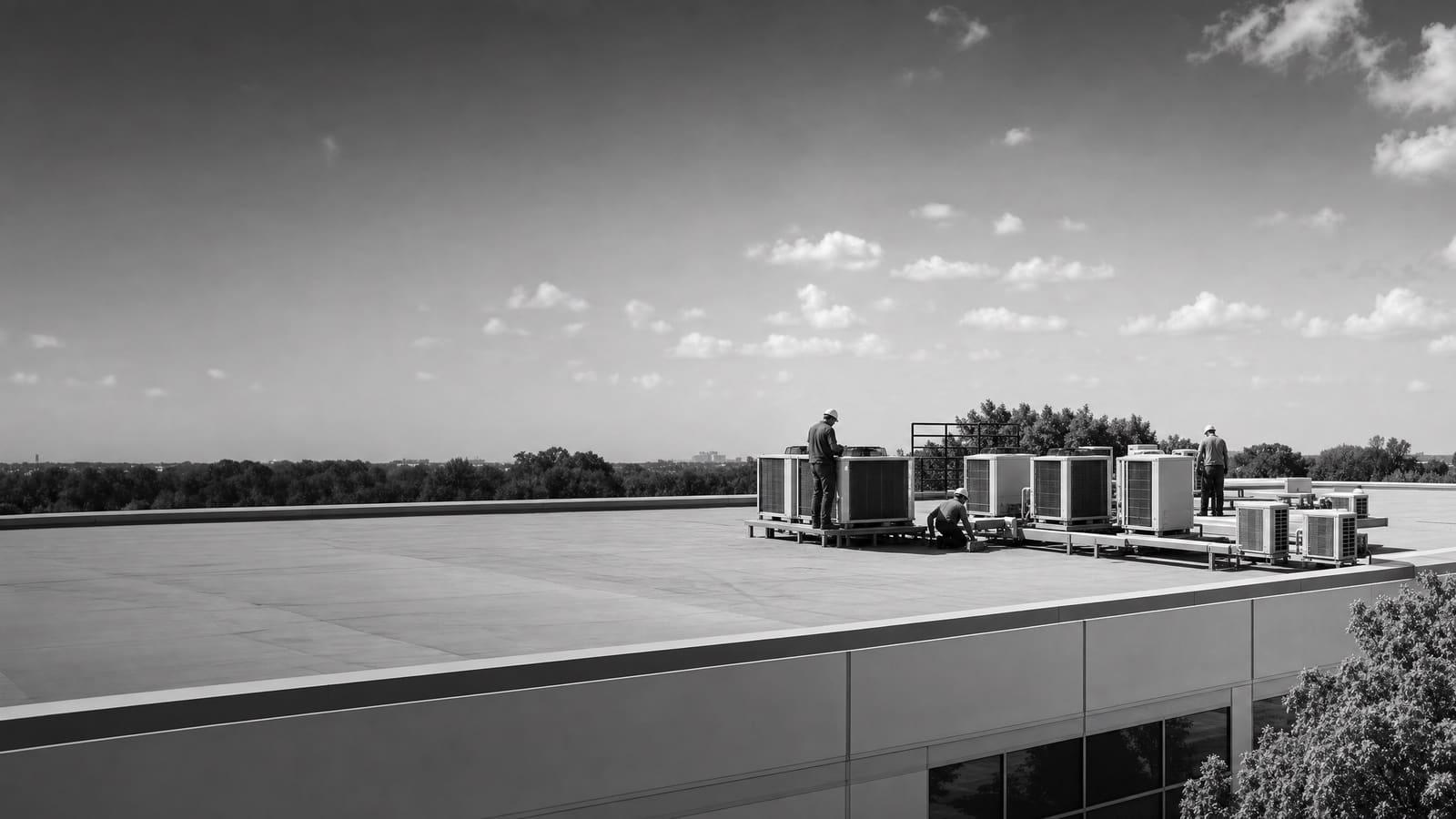
A commercial HVAC replacement confirms the building's real load, selects equipment against availability, removes and recovers the old system, sets the new one, and commissions it to spec. Replacement beats another repair once a unit is past about fifteen years, needs frequent service, or no longer holds the space. Federal guidance is blunt about the cost of waiting: an old, inefficient rooftop unit can waste $900 to $3,700 a year, each.
A site review still has to verify curb size and roof structure, electrical capacity at the panel, gas line status, and crane access before any of that price holds.
THREE WAYS TO GO
Three replacement paths, and when each one fits
Most commercial replacements come down to three paths. The right one depends on how the building is used and what the roof can support.
The simplest is a like-for-like swap: same tonnage, same fuel, same curb. It gets the space conditioned fastest and keeps engineering light, but it also carries forward whatever sizing mistake the old unit had.
The second is a high-efficiency replacement. DOE's rooftop unit challenge pushed manufacturers to build units that cut energy use by up to half compared with the standard in force at the time — a specification more than 20 models went on to exceed. On a roof that runs long cooling hours, that gap shows up on every bill.
The third is a heat pump rooftop unit, either all-electric or dual fuel. Federal guidance treats the South and West as good territory for these units, because heating demand there stays mild to moderate and the equipment can carry most or all of it.
WHAT MOVES THE NUMBER
Where a replacement budget actually moves
No two roofs price the same, and the spread almost never comes from the box itself. These are the lines that move a commercial replacement budget most, ordered roughly by how far they can swing between two buildings that look identical from the street.
BUYING GUIDANCE
Buy the replacement instead of reacting to it
Rooftop units condition close to half of all commercial floor space in the country, which is why so much of the industry's guidance is written about them. It is also why the most common way they get replaced is the worst one: the unit fails in season, the building needs cooling today, and the only real choice left is whatever is on a truck.
Federal guidance is direct about this pattern. Facility managers tend to wait until a unit no longer conditions the space, needs constant service, or fails completely. Replacing proactively usually beats replacement-on-failure, and it often beats a like-for-like swap at the end of service life too, because a planned project leaves room to compare equipment, check incentives, and price the work with more than one vendor.
The practical version for a Mobile building owner is to decide before the failure. Pull the age of every unit on the roof. Anything past fifteen years is already a candidate, since older units waste substantial energy compared with current models. Then decide what you would install. When one does fail, the decision is already made and only the schedule is urgent.
COMPLEXITY CHECK
What makes one roof simple and the next one complicated
Two buildings with the same tonnage on the roof can quote very differently. What separates them is almost always access, structure, and what the new equipment asks of services the building already has.
LOWER COMPLEXITY
Matched swap on an open roof
Same tonnage and fuel, an existing curb the new unit fits, clear crane reach from the lot, and gas and electric already sized for the load. Engineering stays light and the schedule stays short.
HIGHER COMPLEXITY
Bigger unit, tighter site, new fuel
A larger footprint over an old curb, a roof that needs structural review, a lot with no crane reach, or an all-electric conversion that pushes the panel. Each one adds design time and another trade.
SITE REVIEW
What has to be confirmed before a price means anything
A quote written from a nameplate photo is a starting number, not a commitment. The site review is what turns it into one, and DOE's own checklist for rooftop replacement is a good template for what has to be looked at.
Start with the load. Sizing should come from how the space is used today, not from what the old unit's plate says. Twenty years changes occupancy, plug load, lighting, and sometimes the envelope. A unit sized for the old building will either short-cycle or fall behind.
Then work down the infrastructure list. Electrical capacity comes first, because it decides whether an all-electric option is even on the table. Physical constraints come next: curb dimensions, roof structure, clearances, and whether a crane can reach the set point. Gas lines matter if you are keeping or dropping gas heat.
Finally, confirm availability and the people. Equipment lead time belongs on the quote next to the price, and a contractor's experience with the specific equipment type is its own risk line. Federal guidance lists contractor knowledge as a real constraint on heat pump projects, not a footnote.
Ask for the checks in writing
A scope that names the load basis, the curb and structural finding, the panel capacity check, the crane plan, and the committed equipment lead time is comparable across bidders. A scope that names only tonnage and price is not.
AFTER THE INSTALL
Two decisions that outlive install day
The install is one morning. The choices made around it set your operating cost, your service exposure, and how the next unit on that roof gets handled. Two of them are worth deciding deliberately instead of by default.
The first is whether the building runs on a replacement schedule or on failure. The second is what happens to a roof that ends up carrying two generations of equipment, which is the normal outcome of replacing one unit at a time. Neither is really an equipment question. Both are budgeting and service-contract questions, and both are far easier to answer while you still have a working unit.
SCHEDULE
Planned beats failure
Waiting until a unit stops conditioning the space removes every option except availability. A schedule built from unit age keeps competitive bidding, incentive checks, and off-hours work on the table.
FLEET
Mixed equipment on one roof
Replacing one unit at a time leaves generations side by side. Confirm which refrigerant the new unit uses, then update the service contract and spare-parts plan so the whole roof stays supportable.
PHASING AND LIFETIME COST
Sequencing a multi-unit roof across budget years
Most commercial roofs do not get replaced all at once. They get replaced one or two units at a time, over several budget years, in whatever order the failures happen to fall. Choosing that order on purpose is one of the cheapest improvements available to a facility owner.
Rank the units by age and by what they serve. A unit past fifteen years over a space occupied all day is a different priority than one of the same age over storage. Then look at what grouping buys you: one crane day for two units, one permit cycle, one mobilization, and one negotiation instead of three separate emergencies at three separate prices.
Lifetime cost is where the efficiency argument stops being abstract. An old, inefficient rooftop unit can waste $900 to $3,700 a year on its own, and organizations working through DOE's rooftop campaign upgraded more than 43,000 units and reported roughly $37 million in combined annual savings. Those are results across a very large fleet, not a promise for your roof. But they set the direction: the money a deferred replacement saves this year tends to reappear on the utility bill, spread across every year you defer it.
QUOTE CHECKLIST
Five things a comparable quote should show
Two quotes are only comparable when they describe the same scope. If a bid is missing any of these, ask for it before you compare prices — the gap is usually where the change order lives.
01
Equipment, spelled out
Make, model, tonnage, efficiency tier, refrigerant, and heating type — not just "replace RTU."
02
Lead time next to the price
Committed availability for the exact unit quoted, and what happens to the schedule if it slips.
03
Curb, structure, and roof work
Curb adapter, any framing, and how the roof membrane gets patched and warranted afterward.
04
Rigging and site plan
Crane size, staging area, stall closures, and the hours the work actually happens.
05
Permits, startup, and commissioning
Who pulls permits, who meets the inspector, and what gets documented at startup.
Keep planning locally
Related mechanical pages in Mobile
Get a defensible number
Price the equipment and the building together.
Send the address, operating target, and target opening date. Flux will identify what must be verified before the project can be priced.
Get a free estimateQuestions
Straight answers.
When does replacement beat one more repair?
Once a unit is past about fifteen years, needs frequent service, or can no longer hold the space, federal guidance treats it as a replacement candidate. Old, inefficient rooftop units can waste $900 to $3,700 a year each, which is often more than the repair being debated.
Should you replace like-for-like or resize?
Confirm the load either way. If the space and how it is used have not changed, like-for-like is usually right and it is the fastest path back to conditioned air. If occupancy, plug load, or layout changed, resizing fixes comfort problems the old unit could never solve.
Is a heat pump rooftop unit worth considering here?
It is worth pricing. DOE guidance says heat pump rooftop units suit the South and West well, because winter heating demand stays mild to moderate and the equipment can cover most or all of it. The decision still turns on electricity price, panel capacity, and whether you keep gas backup.
What happens to the old refrigerant?
It gets recovered, not vented. EPA regulations under the Clean Air Act govern how refrigerant is handled and recycled in stationary air-conditioning and heat pump equipment, and that recovery work belongs on the quote as its own line.
Why does equipment availability belong on the quote?
Because it sets the schedule. DOE lists equipment availability as a core consideration in rooftop replacement planning, alongside contractor familiarity with the specific technology. A committed lead time on paper is the difference between a planned install and an unplanned outage.
Sources used for this guide
- [1]betterbuildingssolutioncenter.energy.gov — DOE Advanced Rooftop Unit Replacement Guidance
- [2]betterbuildingssolutioncenter.energy.gov — DOE Commercial Heat Pump Rooftop Unit Replacement Guidance
- [3]betterbuildingssolutioncenter.energy.gov — DOE High-Efficiency Commercial Rooftop Unit Toolkit
- [4]energy.gov — DOE Efficient Commercial Rooftop Air Conditioner Program
- [5]epa.gov — EPA Stationary HVAC Refrigerant Management