THE DIRECT ANSWER
What a commercial HVAC replacement actually includes
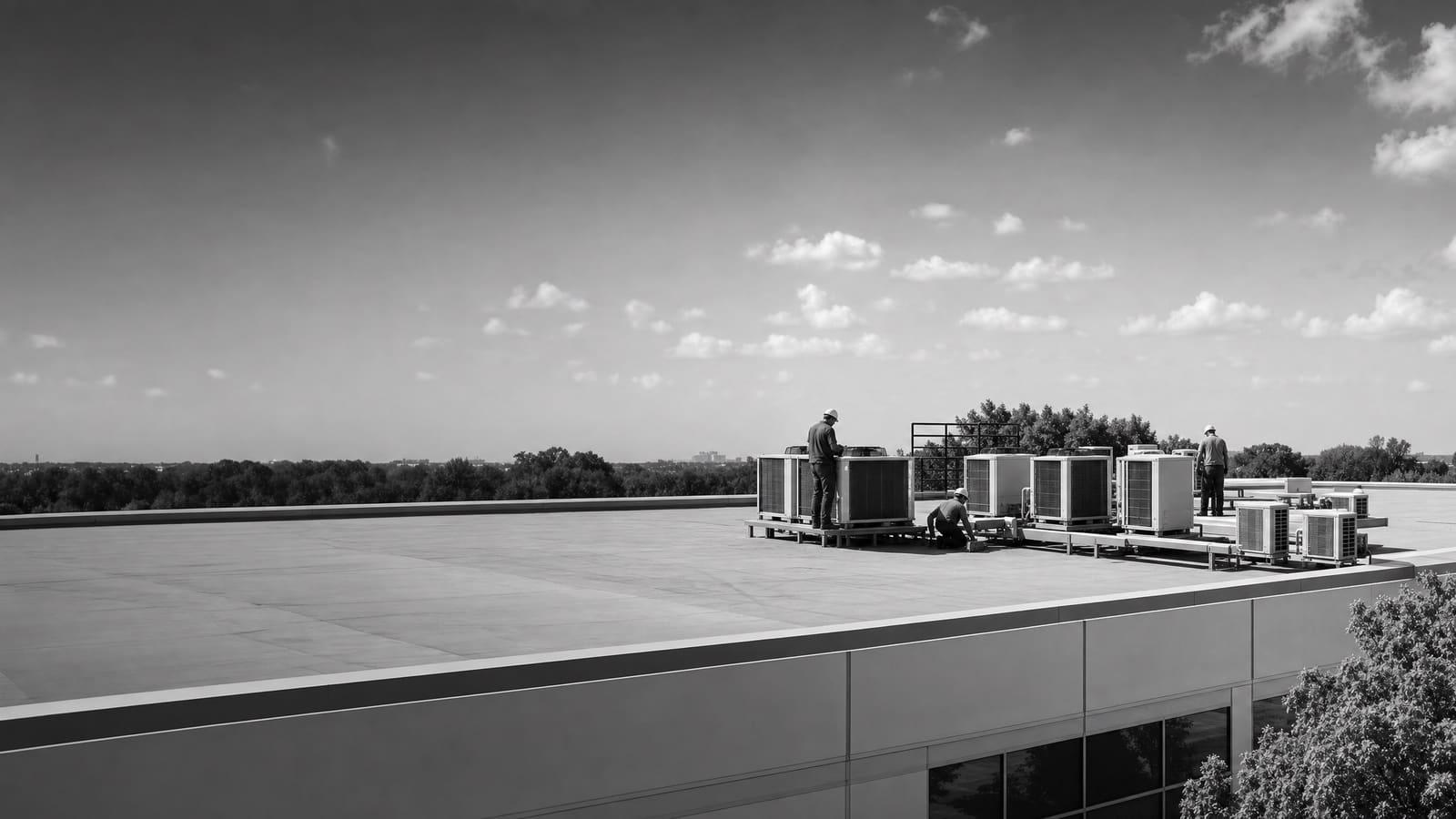
A commercial HVAC replacement covers load verification, equipment selection, rigging and set, gas, electric and refrigerant connections, controls integration, permits, and commissioning. Replacement starts beating another repair once a unit is past about fifteen years, because old, inefficient rooftop units can waste roughly $900 to $3,700 each per year in energy compared with efficient models. Past that point, repair spending buys time rather than performance.
A site review still has to confirm tonnage against current use, the curb and the structure under it, available electrical capacity, and the existing gas service before any of that applies to your building.
THREE WAYS TO GO
Gas heat, dual fuel, or an all-electric cold-climate unit
Most Minneapolis replacements come down to how the unit makes heat. A standard air-conditioning rooftop unit with gas heat is the familiar path and the simplest scope. A heat pump rooftop unit does the same cooling but adds reverse-cycle heating, which changes both the fuel mix and the electrical service the unit needs.
Federal guidance is blunt about the tradeoff. Heat pump heating efficiency falls as outdoor temperature drops, and at the coldest hours it trends toward parity with electric resistance heat. That makes standard heat pump rooftop units a better fit for mild-to-moderate winters than for a Minneapolis January. It does not rule electric heat out here. It means the two serious electric paths in this climate are a dual-fuel unit that hands heating back to gas when it gets cold, or a cold-climate heat pump built to hold capacity at low outdoor temperatures.
WHAT MOVES THE NUMBER
The line items that decide your installed price
No honest installed price exists before someone looks at the roof. These are the items that separate a straightforward swap from a project. Ask each bidder to price them separately so you can compare like with like.
IN PRACTICE
Buy the replacement instead of reacting to it
The most expensive commercial HVAC replacement is the one nobody planned. Federal guidance describes the common pattern plainly: facility managers delay a new rooftop unit until the old one no longer holds the space, needs constant service, or fails outright. At that point the decision gets made by whatever is on a truck this week.
Planning the swap ahead of failure changes what you are able to buy. You get to compare efficiency tiers instead of accepting the first available match. You get to look at incentive options before the equipment is ordered. And you get to schedule the crane on a Sunday morning rather than a Tuesday in July.
The savings are not theoretical. The federal high-performance rooftop unit specification targeted up to fifty percent less energy use than the standard equipment of its day, and the organizations that upgraded more than forty-three thousand units through the Advanced RTU Campaign reported thirty-seven million dollars in combined annual utility savings. Spread across a fleet, that becomes a visible line on the operating budget.
SCOPE CHECK
What makes one swap simple and the next one a project
Two buildings on the same block can get very different quotes for the same tonnage. The difference is almost never the box itself. It is what the box has to connect to, and what has to happen to get it up there.
LOWER COMPLEXITY
Straight swap on an existing curb
Same tonnage, same fuel, the existing curb takes an adapter, gas and electric are already sized, the crane has open lot access, and the space is still used the way it was when the old unit went in.
HIGHER COMPLEXITY
Fuel switch, upsize, or tight access
Moving to electric heat, adding tonnage, a roof that needs structural review, a lot with nowhere to set a crane, or a tenant space that cannot lose conditioning while the change happens.
BEFORE YOU BID IT
The site review that keeps the quote from moving
Federal heat pump guidance gives a useful checklist for any rooftop replacement, not only an electric one. It asks you to confirm infrastructure in three parts: available electrical capacity, physical constraints at the unit location, and the gas lines already serving it. Those three answers decide most of what your quote will say.
Electrical capacity is where fuel-switch projects surprise people. A heat pump or all-electric unit needs more electrical service than the gas unit it replaces, and if the panel, the feeder, or the building service cannot carry it, the electrical scope can rival the mechanical scope. Physical constraints cover the curb, the structure beneath it, clearances for airflow and service, and whether a crane can actually reach the spot. Gas lines matter in both directions, since you are either keeping and possibly resizing them or safely abandoning them.
The same guidance adds one item buyers skip: contractor availability and knowledge for the technology you are choosing. Newer equipment needs someone who can commission it and still service it two winters from now.
Ask for these three answers in writing
Available electrical capacity at the panel serving the unit, the physical constraints at the curb including structure and crane reach, and the plan for the existing gas line. A bidder who cannot answer all three has not really been on your roof.
MINNEAPOLIS SPECIFICS
Licensing, permits, and what a real winter does to the choice
Two local facts should shape the decision before you compare prices. First, the City of Minneapolis licenses mechanical contractors specifically for the work a replacement involves: heating, ventilation and air conditioning, refrigeration, and gas piping. The City publishes the list of approved companies, and the work runs through its mechanical and heating permit process. A rooftop swap usually touches all three categories, so confirm the license covers all three.
Second, the climate narrows the electric options. Federal guidance states that heat pump heating efficiency falls as outdoor temperature drops and trends toward electric resistance parity at the bottom, which is why standard heat pump rooftop units are described as best suited to mild-to-moderate winters. In Minneapolis, that points a fuel switch toward dual-fuel or cold-climate equipment instead.
Check the license before the price
Look the bidder up on the City of Minneapolis licensed mechanical and heating contractor list, and confirm the mechanical permit is inside the installed price rather than a change order after the crane leaves.
OWNERSHIP QUESTIONS
Two things that outlive the install
The install is a week. The consequences run for the service life of the equipment: operating cost, service calls, and refrigerant handling. Two of those are worth deciding on purpose instead of inheriting by accident.
The first is what you own after the swap. If you run several buildings, or several units on one roof, the choice you make on this unit quietly sets the pattern for the next four. Mixed fleets cost more to train for, stock for, and service than uniform ones.
The second is refrigerant. EPA regulations under Section 608 of the Clean Air Act address how refrigerant is handled and recycled in stationary refrigeration, air-conditioning, and heat pump equipment. That applies to the unit coming off the roof as much as the one going on, and it belongs in the written scope of work.
FLEET STRATEGY
One unit sets the pattern
Standardizing the controls platform, the efficiency tier, and the refrigerant across a roof cuts training, spare parts, and service cost. Deciding unit by unit is how a roof ends up with six unrelated systems.
REFRIGERANT
Recovery is part of the job
Section 608 covers handling and recycling for the equipment being removed too. Ask who recovers the charge, who documents it, and whether that work is already inside the quoted price.
PHASING AND LIFETIME COST
How to sequence a roof full of aging units
Almost nobody replaces every unit on a roof at once, and almost nobody should. The better approach is to rank the units and spend on the worst ones first.
Age is the cheapest sorting tool you have. Federal guidance flags units past fifteen years as the ones wasting the most energy and money, and puts the annual waste on an old, inefficient rooftop unit at roughly nine hundred to thirty-seven hundred dollars each. Count the units on your roof that are over fifteen years old and the phasing order mostly writes itself.
From there, weigh three things per unit: what it costs to keep running, what a replacement would save, and what a failure would cost you in the worst week of the year. A unit serving a kitchen or a server room is not the same risk as one serving a storage mezzanine, even when the nameplates match.
Then price the program rather than the unit. One crane day covering three units usually beats three separate mobilizations, and one planned procurement round gives you far more room to negotiate than three emergency orders placed in season.
WHAT A GOOD QUOTE SHOWS
Five things every bid should state before you compare
Bids for the same rooftop replacement often differ by more than price. Make each bidder state these five items and the numbers become comparable. If one bid leaves three of them out, it is not cheaper. It is less complete.
01
The load calculation behind the tonnage
Not the old nameplate. Sizing based on how the space is occupied and used now.
02
Equipment model, efficiency tier, and refrigerant
Named specifically, with expected availability attached, rather than a vague "or equal."
03
Curb, structural, and rigging scope
Adapter, any roof work, crane reach and setup location, and how long the lot closes.
04
Electrical and gas scope
Panel capacity, any feeder or service work, and what happens to the existing gas line.
05
Permits, commissioning, and closeout
City mechanical permit, startup readings, controls verification, and warranty registration.
Keep planning locally
Related mechanical pages in Minneapolis
Get a defensible number
Price the equipment and the building together.
Send the address, operating target, and target opening date. Flux will identify what must be verified before the project can be priced.
Get a free estimateQuestions
Straight answers.
When does replacement beat one more repair?
Once a rooftop unit is past about fifteen years, repairs mostly buy time instead of performance. Federal guidance puts the annual energy waste on an old, inefficient commercial rooftop unit at roughly $900 to $3,700, which often runs higher than what the repairs themselves are costing you. Compare those two numbers before approving another service call.
Does a heat pump rooftop unit make sense in Minneapolis?
Sometimes, but not the standard kind. Federal guidance notes that heat pump heating efficiency drops as outdoor temperature falls and approaches electric resistance parity at the bottom, so standard heat pump rooftop units suit mild-to-moderate winters best. In this climate the realistic electric options are dual-fuel units that switch back to gas in a cold snap, or cold-climate heat pumps designed to hold capacity at low temperatures.
Do I need a licensed contractor and a permit?
Yes. The City of Minneapolis licenses mechanical contractors for HVAC, refrigeration, and gas piping work, and publishes the list of approved companies. Replacement work goes through the City's mechanical and heating permit process. Confirm the license covers every category your job touches, and confirm the permit is included in the installed price.
Should I replace like-for-like or resize the unit?
Confirm the load either way. If the space and its use have not changed since the old unit went in, like-for-like is often the right and fastest call. If occupancy, equipment, or the envelope changed, resizing fixes comfort complaints the old unit was never able to solve and stops you from carrying an old sizing mistake forward for another twenty years.
What happens to the refrigerant in the old unit?
It has to be recovered and handled under EPA Section 608 rules, which govern refrigerant handling and recycling in stationary air-conditioning and heat pump equipment. Ask the bidder who performs the recovery, who documents it, and whether that work is already priced. It should be part of the removal scope, not a surprise after the crane leaves.
Sources used for this guide
- [1]betterbuildingssolutioncenter.energy.gov — DOE Advanced Rooftop Unit Replacement Guidance
- [2]betterbuildingssolutioncenter.energy.gov — DOE Commercial Heat Pump Rooftop Unit Replacement Guidance
- [3]betterbuildingssolutioncenter.energy.gov — DOE High-Efficiency Commercial Rooftop Unit Toolkit
- [4]energy.gov — DOE Efficient Commercial Rooftop Air Conditioner Program
- [5]epa.gov — EPA Stationary HVAC Refrigerant Management
- [6]minneapolismn.gov — Mechanical and Heating Contractors - City of Minneapolis