THE DIRECT ANSWER
What a commercial HVAC replacement actually includes
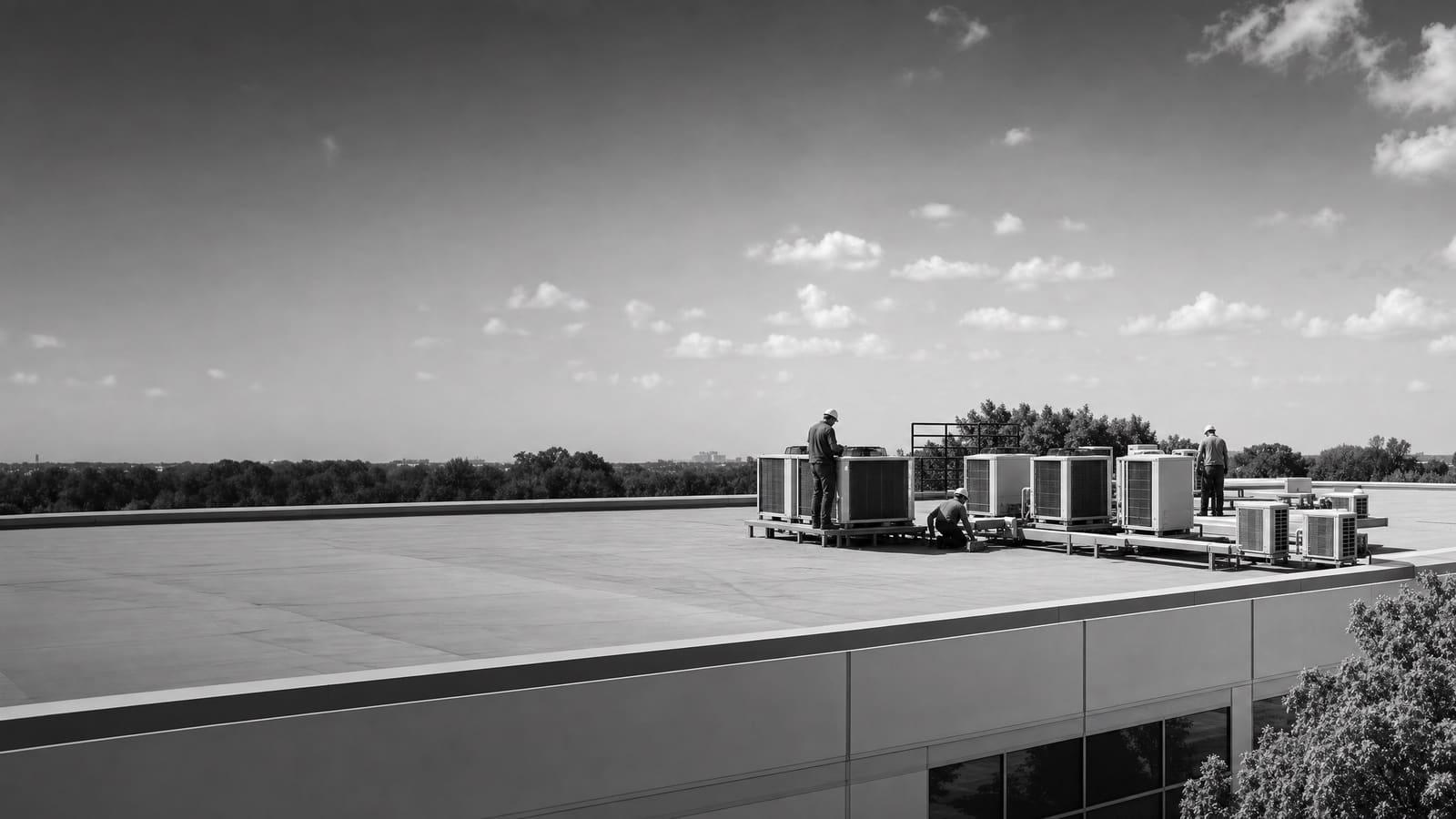
A commercial HVAC replacement covers load confirmation, equipment selection, refrigerant recovery from the old unit, rigging and set, gas and electrical connections, controls, and documented commissioning. Replacement beats another repair once a rooftop unit is past about fifteen years, needs frequent service calls, or no longer holds the space. Old, inefficient rooftop units can waste $900 to $3,700 each per year in energy alone, and no repair recovers that.
A site review still has to verify curb size and roof structure, available electrical capacity and gas service, crane reach across the lot, and whether today's use of the space still matches the old nameplate.
THE CHOICE
Three ways to handle a unit at end of life
Most buildings meet this decision the same way. A rooftop unit stops holding the space in August, and someone has to choose in a hurry. Rooftop equipment conditions close to half of all commercial floor area in the country, so the same three options come up over and over.
The default is replacement on failure, and it is usually the worst version of the choice. You take whatever unit is available, on whatever schedule the supply chain allows, at whatever price that week happens to set. Deciding before the unit dies buys you a real comparison instead of a rescue.
There is a fourth path worth naming. A unit with life left in the cabinet and compressor can sometimes be retrofitted with advanced controls rather than replaced. That is a smaller project with a shorter payback, and it is a legitimate answer when the equipment is tired but not failing. It does not rescue a unit that is already on its way out.
WHAT MOVES THE NUMBER
Where the money actually goes
No two roofs price the same, so read these as the lines that move a quote rather than as a price list. They are ordered roughly by how far each one can swing the total.
BUYING GUIDANCE
Choosing equipment without guessing
Start with the load, not the nameplate. The unit coming off the roof was sized for the building as it existed when it was installed, and fifteen or twenty years changes occupancy, plug loads, lighting, and often the envelope. Carrying the old tonnage forward carries the old sizing mistake forward with it. Confirming the load is a short exercise that either validates a like-for-like swap or explains a comfort complaint nobody could ever fix.
Next, decide the efficiency tier deliberately. High-performance rooftop units were built to a specification meant to cut energy use by up to half against the older baseline, and there are now more than twenty models on the market that exceed that specification. That is a real menu, not a single premium option. The gap between the cheapest available unit and a high-efficiency one shows up every month for the next two decades, which is why it deserves more than a shrug during an emergency.
Then make availability part of the decision. A unit you cannot get for two months is not the same purchase as one sitting in a regional warehouse. Ask for installed price and lead time side by side on every option, so the tradeoff is visible while you still have the ability to choose.
SCOPE CHECK
What makes one job simple and another hard
Two replacements of the same tonnage can price very differently. The difference is almost never the unit itself. It is what the building asks the crew to do around the unit.
LOWER COMPLEXITY
Straight swap on a clear roof
Same tonnage on the existing curb, open lot with room to stage a crane, gas and electrical already sized for the unit, and standalone controls. Permitting is routine and the set happens in a morning.
HIGHER COMPLEXITY
New footprint or fuel change
Different size or weight that triggers structural review, tight access that limits crane reach, added electrical capacity for an electric conversion, or integration into an existing building automation system. Each of those adds scope and calendar.
SCOPING
What the site review has to confirm
Federal guidance on rooftop replacement puts the same short list in front of every owner, and it is a good checklist to hold a contractor to. Electrical capacity comes first, because an all-electric or heat pump unit can ask for more service than the panel currently has, and finding that out after the order is placed is expensive. Physical constraints come next: curb dimensions, roof structure, clearances around the unit, and whether the crane can actually reach the position from a spot you are allowed to close.
Gas lines matter in both directions. A dual-fuel unit needs the gas service kept and confirmed. A full electric conversion means deciding what happens to a line you are abandoning. Contractor familiarity with the specific equipment belongs on the list too, because startup and controls setup on newer high-efficiency units is not the same work as on a twenty-year-old cabinet.
Finally, incentives. Efficiency programs for commercial rooftop equipment are common enough to be worth asking about before the order is placed, since eligibility usually attaches to a specific model rather than to the project in general.
Before you accept a number
Ask which of these the contractor physically verified and which they assumed. Measured curb dimensions, a look at the electrical panel, and a real crane position are the three that most often turn into change orders when they were guessed at from the parking lot.
AFTER THE INSTALL
Two things ownership carries afterward
The install ends. The operating decisions it creates do not. Both of the items below are easier to handle if they are discussed before the equipment is ordered rather than discovered during the first service call.
Neither one changes how the building runs on day one. They change what the next five years of service contracts, spare parts, and capital planning look like, which is the part of the purchase that rarely shows up on the quote.
SERVICE PLANNING
A fleet on more than one refrigerant
New equipment ships on newer refrigerants while older units on the same roof keep running on what they have. Federal rules govern handling, recovery, and recycling on all of it, so mixed fleets need a service plan that accounts for both.
CAPITAL PLANNING
Scheduled spend versus emergency spend
Facility teams commonly delay replacement until a unit fails outright, needs constant service, or stops conditioning the space. Replacing proactively is usually the better business decision, and it is the only version where you get to pick the equipment and the week.
OVER TIME
Phasing a roof instead of chasing failures
If you own more than one unit, the useful move is to stop treating each replacement as its own emergency. Walk the roof once, record age, tonnage, and condition for every unit, and rank them. That list turns an unpredictable line item into a schedule you can budget against, and it lets you standardize on one equipment family instead of accumulating four different service manuals.
The scale of that approach is well documented. More than two hundred public and private organizations working through the national rooftop upgrade campaign have replaced or retrofitted over forty-three thousand units, and those upgrades save a combined thirty-seven million dollars a year in energy costs. The savings are not exotic. They come from replacing units that were quietly wasting money and from choosing the efficiency tier deliberately instead of by default.
Phasing also gives procurement room to work. Ordering two units for a planned spring change-out is a different conversation with a supplier than sourcing one unit in an August panic. It gives you the ability to hold price, confirm lead time, and schedule the crane day around your operating hours rather than around the failure.
COMPARING QUOTES
Five things a comparable quote shows
Two quotes are only comparable when they scope the same work. If any of these five is missing, you are comparing an installed project against a piece of equipment.
01
Model, tonnage, and efficiency tier
The exact unit being proposed, not a category, so efficiency is comparable line to line.
02
Lead time next to the price
Real availability for that model, dated, because a cheaper unit two months out is a different purchase.
03
Curb, structural, and rigging scope
Who supplies the curb adapter, what the roof needs, and who owns the crane and the lot closure.
04
Utility connection work included
Any electrical, gas, or refrigerant line changes named explicitly rather than left as an allowance.
05
Commissioning and permit responsibility
Startup, charge, airflow, and controls verified and documented, with permits and inspections named in the price.
Keep planning locally
Related mechanical pages in Omaha
Get a defensible number
Price the equipment and the building together.
Send the address, operating target, and target opening date. Flux will identify what must be verified before the project can be priced.
Get a free estimateQuestions
Straight answers.
When does replacement beat one more repair?
Once a unit is past about fifteen years, needs frequent service, or no longer conditions the space, repair is buying time on an asset that is already losing money. Older inefficient rooftop units can waste $900 to $3,700 each per year in energy, which repair does not recover.
Should we replace like-for-like or resize?
Confirm the load either way. If the space and its use have not changed, like-for-like is often correct and fastest. If occupancy, equipment, or the envelope changed, right-sizing fixes comfort problems the old unit was never able to solve.
Is a heat pump rooftop unit a good swap here?
It depends on the heating load. Heat pump efficiency drops as outdoor temperature falls, so buildings with sustained winter heating usually evaluate dual-fuel or cold-climate models rather than a standard all-electric unit. Electrical capacity is the other gate.
What happens to the refrigerant in the old unit?
It has to be recovered under federal rules that govern handling and recycling in stationary air-conditioning equipment. It is a small line on the quote, but it is required work and it should be named rather than assumed.
How long is the building without cooling?
The visible disruption on a straight swap is a crane morning and some coned-off parking. The real variable is equipment lead time, which is why availability belongs on the quote next to the price.
Sources used for this guide
- [1]betterbuildingssolutioncenter.energy.gov — DOE Advanced Rooftop Unit Replacement Guidance
- [2]betterbuildingssolutioncenter.energy.gov — DOE Commercial Heat Pump Rooftop Unit Replacement Guidance
- [3]betterbuildingssolutioncenter.energy.gov — DOE High-Efficiency Commercial Rooftop Unit Toolkit
- [4]energy.gov — DOE Efficient Commercial Rooftop Air Conditioner Program
- [5]epa.gov — EPA Stationary HVAC Refrigerant Management