THE SHORT VERSION
What a commercial HVAC replacement actually covers
A commercial HVAC replacement covers confirming the load, selecting equipment against real availability, rigging the old unit off and the new one on, reconnecting power, gas, and controls, then commissioning the system to spec. Replacement beats another repair once a rooftop unit is past fifteen years and service calls are stacking up. DOE puts the annual waste from an old, inefficient rooftop unit at $900 to $3,700. Running to failure spends that money and removes your choice of equipment and timing.
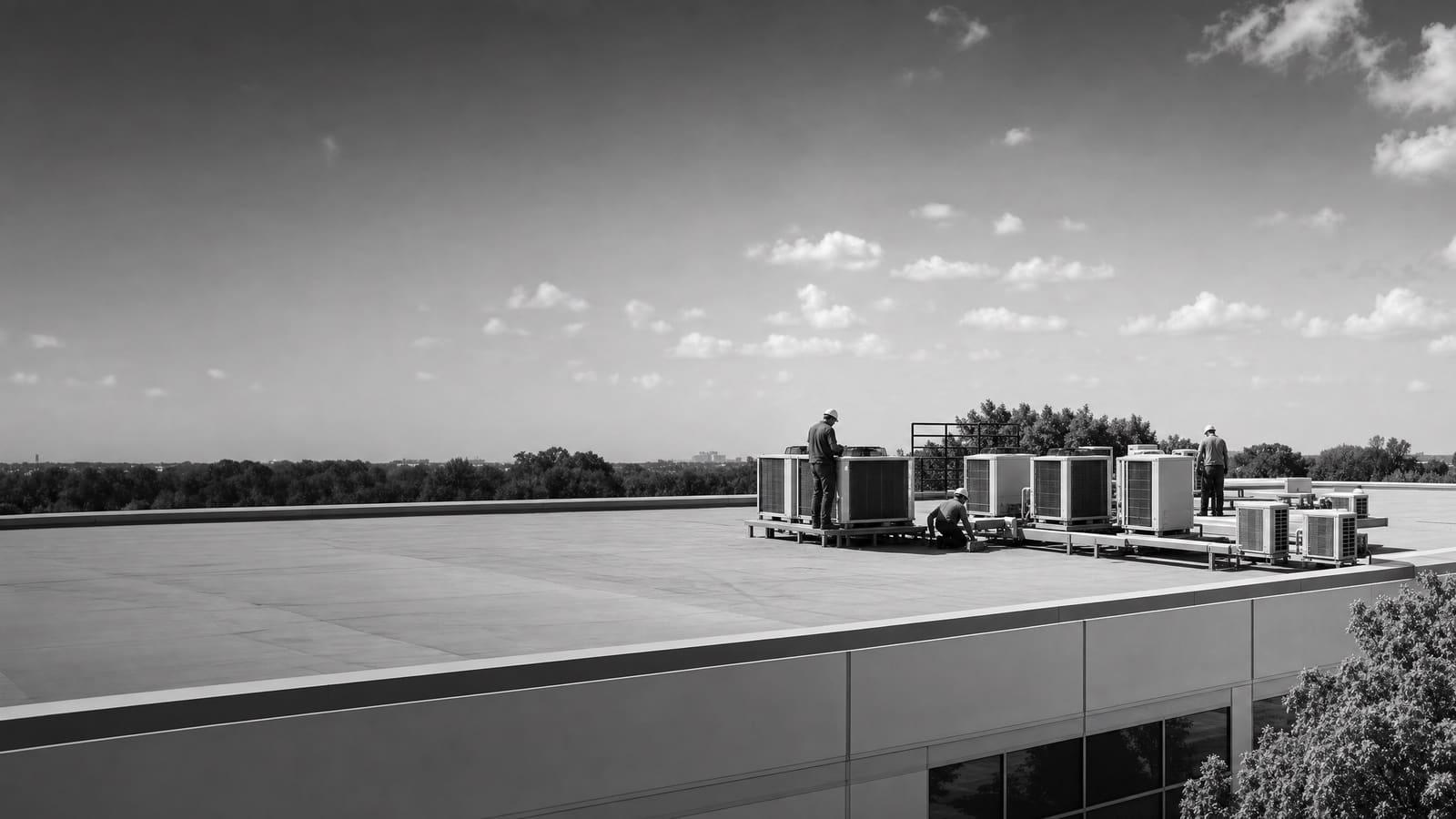
A site review still has to verify curb and roof structure, crane reach and lot access, available electrical capacity, existing gas service, and whether today's occupancy matches the old nameplate.
THE THREE PATHS
Your real options when a unit is at end of life
Most buildings have three honest paths, and the right one depends on what the unit does today and what the building will be asked to do next. DOE frames part of this as a choice between replacing with a more efficient unit or retrofitting the existing one with advanced controls, whichever makes better financial sense. If the unit still has service life left, that controls retrofit deserves a price of its own. The newer wrinkle is heat pump rooftop units, which are technically similar to air conditioning units but add reverse-cycle heating. DOE treats climate, electrical capacity, gas service, equipment availability, and installer familiarity as the deciding factors. Price the paths side by side before the unit fails, because a failure collapses the decision down to whatever is on a truck.
WHAT MOVES THE NUMBER
The lines that swing a commercial HVAC quote
No two roofs price the same, so the useful move is knowing which lines swing and which sit close to fixed. These are the items that move an installed number the most, ordered roughly by how much they vary from building to building.
BUYING THE RIGHT UNIT
Choose the equipment, not just the price
The most common mistake in a commercial replacement is buying the old nameplate again. Twenty years of tenant changes, added plug load, lighting retrofits, and envelope work move the real load in both directions. Sometimes the building needs less tonnage than it has. Sometimes a space that was storage is now a full office floor. Confirming the load costs a fraction of the equipment and decides whether the new unit fixes the complaints or inherits them.
The second decision is fuel. Rooftop units condition close to half of all commercial floor space in the country, so this is the most common HVAC decision a facility owner will ever make. Heat pump rooftop units are technically similar to air conditioning units and add reverse-cycle heating, but DOE is direct about the limits: heating efficiency drops as outdoor temperature falls and trends toward parity with electric resistance heat. That is why dual-fuel and cold-climate versions exist, and why the winter heating load at your specific building decides which of the three makes sense.
The third is timing. Facility managers usually wait until a unit fails, needs constant service, or stops holding the space. DOE's point is that proactive replacement often beats replacement-on-failure, because failure removes the ability to shop efficiency tiers, compare fuel, or schedule the crane around your tenants.
SCOPE CHECK
What makes a replacement simple or complicated
The same tonnage can be a one-morning job on one roof and a multi-trade project on another. The difference is almost always what the new unit asks the building for that the old one did not.
LOWER COMPLEXITY
Straight swap conditions
Same fuel, same or smaller tonnage, an existing curb that accepts an adapter, adequate power already at the roof, and open lot access for the crane. The use of the space has not changed since the last unit went in. These jobs get scheduled around weather and equipment availability more than anything else.
HIGHER COMPLEXITY
Where the scope expands
Switching fuel to a heat pump, adding tonnage, a footprint the old curb cannot carry, or a panel with no spare capacity. DOE lists electrical capacity, physical constraints, and gas lines as the infrastructure checks that decide this. Add tight access or a space that cannot lose conditioning for a day.
BEFORE YOU BUY
What a real site review has to settle
A quote written from a nameplate photo is a starting number, not a price. Getting to a number that holds takes about an hour on the roof and in the electrical room.
The roof visit settles the physical questions: curb dimensions and condition, the structure underneath it, how the new unit's footprint compares, and where a crane can actually set up. Lot layout matters more than owners expect, because reach and closure time both get priced.
The electrical room settles the ones that surprise people. DOE treats electrical capacity as a primary consideration for heat pump rooftop units, and it applies to higher-efficiency air conditioning units too. If the panel has no room, that work belongs on the same quote rather than on a change order in month two.
The last set of questions is operational. Which spaces cannot lose conditioning, when the building is empty, whether the roof is reachable during business hours, and who signs off on closing part of the lot. Those answers set the schedule, and the schedule sets a real part of the cost.
Everything found in that hour is cheaper to solve on paper than on crane day.
Bring these to the walkthrough
A nameplate photo, the last two years of service history on the unit, a recent utility bill, roof access details, and the hours the space can be down. That package is usually what turns a range into a firm installed price.
OWNING THE SYSTEM
Two decisions that outlast the install
The install takes a week of your attention. The unit takes the next fifteen to twenty years of it, so two decisions deserve more thought than they usually get.
Refrigerant is the first. EPA rules under Section 608 of the Clean Air Act govern how refrigerant is handled, recovered, and recycled in stationary air conditioning and heat pump equipment. New equipment arrives on newer refrigerants, which means a building with mixed-age units is carrying more than one service story at once. That belongs in the service contract and the spare-parts plan, not discovered during a summer call.
The second is standardization. If you own several units or several buildings, settling on one equipment family and one control platform makes every future replacement faster to quote and cheaper to service.
REFRIGERANT
Handling is regulated, not optional
Section 608 covers the handling and recycling of refrigerant in stationary air conditioning and heat pump equipment, and exists to prevent releases. Recovery from the old unit is part of a compliant replacement, so confirm the quote includes it.
FLEET STRATEGY
Replace on a plan, not a phone call
More than 200 organizations have upgraded over 43,000 rooftop units through DOE's campaign, saving a combined $37 million a year. That kind of result comes from replacing on a schedule you set, not the one a failure hands you.
PHASING AND PROCUREMENT
How to sequence a multi-unit replacement
Few buildings replace every unit at once, and few should. The cheaper path is a ranked list. Start with age, since DOE calls out rooftop units over fifteen years old as the ones wasting substantial energy and money. Then layer in service history, the spaces where comfort complaints concentrate, and which units carry loads you cannot afford to lose. That ordering usually produces two or three units worth doing this year and a schedule for the rest.
Procurement follows the same logic. Equipment availability is one of the factors DOE lists for any rooftop decision, and it is the one most likely to wreck a schedule. Getting a lead time in writing next to the price lets you order ahead of the season instead of during it. If several units are going in over a couple of years, ordering as a group is usually where the pricing improves.
On lifetime cost, run the arithmetic that matters. A single old, inefficient unit can waste $900 to $3,700 a year on its own. Multiply that by the number of aging units on the roof and by the years you plan to hold the building, then compare the total against the premium for a higher efficiency tier. On a long hold, the premium is usually the smaller number.
COMPARING QUOTES
Five things a comparable quote shows
Two bids for the same roof can differ by a third and both be honest, because they are not covering the same scope. Make every quote show these five, then compare.
01
Equipment, tonnage, and efficiency tier
Model number, tons, fuel, and the efficiency rating. A tier upgrade should appear as a line you can accept or decline.
02
Lead time in writing
The date the unit is actually available, not a general estimate. Availability belongs next to the price on every option quoted.
03
Curb, structure, and rigging
Adapter or new curb, any roof framing, crane size, the lot closure plan, and who carries the cost if a second lift is needed.
04
Electrical, gas, and refrigerant scope
Panel capacity work, line changes, and recovery and disposal of the old charge, each priced rather than assumed.
05
Commissioning and documentation
Startup readings, charge, airflow, control settings, and the paperwork that keeps the manufacturer warranty intact.
Keep planning locally
Related mechanical pages in Aurora
Get a defensible number
Price the equipment and the building together.
Send the address, operating target, and target opening date. Flux will identify what must be verified before the project can be priced.
Get a free estimateQuestions
Straight answers.
When does replacement beat one more repair?
Age and repair frequency usually decide it. DOE flags rooftop units over fifteen years old as the ones wasting substantial energy and money, and puts the annual waste from an old, inefficient unit at $900 to $3,700. Once repairs are recurring, that waste is running alongside them every month.
Should we switch to a heat pump rooftop unit?
It depends on winter heating load, electrical capacity, and gas service at that specific building. Heat pump rooftop units add reverse-cycle heating in a similar package, but DOE notes heating efficiency falls as outdoor temperature drops and moves toward parity with electric resistance heat. Dual-fuel and cold-climate versions exist for exactly that reason.
Is replacing always better than adding controls?
No. DOE's guidance treats retrofitting an existing unit with advanced controls as a legitimate alternative to replacement, depending on which makes better financial sense. If the unit still has real service life left, price both before committing to a crane day.
How much does commercial HVAC installation cost in Aurora?
The number is set by tonnage, efficiency tier, fuel, curb and structural work, crane access, and any electrical capacity the new unit needs. That is why a firm price follows a look at the roof and the electrical room rather than a phone call.
What happens to the refrigerant in the old unit?
It has to be recovered and handled under EPA Section 608 rules, which govern refrigerant handling and recycling in stationary air conditioning and heat pump equipment. Recovery and disposal should appear as a priced line on the quote, not as an assumption.
Sources used for this guide
- [1]betterbuildingssolutioncenter.energy.gov — DOE Advanced Rooftop Unit Replacement Guidance
- [2]betterbuildingssolutioncenter.energy.gov — DOE Commercial Heat Pump Rooftop Unit Replacement Guidance
- [3]betterbuildingssolutioncenter.energy.gov — DOE High-Efficiency Commercial Rooftop Unit Toolkit
- [4]energy.gov — DOE Efficient Commercial Rooftop Air Conditioner Program
- [5]epa.gov — EPA Stationary HVAC Refrigerant Management