THE SHORT VERSION
What a commercial HVAC replacement actually includes
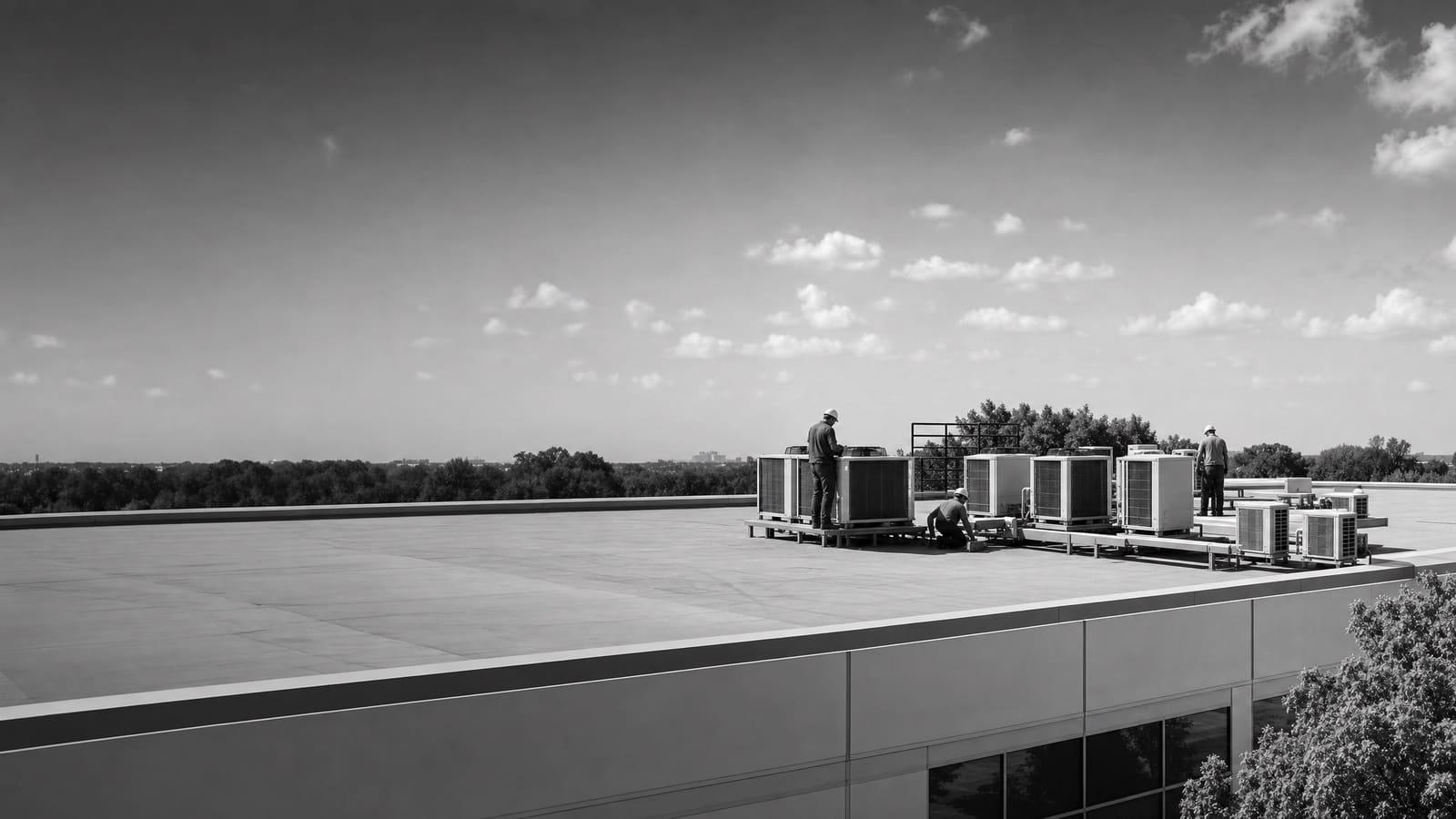
A commercial HVAC replacement is a load check, an equipment selection made against real availability, a rigging and permit plan, and a commissioned startup — not just a new box on the curb. Replacement beats one more repair when the unit is past about fifteen years, when failures repeat in cooling season, or when service is constant. Old, inefficient rooftop units waste roughly $900 to $3,700 each per year, so the math often turns before the equipment fully quits.
A site review has to confirm tonnage against how the space is used today, curb and structural fit, available electrical capacity, gas line status, and crane access before any installed price is real.
THE THREE PATHS
Three ways to handle a failing rooftop unit
Every failing rooftop unit gets handled one of three ways, and the choice is usually made by default rather than on purpose.
Waiting for failure is the most common and the most expensive. Facility teams delay replacement until the unit can no longer hold the space, needs constant service, or stops entirely — and then the decision gets made under pressure, with whatever equipment is in the region that week. Replacing proactively is usually the better business move, and it frequently beats even a like-for-like swap made at the end of a unit's service life.
The middle path, a planned like-for-like swap, is the right answer more often than efficiency arguments suggest. If the space and the way it is used have not changed, matching the existing unit is fast, cheap to engineer, and simple to permit. The upgrade path earns its extra cost when use has changed, when bills have crept up, or when the building is moving toward electric equipment anyway.
WHAT MOVES THE NUMBER
The lines that decide an installed price
Two quotes are only comparable when the same lines appear on both. Ask for each of these separately rather than buried in one installed figure.
IN PRACTICE
Choosing the equipment before the unit picks for you
The easiest decision to get wrong is sizing. The nameplate on a twenty-year-old unit records what the building needed when it was installed, not what it needs now. Occupancy changes, lighting changes, plug loads change, and tenants reconfigure space. A load calculated from current use is the only way to know whether the replacement should match, drop a size, or step up.
The second decision is fuel. Heat pump rooftop units are built on the same platform as air-conditioning rooftops and add reverse-cycle heating. Across most of the US South and West, today's heat pump rooftops can cover most or all of a building's winter heating demand, which puts an all-electric or dual-fuel swap genuinely on the table here. What decides it is infrastructure: electrical capacity at the panel, physical room on the curb, and what happens to the gas line you stop using.
The third is timing. Availability belongs in the decision, not in a discovery after you sign. A unit that is right on paper and months from delivery is the wrong unit for a building already running on portable cooling.
COMPLEXITY
What makes one swap simple and the next one hard
Two rooftop replacements on the same street can price very differently. What separates them is rarely the equipment. It is what the building makes the crew do to get that equipment set, connected, and running.
LOWER COMPLEXITY
Same size, same fuel, open lot
The new unit matches the old footprint, the existing curb takes it or takes a standard adapter, power and gas are already sized, and the crane sets up away from the entrance. One morning of visible work and straightforward paperwork.
HIGHER COMPLEXITY
New size, new fuel, tight access
Tonnage changes, so the curb and possibly the roof structure get reviewed. Going all-electric can add panel or feeder work. A tight lot means a larger crane, a longer reach, or a night lift, and several addresses mean several permits.
SCOPING
What the site review has to settle
A quote written from a phone call is a guess. The site review is where the number becomes real, and it should cover six things.
Start on the roof: curb dimensions, the condition of the deck around it, and whether the new footprint needs an adapter or a structural look. Then the utilities. Confirm the electrical service and panel capacity the replacement needs, especially if the new unit adds electric heat, and confirm what happens to the gas line if you are leaving gas behind. Then access. Where the crane sets up, how much of the lot closes, and for how long, decided before tenants hear anything.
Then the parts nobody sees. The old refrigerant charge has to be recovered by a certified technician under federal rules, which is a compliance step rather than an optional line. Controls and building automation points need to be identified now, because a unit that runs but does not talk to the building becomes a complaint in month two. Finally, ask which code items the replacement triggers in this jurisdiction and get the answer in writing before the order goes in.
Get the walk before the number
If a contractor prices a rooftop replacement without seeing the roof, the panel, and the lot, the number will move later. Ask for the site review first, then compare bids that were all written from the same set of facts.
TUCSON SPECIFICS
Permits are pulled per address, not per project
Commercial HVAC replacement in Tucson runs through the city's development services department as a commercial trade permit, and the permit record is more specific than most owners expect. The city's published commercial permit activity lists each job with the equipment described plainly: tonnage, efficiency rating, fuel type, and where the outdoor and indoor equipment sit. One issued record for a gas split replacement names the tonnage, the efficiency rating, the furnace efficiency, and the fact that the condenser sits on the roof with the coil in a closet.
Two things follow. The scope you sign should match the scope that gets permitted, because a tonnage or fuel change is not a quiet field decision. And permits are pulled per address — a property with five addressed units generated five separate commercial trade permits on the same day, each with its own number.
Count the permits before you book the crane
If your property covers several addresses or suites, confirm the permit count and the inspection count in writing before the crane day is set. Five units on one site can mean five permits, five inspections, and a longer close-out than a single-address job.
OWNERSHIP
Two questions that outlive the install
The installation takes a week of your attention. The consequences run for the life of the equipment, and two of them are worth settling before the purchase order goes out. The first is who actually carries the cost and who collects the benefit under your lease. The second is what a new unit does to a roof that still holds older machines. Neither question changes the crane day, but both change which unit you should buy. Answer them early and the equipment decision usually gets simpler.
LEASE STRUCTURE
Who pays, who benefits
In many commercial leases the owner funds the capital and the tenant collects the utility savings. Name that split out loud before choosing between a like-for-like swap and a higher-efficiency unit, because it decides whose payback you are actually calculating.
MIXED FLEETS
One roof, two refrigerants
New equipment ships with a different refrigerant than units installed a decade ago, so a partly replaced roof carries two types at once. Federal rules govern how each is handled and recovered. Tell your service contractor before the fleet is mixed, not after the first leak.
PLANNING AHEAD
Phasing a roof full of units
Most buildings do not replace one unit. They replace a roof full of them over several years. Phasing works best when the fleet is inventoried first: age, tonnage, refrigerant, and condition of every unit, written down in one place. That list turns a run of emergencies into a schedule you control, and it shows which units to replace proactively and which can still run another season.
Proactive replacement usually beats replacement-on-failure, and it often beats a like-for-like swap made at the end of a unit's useful life. The reason is simple. When a unit dies in season, the decision shrinks to whatever is available that week. When you plan it, you can compare efficiency tiers, chase incentives, negotiate a multi-unit equipment order, and schedule one crane day for two or three units instead of three separate mobilizations.
Lifetime cost is where the case gets made. A single old, inefficient rooftop can waste $900 to $3,700 a year, and rooftop systems cool close to half of all commercial floor area in the country. Compare the installed price against that annual number, not against the repair invoice sitting in front of you.
THE QUOTE
Five things a comparable quote shows
Quotes are only comparable when they show the same things. Ask every bidder for these five in writing before you rank anyone on price.
01
Equipment, spelled out
Manufacturer, model, tonnage, efficiency rating, heating type, and refrigerant — the same detail the permit description will carry.
02
Availability, not just price
The actual lead time for the unit quoted, and what changes if you accept an alternate model instead.
03
Rigging and lot plan
Who supplies the crane, how much of the lot closes, on which day, and for how long.
04
Permits and inspections owned
Which trade permits get pulled, how many, by whom, and who meets the inspector on site.
05
Commissioning and close-out
Startup readings, charge, airflow, controls setup, and the documentation your warranty depends on.
Keep planning locally
Related mechanical pages in Tucson
Get a defensible number
Price the equipment and the building together.
Send the address, operating target, and target opening date. Flux will identify what must be verified before the project can be priced.
Get a free estimateQuestions
Straight answers.
When does replacement beat one more repair?
When the unit is past roughly fifteen years, when it can no longer hold the space, or when service calls have become routine. Old, inefficient rooftop units waste roughly $900 to $3,700 each per year, so waiting for total failure usually costs more than replacing on your own schedule.
Should the new unit match the old one?
Confirm the load either way. If the space and how it is used have not changed, a like-for-like swap is fast, cheap to engineer, and simple to permit. If occupancy, layout, or equipment changed, right-sizing fixes comfort problems the old unit could never solve.
Does a commercial HVAC replacement in Tucson need a permit?
Yes. Replacements are permitted as commercial trade permits through the city, and the record describes the equipment specifically — tonnage, efficiency, fuel type, and where the outdoor and indoor equipment sit. Permits are pulled per address, so a multi-address property needs more than one.
How much does commercial HVAC installation cost?
There is no single installed price, because tonnage, efficiency tier, curb and structural work, electrical capacity, and crane access all move it. Get a site review first, then compare bids that show those lines separately instead of one lump number.
Is a heat pump rooftop a real option here?
It can be. Heat pump rooftop units use the same platform as air-conditioning rooftops and add reverse-cycle heating, and across most of the US South and West they can cover most or all of the winter heating demand. Electrical capacity and curb fit decide whether it works at your building.
Sources used for this guide
- [1]betterbuildingssolutioncenter.energy.gov — DOE Advanced Rooftop Unit Replacement Guidance
- [2]betterbuildingssolutioncenter.energy.gov — DOE Commercial Heat Pump Rooftop Unit Replacement Guidance
- [3]betterbuildingssolutioncenter.energy.gov — DOE High-Efficiency Commercial Rooftop Unit Toolkit
- [4]energy.gov — DOE Efficient Commercial Rooftop Air Conditioner Program
- [5]epa.gov — EPA Stationary HVAC Refrigerant Management
- [6]tucsonaz.gov — commercialweeklyactivity_0623to062725.pdf