THE SHORT ANSWER
What a commercial HVAC replacement actually includes
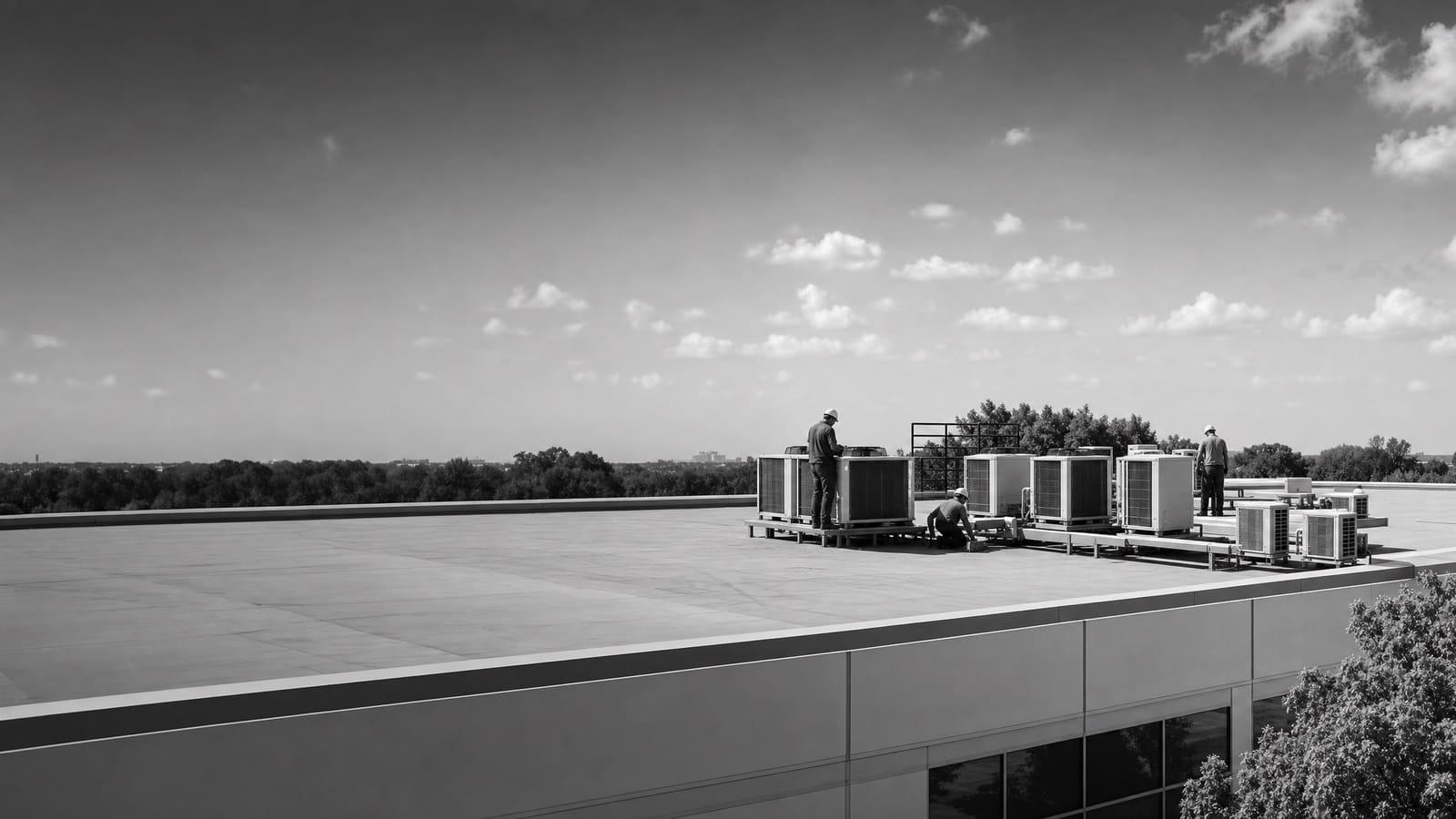
A commercial HVAC replacement covers load verification, equipment selection, rigging and set, connection of power, gas, and controls, then commissioning and documented startup. Replacement beats another repair once a rooftop unit is past roughly 15 years, because federal guidance finds aging units waste far more energy than current models. Old, inefficient rooftop units are estimated to waste $900 to $3,700 per unit every year, which is often more than the repair invoices that keep them running.
A site review still has to confirm the actual load, the roof curb and structure, electrical capacity, and crane access before any of that turns into a firm installed price.
THREE PATHS
How commercial buyers usually handle an aging unit
Most buyers land on one of three paths. The default is waiting for the unit to fail, which federal guidance describes as the common habit: owners delay until the unit no longer conditions the space, needs constant repair, or quits outright. That works right up until it doesn't, and then the calendar chooses your equipment for you. The second path is a planned replacement with a high-efficiency unit, timed while the old one still runs. DOE's rooftop unit work found that proactive upgrades usually beat both replacement-on-failure and a straight like-for-like swap at end of service life. The third path applies when the unit still has years left: retrofit advanced controls instead of replacing the box. DOE treated replacement and controls retrofit as two legitimate options and told owners to pick whichever makes better financial sense for that specific unit.
WHAT MOVES THE NUMBER
The lines that decide what this costs
No two rooftops price the same, but the same handful of lines move the number on nearly every commercial replacement. Ask for each one as a separate figure so you can compare proposals line by line instead of arguing about one lump sum.
PICKING THE UNIT
Choosing the equipment, not just the size
The first real decision is whether you are buying the same machine again. A like-for-like swap is fast and cheap to engineer, and it is often correct when the space is used the way it was when the old unit went in. It also carries forward every sizing mistake the last unit had. If occupancy, operating hours, plug load, or the envelope changed, confirm the load before ordering anything.
The second decision is heating. Federal guidance now treats the heat pump rooftop unit as a normal option rather than an experiment, since it is the same machine as a standard rooftop unit with reverse-cycle heating added. The checklist for that call is practical: climate and heating load, projected utility bill impact, emissions goals, building type, equipment availability, and the infrastructure already on the roof, meaning electrical capacity, physical constraints, and existing gas lines. Contractor familiarity and available incentives sit on the same list.
That guidance puts most of the South and West squarely inside heat pump territory, where today's units handle most or all of the winter heating demand. It also flags the exception directly: southern winters are mild until they are not, and a hard cold snap is when heat pump output trends toward electric resistance performance. That is why three product families exist, dual fuel, all-electric, and cold climate, and why backup heat belongs in the equipment conversation instead of after startup.
SIDE BY SIDE
A one-morning swap versus a real project
Two buildings with the same tonnage can be a one-morning swap or a multi-week project. The difference is rarely the unit itself. It is the curb, the roof structure, the electrical service, and how the crane gets to the building.
LOWER COMPLEXITY
Straight swap conditions
Same tonnage and footprint, an existing curb an adapter fits, gas heat staying gas, a lot the crane can close for a morning, and controls that already speak to the building system.
HIGHER COMPLEXITY
What turns it into a project
Tonnage or footprint changes, an older deck that needs structural review, all-electric heat that pushes panel or service capacity, tight access with no crane path, and work confined to nights or weekends.
SCOPING
What a real site review has to confirm
A quote that arrives without anyone looking at the roof is a guess with a number attached. The walk exists to convert unknowns into scope.
Start with the equipment: nameplate data, age, refrigerant type, heating type, and the repair history from the last two seasons. A unit past fifteen years with a repair record is the exact profile federal guidance points to as the proactive replacement candidate, because the energy it wastes, estimated at $900 to $3,700 per unit annually for old and inefficient rooftop units, often exceeds what you are spending to keep it alive.
Then the building. Curb dimensions and condition decide whether an adapter works or the opening gets rebuilt. Roof structure decides whether a heavier unit triggers review. The disconnect, panel, and available service capacity decide whether an all-electric option is even on the table. Gas line size matters if you are staying with gas or moving to dual fuel. Duct connections, ventilation, and existing controls decide how much of the day happens after the unit lands.
Last, the logistics: crane path and reach, which stalls close, delivery timing, and the hours the building can actually be down. Those answers set the schedule, and the schedule sets a real part of the price.
Have this ready before the walk
Nameplate photos of every unit on the roof, the last two years of service invoices, your electrical panel schedule, and the hours the building can go without cooling. Those four things usually shorten scoping by a week.
OWNERSHIP AND OPERATIONS
Two questions that change the right purchase
Two things decide more about a commercial HVAC replacement than the brand on the unit: who ultimately pays for it, and what the rest of the roof looks like. Neither shows up on a spec sheet, and both change what the correct purchase is.
Owners holding a building long term can justify the efficiency tier on operating cost alone. A building being sold, or a tenant improvement with a short remaining term, usually cannot. And on a roof carrying six or eight units of different ages, one replacement is really the first decision in a sequence of five. Answer both before you pick an efficiency tier, because the same unit can be a strong buy in one case and an overspend in the other.
OWNERSHIP HORIZON
How long you hold the building
Efficiency premiums pay back through operating cost, so the payback window has to fit inside the time you keep the asset. On a short remaining lease term, the conversation shifts to who funds the upgrade and how it gets recovered.
FLEET REALITY
The other units on the roof
Mixed-age roofs create mixed service needs. Standardizing platform, controls, and refrigerant type across replacements simplifies parts and training later, and federal rules already govern how refrigerant is recovered from the units you retire.
PHASING AND PROCUREMENT
Buying one unit versus planning the next five
If you own more than one rooftop unit, the useful exercise is not pricing a single replacement. It is ranking the roof. Sort units by age, repair spend, and the load each one serves, then replace in that order across two or three budget cycles. That turns an unpredictable capital event into a line item you can defend.
Scale is what makes this worth the effort. Through DOE's Advanced RTU Campaign, more than 200 public and private organizations upgraded over 43,000 rooftop units and cut a combined $37 million a year from their energy bills. That is what a disciplined replacement program looks like when it runs on a schedule instead of on failure.
Procurement is the other half. High-efficiency rooftop units are no longer scarce. The federal performance challenge that once had zero qualifying products on the market now has more than twenty models exceeding the specification, and a national minimum efficiency standard has raised the floor under everything else. What still varies is availability, so ask for a written lead time next to the price and treat any unit quoted without one as unconfirmed.
Finally, price the decade rather than the invoice. Rooftop equipment conditions close to half of all commercial floor space in the country, which is why the gap between a base-tier and a high-efficiency selection compounds quietly on every bill for fifteen years or more.
BEFORE YOU SIGN
Five things a comparable quote shows
Comparable quotes are not the same as identical prices. If two proposals show these five things, you can actually compare them. If one is missing, that is the question to ask first.
01
Equipment identified in full
Make, model, tonnage, efficiency tier, heating type, and refrigerant, not just a tonnage number.
02
Written lead time
Confirmed availability next to the price, plus what happens to your schedule if the unit slips.
03
Site work spelled out
Curb adapter, roof and structural scope, crane plan, lot closure, and removal of the old unit.
04
Permits and inspections owned
Who pulls them, who schedules inspections, and which code items your jurisdiction applies to a replacement at this tonnage.
05
Commissioning and warranty
Charge, airflow, and controls verified against spec, documented at handoff, with warranty terms in writing.
Get a defensible number
Price the equipment and the building together.
Send the address, operating target, and target opening date. Flux will identify what must be verified before the project can be priced.
Get a free estimateQuestions
Straight answers.
When is replacement better than one more repair?
Once a unit is past roughly fifteen years and needs frequent attention, the energy it wastes usually outweighs the repair bills. Federal estimates put the waste from old, inefficient rooftop units at $900 to $3,700 per unit each year, which is why proactive replacement often beats waiting for failure.
Should the new unit be a heat pump?
Federal guidance says most of the South and West suits heat pump rooftop units, and that today's models cover most or all winter heating demand there. The decision turns on electrical capacity, existing gas lines, utility rates, building type, and how you want backup heat handled during a hard cold snap.
What actually sets the schedule?
Equipment availability, not the crane. The physical swap is a planned, bounded event once the unit is on site. Ask for a written lead time beside the price, and confirm who owns permits and inspections so approvals are not discovered late.
Can we improve a unit without replacing it?
Sometimes. DOE's rooftop unit campaign treated advanced controls retrofits as a legitimate alternative to replacement, and told owners to choose whichever option makes better financial sense for that unit. It works best on a mid-life unit that still runs reliably.
What happens to the refrigerant in the old unit?
EPA rules under Section 608 of the Clean Air Act govern how refrigerant is handled and recycled in stationary air conditioning and heat pump equipment. Recovery at removal is part of the job, and the documentation should come back to you with the closeout package.
Sources used for this guide
- [1]betterbuildingssolutioncenter.energy.gov — DOE Advanced Rooftop Unit Replacement Guidance
- [2]betterbuildingssolutioncenter.energy.gov — DOE Commercial Heat Pump Rooftop Unit Replacement Guidance
- [3]betterbuildingssolutioncenter.energy.gov — DOE High-Efficiency Commercial Rooftop Unit Toolkit
- [4]energy.gov — DOE Efficient Commercial Rooftop Air Conditioner Program
- [5]epa.gov — EPA Stationary HVAC Refrigerant Management