THE DIRECT ANSWER
What a commercial HVAC replacement actually includes
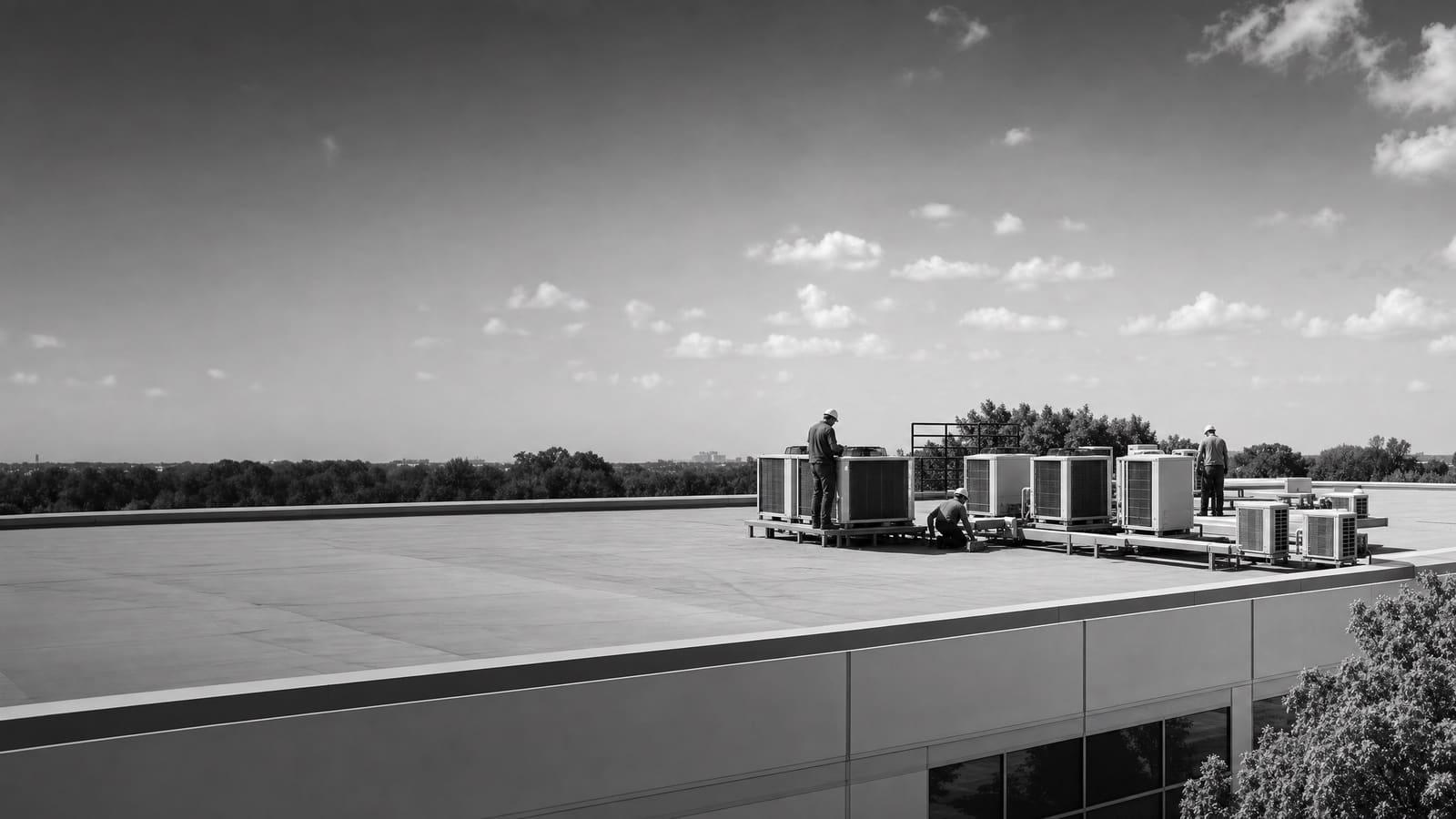
A commercial HVAC replacement means confirming the load, selecting equipment against real availability, setting the unit, connecting power, gas, and controls, then commissioning it so it performs to spec instead of just turning on. Replacement beats another repair once a rooftop unit passes about fifteen years and the service calls start clustering. An old, inefficient rooftop unit can waste $900 to $3,700 a year in energy by itself, which often exceeds the repair being debated.
A site review still has to confirm curb size, roof structure under the new weight, crane reach, and whether the electrical service supports the unit you want.
THREE WAYS TO GO
Like-for-like, high-efficiency, or heat pump
Three paths cover most commercial replacements, and the right one depends less on the building than on what you want it to cost to run.
The first is a like-for-like swap on the existing curb. It gets cooling back fastest and keeps engineering and permitting simple, but it carries the old sizing forward whether that sizing was right or not.
The second is a high-efficiency replacement, where the load is recalculated against how the space is used today and the unit is chosen to match. This is a real shelf, not a special order: the market went from zero qualifying models to more than twenty that exceed the high-efficiency performance specification written for commercial rooftop units.
The third is a heat pump rooftop unit, which adds reverse-cycle heating to the same basic machine. These come as all-electric, cold-climate, and dual-fuel versions with gas backup. Heat pump heating efficiency falls as outdoor temperature drops, so your winter heating profile decides which version fits and whether gas backup stays in the design.
Price all three at once. Comparing them after a unit fails is not comparing them.
WHAT MOVES THE NUMBER
The six lines that decide the price
No two roofs price the same, and the equipment is rarely where bids diverge. These are the lines that move a commercial HVAC installation number most, and the ones worth pinning down before you compare totals from different contractors.
IN PRACTICE
Buy the replacement instead of reacting to it
Most facility managers wait. The unit still runs, the budget is spoken for, and replacement gets deferred until the equipment can no longer condition the space, needs constant service, or fails outright. That is the most expensive way to buy a rooftop unit. Replacing proactively generally beats replacement-on-failure, and it often beats a last-minute like-for-like swap, because emergency timing takes both the efficiency decision and your negotiating leverage off the table.
The practical move is to inventory the roof before anything breaks. Write down the age, tonnage, refrigerant, and service history of each unit. Anything past fifteen years belongs on a replacement list with a year next to it, not a hope. Then price two versions of the same job: the fast like-for-like swap, and the better unit you would actually choose with time to plan. Seeing both numbers side by side is what makes the efficiency upgrade defensible to whoever signs.
When a failure does come, that homework turns a two-week scramble into a phone call. You already know the tonnage, the curb, the crane plan, and which unit you want. The only open question is availability, and you asked about that months ago.
SIDE BY SIDE
How complex is your replacement, really
Not every replacement carries the same risk. A quick read tells you whether this is a one-morning swap or a project that needs engineering first, and which one you have should change how much lead time, contingency, and internal approval you plan for.
LOWER COMPLEXITY
Straight swap on an existing curb
Same tonnage, same fuel, curb reused with an adapter, open lot for the crane, no controls change. Permitting stays simple and the work on the roof is short.
HIGHER COMPLEXITY
Fuel switch, resize, or tight access
Going all-electric, adding tonnage, or working a site with nowhere to set a crane. Electrical capacity, roof structure, and street staging all get reviewed first, and the schedule stretches to match.
SCOPING IT RIGHT
What a real site review has to confirm
A quote written from a nameplate photo is a starting point, not a price. Before it becomes a number you can sign, someone has to stand on the roof.
The review confirms physical fit first: curb dimensions, whether an adapter works or a new curb is required, roof structure under the new weight, and clearances for service access. Then it confirms infrastructure. Electrical capacity is the item that surprises buyers most often, because an all-electric unit can draw more than the existing panel and feeders were sized for, and that upgrade is not a small line. Gas sizing matters the same way in reverse when a unit grows.
Access is the third piece. The crane needs somewhere to set up, a clear path over the building, and a window when the lot or a lane can be closed. Sites without that need a different rigging plan, and the plan belongs in the quote rather than in a change order later.
Last, the review should flag what the replacement triggers. Refrigerant recovery from the old unit must be handled by certified technicians, and it is fair to ask which current code requirements a replacement pulls in that the original install predates.
Ask for the electrical answer in writing
If you are considering an all-electric or heat pump unit, make the contractor state the required service, the capacity you have today, and whether any upgrade is inside the price. That single line separates a real number from an optimistic one.
OWNERSHIP
Two decisions that outlive the install
The installation takes a week. The decisions inside it run for the next fifteen or twenty years, on your utility bill and your service contract, and neither is easy to revisit once the unit is on the roof.
The first is refrigerant. New commercial equipment ships on newer low-GWP refrigerants, and the handling, recovery, and leak repair of refrigerant in stationary air conditioning and heat pump equipment is federally regulated. That determines who can legally service the unit and what your provider needs to stock.
The second is what happens to a mixed fleet, where old and new units share a roof under different service rules, different parts, and different controls. That gets expensive quietly, one call at a time, unless the roof is planned as a whole.
REFRIGERANT
Service and parts change with the unit
Recovery from the old unit and work on the new one must be performed by certified technicians. Confirm your service provider is equipped for the refrigerant your new equipment uses before handoff.
FLEET STRATEGY
Plan the roof, not the unit
If five units will reach end of life across eight years, phase them on purpose. One standard platform simplifies parts, controls, technician familiarity, and every quote you request after this one.
PHASING AND COST
Sequencing a multi-unit roof
When a building carries several rooftop units of similar age, the worst outcome is replacing them one at a time as each fails, in whatever season it picks. Failures cluster, because the units were installed together and ran the same hours on the same schedule. Capital budget, meanwhile, arrives once a year. Those two facts collide, and the collision is what produces emergency pricing.
Phasing fixes it. Group the roof by actual condition rather than by install date, replace the worst two or three in the first cycle, and hold the rest on a maintenance plan with a named replacement year. Buying two or three units together usually prices better than buying one, and it lets you standardize on a single platform and control system instead of collecting a museum of one-off equipment.
Lifetime cost is the argument that wins the budget conversation. An aging unit is not only a failure risk; it burns money every month it runs, and the annual energy waste from one old rooftop unit can approach or exceed the repair spending being approved to keep it alive. Put the energy number, the repair history, and the installed replacement price on one page. The decision usually makes itself.
BEFORE YOU SIGN
Five things a comparable quote shows
Bids are only comparable when they cover the same scope, and most do not. Ask every contractor to put these five items in writing before you line the totals up next to each other.
01
Equipment, tonnage, and efficiency tier
Model number, capacity, refrigerant, and efficiency rating, so the units being compared are genuinely equivalent.
02
Lead time, not just price
Real availability for the exact unit quoted, and what the plan is if that date slips.
03
Curb, structural, and roof work
Adapter or new curb, any framing, and how the roofing is patched and warranted afterward.
04
Rigging, permits, and inspections
Who owns the crane day, lot closures, permit filing, and sign-off, all inside the installed price.
05
Commissioning and documentation
Startup, charge, airflow, and controls verified against spec, with a report that keeps the warranty intact.
Keep planning locally
Related mechanical pages in Jersey City
Get a defensible number
Price the equipment and the building together.
Send the address, operating target, and target opening date. Flux will identify what must be verified before the project can be priced.
Get a free estimateQuestions
Straight answers.
When does replacing a rooftop unit beat repairing it again?
Once a unit is past about fifteen years, needs frequent service, or can no longer hold the space, repair is buying time at a bad rate. An old, inefficient rooftop unit can waste $900 to $3,700 a year in energy on its own, before you count the repair invoices.
Should we replace like-for-like or recalculate the load?
Confirm the load either way. If the space and how it is used have not changed, like-for-like is often the right call. If occupancy, equipment, or hours changed, sizing to today's use fixes comfort problems the old unit could never solve.
Is a heat pump rooftop unit the right replacement?
It depends on your heating season. Heat pump efficiency drops as outdoor temperatures fall, so all-electric units suit milder heating loads while cold-climate and dual-fuel versions exist for colder ones. Electrical capacity and installed cost decide the rest.
Who handles the crane, permits, and inspections?
The installing contractor should own the rigging plan, lot coordination, permit filing, and inspection sign-off as part of the installed price. Confirm the quote says so in writing, because these are the most common change orders on a replacement.
Will new equipment use a different refrigerant?
New commercial units ship on newer low-GWP refrigerants. Day-to-day operation does not change, but handling, recovery, and leak repair are federally regulated and must be done by certified technicians, so service contracts and spare parts need to match.
Sources used for this guide
- [1]betterbuildingssolutioncenter.energy.gov — DOE Advanced Rooftop Unit Replacement Guidance
- [2]betterbuildingssolutioncenter.energy.gov — DOE Commercial Heat Pump Rooftop Unit Replacement Guidance
- [3]betterbuildingssolutioncenter.energy.gov — DOE High-Efficiency Commercial Rooftop Unit Toolkit
- [4]energy.gov — DOE Efficient Commercial Rooftop Air Conditioner Program
- [5]epa.gov — EPA Stationary HVAC Refrigerant Management