
HOUSTON, TX · MECHANICAL
Commercial mechanical contractors in Houston.
Flux Facility services, repairs, replaces, and maintains the heating, cooling, ventilation, and piping inside commercial and industrial buildings across the metro area.
Mechanical work that hits the date.
Whether a build-out needs mechanical from scratch or one system reached its end, the schedule is the job. One request covers plumbing, HVAC, boilers and chillers, and ductwork with the coordination that keeps other trades moving.
Industrial work is its own discipline: process piping, sheet metal and pipe fabrication, and design-build engineering when the drawings don't exist yet. One point of contact from scope to commissioning, and a number that doesn't move after signing.
START HERE
What does a mechanical contractor do for Houston commercial buildings?
A mechanical contractor keeps the heating, cooling, ventilation, and piping in a Houston commercial building running: service calls, repairs, preventive maintenance agreements, equipment replacement, and small retrofit projects. Flux runs all of it on one contract, so a failed compressor and a leaking main reach the same dispatcher.
Pricing starts with a site survey. We walk the building, list the equipment, read the service history, and write down the operating complaints your staff already tracks — the hot zone on the third floor, the unit that has been repaired three times. That record becomes the scope of work and the number on the proposal. Property managers, facility directors, school and hospital staff, and general contractors all buy this way.
Does Houston require a separate mechanical contractor registration?
Yes, and the rule is explicit. A state air conditioning license from the Texas Department of Licensing and Regulation is not enough on its own. A licensed contractor that wants to do work inside city limits must register that state license with the jurisdiction and purchase a permit for the work.
Registration runs through the city's Mechanical Section on Form CE-1307, with a copy of the current state license card, photo ID, and a certificate of insurance naming the Mechanical Section as certificate holder. The registration is good for one year and must be renewed annually, separate from the state license renewal. Ask any bidder for both documents and check the dates before crews mobilize.
License checks
How do you check a mechanical contractor's license in Houston?
State license class and renewal
LICENSE
The state licenses air conditioning contractors as Class A or Class B, and renewal runs $65 a year. Ask for the card itself, since the renewal date on it tells you whether the license was current when the bid was written.
Continuing education on file
TRAINING
State contractors complete 8 hours of approved continuing education per renewal year, and at least 1 of those hours covers Texas law and rules. Technicians are exempt from that requirement, so the certificate you want belongs to the license holder.
Refrigerant handling cards
REFRIGERANT
EPA 608 certification, the federal card for recovering refrigerant, applies to the technician who opens a sealed system. We confirm those cards before anyone breaks into a circuit on your roof.

PROJECT PLANNING
How do Houston mechanical permits and inspections work?
Permit before the wrench turns
PERMITS
A licensed contractor doing work inside city limits must purchase a permit for that work. We pull it under our registration and put the permit number on your closeout paperwork.
One counter downtown
FILING
The city runs a single permitting center downtown for permit issuance and inspections. We file there and track the inspection date, so your team is not holding a tenant space open on a guess.
When an inspection stalls
ESCALATION
The city's Mechanical Section answers license and registration questions at (832) 394-8850. We make that call ourselves and send you the answer in writing the same day.
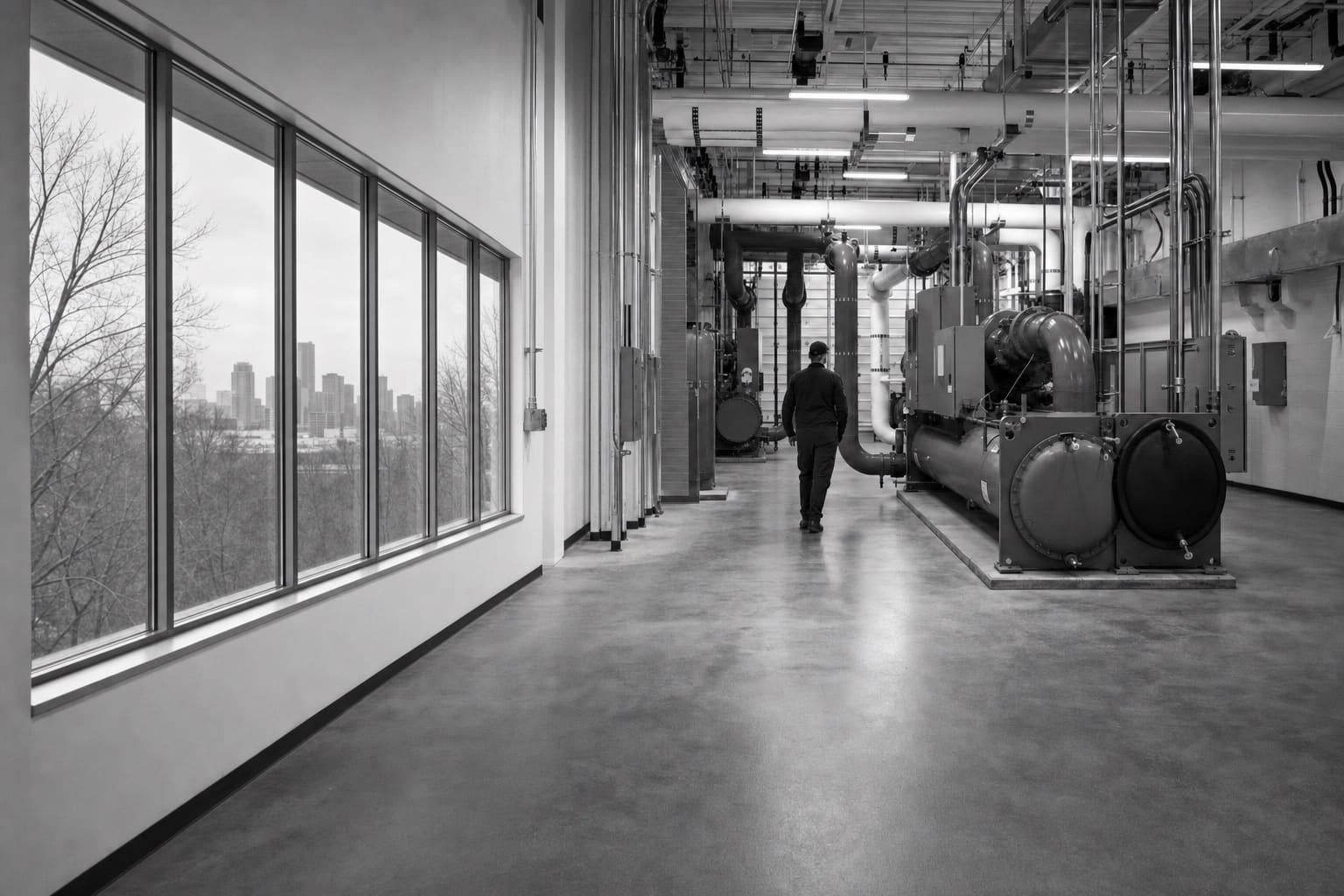
WHAT WE HANDLE
Everything under the mechanical door.
CONSTRUCTION & INSTALLATION
DESIGN & PRECONSTRUCTION

Scope inputs
What belongs in a Houston commercial mechanical scope of work?
- Equipment list with make, model, tonnage, and location. We build it during the survey and price every line from it.
- Service history for the past year, including repeat repairs and any callback your staff logged against a specific unit.
- Operating concerns from the people in the building: hot zones, noise, humidity complaints, rooms that never balance.
- Separate line items for preventive maintenance agreement visits and for repair work, so a filter change and a compressor swap never blend into one number.
- Written exclusions — controls, plumbing, roof access, after-hours labor — settled before the first invoice, not after it.
BEFORE YOU BUY
Why are licensed mechanical crews booked out in Houston?
- This market has the lowest unemployment in the HVAC trade in the country. Put planned replacements and retrofits on the calendar months ahead, so you are not shopping a bid during a breakdown.
- Technician pay here runs above the Texas average. Ask every bidder to show crew size and hours on the proposal, then compare the labor line instead of the bottom line.
- A state contractor license takes 48 months of documented supervised field hours within the previous 72 months. Ask which person on the crew holds the license and who is working under it.
- Refrigerant certification testing runs at several sites in the area, with openings from same-day to about a week. We keep cards current between jobs rather than pulling a technician off your building to sit an exam.
ASKED IN HOUSTON
Common questions about commercial mechanical contractors in Houston
What is the difference between a general contractor and a mechanical contractor?
SCOPE
A general contractor runs the whole project and hires the trades. A mechanical contractor does the heating, cooling, ventilation, and piping, and usually stays with the building on service after the job closes.
What's the difference between HVAC and commercial HVAC?
EQUIPMENT
Scale and paperwork. Commercial work means rooftop equipment and building-wide piping, plus a registered licensed contractor, a purchased permit, and service records a facility team can audit.
What is the best commercial HVAC company?
FLUX
Flux fits when you want heating, cooling, ventilation, and piping under one contract, backed by a current state license, city registration on file, and a scope written from your own equipment list.
Project in Houston?
Tell us the building, exact scope, and target date. Flux will review the request and send the next step.
QUESTIONS
Straight answers.
Do you work with schools, hospitals, and city-owned buildings?
Yes. Flux serves schools, healthcare facilities, municipal buildings, and industrial sites, along with property managers and general contractors. We handle vendor onboarding, insurance certificates, and badging before the first visit.
Does Flux handle commercial plumbing, or only heating and cooling?
Both. Commercial plumbing service and repairs sit on the same agreement as the heating, cooling, and ventilation work, which keeps one dispatcher, one set of records, and one invoice on the account.
How fast can Flux respond when a rooftop unit quits?
Response time belongs in the agreement in writing. We name the covered hours, the after-hours labor rate, and the number that reaches a dispatcher, and we keep our license and city registration current so a permitted repair is not stuck waiting on paperwork.
Can Flux work on building controls and air quality, or just the equipment?
Controls and indoor air quality fall inside our mechanical scope on commercial and industrial sites. We list which control points — the sensors, switches, and thermostats the system reads — we cover, and which ones stay with your existing provider.
GET STARTED
Plan it once. Build it right.
Send the plans or the nameplate and get a complete installed price: real scope, real lead times, no surprises on the back end.
MORE SERVICE AREAS