THE SHORT ANSWER
What a commercial HVAC replacement actually includes
A commercial HVAC replacement covers the load check, equipment selection, permits, rigging and set, gas and electrical connections, controls, and commissioning. Replacement beats another repair once a unit is past about 15 years and failing repeatedly. The Department of Energy puts the waste from an old, inefficient rooftop unit at $900 to $3,700 per unit every year — money that leaves whether or not the compressor holds. Age, repeat service calls, and climbing bills together are the signal.
A site review has to confirm tonnage against how the space is used now, curb and roof structure, electrical capacity at the panel, and crane access before any installed price is real.
THE THREE PATHS
Pick the equipment path before you collect quotes
Most replacements come down to three choices, and the right one depends on how much the building has changed since the last unit went up. A like-for-like swap is the fastest way back to cooling, but it carries forward whatever sizing the old unit had. A heat pump rooftop unit adds reverse-cycle heating and drops the gas connection; DOE guidance puts the West in the group where today's heat pump rooftop units handle most or all of the winter heating demand, so the climate argument in Fontana is favorable rather than borderline. A high-efficiency unit above the federal minimum costs more up front and pays back through the meter — the performance specification DOE developed with manufacturers targeted units that cut energy use by up to half against the standard in place at the time.
Decide the path first. Comparing an efficient heat pump against a bare-minimum unit on price alone tells you nothing useful.
WHAT MOVES THE NUMBER
The lines that decide what your replacement costs
No two roofs price the same, so treat these as the places a quote either does real work or hides risk. The tags show how much each line tends to move once someone actually walks the roof.
IN PRACTICE
How to buy the replacement instead of just approving it
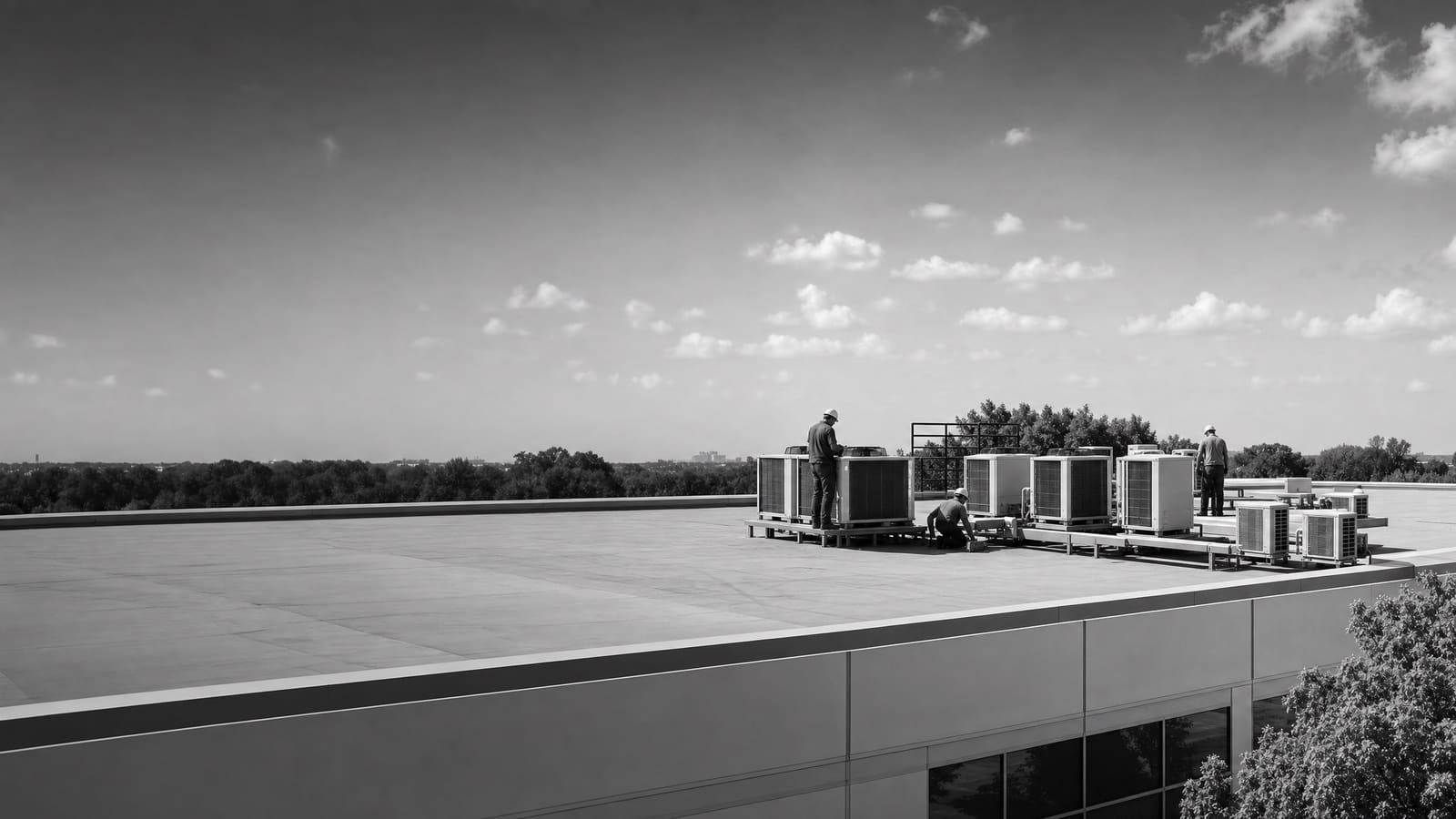
The most expensive mistake in a rooftop replacement is not buying the wrong brand. It is buying the wrong size. Rooftop units cool close to half of all U.S. commercial floor area, and most of them were sized for a building that no longer exists in the same form. Occupancy shifted, plug loads climbed or fell, lighting got replaced, part of the space became storage. Sizing the new unit off the old nameplate copies every one of those errors forward for the next twenty years.
The second mistake is waiting. DOE is direct about the pattern: facility managers usually delay until the unit stops holding the space, needs constant service, or dies outright. Replacing proactively often beats replacement-on-failure, and it often beats a like-for-like swap at end of life, because a planned project lets you choose the equipment, the efficiency tier, and the day the crane shows up. A failure in August gives you whatever is on the shelf.
So run the decision in this order: confirm the load, choose the equipment path, then price it. Quotes gathered before those two steps are quotes for three different projects.
SCOPE CHECK
Simple swap or engineered project?
Before you set expectations with ownership or a tenant, figure out which side of this line your roof sits on. It changes the schedule more than the price does.
LOWER COMPLEXITY
Same size, same fuel, clear roof
The use of the space has not changed, the new unit lands on the existing curb or a straightforward adapter, the electrical service and gas connection stay as they are, and the crane has open lot space with a short reach. Permits are routine and the set is a single morning.
HIGHER COMPLEXITY
New size, new fuel, or tight access
Tonnage or footprint grows, the building goes electric and the panel has to be verified, the roof needs structural review, or the only crane position closes a drive aisle. DOE flags electrical capacity, physical constraints, and gas lines as the infrastructure checks that decide whether a conversion is realistic at all.
THE SITE REVIEW
What has to be verified before a price means anything
A real site review answers questions in a fixed order. What is the actual load today, based on how the space is used rather than what the last contractor installed? Will the new unit sit on the existing curb, and can the roof carry it? Is there electrical capacity for the equipment being considered, especially if the building is moving off gas? Where does the crane set up, how long does that position close part of the lot, and what does that do to tenants or deliveries?
DOE's heat pump guidance frames these as infrastructure questions — electrical capacity, physical constraints, and gas lines — and adds one more that owners tend to skip: contractor availability and knowledge for the specific equipment type. Newer equipment behaves differently at startup and in the controls, and a crew that has not commissioned it before will hand you a unit that runs but does not perform.
Get those answers in writing before you compare numbers. A quote written without them is a guess with a decimal point.
The one question that reorders everything
Ask whether the load was calculated or copied. If it was copied from the old nameplate, every other line on the quote is priced against a building that may not exist anymore, and the comfort complaints you have now will survive the replacement.
FONTANA CONTEXT
Permits and climate change the sequence here
California building departments treat mechanical and electrical upgrades and repairs as permitted work, not just new construction. That matters for sequencing: a rooftop replacement normally needs its permit application moving during the equipment lead window, not after the unit is sitting on the ground next to the building. Owners who wait until delivery to start paperwork lose the days they thought they had bought by ordering early.
Climate pushes the other decision. Fontana's cooling season is long and hot, and its winters are mild — the conditions DOE describes for the West, where current heat pump rooftop units can carry most or all of the winter heating load. That makes an electric replacement a genuine option here rather than a compromise, provided the electrical capacity check comes back clean.
Sequence it this way
Confirm the load, choose the equipment, then file for the mechanical and electrical permits while the unit is being built. The crane day should be waiting on the equipment, never on the permit counter.
OWNERSHIP CONSIDERATIONS
Two things that outlive the install
The install is a morning. The consequences run for the next fifteen to twenty-five years, and two of them are worth deciding on deliberately rather than inheriting. The first is how the new refrigerant fits a building that still has older units on the roof. The second is whether you keep replacing on failure or move to a planned cycle. Both are cheaper to decide now than to discover later, and both show up in what you pay a service contractor every year after handoff.
REFRIGERANT AND MIXED FLEETS
One roof, two service realities
EPA rules under Section 608 of the Clean Air Act govern how refrigerant is handled and recovered in stationary air-conditioning and heat pump equipment. When new units land next to older ones, your service contract and spare-parts plan now cover two refrigerant regimes at once. Ask how that is staffed before you sign the maintenance agreement.
PLANNED VERSUS REACTIVE
Choosing the replacement year
DOE's position is that proactively replacing inefficient, underperforming units is often the better business move than waiting for failure — or even than a like-for-like swap at end of service life. Planned replacement lets you pick the efficiency tier, the equipment type, and a shoulder-season date instead of taking what is available in August.
MULTIPLE UNITS
Phasing a roof full of aging equipment
Buildings rarely have one tired unit. They have five, installed the same year, aging on the same curve. Replacing all of them at once is clean but capital-heavy; replacing them one failure at a time is how owners end up with five different control platforms and no negotiating position.
Phasing works, and it works at scale. Through DOE's Advanced RTU Campaign, more than 200 public and private organizations upgraded over 43,000 rooftop units, saving a combined $37 million a year on energy bills. Those were programs, not emergencies — units grouped, specified once, and replaced on a schedule. The same logic applies to a single property. Rank the roof by age, service history, and how much comfort complaint each unit generates, then replace in that order across two or three budget years.
The procurement advantage is real. One specification across a phased group means one efficiency tier, one controls platform, one set of spare parts, and a lead time you can plan around instead of react to. Lifetime cost lands where the operating spend does — a unit chosen deliberately costs less every month it runs than a unit chosen the day the compressor failed.
BEFORE YOU SIGN
Five things a comparable quote has to show
If two quotes disagree by a wide margin, one of them is usually missing something below. Make every bidder show all five so you are comparing the same project.
01
The load basis
Whether tonnage came from a calculation on current use or from the old nameplate, stated plainly.
02
Equipment and lead time
Model, efficiency tier, refrigerant, and the real availability date sitting next to the price.
03
Curb, structure, and connections
Adapter or new curb, any roof work, and whether gas or electrical changes are included or excluded.
04
Rigging and lot impact
Crane position, hours the stalls close, and who coordinates tenants and deliveries that day.
05
Permits and commissioning
Which permits are pulled and by whom, plus documented startup, charge, airflow, and controls verification.
Keep planning locally
Related mechanical pages in Fontana
Get a defensible number
Price the equipment and the building together.
Send the address, operating target, and target opening date. Flux will identify what must be verified before the project can be priced.
Get a free estimateQuestions
Straight answers.
When does replacement beat one more repair?
Look at three things together: age past roughly fifteen years, how often the unit needs service, and what it costs to run. DOE puts the annual waste from an old, inefficient rooftop unit at $900 to $3,700 each. When that number is in play, another repair only rents you time.
Should a Fontana building replace gas heat with a heat pump?
Often yes, if the electrical checks out. DOE describes current heat pump rooftop units as capable of handling most or all winter heating demand across the West, where winters are mild. The deciding factor is usually electrical capacity at the panel, not the climate.
Can we just swap the same size unit back on?
You can, and it is the fastest path back to cooling. Just confirm the load first. If occupancy, equipment, or use of the space changed since the original install, a like-for-like swap copies the old sizing error forward for the life of the new unit.
Does a rooftop replacement need a permit?
Treat it as permitted work. California building departments require permits for mechanical and electrical upgrades and repairs, not only new construction. File during the equipment lead window so the crane day is waiting on delivery rather than on plan review.
What happens with refrigerant on a mixed-age roof?
New equipment ships on current refrigerants while older units on the same roof stay on what they have. EPA Section 608 rules govern how refrigerant is handled and recovered in both, so confirm your service contractor is certified and stocked for the mix before handoff.
Sources used for this guide
- [1]betterbuildingssolutioncenter.energy.gov — DOE Advanced Rooftop Unit Replacement Guidance
- [2]betterbuildingssolutioncenter.energy.gov — DOE Commercial Heat Pump Rooftop Unit Replacement Guidance
- [3]betterbuildingssolutioncenter.energy.gov — DOE High-Efficiency Commercial Rooftop Unit Toolkit
- [4]energy.gov — DOE Efficient Commercial Rooftop Air Conditioner Program
- [5]epa.gov — EPA Stationary HVAC Refrigerant Management
- [6]californiacity-ca.gov — HVAC Permits