THE SHORT VERSION
What a commercial HVAC replacement actually includes
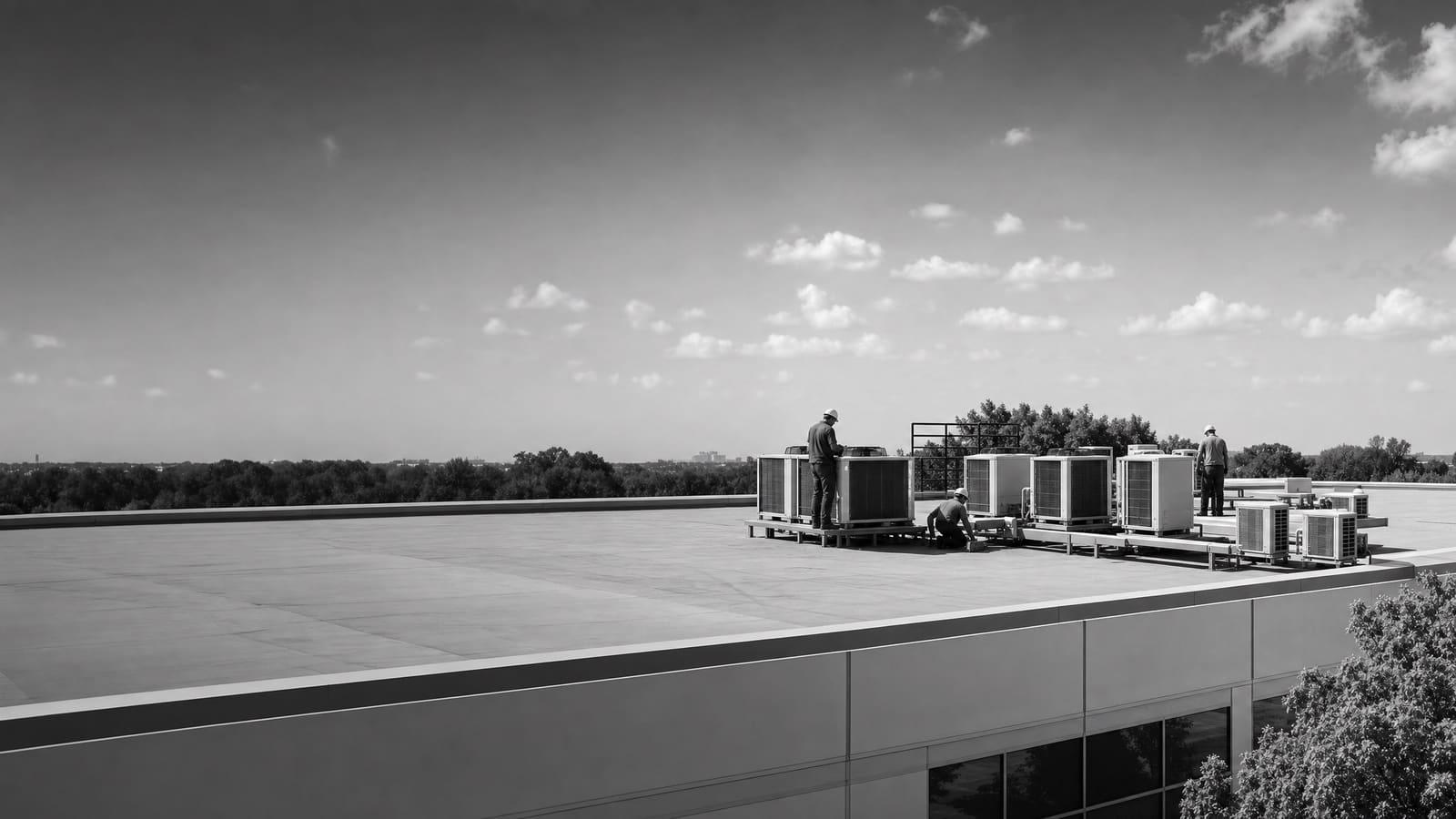
A commercial HVAC replacement is four things: a load confirmed against how the space is used now, equipment selected against real availability, a crane and connection day, and a documented commissioning. Rooftop units cool close to half of all U.S. commercial floor area, so most of these projects are a packaged unit swap. Replacement beats one more repair once the unit is past fifteen years — old, inefficient rooftop units waste $900 to $3,700 each per year in energy alone.
That threshold is a starting point, not a verdict. A site review still has to confirm curb condition, roof structure, crane access, electrical capacity at the panel, and whether the current tonnage matches the load.
THREE WAYS TO GO
Three replacement paths worth pricing
Almost every commercial replacement comes down to three paths, and hours of operation matter more than building age when you pick. A like-for-like swap puts the same class of equipment back on the same curb and gets the space conditioned again fastest. A high-efficiency unit costs more up front and earns it back through the meter — DOE's high-performance specification challenged manufacturers to build rooftop units that cut energy use by up to half against the standard equipment of the time, and manufacturers answered with more than twenty models that exceed it. A heat pump rooftop unit adds reverse-cycle heating in the same box and turns the project into a fuel decision as much as an equipment decision. Price at least two of the three. The gap in purchase price is usually smaller than the gap in what they cost to run.
WHAT MOVES THE NUMBER
The budget lines that actually swing
No one can quote a commercial rooftop replacement from tonnage alone. These are the lines that move the number most between one building and the next, ordered roughly by how often they surprise an owner after the first walk.
IN PRACTICE
How to choose equipment without overbuying
Start with the load, not the nameplate. A unit installed twenty years ago was sized for the occupancy and equipment of that era. A space that once held a full shift may now be half storage, or the opposite. Replacing tonnage you no longer need means paying for capacity twice: once at purchase, and again in comfort complaints when an oversized unit short-cycles.
Then let operating hours pick the efficiency tier. A building running long days, six or seven days a week, earns back a higher tier quickly because the savings accrue every hour it runs. A lightly used space does not. Operating hours are also the honest test for a heat pump rooftop unit. DOE frames that choice around climate, utility prices, and infrastructure: heat pumps hold their efficiency well through mild-to-moderate winter heating and lose ground as outdoor temperatures fall. So the question for a Chesapeake building is how many hours it actually spends in each range, and what you pay for electricity against gas.
Availability is the third input, and it is not a footnote. A unit you can get in a few weeks and a unit you can get next quarter are two different projects, especially if the old one has already failed. Ask for lead time next to price on every option, and ask what the fallback is if the factory date slips.
SCOPE CHECK
What makes one swap simple and the next one complicated
Two buildings with the same tonnage can produce quotes that are nowhere near each other. The difference is almost never the unit itself. It is what has to change around it.
LOWER COMPLEXITY
Same box, same footprint
The replacement matches the old unit's footprint and weight, the curb is sound, the roof has clear crane reach from the lot, and electrical and gas service stay as they are. Permits are mechanical and electrical, inspections are routine, and the on-site work is a single planned day.
HIGHER COMPLEXITY
New footprint or new fuel
The unit changes size or gets heavier, the curb needs an adapter or the roof needs framing, crane reach is blocked by the building or a tight lot, or an all-electric conversion needs new panel and feeder capacity. Expect structural review, a wider permit scope, and phased work around occupancy.
BEFORE YOU PRICE IT
What a real site review has to confirm
A quote written from a photograph is a guess with a number attached. The walk that makes it real is not long, but it has to cover specific ground.
On the roof: nameplate data, curb dimensions and condition, unit weight, the state of the existing duct connections, and whether an economizer is present. Below the roof: the panel feeding the unit, the capacity available in it, the gas connection if there is one, and how the controls are wired and where they report. Outside: where the crane can set up, how much of the lot it takes, what it has to reach over, and whether trees, power lines, or a canopy change the machine you need.
The review should also settle timing. Which day of the week can you afford to lose stalls? Can the space go a full day without conditioning, or does the work need temporary cooling? Who signs for the inspection?
Get all of that on paper before you compare bids. Two quotes that disagree by a wide margin usually disagree because one included the curb adapter, the crane, and the controls work, and the other left them to be discovered later.
The question that separates a bid from a guess
Ask each bidder what they physically verified on your roof and in your electrical room, and what they assumed. Anything in the assumed column is a change order waiting to happen. Get the assumptions listed in writing, with a price attached to each one if it turns out to be wrong.
OWNERSHIP REALITIES
Two things that outlive the install day
The installation is one day. What you decide that day sets your costs for the next fifteen years or more, and two items get skipped most often during a scramble. The first is refrigerant. New commercial equipment ships on newer refrigerants, and the charge in the old unit has to be recovered under federal rules rather than vented — regulated work with a paper trail, not a line you can negotiate away. The second is what happens when equipment gets replaced one failure at a time. Replacing on failure means paying emergency premiums, accepting whatever unit is in stock, and giving up any chance to standardize. A planned sequence gets you better pricing, matched controls, and a service contract that covers one platform instead of five.
REFRIGERANT
The transition is a service question
Recovery from the old unit is regulated under the Clean Air Act and handled by certified technicians. Going forward, a mixed fleet on different refrigerants means different parts, different training, and a service contract that should say plainly which units it covers.
FLEET STRATEGY
Planned beats replace-on-failure
Waiting for failure hands the decision to whatever is in stock that week, at emergency pricing, in the worst season. Sequencing replacements across two or three budget years buys you equipment choice, matched controls, and negotiating room on price.
THE LONGER VIEW
Phasing, procurement, and what the unit costs to own
If you own more than one rooftop unit, treat them as a fleet with a schedule instead of a set of independent emergencies. Walk every unit once and record age, tonnage, refrigerant, and condition, then rank them. Units past fifteen years with a repair history move to the front. That list is what turns a capital request into an argument a finance team can approve, because the annual energy waste on a tired unit is a number you can set directly beside the purchase price.
Procurement follows the same logic. Buying two or three units on one order usually beats buying them one at a time twelve months apart, and it lets you standardize on a single manufacturer and control platform. That standardization pays later in parts inventory, technician familiarity, and how fast a service call gets resolved.
Then judge the whole decision on lifetime cost rather than first cost: purchase, installation, energy across the service life, expected maintenance, and the downtime you avoid. Owners who ran that math through DOE's Advanced RTU Campaign upgraded more than 43,000 units and now save a combined $37 million a year. No single swap was dramatic. The arithmetic just held up every year.
THE QUOTE
Five things a comparable quote has to show
Bids only compare if they cover the same scope. Ask every bidder to break out these five, so you are reading the same document several times instead of several different documents.
01
Equipment, tier, and lead time
Model, tonnage, efficiency tier, and the quoted availability date — plus what happens if the factory date moves.
02
Curb, structure, and rigging
Curb adapter or new curb, any framing, crane size, lot closure duration, and who pulls the permits for it.
03
Electrical and gas scope
Disconnect, feeder, and panel work, and whether gas is kept, extended, or abandoned — priced, not marked as by others.
04
Controls and integration
Thermostat or automation tie-in, sequences, economizer, and confirmation the new unit reports the way the old one did.
05
Commissioning and closeout
Startup readings, charge, airflow, and controls verified against spec, plus the documentation your warranty depends on.
Keep planning locally
Related mechanical pages in Chesapeake
Get a defensible number
Price the equipment and the building together.
Send the address, operating target, and target opening date. Flux will identify what must be verified before the project can be priced.
Get a free estimateQuestions
Straight answers.
When does replacement beat another repair?
Once a rooftop unit is past about fifteen years, the math usually turns. Old, inefficient units waste $900 to $3,700 a year each in energy, and that cost runs whether or not you approve the next repair. A second major repair on a unit that age is often just a down payment on the replacement you will make anyway.
Should you replace like-for-like or resize?
Confirm the load either way. If the space and how it is used have not changed, like-for-like is often correct and it is the fastest path back to conditioning. If occupancy, layout, or plug loads changed, right-sizing fixes comfort complaints the old unit could never solve.
Is a heat pump rooftop unit the right call?
It depends on how much winter heating the building actually needs, what you pay for electricity against gas, and whether the electrical panel can carry an all-electric unit. DOE guidance puts heat pumps at their best through mild-to-moderate heating and notes efficiency drops as outdoor temperatures fall. Dual-fuel units exist for exactly that gap.
Who handles the crane, permits, and inspections?
The installing contractor should own the rigging plan, lot coordination, permits, and inspections as part of the installed price. If a quote lists any of that as by others, it is not comparable to one that includes it — and the difference lands on you later.
What happens to the refrigerant in the old unit?
It has to be recovered, not released. EPA rules under Section 608 of the Clean Air Act govern how refrigerant is handled and recycled in stationary air-conditioning equipment, so recovery is certified work that should appear on the quote as its own line.
Sources used for this guide
- [1]betterbuildingssolutioncenter.energy.gov — DOE Advanced Rooftop Unit Replacement Guidance
- [2]betterbuildingssolutioncenter.energy.gov — DOE Commercial Heat Pump Rooftop Unit Replacement Guidance
- [3]betterbuildingssolutioncenter.energy.gov — DOE High-Efficiency Commercial Rooftop Unit Toolkit
- [4]energy.gov — DOE Efficient Commercial Rooftop Air Conditioner Program
- [5]epa.gov — EPA Stationary HVAC Refrigerant Management