THE SHORT ANSWER
What a commercial HVAC replacement actually covers
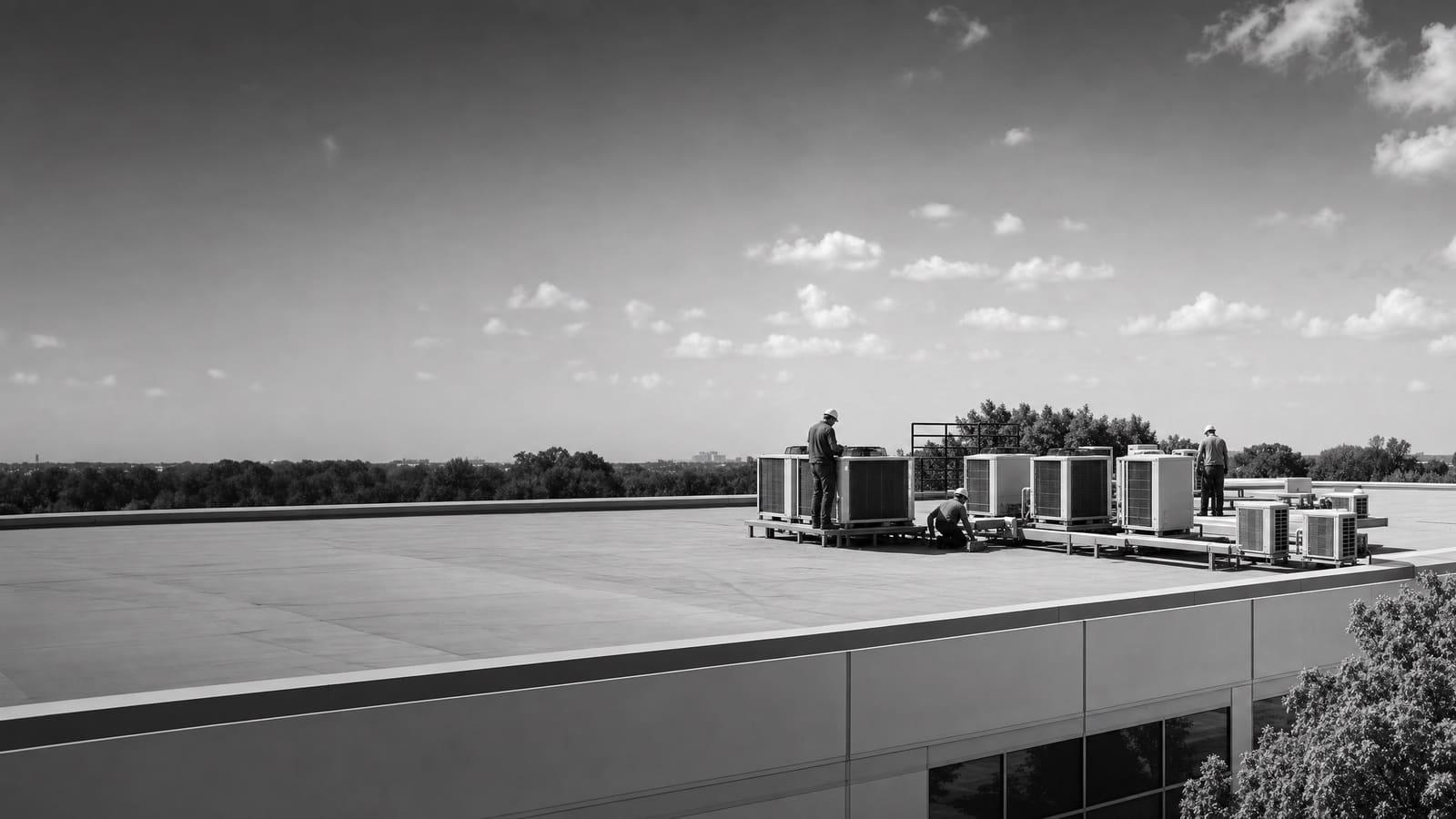
A commercial HVAC replacement covers a confirmed load, equipment selected against real lead times, removal of the old unit under federal refrigerant recovery rules, curb and duct adaptation, electrical and controls work, permits, and commissioning. Replacement usually beats another repair past about fifteen years of service, when a tired rooftop unit is wasting roughly $900 to $3,700 a year in energy before the repair bills.
A site review still has to verify the real load, the curb and roof structure, available electrical capacity, and crane access before any of that turns into a firm number.
THREE PATHS
Three ways to handle a failing commercial unit
Most commercial buyers are choosing between three real options, and the honest answer depends on the unit's age and how the space is used now.
Repair keeps a unit running another season. It's the right call on a younger unit with one discrete failure — a contactor, a board, a motor. It stops being the right call when the compressor is the problem, because then you're buying time on the most expensive thing on the roof to operate.
Retrofit sits in the middle. Adding advanced controls to a mechanically sound unit captures part of the savings without a crane day, and the Department of Energy treats controls retrofit and full replacement as parallel options depending on which one pencils out for the building.
Full replacement resets the clock. It's the only path that fixes sizing, brings the unit to current efficiency standards, and starts a fresh warranty. It costs the most up front and takes the longest, because equipment lead time drives the schedule far more than labor does.
WHAT MOVES THE NUMBER
The budget lines that actually swing
Equipment is the line everyone reads first. These are the ones that decide whether the number you sign matches the invoice you pay, and each should appear separately on a commercial quote.
BUYING GUIDANCE
How to pick equipment you won't regret in year three
Start with the load, not the nameplate. A twenty-year-old unit was sized for a building that no longer exists in practice — different occupancy, different plug load, different lighting, sometimes different insulation. Carrying the old tonnage forward carries the old mistake forward with it. An oversized unit short-cycles, and in a humid climate that means the space gets cold without ever getting dry.
Then decide between gas heat and a heat pump. Southern climates have historically mild winter heating loads, and current heat pump rooftop units are capable of covering most or all of that demand. That makes an all-electric unit a genuine option here in a way it isn't everywhere. The trade is infrastructure: a heat pump unit may need more electrical capacity than the gas unit it replaces, so confirming panel and feeder capacity is a real step, not a formality.
Last, treat the efficiency tier as an operating decision rather than a shopping decision. High-performance rooftop equipment was developed to cut energy use by as much as half against the older baseline, and in a cooling-dominated building that gap compounds every summer. Ask for the annual operating estimate next to the installed price. A contractor who can only quote the price is quoting half the number.
SCOPE CHECK
What makes this project simple or hard
Two projects with identical tonnage can sit a week apart on schedule and far apart on price. The difference is almost never the equipment. It's what the unit is landing on and what it has to connect to.
LOWER COMPLEXITY
Same footprint, same fuel
The replacement matches the existing curb, the electrical service already carries the load, the roof structure is unchanged, and the lot gives the crane clean reach. Permitting is straightforward and the set happens in a morning.
HIGHER COMPLEXITY
New size, new fuel, tight site
Tonnage changes, so structural review enters. A gas-to-electric switch brings panel and feeder work. Multiple units, an occupied building, or a lot with no staging room pushes the job into phases and after-hours work.
BEFORE YOU PRICE IT
What a real site review has to confirm
A quote written from a nameplate photo is a starting point, not a price. Before anyone commits to a number, somebody needs to be on the roof.
The load calculation comes first, based on how the space is used today. Then the physical constraints: curb dimensions, roof structure, unit weight, clearance to parapets and neighboring equipment, and whether the existing duct connections line up. Physical fit is the most common reason a replacement quote moves after signing.
Infrastructure is next. Electrical capacity decides whether an all-electric unit is even on the table, and the existing gas service decides whether keeping gas heat is cheap or expensive. If either needs upsizing, that's a separate trade with its own schedule and its own permit.
Access closes it out. Where the crane sets up, what it has to clear, how many stalls come out of service, and for how long. In an occupied building, that answer usually decides whether the work lands on a weekday or a Sunday.
Crew availability belongs in the same conversation. Newer equipment types need installers who have done them before, and that pool is smaller than the pool for a like-for-like swap.
The five things to confirm on the roof
Confirmed load, curb and structural fit, electrical capacity, gas service, and crane access. If a quote arrives before all five are settled, it's an estimate wearing a proposal's clothes.
IN CAPE CORAL
What Florida permitting adds to the schedule
Commercial HVAC replacement in Florida is a permitted alteration, and the plan set is heavier than most buyers expect. When the scope includes installing or relocating HVAC equipment, the mechanical drawings have to be signed and sealed by a Florida licensed engineer or architect. Energy calculations are required whenever the scope touches heating, ventilation, or air conditioning, and the drawings have to show where the equipment sits. If tonnage or footprint grows, roof framing plans and wall sections can come in as well.
The practical effect is a sequencing one. You engage a design professional before the permit application, not after the unit is on order. Confirm the current submittal list with the Cape Coral building department, since requirements are set locally and change between code editions.
Sealed plans are a lead-time item
Getting a Florida licensed engineer or architect onto sealed mechanical drawings and energy calculations takes time that can run in parallel with equipment lead time — if you start it early. Started late, it becomes the thing everyone waits on.
OWNING THE DECISION
Two things that outlive the install
The install takes a few days. What you decide during it runs fifteen years or longer. Two of those decisions get made by default on most projects, and both are worth making on purpose.
The first is who carries the unit after handoff. Commissioning proves the system meets spec on day one — charge, airflow, control settings, documented. Maintenance is what keeps it there. Rooftop units condition close to half of all commercial floor space in the country, and the reason so many underperform isn't the equipment. It's that nobody verified them after the truck left.
The second is refrigerant. Federal rules govern how refrigerant is recovered from the unit coming down and how the new one is serviced. On a portfolio, that becomes a planning question: which buildings run which refrigerant, and what your service agreement says about parts for the older ones.
OPERATIONS
Commissioning and the handoff
Ask for documented startup values — refrigerant charge, airflow, and control setpoints — verified against the submittal. That document is what you use when a comfort complaint arrives in month two, and it's what keeps the warranty defensible.
FLEET PLANNING
Refrigerant across your buildings
New equipment ships on newer refrigerants than the units it joins. Day-one operation doesn't change, but your service contract and spare-parts strategy should reflect a fleet now running two chemistries.
PHASING AND LIFETIME COST
Replacing on your schedule instead of the equipment's
There are two ways to buy commercial HVAC. You can replace on failure, which means taking whatever unit is available at peak-season pricing while tenants sit uncomfortable and wait. Or you can replace proactively, which means you choose the unit, the week, and the crew.
Proactive replacement is usually the better business decision, and the case strengthens as the equipment ages. The annual energy waste on an old, inefficient unit is a budget line whether or not you acknowledge it. The only real question is whether that money goes toward a new unit or stays with the utility.
If you have several units, phase them. Rank by age, by repair history, and by which spaces generate the most complaints, then replace one or two a year on a planned schedule. That levels capital spend, gives you a real installed price to budget against instead of an emergency number, and lets each install inform the next. It also spreads out the parking disruption, which tenants notice far more than they notice the equipment.
Ask for lifetime cost, not first cost. Installed price, plus estimated annual energy, plus expected maintenance, across the years you plan to hold the building. That's the comparison that actually changes decisions.
QUOTE CHECKLIST
Five things a comparable quote must show
If two quotes don't present these five the same way, you aren't comparing them — you're guessing. Ask for each one in writing before you sign anything.
01
Equipment, tonnage, and efficiency tier
Model number, capacity, and efficiency level, so two bids can be laid side by side without translation.
02
Lead time, stated as a date
When the unit ships, not when the crew is free. Availability drives the schedule more than labor does.
03
Curb, structural, and duct work
Whether the new unit fits the existing curb, what adapter is needed, and any structural review the added weight triggers.
04
Permits, sealed plans, and inspections
Who engages the design professional, who files, who meets the inspector, and whether all of that sits inside the price.
05
Commissioning and documentation
Startup values verified against spec and handed over in writing, with warranty terms stated plainly.
Keep planning locally
Related mechanical pages in Cape Coral
Get a defensible number
Price the equipment and the building together.
Send the address, operating target, and target opening date. Flux will identify what must be verified before the project can be priced.
Get a free estimateQuestions
Straight answers.
When does replacing beat repairing again?
Past about fifteen years, an inefficient rooftop unit is wasting roughly $900 to $3,700 a year in energy before you add repair bills. If the failure is a compressor, or the unit has taken multiple service visits in one season, replacement is usually the cheaper answer over any holding period you would actually budget for.
Can a heat pump replace a gas rooftop unit here?
Often, yes. Winter heating loads in southern climates are mild, and current heat pump rooftop units are capable of covering most or all of that demand. The real gate is electrical capacity: an all-electric unit may need more than the panel and feeder serving the old unit can provide. Confirm that before the equipment order, not after.
What does the permit require in Florida?
For commercial HVAC installation or relocation, the plan set includes mechanical drawings signed and sealed by a Florida licensed engineer or architect, energy calculations, and drawings showing equipment location. Growing tonnage or footprint can add framing plans and wall sections. Confirm the current submittal list with the Cape Coral building department, since requirements are set locally.
What happens to the refrigerant in the old unit?
It gets recovered by certified technicians under federal Clean Air Act rules covering stationary refrigeration and air conditioning equipment. It isn't optional, and it isn't something you should have to ask about — recovery and disposal belong on the quote as their own line.
Should we replace all our units at once?
Rarely. Phasing by age, repair history, and which spaces complain most levels your capital spend and limits disruption. The exception is when several units share one rigging setup or coincide with a roof project, where doing them together saves a crane mobilization and one round of lot closures.
Sources used for this guide
- [1]betterbuildingssolutioncenter.energy.gov — DOE Advanced Rooftop Unit Replacement Guidance
- [2]betterbuildingssolutioncenter.energy.gov — DOE Commercial Heat Pump Rooftop Unit Replacement Guidance
- [3]betterbuildingssolutioncenter.energy.gov — DOE High-Efficiency Commercial Rooftop Unit Toolkit
- [4]energy.gov — DOE Efficient Commercial Rooftop Air Conditioner Program
- [5]epa.gov — EPA Stationary HVAC Refrigerant Management
- [6]tampa.gov — Permit Application Guide Commercial Alteration