THE DIRECT ANSWER
What a commercial HVAC replacement actually includes
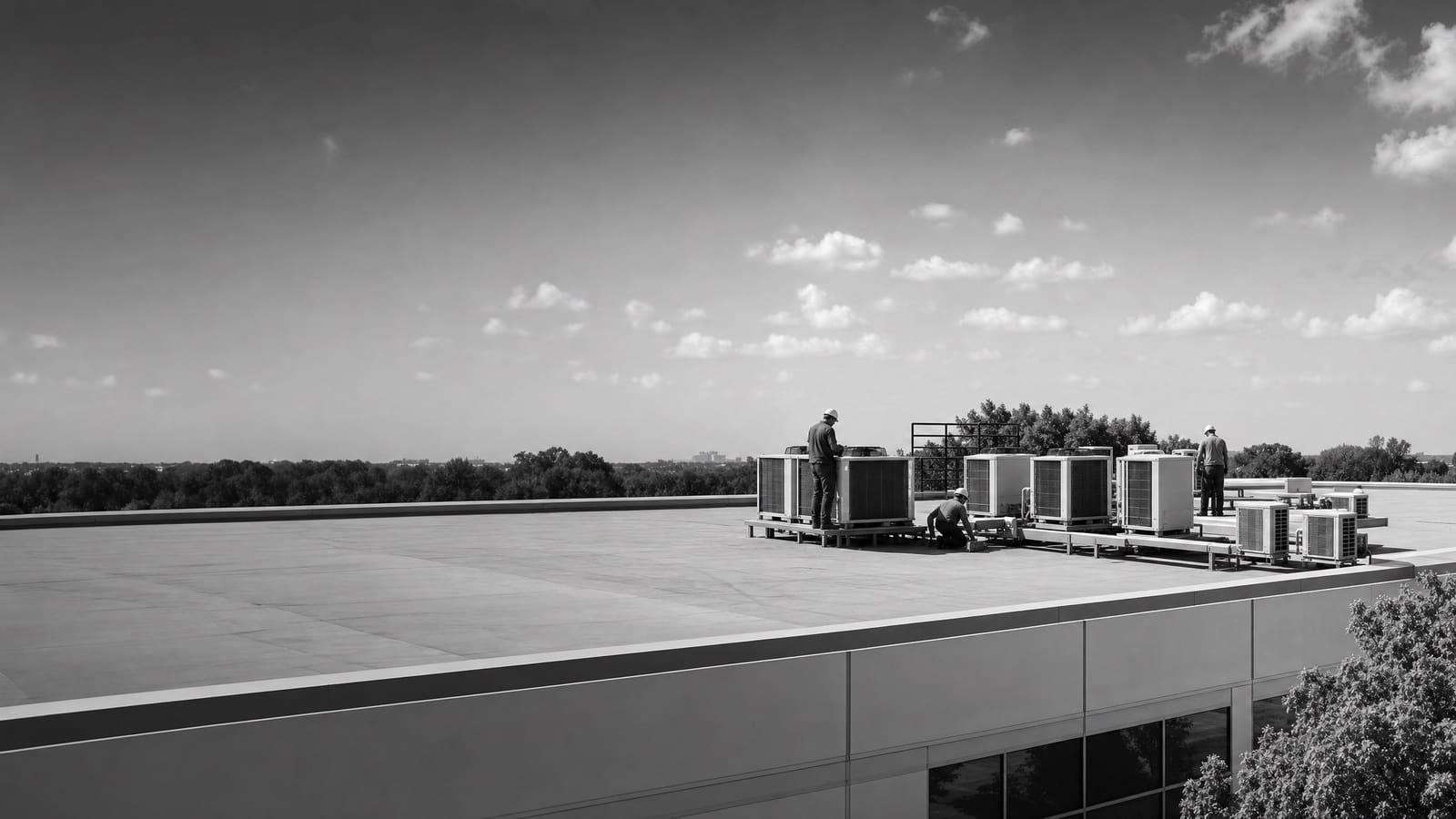
A commercial HVAC replacement covers confirming the load, selecting equipment against real availability, the crane set and any curb work, the gas, electrical, and refrigerant connections, controls integration, permits, and commissioning. Replacement beats one more repair once a unit is past about fifteen years and failures are stacking up. Federal work on commercial rooftop units found that old, inefficient ones waste roughly $900 to $3,700 per unit every year, and no repair recovers that.
A site review still has to verify tonnage against how the space is used now, the curb and roof structure, crane access, and whether electrical capacity or gas service supports the equipment you want.
THREE WAYS TO GO
Three replacement paths, and who each one fits
Most buildings are choosing between three paths, and the right one depends less on the price sheet than on what has changed since the last unit went in.
The first path keeps the fuel and the footprint. It is the fastest way back to conditioned space, and it carries the old sizing forward for another fifteen to twenty years.
The second path recalculates the load and buys efficiency. Federal work with manufacturers produced rooftop units built to cut energy use by up to half against the older standard, and more than twenty models now exceed that specification.
The third path changes the heat source. Heat pump rooftop units are technically close to standard air-conditioning units but add reverse-cycle heating, and federal guidance sorts them into dual fuel, all-electric, and cold climate versions. That choice turns on winter design temperature, electrical capacity, and what your gas service is doing.
WHAT MOVES THE NUMBER
Where a Boise HVAC installation budget actually moves
Equipment is rarely the line that surprises people. The variable lines are the ones tied to your roof, your power, and your calendar. Ask for each of these to be priced separately so you can see what is scope and what is contingency.
IN PRACTICE
How to buy the equipment, not just the install
The most expensive mistake in a rooftop replacement is waiting for the failure. Federal guidance is blunt about it: units past about fifteen years old can waste substantial amounts of energy and money, but facility managers usually hold off until the unit stops conditioning the space, needs constant service, or quits entirely. A unit bought on the day it dies is bought under the worst possible terms, from whatever is available, at whatever that week costs.
Planned replacement changes those terms. You get to compare a like-for-like unit against a high-efficiency one on paper first. Rooftop units condition close to half of all commercial floor area in the country, so this is a well-mapped purchase. More than twenty models now exceed the high-efficiency specification that federal challenge set, and one national campaign has carried more than two hundred organizations through upgrades on over forty-three thousand units.
Equipment availability belongs on that comparison sheet, right next to price. Federal heat pump guidance lists availability and contractor familiarity as decision factors in their own right, alongside electrical capacity and physical constraints. A slightly more efficient unit that is four months out is not the better buy for a building cooling a full floor of tenants in August.
SIMPLE VS COMPLICATED
What makes a replacement simple, and what makes it hard
Two projects at the same tonnage can be a month apart on schedule. The difference is almost always what has to change besides the box itself.
LOWER COMPLEXITY
Same fuel, same footprint
The new unit lands on the existing curb or a straightforward adapter. The fuel source is unchanged, the electrical service already carries the load, and the controls speak the same language. Permitting and inspection stay routine.
HIGHER COMPLEXITY
New heat source or a bigger unit
Fuel switching, larger tonnage, or a different footprint. Federal heat pump guidance points at electrical capacity, physical constraints, and gas lines as the three infrastructure checks that decide feasibility before price matters at all.
BEFORE THE QUOTE
What a site review has to settle
A useful quote starts with a walk that answers questions no photo can. How is the space used today, and does that match the tonnage that has been sitting up there since the last replacement? Is there room on the electrical service, and where is the gas line if there is one? Can a crane reach the set point, and what does that do to the parking lot for a morning?
Federal heat pump guidance turns this into a checklist for a reason. It groups the deciding factors into climate and heating load, cost and utility bill impact, emissions, building type, equipment availability, infrastructure, and contractor familiarity with the technology. Infrastructure then breaks down further into electrical capacity, physical constraints, and gas lines. A building can want an all-electric unit and still fail the electrical capacity check, and that is far cheaper to learn during scoping than on the crane day.
Refrigerant handling belongs in the same conversation. EPA rules under Section 608 of the Clean Air Act govern how refrigerant is handled and recycled in stationary air conditioning and heat pump equipment, so recovery from the old unit is a regulated step with a paper trail, not a line item to shave.
Ask for the infrastructure answers in writing
Before you compare prices, get electrical capacity, gas line status, curb condition, and crane access documented. Those four answers decide whether the cheaper quote is even the same project as the more expensive one.
IDAHO PERMIT BASIS
How the permit is priced on an Idaho HVAC project
Idaho's HVAC contractor permit application runs through the state Division of Occupational and Professional Licenses, and it makes one thing explicit that should change how you read a quote. Permit fees are calculated from the total HVAC system cost, and that cost has to be listed on the permit.
The application defines that cost as what the owner pays in labor charges and other costs incurred to complete the installation of the equipment and materials installed as part of the HVAC system. So the permit fee moves with your scope, not with tonnage alone. A replacement that adds curb work, new electrical, and controls integration carries a larger permit basis than a straight swap of the same unit.
Applications, permit applications, fees, and forms go to the state's Boise office.
Confirm the permit basis before you sign
Ask which party pulls the permit, what system cost they will list on it, and whether the fee sits inside the quoted installed price. Because Idaho ties the fee to total installed cost, a scope change mid-job can move the permit number too.
OWNERSHIP QUESTIONS
Two things to settle before the unit lands
A replacement decision outlives the people who make it. A rooftop unit bought this year will likely still be running deep into the 2040s, so the two questions worth arguing about now are who carries which cost and what the roof looks like afterward.
LEASE STRUCTURE
Who owns the capital line
In a triple-net or modified gross lease, the capital replacement and the operating savings often sit with different parties. A high-efficiency unit trims the tenant's utility bill while the owner writes the check, and that is worth resolving before the specification is locked.
FLEET STRATEGY
Mixed ages, mixed refrigerants
Replacing one unit on a roof of six creates a fleet of mixed ages and mixed refrigerants. EPA Section 608 rules govern how refrigerant is handled and recycled across all of it, so service contracts and spare-parts planning should match what is actually up there.
THE LONGER VIEW
Phasing a roof full of aging units
Few buildings replace everything at once, and few should. The practical approach is to rank the units by age, service history, and how much of the building each one carries, then replace on a schedule instead of on failure. Federal guidance describes proactive replacement of inefficient, underperforming units as a smart business move compared with replacement-on-failure, and even compared with a like-for-like swap at the end of a unit's useful service life.
The arithmetic behind that is not complicated. If an aging unit is wasting somewhere between roughly nine hundred and thirty-seven hundred dollars a year, every year you defer is a year you pay it. Across a roof with four or five tired units, that deferred cost compounds quietly while the capital request sits unapproved.
Procurement gets easier on a schedule too. Planned work lets you order against a known lead time, share a crane mobilization across more than one unit, and run a permit and inspection cycle once instead of repeatedly. Incentives also appear on the federal checklist of decision factors, and they generally have to be lined up before the work happens, which a failure replacement never leaves time for. Ask what your utility currently offers and confirm the timing before you sign, because program terms change.
QUOTE CHECKLIST
Five things a comparable quote shows
Two quotes are only comparable when they carry the same scope. If one of them is missing any of these, it is not cheaper. It is smaller.
01
The selected unit, named
Tonnage, efficiency tier, and model, plus the load calculation the selection came from.
02
Equipment lead time
A real availability date sitting next to the price, not a promise to check later.
03
Curb, rigging, and lot plan
Curb adapter scope, crane reach and staging, and how long stalls are closed.
04
Permits, fees, and inspections
Who pulls the Idaho permit, the system cost listed on it, and whether the fee is included.
05
Commissioning and documentation
Startup, charge, airflow, and control settings verified against spec and handed over in writing.
Keep planning locally
Related mechanical pages in Boise
Get a defensible number
Price the equipment and the building together.
Send the address, operating target, and target opening date. Flux will identify what must be verified before the project can be priced.
Get a free estimateQuestions
Straight answers.
When is replacement better than another repair?
Federal rooftop guidance points at units past about fifteen years old as the ones wasting real money, and it notes that most owners wait until the unit no longer conditions the space, needs frequent maintenance, or fails outright. If repairs are stacking up on a unit that age, the repair is buying time, not capacity.
Does a heat pump rooftop unit make sense for our building?
That depends on winter design temperature, electrical capacity, and what your gas service is doing. Heat pump rooftop units are most efficient with mild to moderate winter heating, and their heating efficiency falls as outdoor temperature drops. Dual fuel and cold climate versions exist for exactly that reason.
How are HVAC permit fees figured in Idaho?
The state HVAC contractor permit application bases permit fees on the total HVAC system cost, which must be listed on the permit. That cost is defined as what the owner pays in labor charges and other costs incurred to complete the installation of the equipment and materials.
What happens to the refrigerant in the old unit?
EPA regulations under Section 608 of the Clean Air Act cover the handling and recycling of refrigerants in stationary refrigeration, air conditioning, and heat pump equipment. Recovery from the removed unit is a regulated step, so it should appear in the written scope rather than being assumed.
We have several aging units. What should we plan first?
Rank them by age, service history, and how much of the building each one carries. Replacing on a schedule lets you share a crane mobilization, order against known lead times, and line up any available incentive before the work starts, which a failure replacement never allows.
Sources used for this guide
- [1]betterbuildingssolutioncenter.energy.gov — DOE Advanced Rooftop Unit Replacement Guidance
- [2]betterbuildingssolutioncenter.energy.gov — DOE Commercial Heat Pump Rooftop Unit Replacement Guidance
- [3]betterbuildingssolutioncenter.energy.gov — DOE High-Efficiency Commercial Rooftop Unit Toolkit
- [4]energy.gov — DOE Efficient Commercial Rooftop Air Conditioner Program
- [5]epa.gov — EPA Stationary HVAC Refrigerant Management
- [6]dopl.idaho.gov — Microsoft Word - Contractor Permit Application 2011.doc