THE SHORT VERSION
What a commercial HVAC replacement actually includes
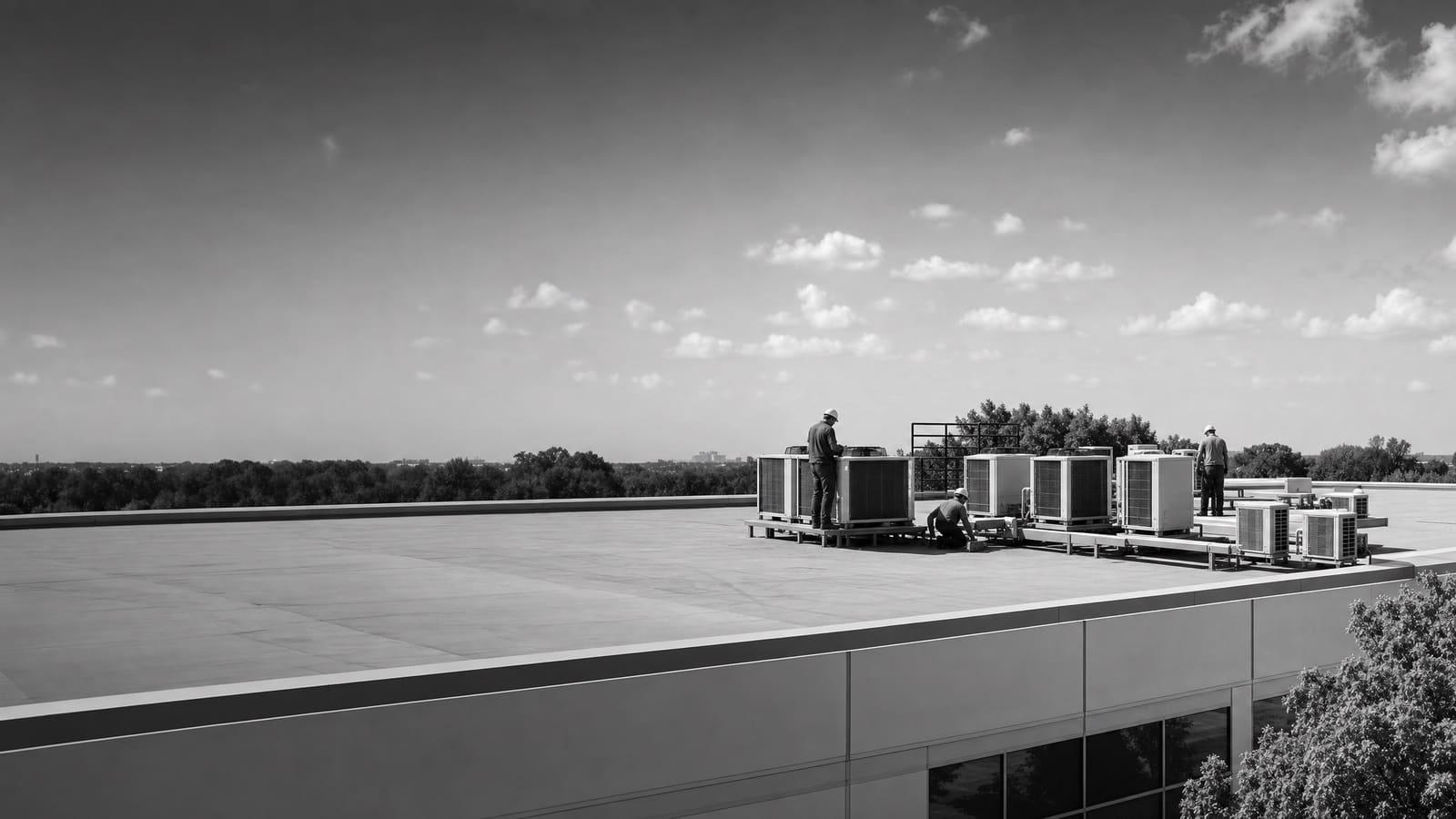
A commercial HVAC replacement is a load check, an equipment order, a permit set, a crane day, and a commissioning pass that proves the new unit performs. Replacement beats one more repair once a rooftop unit is past fifteen years, needs frequent service, or no longer holds the space. Old, inefficient rooftop units waste $900 to $3,700 per unit every year, so a tired unit keeps charging you whether or not it breaks again.
A site review still has to confirm tonnage against how the space is used now, the condition of the curb and the roof deck, panel capacity, and whether a matching unit can actually be ordered in time.
THREE WAYS THIS GOES
Three ways owners handle a failing unit
Most buildings pick one of three, and the choice usually gets made by default rather than on purpose. Waiting for failure is the expensive one. When a unit quits in the middle of a hot week, you take whatever tonnage a distributor has on the shelf, pay for after-hours crane time, and lose use of the space until it is sorted. The unit chooses the date, the equipment, and the budget.
Planned replacement gives all three back. You compare bids, order the unit you actually want, and set it on a morning that suits the tenants. From there the real fork is like-for-like versus an upgrade. Like-for-like is the cheapest path through the paperwork and the fastest on the roof. A high-efficiency or heat pump unit costs more at the order and pays back through the meter, which only works if you have time to price it properly.
The honest test is age and behavior. A unit past fifteen years that needs frequent service is already spending your money quietly.
WHAT MOVES THE NUMBER
What a commercial HVAC quote is actually paying for
Nobody can quote a rooftop replacement from a tonnage number alone. These are the lines that separate two bids on the same building, and the ones worth reading closely before you compare totals.
IN PRACTICE
Buying the unit is not the same as buying the install
It is easy to shop a commercial HVAC replacement like an appliance. Two bids, same tonnage, pick the lower number. That comparison misses where the money goes and where the savings come from.
High-efficiency rooftop equipment is no longer exotic. A federal performance specification pushed manufacturers to build units that cut energy use by up to half against the older standard, and more than 20 models now beat that specification. Field demonstrations confirmed the savings showed up in real buildings and not only on data sheets. In the campaign that followed, more than 200 organizations upgraded over 43,000 rooftop units and cut a combined $37 million a year from their energy bills. That is the argument for reading the efficiency tier instead of defaulting to the cheapest box that fits the curb.
The efficiency only shows up if the install is right. A unit that is oversized, charged wrong, or handed over on factory control settings performs like the tired one it replaced. The load has to be confirmed against how the space is used today, not against a nameplate written twenty years ago.
There is also a middle path worth pricing. If a unit is mechanically sound but running dumb, retrofitting advanced controls instead of replacing it can be the better financial call. That comparison belongs in front of you before you commit to new equipment.
SIMPLE OR COMPLICATED
What makes one replacement simple and the next one messy
Two buildings can order the same unit and get very different bids. What separates them is access, infrastructure, and how much has changed since the last unit went in.
LOWER COMPLEXITY
A straight swap on an open roof
Same tonnage, a curb that adapts cleanly, a panel with room to spare, gas already run, and a lot the crane can set up in. Use of the space has not changed, so the load calculation confirms what is already on the roof.
HIGHER COMPLEXITY
Anything that changes the infrastructure
Going all-electric on a panel with no spare capacity, growing tonnage on an old curb, or a tight site with no good crane position. Add structural review, gas lines to abandon, and a building that cannot lose the space for a day.
BEFORE ANYONE QUOTES
What the site review has to settle
A useful site review answers a short list of questions, and every one of them can change the equipment decision.
Start with the load. The right tonnage comes from how the space is used now, including occupancy, plug loads, hours, and any envelope work done since the last install. Carrying the old nameplate forward carries the old mistake forward with it.
Then the infrastructure. Electrical capacity is the item that surprises people, because a heat pump or all-electric unit can ask for more service than the panel has. Physical constraints come next: curb footprint, roof structure, clearances, and where a crane can actually stand. Gas lines are third, whether that means keeping them, extending them, or retiring them safely.
Availability is a real constraint, not a footnote. The unit you want has to be orderable on a timeline that matches your season, and the crew installing it has to know the equipment. Heat pump rooftop units in particular reward a contractor who has commissioned them before.
Last, incentives. If a program applies to the efficiency tier you are considering, the paperwork usually attaches to the equipment selection, so it belongs in the conversation before the order goes in.
The question that decides the most
Ask what happens if the panel does not have spare capacity. If the answer is a service upgrade, that changes the budget, the schedule, and possibly the equipment itself. Better to learn it at the walkthrough than on crane day.
AFTER THE CRANE LEAVES
Two things you own long after the install
The crane day ends in a morning. The choices inside it stay with the building for the life of the unit, and two of them show up on every service call afterward. Refrigerant is the first. How it is handled, recovered, and recycled in stationary air-conditioning and heat pump equipment is governed by federal rule, so it is regulated work rather than a line to shop on price, and new equipment ships on newer refrigerants than what is coming off the roof. The second is consistency across whatever else you own.
SERVICE PLANNING
A mixed fleet needs a plan
Once a roof holds units on two different refrigerants, parts, training, and service contracts split in two. Decide early whether you are converting the whole roof over a few seasons or living with both for a decade.
PORTFOLIO DECISIONS
One rule, not one model
Write down what makes a site a candidate for a heat pump unit and what pushes it toward dual fuel or like-for-like. Heating load, electrical capacity, and equipment availability differ enough that no single answer fits every building.
PLANNING AHEAD
Phasing a roof full of units
Most commercial buildings do not have one rooftop unit. They have several, installed within a year or two of each other, which means they will reach the end of their service life within a year or two of each other as well. That is the planning problem worth solving before it solves itself.
Sort the roof by age and condition rather than by which unit is complaining loudest. Anything past fifteen years is a candidate on paper. From there, service history and what each unit costs to run separate the ones to replace this year from the ones to watch. The waste from an old, inefficient unit runs $900 to $3,700 a year, so the units you defer are not free to defer.
Then set a pace you can actually fund. A steady replacement schedule usually beats a roof full of failures in one bad summer, and it spreads the disruption instead of stacking it. It also gives you leverage on procurement, because a known plan is something a supplier can quote against and hold equipment for.
Build in the lead time. Availability is part of the decision, not a detail discovered after you approve the bid. A unit ordered in the shoulder season lands on your schedule. The same unit ordered the week it fails lands whenever it lands, and you take what is available.
APPLES TO APPLES
Five things a comparable quote should show
Bids become comparable when they show the same things. Ask for these five and two quotes on the same roof stop being a guessing game.
01
The equipment, spelled out
Model, tonnage, efficiency tier, heating type, and refrigerant, so you know exactly what you are comparing.
02
The load basis
What the sizing was calculated from, not just the tonnage of the unit coming off the roof.
03
Curb, roof, and rigging
Curb adapter, any roof or structural work, the crane plan, and how long the lot is closed.
04
Electrical and gas scope
Panel capacity confirmed, breaker or feeder work included, and what happens to the existing gas line.
05
Startup and commissioning
Charge, airflow, and controls verified against spec, documented, and inside the price rather than billed after.
Keep planning locally
Related mechanical pages in Wichita
Get a defensible number
Price the equipment and the building together.
Send the address, operating target, and target opening date. Flux will identify what must be verified before the project can be priced.
Get a free estimateQuestions
Straight answers.
When does replacement beat one more repair?
Age and behavior decide it. A rooftop unit past fifteen years that needs frequent service, no longer holds the space, or has already been repaired twice this season is spending money quietly. Old, inefficient units waste $900 to $3,700 each per year, which covers more of a replacement than most owners expect.
Should we replace like-for-like or resize the unit?
Confirm the load either way. If occupancy, equipment, and operating hours have not changed since the last install, like-for-like is usually right and it is the fastest path on the roof. If the space is used differently now, resizing fixes comfort complaints the old unit was never able to solve.
Is a heat pump rooftop unit the right call?
It depends on the heating load, the electrical service, and what can be ordered. Heat pump rooftop units are most efficient in mild to moderate winter heating, and as outdoor temperatures fall their heating efficiency trends toward electric resistance. That is why dual-fuel and cold-climate versions exist, and why the choice is made building by building.
What happens to the refrigerant in the old unit?
It gets recovered by the crew, not vented. Handling, recovery, and recycling of refrigerant in stationary air-conditioning and heat pump equipment is regulated federally, so recovery and disposal should already be inside the installed price rather than added as an extra.
Can better controls buy us more time?
Sometimes, and it is worth pricing. Owners can either replace an old rooftop unit with a more efficient one or retrofit it with advanced controls, depending on which makes better financial sense. Controls are the stronger answer when the equipment is mechanically sound but running on poor settings.
How much does commercial HVAC installation cost in Wichita?
There is no honest single number, because tonnage, efficiency tier, curb and roof work, crane access, and electrical scope move the total on every building. The operating side is easier to pin down: an old, inefficient rooftop unit wastes $900 to $3,700 a year, and that is the figure to weigh a quote against.
Sources used for this guide
- [1]betterbuildingssolutioncenter.energy.gov — DOE Advanced Rooftop Unit Replacement Guidance
- [2]betterbuildingssolutioncenter.energy.gov — DOE Commercial Heat Pump Rooftop Unit Replacement Guidance
- [3]betterbuildingssolutioncenter.energy.gov — DOE High-Efficiency Commercial Rooftop Unit Toolkit
- [4]energy.gov — DOE Efficient Commercial Rooftop Air Conditioner Program
- [5]epa.gov — EPA Stationary HVAC Refrigerant Management