THE SHORT ANSWER
What a commercial HVAC replacement actually includes
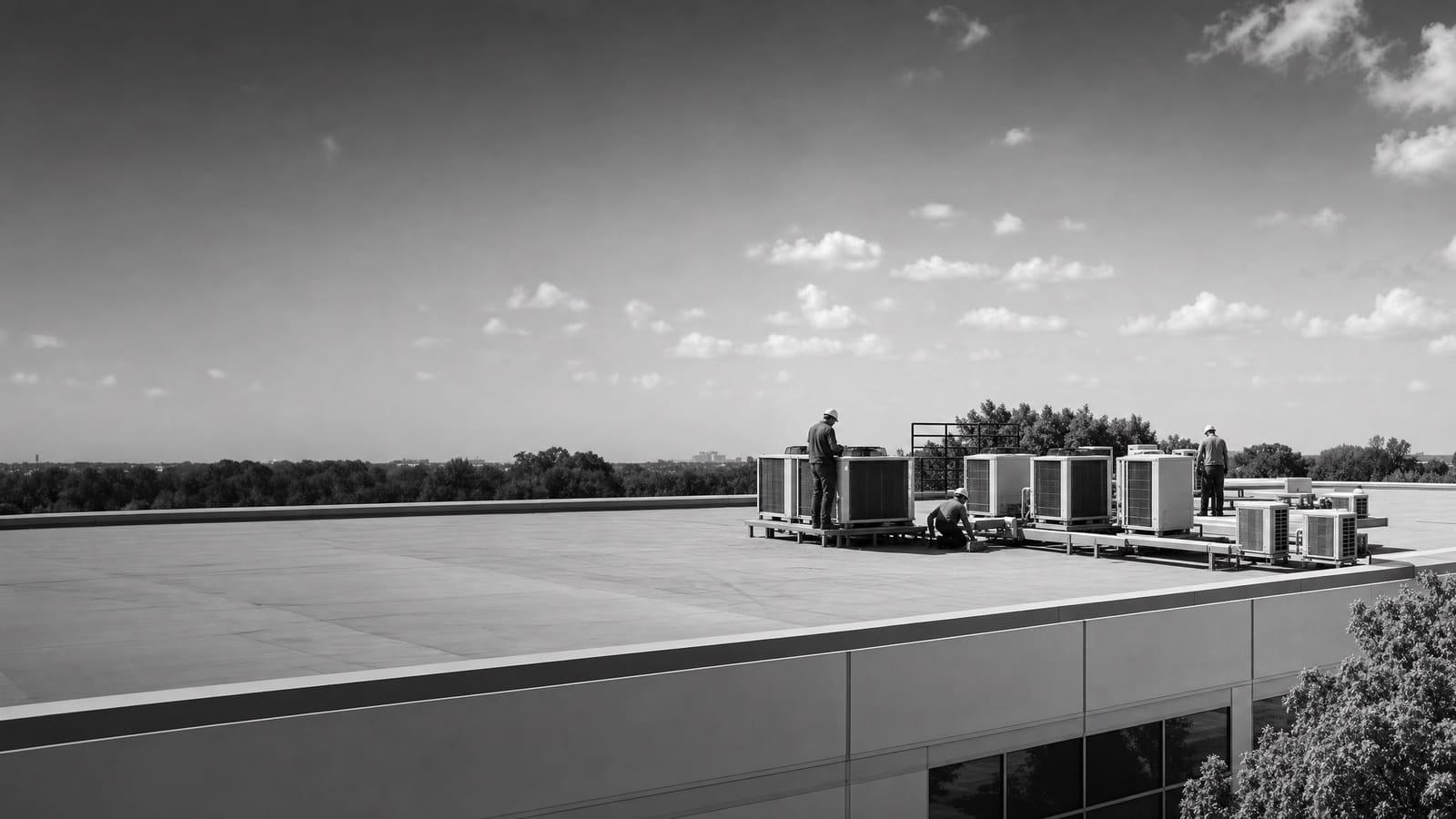
A commercial HVAC replacement covers the load review, the equipment selection and order, the crane set, the mechanical and electrical connections, and the commissioning that proves the system performs. Replacement usually beats another repair once a unit is past about 15 years and the service calls stack up. The Department of Energy estimates an old, inefficient rooftop unit wastes roughly $900 to $3,700 in energy per unit each year, which often carries more weight in the decision than the last repair invoice did.
A site review still has to confirm tonnage against how the space is used today, roof and curb condition, crane access, and whether the electrical service and existing gas piping support the equipment you want.
THREE PATHS
Three ways to replace a commercial rooftop unit
Most commercial replacements come down to three choices, and the right one depends on what is already on the roof and what you want the building to cost to run. A like-for-like swap keeps the same equipment type and the same fuel. A high-efficiency unit keeps the type but buys down operating cost; the Department of Energy's high-performance specification targeted units that cut energy use by up to half compared with the standard in place at the time, and more than twenty models now exceed that specification. A heat pump rooftop unit changes how the building heats. DOE treats that as a site-by-site question rather than a portfolio-wide rule, because electrical capacity, existing gas lines, winter heating load, and equipment availability all decide whether it works at your address.
WHAT MOVES THE NUMBER
The lines that change most between buildings
No two roofs price the same, so read a quote as a set of line items instead of one number. These are the lines that move most from building to building, and each one should be visible before you sign anything.
HOW TO CHOOSE
Buy the unit that fits the building today
The old nameplate is a record of a decision someone made fifteen or twenty years ago. Occupancy changes, plug loads change, and lighting and envelope work change the cooling load. Confirming the load against how the space is used now is the difference between a unit that holds setpoint quietly and one that short-cycles through every shoulder season. That review is inexpensive compared with living with the wrong tonnage for two decades.
Efficiency tier is the next decision, and it is easier to make with a number attached. If DOE's range holds for your equipment, an aging inefficient unit is burning $900 to $3,700 a year that a better unit would not. Put that figure next to the price difference between tiers and the payback stops being abstract.
The last input is timing. DOE's own guidance notes that facility managers often wait until a unit fails completely, and that planned replacement is usually the better business move than replacement-on-failure or a rushed like-for-like at end of life. Waiting removes your leverage on lead time, equipment selection, and crane scheduling all at once. Equipment availability and the installing contractor's experience with the technology you are buying both belong in the decision, not just the price.
SCOPE CHECK
Simple swaps and complicated ones
Two replacements with the same tonnage on paper can be very different projects. What separates them is usually access, infrastructure, and whether anything about the equipment is changing.
LOWER COMPLEXITY
Same type, same size, open roof
The new unit matches the existing curb closely, the electrical service already supports it, and the crane has a clear setup with room to stage. Permits are routine and the on-site work is short.
HIGHER COMPLEXITY
New size, new fuel, or tight access
Growing tonnage can trigger structural review. Switching to a heat pump raises electrical capacity questions. A constrained lot or a tall building means a larger crane, a longer closure, and more coordination with tenants.
BEFORE THE QUOTE
What a site review has to confirm
A price given over the phone from a nameplate is a guess. A real scope starts on the roof and works outward from the unit.
The visit should confirm the existing equipment and its condition, the load the space actually needs today, and whether the curb and roof structure can carry the replacement without repair. It should trace the electrical feed back to the panel and confirm there is capacity for the unit under consideration, since DOE lists electrical capacity, physical constraints, and gas lines as the infrastructure items that decide whether a given technology is even viable at a site. It should look at the crane path, the staging area, and how many parking stalls come out of service and for how long.
It should also cover the parts that are easy to leave for later and expensive to discover late: how the unit will talk to your existing controls, what happens to the space while the old unit is off, and who pulls and closes the permits. If the answer to any of those is unclear at scoping, it will not get clearer once the crane is scheduled.
Ask for these before the quote is final
The load basis for the tonnage, the curb and structural approach, confirmed electrical and gas capacity, the crane and lot plan with closure hours, and who owns permits and inspections. All five should be written down, not implied.
AFTER THE INSTALL
Two things the owner carries afterward
A replacement is a one-morning event on site and a fifteen-year commitment on the books. Two items outlive the crane day and are worth settling while you still have the contractor's attention. Both are cheap to address at install and awkward to address later, once the unit is running and the project file is closed.
REFRIGERANT
Service and compliance planning
EPA rules under Section 608 of the Clean Air Act govern how refrigerant is handled and recycled in stationary air-conditioning and heat pump equipment. On a mixed fleet that means tracking what each unit holds and confirming your service provider works to those requirements.
SUPPLY AND SUPPORT
Availability, technicians, and incentives
DOE's checklist includes equipment availability and contractor knowledge alongside the technical items, plus incentives. Confirm parts support and who services the unit locally before ordering, and check what incentives apply while the specification is still open.
PLANNING AHEAD
Phasing, procurement, and cost over the unit's life
If you have more than one aging unit, sequencing them beats reacting to them. Rank the roof by age, repair history, and how much each unit costs to run, then replace in that order across budget cycles. Planned sequencing lets you order equipment on your timeline, standardize on fewer models, negotiate as a set of projects rather than an emergency, and schedule crane days when the building can absorb them.
The savings side of this is documented at scale. Through DOE's Advanced RTU Campaign, more than 200 public and private organizations upgraded over 43,000 rooftop units, and those upgrades saved a combined $37 million a year on energy bills. That is an aggregate figure across many buildings, not a promise for a specific roof, but it shows the direction the arithmetic runs when old units get replaced deliberately instead of after they fail.
Lifetime cost is where the up-front comparison usually resolves. A cheaper unit that runs harder, cycles more, and gets serviced more often can pass the efficient option in total cost well before it reaches end of life. Ask for the operating assumption behind each option, and hold the quote to the same tonnage and the same efficiency basis so the numbers are comparable.
QUOTE CHECKLIST
Five things a comparable quote should show
If two bids are hard to compare, it is usually because these five items appear in one and not the other. Ask for all of them in writing before you decide.
01
Equipment, tonnage, and efficiency tier
Model number, capacity, efficiency rating, and the load basis the tonnage came from.
02
Lead time and availability
A real delivery window for that model, not a general estimate, plus what changes if it slips.
03
Curb, roof, and structural scope
Curb adapter approach, any roof repair included, and how unforeseen structural work would be priced.
04
Rigging and site plan
Crane size, staging area, stalls closed, closure hours, and who notifies tenants.
05
Commissioning and closeout
Startup, charge and airflow verification, controls setup, permits, inspections, and the documentation you receive.
Keep planning locally
Related mechanical pages in Tulsa
Get a defensible number
Price the equipment and the building together.
Send the address, operating target, and target opening date. Flux will identify what must be verified before the project can be priced.
Get a free estimateQuestions
Straight answers.
When does replacement beat one more repair?
Age plus repair frequency plus operating cost. DOE notes that units past 15 years can waste substantial energy, and puts the annual waste of an old inefficient rooftop unit at roughly $900 to $3,700. When that number plus recurring service exceeds the cost of financing a new unit, replacement is the cheaper option.
Should you replace like-for-like or resize the unit?
Confirm the load either way. If occupancy, equipment, and the envelope have not changed since the last unit went in, like-for-like is often correct. If any of those changed, resizing fixes comfort complaints the old unit was never able to solve.
Is a heat pump rooftop unit a good replacement choice?
It depends on the site, not the region alone. DOE points to electrical capacity, physical constraints, existing gas lines, winter heating load, equipment availability, and contractor experience as the deciding factors, and notes heat pump units perform best where winter heating demand is mild to moderate.
How much does commercial HVAC installation cost?
There is no universal installed price, because tonnage, curb and roof work, crane access, and electrical or gas changes all move the number. The useful step is a scoped quote that shows those lines separately so you can compare bids on the same basis.
What happens to the refrigerant in the old unit?
It has to be recovered and handled under EPA's Section 608 rules, which cover refrigerant handling and recycling in stationary air-conditioning and heat pump equipment. Confirm that recovery and disposal are part of the installed price rather than a separate charge later.
Sources used for this guide
- [1]betterbuildingssolutioncenter.energy.gov — DOE Advanced Rooftop Unit Replacement Guidance
- [2]betterbuildingssolutioncenter.energy.gov — DOE Commercial Heat Pump Rooftop Unit Replacement Guidance
- [3]betterbuildingssolutioncenter.energy.gov — DOE High-Efficiency Commercial Rooftop Unit Toolkit
- [4]energy.gov — DOE Efficient Commercial Rooftop Air Conditioner Program
- [5]epa.gov — EPA Stationary HVAC Refrigerant Management