THE SHORT VERSION
What a commercial HVAC replacement includes
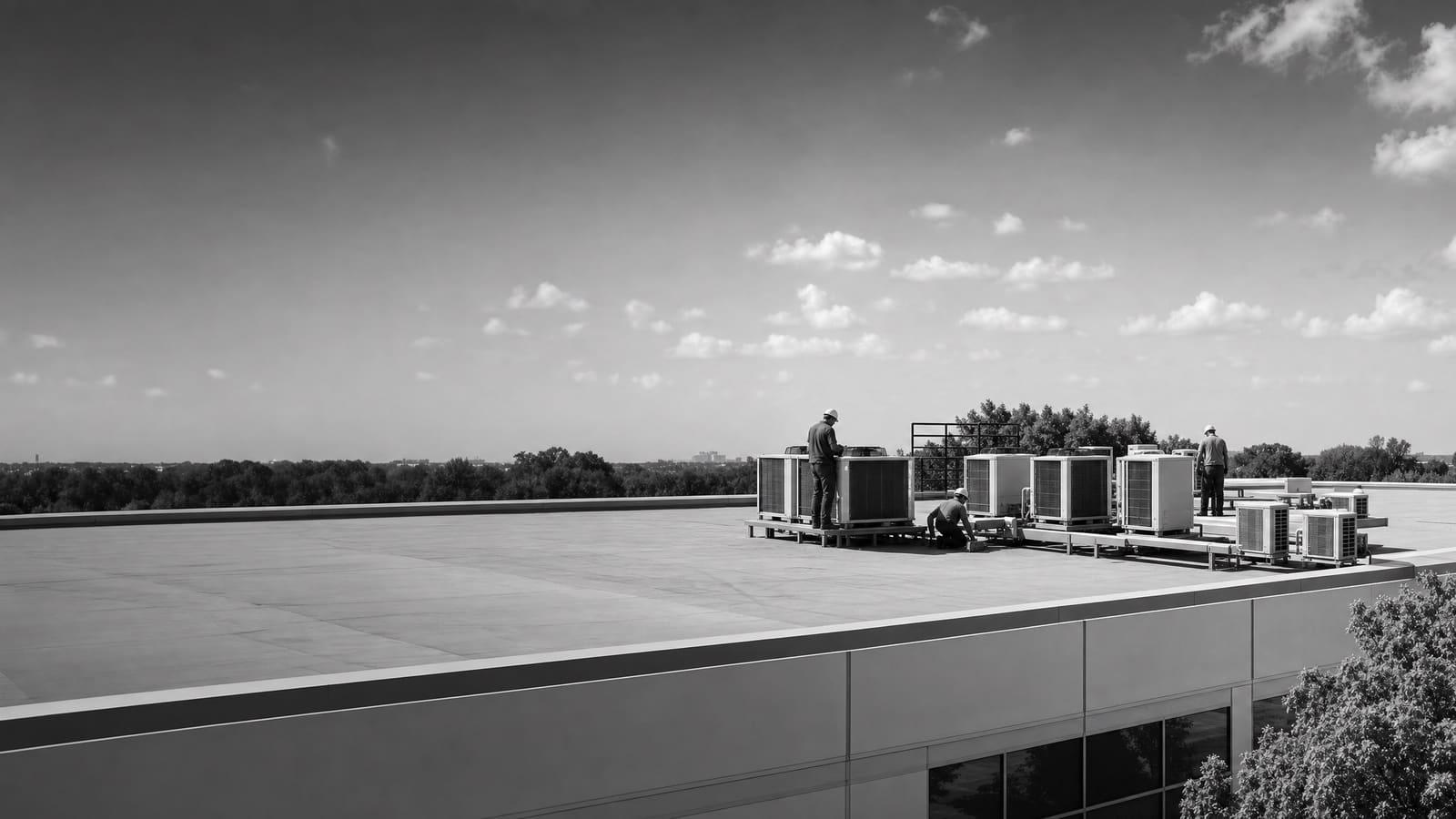
A commercial HVAC replacement is a load check, an equipment decision, a rigging and connection plan, and commissioning that proves the system performs. Rooftop units cool nearly half of all U.S. commercial floor area, and once one passes about fifteen years it wastes real money — federal estimates put that waste at $900 to $3,700 a year per old, inefficient unit. When repairs repeat and that number is true for your roof, replacement stops being the expensive option.
A site review still has to confirm the real load, the curb and roof structure, available electrical capacity, gas service, crane access, and what the existing refrigerant means for the rest of the roof.
THE REAL CHOICE
Three ways owners handle a failing unit
Almost every commercial HVAC decision lands in one of three places, and the difference between them shows up over years rather than on the invoice.
Waiting for failure is the default. It is also the most expensive default, because a dead unit in season removes every choice you had. You take what is available, at the price it is available, on the day a crane can get there.
Planned like-for-like is the middle path. The space and its use have not changed, the curb and connections stay, and the work gets scheduled around your operating hours instead of the weather.
A planned upgrade treats the swap as the one chance to change equipment class. Federal work on rooftop units produced designs that cut energy use by up to half against the standard in place at the time, and the replacement window is also when a heat pump unit becomes realistic — the roof is open, the crane is booked, and the electrical scope is already priced.
The question is not which unit is best. It is which one you will still be paying for in ten years.
WHAT MOVES THE NUMBER
The lines that separate two quotes
Nobody can price a commercial replacement off a tonnage number alone. These are the items that make two quotes on the same building look nothing alike, and the ones worth asking about before you compare totals.
CHOOSING EQUIPMENT
Like-for-like, or a different class of unit
The old nameplate records a decision someone made twenty years ago about a building that no longer exists in the same form. Occupancy changed, lighting changed, plug loads changed, and in most buildings the envelope was touched at least once. Confirming the load before ordering is the cheapest step in the entire project, and it is the step most often skipped because the nameplate is right there on the unit.
Once the load is honest, the real question is equipment class. Federal guidance on heat pump rooftop units frames that decision around a specific set of checks: heating load and climate, the local gap between electricity and gas prices, the emissions profile of the grid, building type, whether the equipment is actually available, and the infrastructure already on the roof — electrical capacity, physical constraints, and existing gas lines. Contractor familiarity and available incentives round it out.
Heat pump efficiency falls as outdoor temperatures drop, trending toward parity with electric resistance heat at the low end. That is why the guidance separates all-electric units from dual-fuel and cold-climate designs instead of treating heat pumps as one product. Where winter heating is mild to moderate, an all-electric unit can carry most or all of the load. Where heating hours run longer or the electrical service is tight, dual-fuel keeps gas heat as backup and avoids a service upgrade. Both are legitimate answers. Guessing between them is not.
SCOPE CHECK
What makes a replacement simple or complicated
Two buildings with the same tonnage can be a one-morning job or a three-trade project. The difference is almost never the unit itself. It is what the unit has to connect to, and what has to move before it can land.
LOWER COMPLEXITY
Straight swap conditions
Same tonnage and footprint, an existing curb the new unit can adapt to, adequate electrical service already at the roof, open lot access for the crane, and stand-alone controls. Use has not changed, so the load calculation confirms the existing size rather than changing it.
HIGHER COMPLEXITY
Conditions that add scope
A change in tonnage or unit weight that triggers structural review, a fuel switch that needs new electrical capacity, tight or shared access that limits the crane, integration into a building automation system, and phased work across several units while the building keeps running.
BEFORE THE QUOTE
What a site review has to settle
A quote that arrives without anyone looking at the roof is a guess with a number attached. The review is short, but it has to produce specific answers.
Start with the load. The calculation should reflect current occupancy, schedule, equipment, and any envelope work done since the original install. That number decides whether you are replacing the same size or correcting a twenty-year-old mistake.
Then the physical constraints. Curb dimensions and condition, the structure under it, a clear path for the crane, and a staging area all decide the rigging plan. Physical constraints are one of the checks federal guidance calls out explicitly, alongside electrical capacity and gas lines, and they are the ones most often discovered on install day instead of during scoping.
Then the services. Available electrical capacity decides whether an all-electric unit is a straightforward option or the start of a service upgrade. Existing gas service decides whether dual-fuel is even on the table. Neither is a judgment call. Both are measurable.
Finally the refrigerant. The old charge has to be recovered by a certified technician under EPA rules, and new equipment ships on different refrigerants than the units it replaces.
Ask for these before you compare totals
Load calculation basis, curb and structural findings, measured electrical capacity, the crane and staging plan, and refrigerant recovery. When two quotes differ by a lot, the gap is almost always in one of those five and not in the equipment.
EASY TO DEFER
Two things owners underweight
Replacement decisions get made on the invoice and then lived with on the utility bill and the service log. Both of the items below change the math long after the crane leaves, which is why they belong in the decision rather than the post-mortem.
Neither one is exotic. They are simply the parts of a project that are easy to push aside, because pushing them aside costs nothing on the day you sign and quite a lot in year three. If you own more than one unit, they compound — a portfolio decision made once and made well is worth more than five separate good decisions.
OPERATING COST
The unit you keep paying for
Federal rooftop unit work produced designs intended to cut energy use by up to half against the standard in place at the time. That difference never appears on the invoice you sign. It appears every month, for as long as you own the unit.
FLEET PLANNING
Mixed refrigerants on one roof
New equipment ships on different refrigerants than the units it replaces. Recovery and service stay in certified hands under EPA rules either way, but a roof running two refrigerant generations needs parts stocking and service planning to match.
LOOKING AHEAD
Phasing a roof full of same-age units
Buildings rarely have one unit at end of life. They have five units installed in the same year, which means they will fail in roughly the same window. The useful move is to stop treating each failure as an event and start treating the roof as a replacement schedule.
Rank the units by age, service history, and the space each one serves. Units past about fifteen years old are where the energy waste concentrates, and the units serving your most schedule-sensitive spaces are where a failure costs the most. Replace against that ranking, a unit or two per budget cycle, instead of against whichever one dies first.
Phasing buys three things. Procurement gets easier, because you are ordering ahead of need rather than accepting whatever sits in a regional warehouse. Standardization becomes possible, so parts, controls, and service procedures converge instead of fragmenting. And incentives become usable, because efficiency programs generally want an application before the work happens — a program you learn about after crane day is a program you did not get.
The national version of this is the Advanced RTU Campaign: more than 200 organizations upgraded over 43,000 units and cut a combined $37 million a year in energy spend. The mechanism was not a special unit. It was deciding before the equipment decided for them.
APPLES TO APPLES
Five things a comparable quote shows
Two quotes are only comparable when both describe the same scope. Most of the distance between a low number and a high one is scope that one contractor included and the other left for a change order. Ask for these five in writing.
01
The load basis
Which calculation the size came from, and whether it reflects current use or just repeats the old nameplate.
02
Equipment, tier, and availability
The exact unit, its efficiency tier, its refrigerant, and a real availability date sitting next to the price.
03
Roof and structural scope
Curb adapter or new curb, any framing work, and who owns the roofing repair around the opening.
04
Rigging and site plan
Crane size, staging area, lot closure hours, and the weather contingency.
05
Startup and commissioning
Charge, airflow, and control settings verified against spec and documented, plus recovery of the old refrigerant.
Keep planning locally
Related mechanical pages in Tacoma
Get a defensible number
Price the equipment and the building together.
Send the address, operating target, and target opening date. Flux will identify what must be verified before the project can be priced.
Get a free estimateQuestions
Straight answers.
When does replacement beat another repair?
When repairs repeat on the same unit and its age is working against you. Rooftop units past about fifteen years old waste substantial energy compared with newer models, and federal estimates put that waste at $900 to $3,700 a year for an old, inefficient unit. Compare the repair bill against that number, not against zero.
Should you replace like-for-like or resize?
Confirm the load either way. If occupancy, equipment, and schedule are unchanged, like-for-like is often correct and the calculation simply confirms it. If use has changed, the old nameplate carries someone else's sizing mistake forward for another twenty years.
Is a heat pump rooftop unit a real option?
Often, but it is a checklist rather than a preference. Federal guidance frames it around heating load and climate, electricity and gas prices, available electrical capacity, physical constraints on the roof, existing gas lines, equipment availability, and incentives. Dual-fuel exists for buildings where going all-electric would force a service upgrade.
What happens to the refrigerant in the old unit?
It is recovered, not released. EPA Section 608 rules govern the handling and recycling of refrigerant in stationary air conditioning and heat pump equipment. Recovery belongs on the quote as a line item, with the technician certification behind it.
How much does a commercial HVAC installation cost?
There is no honest universal number, because equipment class, curb and structural work, electrical capacity, and crane access all move it. What you can compare is scope. Two quotes built on the same load basis, the same equipment class, and the same site plan are comparable. Two totals by themselves are not.
Sources used for this guide
- [1]betterbuildingssolutioncenter.energy.gov — DOE Advanced Rooftop Unit Replacement Guidance
- [2]betterbuildingssolutioncenter.energy.gov — DOE Commercial Heat Pump Rooftop Unit Replacement Guidance
- [3]betterbuildingssolutioncenter.energy.gov — DOE High-Efficiency Commercial Rooftop Unit Toolkit
- [4]energy.gov — DOE Efficient Commercial Rooftop Air Conditioner Program
- [5]epa.gov — EPA Stationary HVAC Refrigerant Management