THE DIRECT ANSWER
What a commercial HVAC replacement actually includes
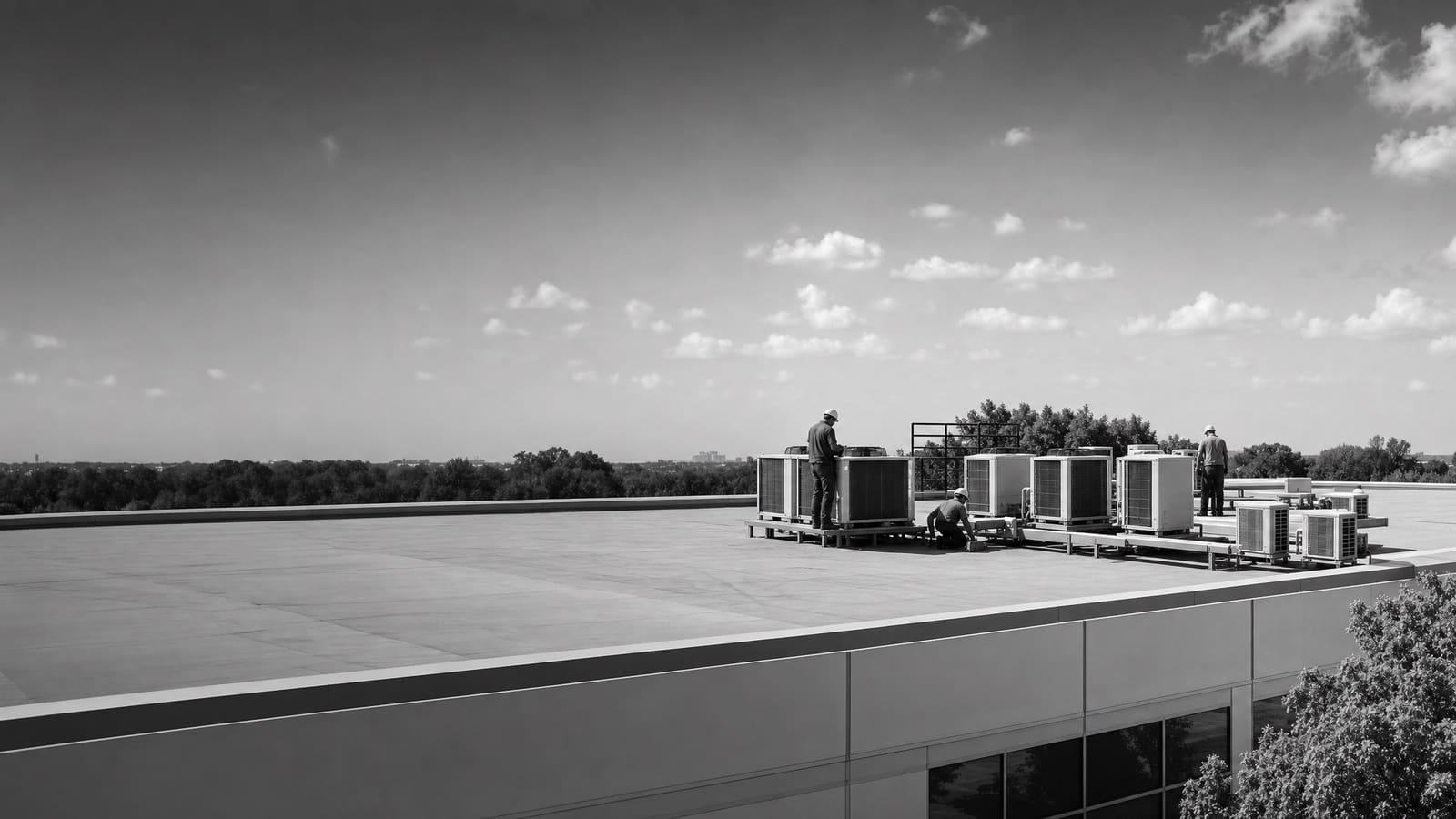
A commercial HVAC replacement is a confirmed load, a selected unit, a set-and-connect day, and a documented startup. Replacement beats another repair once the unit is old enough that its inefficiency costs real money every month. Old, inefficient rooftop units waste roughly $900 to $3,700 per unit each year, and units past fifteen years are the ones worth replacing on purpose instead of on failure.
Those figures describe operating waste, not an installed price. A site review has to confirm tonnage against current occupancy, the curb and roof structure, electrical capacity, and crane access before any number on a quote means anything.
THREE WAYS TO GO
The three replacement paths worth pricing
Most buildings treat rooftop units as a wait-and-see item. The unit runs until it does not, and then whatever is available becomes the decision. Federal guidance is blunt about the cost of that habit: replacing proactively usually beats replacing on failure, and often beats a like-for-like swap at the end of a unit's service life.
There are really three choices in front of you, and they are not equally expensive over ten years. You can retrofit the existing unit with advanced controls and keep the box. You can replace like-for-like with a new unit of the same type and tonnage. Or you can replace with a higher-efficiency or heat pump unit selected against how the building runs today.
The right answer depends on the age of the unit, how much life is left in it, whether the space still uses conditioning the way it did when the unit was picked, and what your electrical service can carry. Price at least two of the three. A quote that shows only one path is not a comparison.
WHAT MOVES THE NUMBER
Budget lines that decide the final price
No two roofs price the same, so read a quote by its line items rather than its total. These are the lines that separate a clean swap from a small construction project, and each one should be priced rather than carried as an allowance.
IN PRACTICE
Choosing between a matching unit and a better one
The instinct on a dead unit is to match the nameplate and move on. Sometimes that is right. If the space is used the way it was when the unit was specified, and the unit was correct then, a matching replacement gets the building back in service with the least engineering and the fewest unknowns.
The problem is that the nameplate records a decision someone made fifteen or twenty years ago. Occupancy changes. Lighting loads drop. Walls move. A unit sized for the old floor plan can be badly oversized for the new one, which shows up as short cycling, humidity complaints, and a bill nobody can explain. Confirming the load costs a fraction of the unit, and it is the only step that tells you whether matching is a shortcut or a mistake.
The efficiency question is separate and easier. High-efficiency rooftop units were developed to cut energy use by up to half against the older standard, and more than twenty models now exceed that specification. Their performance was verified in working buildings, not just on data sheets. If the unit you are replacing is old and inefficient, the efficiency tier is usually where the ten-year money sits, not in the tonnage.
SCOPE CHECK
What makes a replacement simple or complicated
Before you budget, sort the job. Most rooftop replacements land clearly on one side of this line, and the side decides whether you are buying a planned day or a small construction project.
LOWER COMPLEXITY
A same-type swap
Same fuel, same tonnage, same curb, and a lot the crane can reach without closing a drive aisle. The electrical service already carries the load and the controls are stand-alone. Schedule risk here is mostly equipment availability, not scope.
HIGHER COMPLEXITY
A fuel or footprint change
Moving heat to electric, growing tonnage, or changing the footprint. Now electrical capacity, roof structure, gas line disposition, and building automation integration all have to be confirmed, and that design work happens before anything is ordered.
BEFORE YOU BUY
What the site review has to settle
A useful site review is not a walk-around. It is a short list of questions that each have a yes or no answer, and every one of them can change the price.
Start with electrical capacity. If any part of the heating is moving to electric, the question is whether the existing service, panel, and feeders can carry it, and what it costs if they cannot. Next come the physical constraints: curb dimensions, the roof structure under it, clearances around the unit, and whether the crane can actually reach the location from a spot you are willing to close. Then the gas line, if there is one, which is kept, resized, or capped, each with a cost attached. Then equipment availability, which is a schedule question that belongs in the pricing conversation from the first day rather than the week before the lift.
Two more get skipped often. Confirm the load from how the space is used now. And confirm that whoever installs it has done this exact equipment type before, because contractor familiarity is a real variable on heat pump work and it shows up in the commissioning.
The checklist worth asking for
Ask for the site review in writing: measured curb, load basis, available electrical capacity, gas disposition, crane placement, and the quoted lead time on the specific unit. If a contractor will not put those on paper before the crane is booked, the schedule is a guess.
OWNERSHIP QUESTIONS
Two things this replacement decides for the next decade
A rooftop unit is not just a comfort device. It sets your heating fuel, your service parts, and part of your utility bill for as long as it runs. Two of those decisions are hard to unwind once the crane leaves, so they belong in the buying conversation rather than the maintenance one.
Neither has a universal right answer. Both depend on your own utility rates, your electrical service, and how many units you are responsible for. If you own several buildings, decide them once as a standard and apply it, rather than re-deciding under pressure every time a unit fails in season.
FUEL
Gas, dual fuel, or all electric
Heat pump rooftop units are close cousins of standard AC units, with reverse-cycle heating added. Their heating efficiency falls as outdoor temperatures drop and eventually approaches electric resistance, so the design temperature at your site decides whether all-electric, dual fuel, or a cold-climate unit fits.
REFRIGERANT
What the new unit will run on
Refrigerant handling in commercial equipment is federally regulated, from recovery off the old unit through service on the new one. Newer equipment runs newer refrigerants, so a mixed fleet needs a service plan and a parts strategy that covers both generations.
PLANNING AHEAD
Phasing a fleet instead of replacing on failure
If you have four units on a roof and they were installed together, they will fail roughly together, usually at the worst time of year and at whatever price the market is asking that week. Replacement on failure is the most expensive way to buy equipment, because it removes every lever you have. No competitive bid. No efficiency comparison. No incentive application. Whatever sits in the nearest warehouse becomes the specification.
Phasing fixes that. Rank the units by age and condition, pick the worst one or two for this budget year, and put the rest on a schedule you control. Each replacement then gets a real load calculation, two or three priced options, and enough lead time to apply for whatever incentives are open at the time you buy.
The lifetime math supports the approach. Old, inefficient units waste roughly $900 to $3,700 each per year, and that waste compounds quietly while you wait for something to break. Organizations that ran replacement as a program rather than a reaction have upgraded more than 43,000 rooftop units and cut a combined $37 million a year from their energy bills. A unit does not have to be broken to be costing you money.
QUOTE CHECKLIST
Five things a comparable quote shows
Two quotes are only comparable when they price the same scope. Ask every bidder to show these five as separate lines, so the gap between the numbers is a real difference and not a missing item.
01
Equipment, spelled out
Manufacturer, model, type, tonnage, efficiency tier, and the heating source. Not just "new rooftop unit."
02
The load basis
Whether the tonnage came from a load calculation or from the old nameplate, and which one it was.
03
Curb, structure, and roofing
Adapter or new curb, any structural work, and who patches and warranties the roof around the opening.
04
Utilities and controls
Electrical scope, gas line disposition, and how the unit ties into building automation.
05
Schedule and closeout
Quoted lead time, crane date, permits and inspections, refrigerant recovery, and the commissioning report.
Get a defensible number
Price the equipment and the building together.
Send the address, operating target, and target opening date. Flux will identify what must be verified before the project can be priced.
Get a free estimateQuestions
Straight answers.
When is replacement better than another repair?
Once repairs are recurring and the unit is past fifteen years, the operating waste usually outruns the repair bill. Old, inefficient rooftop units burn roughly $900 to $3,700 a year each in avoidable energy, and that is money spent whether or not anything is currently broken.
Should we switch to a heat pump unit?
Heat pump rooftop units are technically similar to standard AC units and add reverse-cycle heating. Their efficiency drops as outdoor temperatures fall, so the answer depends on the design temperature at your site, your electrical capacity, and your gas and electric rates. Dual fuel and cold-climate versions exist for exactly that reason.
What is the most common budget surprise?
Electrical capacity. If any heating moves to electric, the service, panel, and feeders have to carry it, and that work often gets discovered after the unit has already been selected. Confirm capacity before you commit to a fuel.
Can we keep the old unit and just add controls?
Sometimes. Retrofitting advanced controls onto a sound unit captures part of the savings without a crane day or a permit cycle. It is the weaker choice when the unit is near the end of its service life, since you would be investing in a box you are about to remove.
How much does commercial HVAC installation cost?
There is no honest universal number, because the price is set by unit type, tonnage, curb and structural work, electrical scope, and crane access at your building. What is knowable up front is the cost of not replacing: roughly $900 to $3,700 a year for each old, inefficient unit.
Sources used for this guide
- [1]betterbuildingssolutioncenter.energy.gov — DOE Advanced Rooftop Unit Replacement Guidance
- [2]betterbuildingssolutioncenter.energy.gov — DOE Commercial Heat Pump Rooftop Unit Replacement Guidance
- [3]betterbuildingssolutioncenter.energy.gov — DOE High-Efficiency Commercial Rooftop Unit Toolkit
- [4]energy.gov — DOE Efficient Commercial Rooftop Air Conditioner Program
- [5]epa.gov — EPA Stationary HVAC Refrigerant Management