THE SHORT ANSWER
What a commercial HVAC replacement actually includes
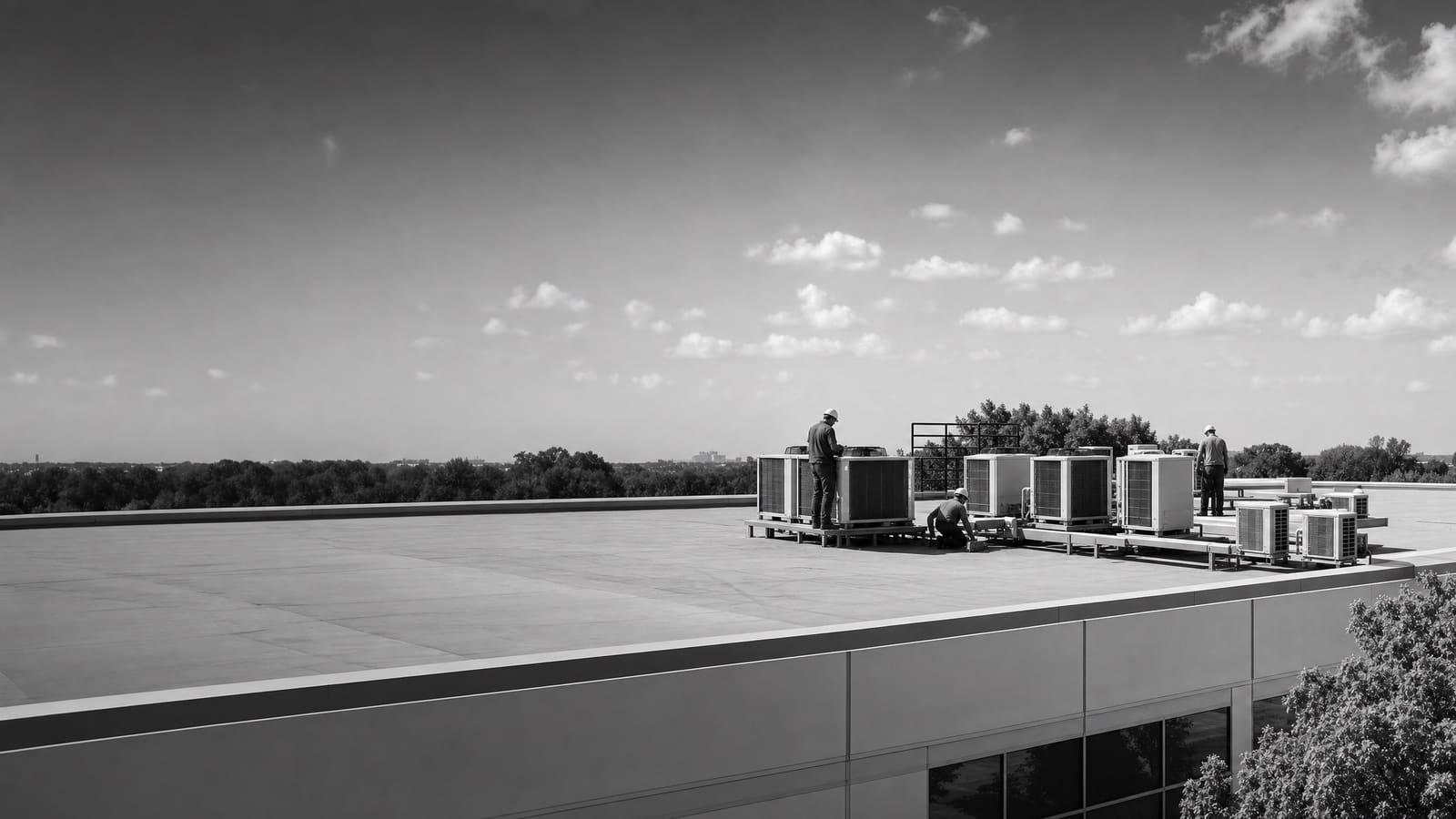
A commercial replacement covers load confirmation, equipment selection against real lead times, rigging and set, curb adaptation, gas and electrical and control connections, permits and inspection, and commissioning before handoff. Replacement beats another repair once a unit is past roughly fifteen years, the same failures repeat in season, or service is holding it together month to month. Old, inefficient rooftop units waste an estimated $900 to $3,700 each per year, so a limping unit already costs money every month it stays.
A site review has to confirm the actual load for today's use, roof and curb condition, crane reach from your lot, available electrical capacity, and the permit scope the change-out triggers. Those five findings set the price.
THREE WAYS TO GO
Three replacement paths worth pricing
Most buildings have three honest options, and they are not equally right. The old nameplate records a decision someone made twenty years ago, under a different occupancy and a different envelope, so it is a starting point rather than an answer. Rooftop units condition close to half of all commercial floor area in the country, which is why this one choice carries so much weight for a single building. The federal high-efficiency rooftop specification was written to cut unit energy use by up to half against the old standard, and more than twenty models now exceed it. Price all three paths on the same roof, on the same day, and decide with the numbers in front of you instead of defaulting to whatever matches the curb.
WHAT MOVES THE PRICE
Six lines that decide your number
There is no universal installed price for a commercial change-out, because these six items differ on every roof. Ask each bidder to show them as separate lines. That is how you compare two quotes instead of guessing at what one of them left out.
IN PRACTICE
Buying the replacement instead of reacting to it
Commercial HVAC work splits into two kinds. One is replacement under pressure, where a unit quits in July and the building needs it handled today. The other is planned, where a tenant improvement, an addition, or an aging fleet gets scheduled on your calendar instead of the equipment's. The buying experience is completely different, and so is the price.
DOE's guidance is blunt about the pattern. Facility managers often wait until a unit no longer conditions the space, needs constant service, or fails outright. Replacing an inefficient, underperforming unit before that point is frequently the better business move — better than replacement-on-failure, and often better than a like-for-like swap at the end of service life. Units past fifteen years are usually where that math turns.
The practical version is a fleet list. Write down every unit on the roof with its age, tonnage, and service history, then rank them. The one failing every season gets replaced on your schedule this year, with time to compare equipment, look at incentives, and pick a week your tenants can absorb. Under the Advanced RTU Campaign, more than 200 organizations upgraded over 43,000 units and now save a combined $37 million a year on energy. Those savings came from planning, not from emergencies.
COMPLEXITY CHECK
What makes this simple, and what makes it hard
Two change-outs on the same street can price very differently and both quotes can be honest. Before you compare bids, work out which of these projects you actually have.
LOWER COMPLEXITY
Straight swap on an open roof
Similar tonnage, an existing curb an adapter fits, gas and electrical already sized for the unit, clear crane reach over open parking, and a space whose use has not changed. Permits are routine and the set happens in a morning.
HIGHER COMPLEXITY
Capacity, fuel, or access changes
Larger tonnage, a structural look at the curb, a gas unit going all-electric with new panel capacity, tight or shared parking that limits where the crane can sit, and controls that have to tie into building automation.
BEFORE YOU BID
What a real site review has to produce
A quote written from a nameplate photo is a placeholder. It is useful for a lead time and a rough number when a unit is down in season, and it should not be the document you sign. The site review is what turns it into a price that holds.
On the roof, that means the actual unit, the curb underneath it, and the condition of the roof around it. It means measured clearances and a look at what the crane can physically reach from your lot. Inside, it means the electrical panel: DOE lists electrical capacity, physical constraints, and existing gas lines as the infrastructure items that decide whether a heat pump swap is straightforward or a project of its own. And it means how the space gets used today, since occupancy, plug loads, and envelope work all moved since the old unit was specified.
The review should also settle who owns which risk. Permits, inspections, rigging, lot coordination, and disposal of the old unit either sit inside the installed price or they land on you later. Ask which, and get the answer in writing. Contractor familiarity with the equipment you are considering is itself a DOE-flagged consideration, so ask what the crew has installed before.
The five findings that set your price
Confirmed load for today's use, curb and roof condition, crane reach and staging from your lot, available electrical capacity and gas service, and the permit scope the change-out triggers. If a quote does not reflect all five, it is an estimate rather than a price.
IN SAN BERNARDINO
Permits and the climate case for going electric
Two local factors change this decision. The first is paperwork. In California, HVAC change-outs are permit work, and permit scope covers mechanical, electrical, and plumbing upgrades or repairs alike — so a swap that touches a circuit or a gas line is not a no-permit job. Confirm the current submittal requirements and inspection timeline with the local building division before a crane date is booked, because plan review sits on the critical path rather than beside it.
The second is climate. DOE's heat pump rooftop guidance says these units perform best where winter heating is mild to moderate, and that across most of the U.S. South and West today's heat pump rooftop units can address most or all of the winter heating demand. Southern California sits squarely inside that description. That does not make electrification automatic — electricity price, panel capacity, and available incentives still decide it — but it removes the usual objection.
Ask both questions before the crane is booked
Confirm permit scope and inspection lead time with the building department, then price the heat pump option beside the gas one. In this climate the comparison is worth running, even in the cases where a like-for-like unit still wins on panel capacity.
OWNERSHIP QUESTIONS
Two things owners settle before the crew arrives
Equipment choice gets the attention, but two ownership decisions shape what the next fifteen years feel like. The first is a lease question. If tenants pay the utility bill and the owner buys the equipment, the party funding a high-efficiency unit is not the party collecting the savings, and that split quietly pushes buildings toward the cheapest box on the roof. Worth naming before the bid rather than after. The second is fleet consistency. One new unit alongside five aging ones creates a mixed roof, and mixed roofs are harder to service, stock parts for, and control from a single system. Neither issue changes the physics of the install. Both change what the right purchase is.
SPLIT INCENTIVES
Who pays, who saves
When the tenant pays the power bill, the owner buying the unit sees none of the efficiency gain. Sort out how the upgrade and the savings get shared before you pick a tier, or the decision defaults to lowest first cost.
MIXED FLEETS
One new unit on an old roof
New equipment often arrives on a different refrigerant than the units beside it. EPA Section 608 governs how refrigerant is handled and recovered in either case, so a mixed roof means two service and parts tracks to plan around.
OVER THE LIFETIME
Phasing, procurement, and what the unit costs after day one
The invoice is the smallest part of what a rooftop unit costs you. Old, inefficient units waste an estimated $900 to $3,700 each per year, and that number runs every year you defer. On a roof carrying six aging units, deferral is a recurring expense with no line item and no approval meeting.
Phasing is how most buildings handle that without one painful capital request. Rank the fleet by age and service history, replace the worst one or two a year, and hold the schedule. Each replacement then lands in a shoulder month instead of a heat wave, gets competitive bids instead of whatever is on the truck, and has time to clear plan review before a crane is booked.
Procurement follows the same logic. Lead times move with tonnage and configuration, and DOE lists equipment availability as its own decision factor for good reason. Ask for availability next to price on every option, because a cheaper unit that lands eight weeks later is not cheaper when the space is unusable in the meantime. Ask about incentives before you order as well. Utility and federal programs exist for high-efficiency and heat pump rooftop equipment, and each one has its own timing and documentation rules that are easier to meet early than to fix later.
QUOTE CHECKLIST
Five things a comparable quote shows
Two bids on the same roof can differ by a wide margin and both be written in good faith, because they scoped different work. These five lines are what make them comparable.
01
The equipment, spelled out
Make, model, tonnage, efficiency tier, and heating type, plus the current lead time for that exact unit.
02
Curb, roof, and structural scope
Adapter or new curb, any framing work, and who signs off if the footprint or tonnage grows.
03
The crane day
Rigging plan, reach, lot closure hours, and whether the lift happens after business hours.
04
Connections and controls
Gas, electrical, and refrigerant line work, plus how the unit ties into existing controls or building automation.
05
Permits, commissioning, and disposal
Who pulls permits, who meets the inspector, what startup verification is documented, and where the old unit goes.
Keep planning locally
Related mechanical pages in San Bernardino
Get a defensible number
Price the equipment and the building together.
Send the address, operating target, and target opening date. Flux will identify what must be verified before the project can be priced.
Get a free estimateQuestions
Straight answers.
How much does a commercial HVAC replacement cost?
It is priced per unit, and the honest answer is that tonnage, efficiency tier, curb and roof work, crane access, electrical capacity, and permit scope decide it. Anyone quoting a flat number before seeing the roof is guessing. What is easier to pin down is the cost of waiting: old, inefficient rooftop units waste an estimated $900 to $3,700 each per year.
When is replacement better than one more repair?
Once a unit is past roughly fifteen years, fails repeatedly in season, or no longer conditions the space adequately, repairs stop buying much. DOE's guidance is that proactively replacing an inefficient unit is often the better business move than waiting for failure, because a planned replacement gets real bids, real lead times, and a schedule you choose.
Should a gas rooftop unit be replaced with a heat pump?
It is worth pricing here. DOE says heat pump rooftop units suit mild-to-moderate winter heating and can handle most or all of the heating demand across most of the South and West. The deciding factors are electricity price, available electrical capacity, physical constraints, and incentives — which is why both options belong on the same quote.
Is a permit required to replace a rooftop unit?
Yes. In California, mechanical and electrical upgrades and repairs both fall inside permit scope, so a change-out is permitted work even when it looks like a straight swap. Confirm current submittal requirements and inspection timing with the local building division early, since plan review affects when the crane can be scheduled.
How long does the actual installation take?
The visible work is short. The variable is equipment lead time, which moves with tonnage and configuration and runs longest on specialty units. That is why availability should sit next to price on the quote — a lower number that arrives weeks later is not the cheaper option when the space cannot be used.
What happens to the refrigerant in the old unit?
It is recovered, not vented. EPA Section 608 regulations govern the handling and recycling of refrigerants in stationary air-conditioning and heat pump equipment, so certified recovery is part of the removal rather than an add-on. On a roof with mixed-age units, plan service and spare parts around more than one refrigerant.
Sources used for this guide
- [1]betterbuildingssolutioncenter.energy.gov — DOE Advanced Rooftop Unit Replacement Guidance
- [2]betterbuildingssolutioncenter.energy.gov — DOE Commercial Heat Pump Rooftop Unit Replacement Guidance
- [3]betterbuildingssolutioncenter.energy.gov — DOE High-Efficiency Commercial Rooftop Unit Toolkit
- [4]energy.gov — DOE Efficient Commercial Rooftop Air Conditioner Program
- [5]epa.gov — EPA Stationary HVAC Refrigerant Management
- [6]californiacity-ca.gov — HVAC Permits