THE DIRECT ANSWER
What a commercial HVAC replacement actually covers
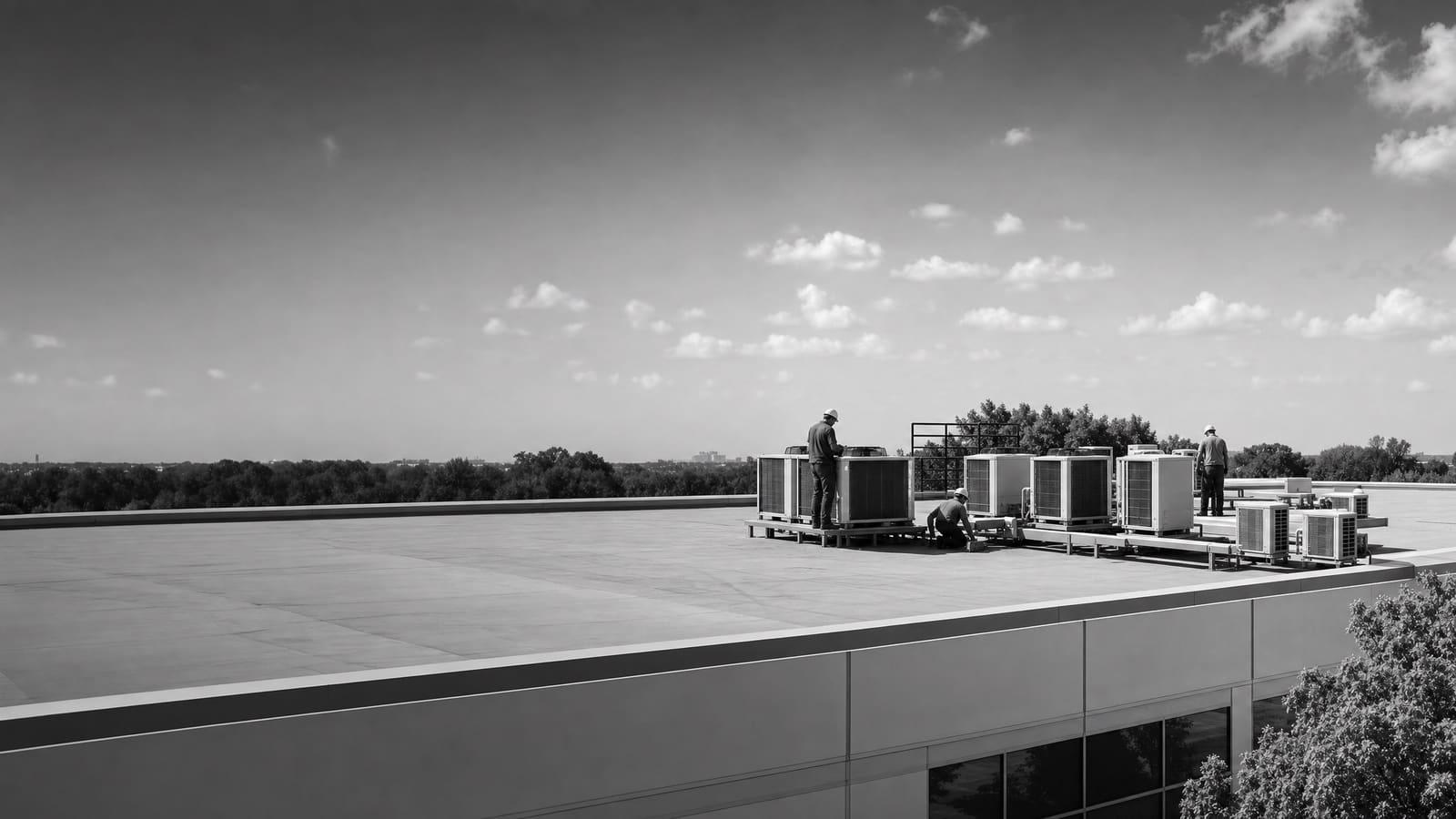
A commercial HVAC replacement covers confirming the load the building carries today, selecting equipment against real availability, permits, curb work and the crane set, connections, and commissioning before handoff. Replacement beats another repair once a unit no longer holds the space, needs frequent service calls, or has passed the fifteen-year mark where DOE says older rooftop units waste substantial energy and money compared with newer equipment.
A site review still has to verify tonnage against current use, curb and structural fit, roof and lot access for a crane, and whether existing gas and electrical service supports the unit you want.
THREE PATHS
Three ways to handle an aging rooftop unit
Most buildings choose between three paths, and the honest difference is timing and control. Waiting for failure is the default, and it is the most expensive version of the same project: you take whatever unit is available and lose the space while you wait. Planned like-for-like replacement puts a new unit on your schedule instead of the equipment's. Upgrading to a high-efficiency or heat pump unit costs more up front and asks more of the site review, but it is the only path that changes what the unit costs to run. DOE is blunt about that third option: old, inefficient rooftop units waste roughly $900 to $3,700 per unit each year, and the campaign that pushed owners toward efficient replacements reported more than 43,000 units upgraded and about $37 million in combined annual energy savings.
WHAT MOVES THE NUMBER
The budget lines that actually swing
No one can price a commercial replacement from a tonnage number alone. These are the lines that separate a straightforward swap from a project, and they are the ones to ask about before a quoted number feels real.
BUYING GUIDANCE
How to compare replacement options without guessing
Start with the load the building carries now, not the number stamped on the old unit. A rooftop unit that was right twenty years ago may be oversized for a space that changed its lighting, its hours, or half its occupancy — and undersized for one that added kitchen equipment or a server closet. Confirming the load is the cheapest step in the project and the one that decides everything after it.
Then price the operating side, not just the install. DOE put the annual waste from old, inefficient rooftop units at roughly $900 to $3,700 each, and the high-performance specification it set with manufacturers targeted units that cut energy use by up to half against the older standard. On one unit that gap is a line item. Across a roof carrying six or eight units, it is the reason planned replacement usually beats another season of repairs.
Last, ask what happens to the old refrigerant. EPA rules under Section 608 of the Clean Air Act govern how refrigerant is handled and recovered from stationary air-conditioning equipment, and that work belongs to the installing contractor. A quote that never mentions recovery has a gap in it.
COMPLEXITY CHECK
One-day swap, or a project
Two replacements with identical tonnage can be very different jobs. Before you compare prices, work out which side of this line your building sits on, because it explains most of the spread between bids.
LOWER COMPLEXITY
Straight swap conditions
Same tonnage and same fuel, an existing curb that matches, clear roof access with room for a crane in the lot, electrical service already adequate, and a space whose use has not changed since the last unit went in.
HIGHER COMPLEXITY
Project conditions
A fuel switch to an all-electric unit, tonnage or footprint changes that trigger structural review, tight or shared parking that limits crane reach, panel capacity that has to be verified, or a tenant who cannot lose conditioning during business hours.
THE SITE REVIEW
What a real site review has to answer
A quote written from a phone call is a guess with a number attached. The review that makes it real is short, and it answers a fixed set of questions.
First, the equipment itself: current tonnage, age, fuel, refrigerant, and whether the unit still holds the space on the worst day of the year. DOE treats fifteen years as the point where an older rooftop unit is likely wasting real money, so age alone can move the conversation from repair to replacement.
Second, the infrastructure. DOE's heat pump rooftop guidance lists the same three checks every time: electrical capacity, physical constraints on the roof, and existing gas lines. Those three decide whether an all-electric unit is a swap or a service upgrade, and they are far cheaper to check now than to discover on install day.
Third, access and schedule. Where the crane sets, which stalls close, how long the lot is down, and what the building can tolerate while it happens. That answer shapes the installed price as much as the equipment does.
Settle these before you compare bids
Nameplate data on the existing unit, a confirmed load, a curb and structural note, an electrical capacity check, a crane and lot access plan, and a firm lead time. Bids that all answer those six things can finally be compared to each other.
OWNERSHIP QUESTIONS
Two decisions that outlive the install
The install is a week. The consequences run for the whole life of the unit, and two of them are worth settling before the purchase order rather than after. One is fuel: whether this unit stays on gas heat, moves to a heat pump, or splits the difference with a dual-fuel configuration. The other is fleet strategy: whether you are replacing one unit or working through a roof full of them, because that changes what you standardize on and what your service contract has to cover. Neither question has a universal answer, and both get much harder to revisit once the unit is set and the connections are made.
FUEL AND HEATING
Gas, heat pump, or dual fuel
DOE guidance says today's heat pump rooftop units suit most of the U.S. South and West and can meet most or all winter heating demand there. It also flags the February 2021 Texas freeze: heat pump efficiency falls as temperatures drop, which is why dual-fuel exists.
FLEET AND PARTS
One unit or the whole roof
Refrigerant type follows the equipment, and EPA Section 608 rules govern how it is handled and recovered on every unit. A roof of mixed vintages means more than one service standard, so decide early whether you are standardizing or managing the split.
PHASING AND PROCUREMENT
Replacing a roof full of units without replacing your year
If you own more than one unit, the useful question is not which one to replace — it is what order to replace them in. Rank by age, service history, and the load each unit carries, then move the worst offender first and let the rest run on a schedule you set. DOE's campaign work was built on that pattern: more than 200 organizations worked through over 43,000 rooftop units rather than replacing everything at once, and the group reported around $37 million in combined annual energy savings.
Phasing also fixes the procurement problem. Equipment lead time is the part of the schedule you do not control, and an order placed months ahead for a planned replacement is a very different order than one placed the morning a unit dies in season. Planned buys let you compare efficiency tiers honestly, check what incentives are open while there is still time to qualify, and pick a crane day that does not land on your busiest week.
The lifetime math is the same argument in another form. Purchase price is one number, paid once. What the unit burns every month is the other, and DOE's per-unit waste range for old equipment shows how quickly the second number catches the first.
ON THE QUOTE
Five things a comparable quote shows
Bids get compared on price because price is the only number everyone prints. These five items are what make two numbers mean the same thing, and any bid missing one of them is not really a bid yet.
01
Tonnage, efficiency tier, and model
The exact unit, not a category. Efficiency tier is where two bids quietly stop matching.
02
Confirmed lead time
A date for the equipment, in writing, sitting next to the price.
03
Curb, structural, and roof work
Adapter or new curb, framing if the footprint changes, and who patches the roof.
04
Crane day and lot plan
Rigging, closures, and the hours the lot is down, all inside the installed price.
05
Commissioning and refrigerant handling
Charge, airflow, and controls verified and documented; old refrigerant recovered under EPA rules.
Get a defensible number
Price the equipment and the building together.
Send the address, operating target, and target opening date. Flux will identify what must be verified before the project can be priced.
Get a free estimateQuestions
Straight answers.
When does replacement beat one more repair?
When the unit no longer holds the space, needs frequent service calls, or is old enough that its operating cost is the real problem. DOE points to fifteen years as the age where rooftop units start wasting substantial energy and money, and puts the annual waste from old, inefficient units at roughly $900 to $3,700 each. At that point another repair buys time, not performance.
Should we switch to a heat pump rooftop unit?
It depends on what the building already has. DOE guidance says today's heat pump rooftop units are appropriate across most of the U.S. South and West and can meet most or all of the winter heating demand there. The checks that decide it are electrical capacity, physical constraints on the roof, and existing gas lines — plus whether local electricity pricing makes the switch pay.
How much does a commercial HVAC replacement cost?
There is no universal installed price, and any number given before someone looks at the roof is a guess. The spread comes from tonnage and efficiency tier, curb and structural work, crane access, and whether gas or electrical service has to change. The operating side is easier to pin down: DOE's range for what an old, inefficient unit wastes is $900 to $3,700 per unit per year.
What actually controls the schedule?
Equipment lead time, not the crane. The on-site set is the short, visible part of the project; waiting on the unit is the part that moves the calendar. That is why a confirmed availability date belongs on the quote next to the price, and why planned replacements cost less trouble than emergency ones.
What happens to the refrigerant in the old unit?
It has to be recovered and handled under EPA's Section 608 rules, which govern refrigerant in stationary refrigeration and air-conditioning equipment. That is the installing contractor's responsibility, and it should be named in the scope. On a roof with units of different vintages, it is also worth confirming what your service contract covers for each refrigerant type.
Sources used for this guide
- [1]betterbuildingssolutioncenter.energy.gov — DOE Advanced Rooftop Unit Replacement Guidance
- [2]betterbuildingssolutioncenter.energy.gov — DOE Commercial Heat Pump Rooftop Unit Replacement Guidance
- [3]betterbuildingssolutioncenter.energy.gov — DOE High-Efficiency Commercial Rooftop Unit Toolkit
- [4]energy.gov — DOE Efficient Commercial Rooftop Air Conditioner Program
- [5]epa.gov — EPA Stationary HVAC Refrigerant Management