THE SHORT VERSION
What a commercial HVAC replacement actually includes
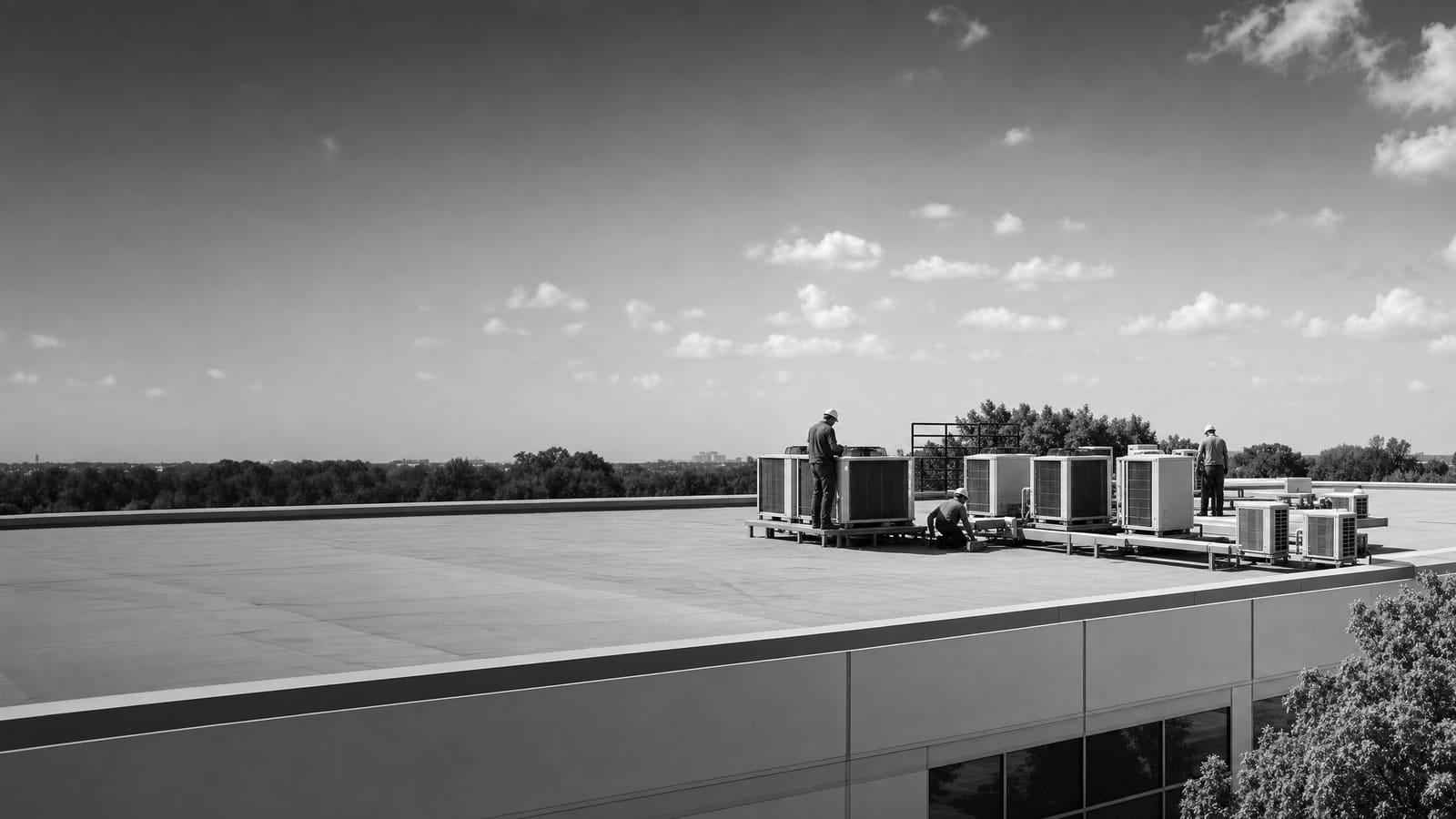
A commercial HVAC replacement is the unit plus everything around it: a load check against how the space is used today, equipment picked against real availability, a curb adapter and any roof work, the crane day, gas and electrical connections, regulated refrigerant recovery, controls integration, and commissioning. Replacement beats one more repair once a unit is past 15 years and failures stack up. Federal analysis found aging rooftop units can waste $900 to $3,700 each year.
A site review has to confirm the real load, the curb and roof structure, electrical capacity at the unit, crane reach across your lot, and what the current controls can actually talk to.
THREE WAYS TO GO
Three replacement paths worth pricing
Most commercial replacements come down to three choices, and they are worth pricing side by side instead of assuming one.
Like-for-like is the fastest path back to conditioned air. Same tonnage, same curb, same fuel, simplest scope. It also carries forward whatever sizing mistake the old unit had.
A right-sized, higher-efficiency replacement adds a load calculation and a better efficiency tier. The Department of Energy pushed manufacturers toward rooftop units that cut energy use by up to half against the older standard, and manufacturers responded with more than twenty models that beat it. That is where operating savings live.
The third path is electric or dual-fuel heating. Heat pump rooftop units are close cousins of standard units but add reverse-cycle heating. DOE guidance describes three forms: dual fuel, all-electric, and cold climate. Heat pump heating efficiency falls as outdoor temperature drops and trends toward electric resistance, so a building with real winter heating load usually looks at dual-fuel or cold-climate equipment rather than a straight all-electric swap.
WHAT MOVES THE NUMBER
Where the money actually goes
Nobody can price a commercial roof from a phone call, because the unit itself is often not the biggest variable. These are the lines that move an installed price the most, and the ones that surprise owners most often.
IN PRACTICE
Choose the equipment before you choose the price
Start with the load, not the nameplate. A unit installed twenty years ago was sized for the occupancy, lighting, and plug load of that building at that time, and all three have changed. If nobody recalculates, the new unit inherits the old assumptions and the same comfort complaints follow it onto the roof.
Then set the efficiency tier deliberately. Rooftop units condition close to half of all US commercial floor space, so a small efficiency difference shows up on the bill every month for fifteen years or more. The 2015 federal standard that followed DOE's push was projected to save businesses $167 billion over the lifetime of the products. Your share of that gets decided as a tier selection on one purchase order.
Availability is the third input, and it belongs on the quote next to the price. DOE's own heat pump guidance lists equipment availability and contractor familiarity as real selection factors, not footnotes. A unit that lands eight weeks late is not a bargain, and equipment your service contractor rarely touches costs more to keep running.
SCOPE CHECK
What makes one replacement simple and another complicated
Two buildings with identical tonnage can price very differently. The gap is almost never the unit itself. It is what the roof, the lot, and the existing services demand around it.
LOWER COMPLEXITY
Straight swap conditions
Same tonnage and fuel, an existing curb that takes a standard adapter, clear crane access from a lot you control, adequate electrical service already at the unit, and simple stand-alone controls.
HIGHER COMPLEXITY
Conditions that add scope
Larger tonnage or a different footprint, structural review on the curb, a tight or shared lot that forces off-hours lifts, service upgrades to support electric heat, and integration into an existing automation system.
BEFORE YOU BUY
What a real site review covers
A quote written from a nameplate photo is an estimate, and it should say so. A quote you can hold someone to comes after somebody stands on the roof.
The review should confirm the actual load for how the space is used now, the condition and dimensions of the existing curb, whether the structure carries the new weight, and how the new footprint lines up with the old opening. It should confirm electrical capacity at the unit and at the panel feeding it, gas line size and routing if the unit burns gas, and the condensate and drainage paths.
Then it moves off the roof. Where the crane sets up, what it has to reach over, and how many stalls disappear for the day. Which tenants lose conditioning during the swap, and whether temporary cooling is worth renting. What the existing controls are, and whether the new unit can talk to them without a translator.
DOE's heat pump guidance frames these as infrastructure questions, covering electrical capacity, physical constraints, and gas lines. They decide feasibility before anyone argues about price.
Ask for the walk before the number
If a contractor will not put boots on the roof before quoting, the change orders show up later instead. The curb, the panel, and the crane path are the three items that turn a clean price into a moving one.
AFTER THE LIFT
Two things that decide what the unit costs you to own
The purchase order closes on install day. The cost of ownership starts there.
Two decisions made during the project follow the unit for its whole life: whether it was commissioned and documented, and whether it fits the fleet your service contractor already supports. Neither one shows up in the equipment line. Both show up in the maintenance budget, and both are cheap to get right during the project and expensive to fix afterward.
COMMISSIONING
Proof it performs, not just runs
Startup, refrigerant charge, airflow, and control settings verified against the design and written down. DOE's rooftop program relied on measured third-party performance rather than data sheets, and your building deserves the same standard.
SERVICE STRATEGY
Refrigerant and parts across a mixed fleet
A new unit may not use the same refrigerant as the older units beside it. EPA Section 608 governs how refrigerant is handled and recycled, so recovery, certified technicians, and spare parts belong in the service plan.
PHASING AND PROCUREMENT
Replace on your schedule instead of the equipment's
Commercial HVAC work happens in one of two moods. A unit dies in season and everything becomes urgent, or a roof gets planned and the work happens on a calendar. The second one is cheaper, and the gap is not small.
DOE makes the point plainly: facility managers often wait until a unit no longer conditions the space, needs constant service, or fails outright. Replacing inefficient units proactively can beat replacement-on-failure, and it can even beat a like-for-like swap at the end of service life. Waiting removes your options. You take whatever tonnage sits in the regional warehouse, you pay whatever the crane costs that week, and you skip the load calculation because the building is already hot.
If you own several units, phase them. Rank by age, service history, and energy waste, then replace two or three a year on a budget you set. The Advanced RTU Campaign counted more than 43,000 upgraded units across 200-plus organizations, saving a combined $37 million a year. That is what disciplined phasing looks like at scale.
Phasing also lets you standardize. One manufacturer, one control platform, and one parts strategy across the roof makes every future service call shorter.
QUOTE CHECKLIST
Five things a comparable quote has to show
Two quotes for the same roof are only comparable if they cover the same scope. Ask every bidder for these five items in writing, then compare.
01
Equipment, tonnage, and efficiency tier
Model number, capacity, and the efficiency rating, so you are comparing the same machine and not a cheaper substitute.
02
Curb, roof, and structural scope
Adapter or new curb, who patches the roof, and whether structural review is included or excluded.
03
Crane, rigging, and lot plan
Crane size, set-up location, closure hours, and who coordinates tenants and parking.
04
Services, controls, and disposal
Electrical and gas work, controls integration, refrigerant recovery, and haul-off of the old unit.
05
Lead time, commissioning, and warranty
A dated availability commitment, a commissioning report at handoff, and what the labor warranty covers.
Keep planning locally
Related mechanical pages in Milwaukee
Get a defensible number
Price the equipment and the building together.
Send the address, operating target, and target opening date. Flux will identify what must be verified before the project can be priced.
Get a free estimateQuestions
Straight answers.
When does replacement beat one more repair?
Watch three signals together: age past fifteen years, repairs that keep repeating, and conditioning that no longer holds the space. DOE reports that older rooftop units can waste $900 to $3,700 per unit each year, so an aging unit collecting repair invoices is usually the expensive choice, not the thrifty one.
What actually sets the schedule on a replacement?
The visible part is the crane day, and it is short compared with everything around it. The real schedule risk is equipment lead time and any electrical or gas upgrade the new unit triggers. That is why a dated availability commitment belongs on the quote right next to the price.
Should we switch to a heat pump rooftop unit?
It depends on the heating load and the infrastructure. DOE guidance weighs climate, utility rates, electrical capacity, physical constraints, gas lines, equipment availability, and contractor familiarity. Heat pump heating efficiency drops as outdoor temperature falls, so buildings with a heavy winter load usually consider dual-fuel or cold-climate equipment rather than an all-electric swap.
What happens to the refrigerant in the old unit?
It gets recovered, not vented. EPA regulations under Section 608 of the Clean Air Act govern how refrigerant is handled and recycled in stationary air conditioning and heat pump equipment. Your quote should name who performs recovery and confirm the old unit is hauled off as part of the installed price.
Is a like-for-like swap ever the right answer?
Often. If the occupancy, equipment, and envelope have not changed and the old unit held the space, matching tonnage on the existing curb is the fastest and simplest path back to service. Still confirm the load first, because a like-for-like order is also how a twenty-year-old sizing error gets renewed.
Sources used for this guide
- [1]betterbuildingssolutioncenter.energy.gov — DOE Advanced Rooftop Unit Replacement Guidance
- [2]betterbuildingssolutioncenter.energy.gov — DOE Commercial Heat Pump Rooftop Unit Replacement Guidance
- [3]betterbuildingssolutioncenter.energy.gov — DOE High-Efficiency Commercial Rooftop Unit Toolkit
- [4]energy.gov — DOE Efficient Commercial Rooftop Air Conditioner Program
- [5]epa.gov — EPA Stationary HVAC Refrigerant Management