THE SHORT VERSION
What a commercial HVAC replacement actually covers
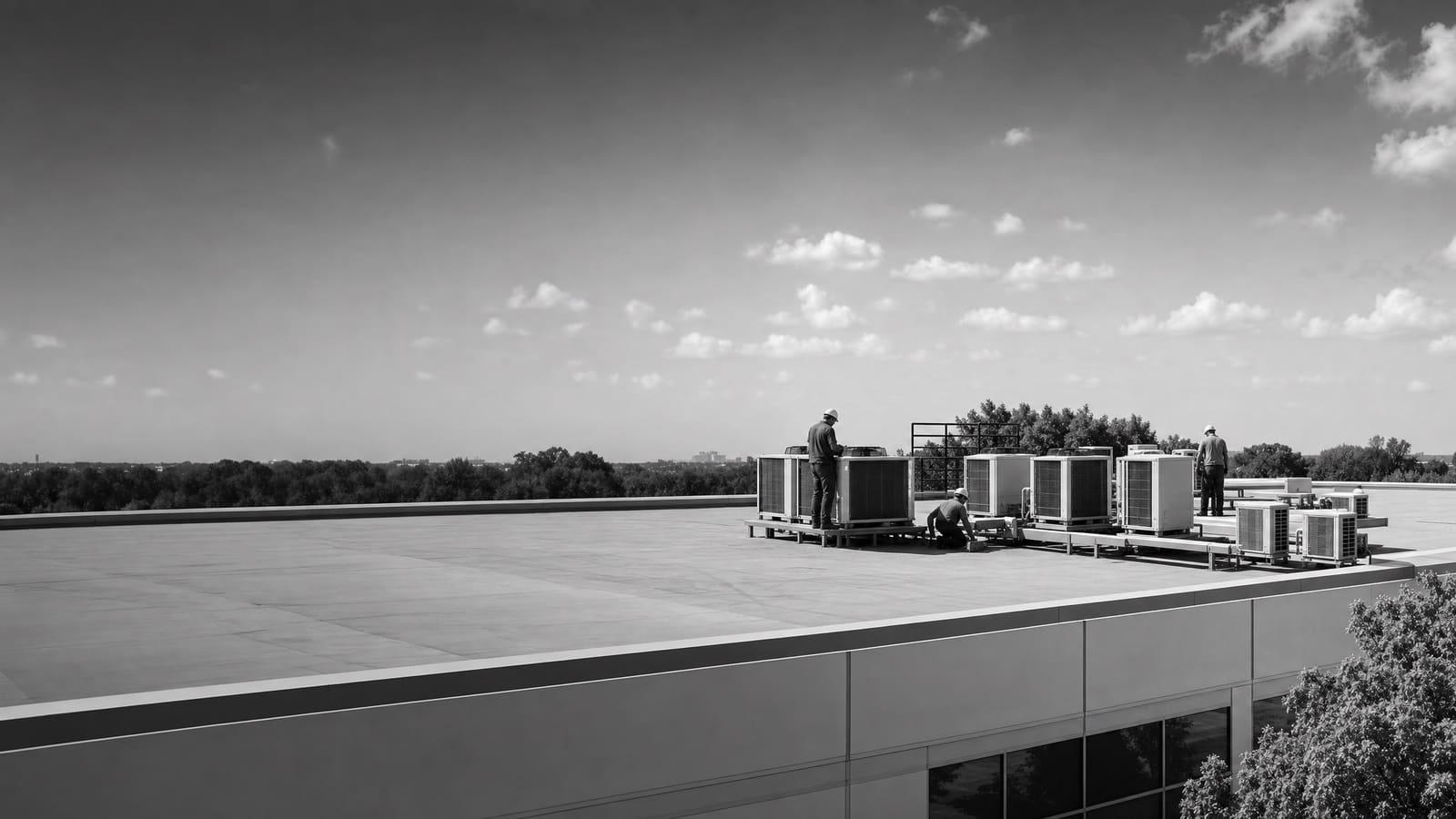
A commercial HVAC replacement covers the load calculation, equipment selection, rigging and set, the gas, electrical, and refrigerant connections, and the commissioning that proves the unit performs. Replacement tends to beat another repair once a rooftop unit passes about fifteen years, because equipment that old wastes energy and fails in season. Old, inefficient rooftop units waste roughly $900 to $3,700 each per year, which is often more than the repair being debated.
A site review has to verify the actual load, the curb and roof structure, crane access to the unit, and whether the electrical service and gas supply can carry the equipment being considered.
THREE PATHS
The equipment choice in front of you
Most commercial replacements come down to three equipment paths, and the right one depends on how long you plan to hold the building and what your service and gas infrastructure already support. A like-for-like swap is the fastest way back to conditioned space and carries the least engineering. A high-efficiency unit costs more up front and pays that back through the energy an aging unit was quietly wasting. A heat pump rooftop unit adds reverse-cycle heating and moves winter load onto electricity, which changes the electrical service question and, in some buildings, the gas line entirely. That last choice turns on climate and heating load, local electricity and gas prices, electrical capacity, physical constraints on the roof, and whether contractors in the market install and service the technology. Decide before the unit dies. Replacement on failure removes every option except whatever is on a truck that week.
WHAT MOVES THE NUMBER
The lines that decide the price
These are the items that move a commercial HVAC quote the most. None of them are optional. They are either priced now or discovered mid-project. Ask for each one to appear separately so two quotes can actually be compared.
BUYING GUIDANCE
Buy the unit before it picks the date
Rooftop units condition close to half of all commercial floor area in the country, so most buildings are having the same conversation: replace the box, or keep patching it. The strongest buying position is a planned replacement. When a unit is chosen ahead of failure, you can size it against how the building is used today, compare efficiency tiers honestly, and wait out a lead time without renting temporary cooling. When the unit dies first, the decision collapses to whatever is available that week.
Sizing deserves more attention than it usually gets. The old nameplate records a decision made under different occupancy, different plug loads, and often a different envelope. A tenant fit-out, a lighting retrofit, or a change in operating hours all move the load. Copying the nameplate carries forward every sizing mistake the last unit had, including the oversizing that shows up later as short cycling and humidity complaints.
Equipment availability belongs in the conversation from day one. Efficiency tier, heating type, and tonnage all affect what a distributor can actually deliver, and heat pump models in particular vary by market. A quote that names a price without naming a lead time is only half a quote.
SCOPE CHECK
Simple swap or a bigger project
Not every replacement carries the same risk. The difference is usually access, capacity, and whether anything about the building changed since the last unit was set.
LOWER COMPLEXITY
Straight swap on an open roof
Same tonnage and heating type, an existing curb that fits, clear crane access from the lot, and electrical service with room to spare. Permits are routine and the set happens in a morning.
HIGHER COMPLEXITY
Capacity or access is the constraint
Tight or shared access, more tonnage than the roof last carried, a panel with no spare capacity, or a switch to all-electric heating. These add structural review, electrical work, and phasing across multiple visits.
THE SITE REVIEW
What a real walk has to confirm
A useful site review answers questions the nameplate cannot. It starts on the roof: curb dimensions and condition, structural support, membrane age, and how the existing unit is anchored. It moves to the connections: the disconnect and breaker feeding the unit, available panel capacity, the gas line and its sizing, and the condensate path. It ends in the space: what the unit actually serves, which zones generate complaints, and how the building is occupied through the day and the week.
The electrical review matters most when a heat pump is on the table. Reverse-cycle heating shifts winter load onto the service, and most all-electric and cold climate units carry electric resistance backup for the coldest hours. That backup is what drives the capacity question. If the panel has no room, the honest options are a dual-fuel unit that keeps gas heat, a service upgrade priced into the project, or staying with the current fuel for this cycle.
The review should also settle who is allowed to do the work. Licensing and permitting here depend on the project value and the jurisdiction, so both belong in the conversation before a contract is signed rather than at inspection.
What to have ready before the walk
Nameplate photos of every unit, a panel schedule or a clear photo of the electrical panel, roof access details, your operating hours, and a list of comfort complaints by zone. That is usually enough to get real options priced.
KNOXVILLE SPECIFICS
License and permit rules to verify first
Tennessee splits HVAC contractor licensing by project value, and that split changes who can legally quote your job. Projects over $25,000 require a state contractor's license with the CMC-C classification, and a full mechanical CMC license also covers the work. Most projects under $25,000 are regulated at the local level instead, which means the city or county where the building sits sets the license, permit, and inspection requirements. Knoxville-area owners should confirm those requirements with the jurisdiction that will actually inspect the job.
There is one more wrinkle worth checking. In municipalities where the State Fire Marshal's electrical inspectors perform inspections, an HVAC permit requires a state Limited Licensed Electrician license, or a contractor's license with the CMC-C classification. If your replacement includes electrical work, ask which of those the contractor holds before the permit application goes in.
Match the license to the project value
Ask every bidder for their license classification and confirm it fits the size of your project. A $30,000 rooftop replacement is CMC-C or CMC work, and a smaller project still has to satisfy whatever the local jurisdiction requires.
OWNERSHIP VIEW
Two questions that change the answer
Two questions shape the outcome more than the equipment brand: how long you will hold the building, and who carries the system after the first year. Answer both before you pick an efficiency tier, because they decide which unit is actually the cheaper one over its life. A landlord buying the equipment and a tenant paying the utility bill do not feel the same savings, so the lease structure belongs in this conversation as much as the load calculation does. The same is true for a building that may sell inside the payback window.
HOLD PERIOD
How long the savings have to run
A high-efficiency or heat pump unit costs more on day one and returns it through utility savings. On a long hold with heavy run hours, that is straightforward. On a short hold or a sale inside the payback window, the like-for-like case gets stronger.
SERVICE PLAN
Who carries it after year one
New commercial equipment arrives on newer, lower-GWP refrigerants, and federal rules govern how refrigerant is recovered and handled by certified technicians. On a mixed fleet, confirm your service provider is equipped for both the old units and the new one.
PHASING AND LIFETIME COST
Replace on a plan, not on a failure
Buildings with more than one rooftop unit rarely replace them all at once, and they should not have to. The better approach is a written replacement order based on age, condition, and what each unit serves. Units past fifteen years, units with a repair history, and units serving the spaces that generate the most complaints go first. That turns a run of emergencies into a budget line you can defend, and it lets you buy equipment on your schedule instead of on a distributor's stock list.
Phasing also creates leverage. When two or three units are planned for the same year, they can be quoted together, share a crane day, and move through one permit and inspection cycle. That is a real saving on mobilization, and it usually shortens the total disruption to the parking lot and to tenants.
Lifetime cost is where these decisions settle. The purchase price is one year of the conversation, and the energy bill runs for the rest of the unit's life. An inefficient unit quietly spends thousands a year that never appears on any quote. Utility and manufacturer incentives can move the first-year number, and those programs change often, so confirm what is actually open when you are ready to buy rather than assuming last year's program is still funded.
COMPARE HONESTLY
Five things a comparable quote shows
Two quotes are only comparable when both show the same lines. Ask every bidder for these five, in writing, before you compare the totals.
01
Equipment, tonnage, and efficiency tier
Model number, heating type, and the efficiency level quoted, so you are comparing the same class of unit.
02
Lead time and availability
When the unit can actually be delivered, and the plan if the current one fails before then.
03
Curb, rigging, and crane scope
Curb adapter, any structural work, crane size, lot closure, and how long the lot is affected.
04
Electrical, gas, and refrigerant work
Breaker and disconnect changes, panel work, gas line modifications, and certified recovery of the old refrigerant.
05
Permits, commissioning, and license class
Who pulls the permit, what commissioning is documented at handoff, and the license classification the contractor holds.
Keep planning locally
Related mechanical pages in Knoxville
Get a defensible number
Price the equipment and the building together.
Send the address, operating target, and target opening date. Flux will identify what must be verified before the project can be priced.
Get a free estimateQuestions
Straight answers.
When does replacement beat another repair?
Once a rooftop unit is past about fifteen years and repairs are stacking up, replacement usually wins. Old, inefficient units waste roughly $900 to $3,700 a year each in energy, which often exceeds the repair being debated. Waiting for failure also removes every choice except what happens to be in stock.
Should you replace like-for-like or resize?
Confirm the load either way. If occupancy, plug loads, and operating hours have not changed since the last unit, like-for-like is often right. If they have changed, sizing to current use fixes the humidity and short-cycling complaints the old unit created.
Is a heat pump rooftop unit a good fit here?
That depends on the building more than the city. Heat pump rooftop units perform best where winter heating demand is mild to moderate, and the decision turns on your heating load, local electricity and gas prices, available electrical capacity, and the backup heat the unit carries. Dual-fuel models keep gas heat when the panel cannot take more load.
What license does a commercial HVAC contractor need in Tennessee?
Projects over $25,000 require a state contractor's license with the CMC-C classification, and a full mechanical CMC license also covers the work. Most projects under $25,000 are regulated locally, so the city or county sets license, permit, and inspection requirements. Where the State Fire Marshal's electrical inspectors handle inspections, an HVAC permit needs a Limited Licensed Electrician license or a CMC-C.
What happens to the refrigerant in the old unit?
It has to be recovered by a certified technician before the unit comes off the roof. Federal Clean Air Act rules govern how refrigerant is handled, recovered, and recycled in stationary air-conditioning equipment. That recovery belongs on the quote, not as a surprise line at the end of the job.
Sources used for this guide
- [1]betterbuildingssolutioncenter.energy.gov — DOE Advanced Rooftop Unit Replacement Guidance
- [2]betterbuildingssolutioncenter.energy.gov — DOE Commercial Heat Pump Rooftop Unit Replacement Guidance
- [3]betterbuildingssolutioncenter.energy.gov — DOE High-Efficiency Commercial Rooftop Unit Toolkit
- [4]energy.gov — DOE Efficient Commercial Rooftop Air Conditioner Program
- [5]epa.gov — EPA Stationary HVAC Refrigerant Management
- [6]support.commerce.tn.gov — HVAC Projects Less Than $25,000