THE DIRECT ANSWER
What a commercial HVAC replacement actually covers
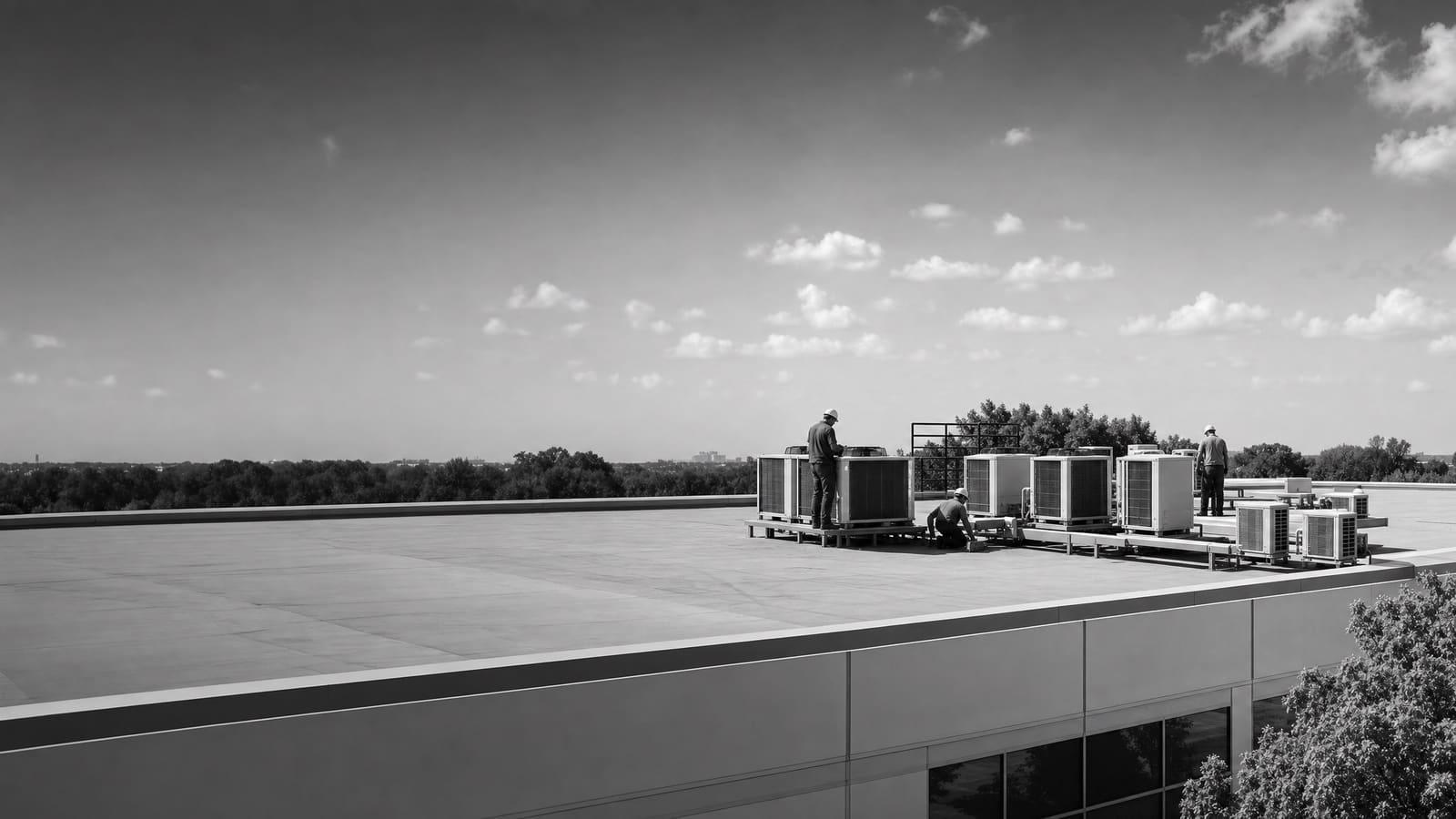
A commercial HVAC replacement covers load verification, equipment selection, rigging and set, mechanical and electrical connections, controls integration, and documented startup. Replacement usually beats another repair once a unit passes fifteen years and needs frequent service: older, inefficient rooftop units waste roughly $900 to $3,700 each per year against newer equipment, and no repair recovers that. Rooftop systems cool close to half of U.S. commercial floor area, so most buildings make this call one unit at a time.
A site review still has to confirm actual load, curb and structural condition, roof and crane access, electrical capacity, and gas service before any tonnage or installed price is committed.
THE REAL CHOICE
Three ways buildings handle a replacement
Most replacements happen one of three ways, and the difference shows up in cost, downtime, and what the building gets for the money.
Waiting for failure is the default. It is also the most expensive version of the same job, because emergency scheduling removes any chance to compare equipment, and the old unit burns money right up to the day it quits.
Planned like-for-like is the middle path. The building keeps the existing curb, connections, and general capacity, so the project stays simple and permitting stays light. It also carries forward whatever the old unit got wrong, including sizing.
A planned efficiency upgrade treats the swap as the one chance to change operating cost. High-efficiency rooftop equipment developed under federal performance specifications was designed to cut unit energy use by up to half against the older standard, and more than twenty models now exceed that specification. That gain is only available on the day the unit is replaced.
WHAT MOVES THE NUMBER
The lines that separate two quotes
A commercial HVAC quote is a stack of separate costs, not one price. These are the lines that move most between two buildings ordering the same tonnage, and the ones worth asking about before you compare bids.
EQUIPMENT DECISION
Choosing between a gas unit and a heat pump
The biggest fork in a commercial replacement is no longer tonnage. It is whether the new unit heats with gas or with a heat pump. Heat pump rooftop units are mechanically close cousins of standard air-conditioning units and add reverse-cycle heating. Three shapes exist: dual fuel, which keeps a gas burner for the coldest hours; all-electric; and cold climate models built for lower temperatures.
Climate drives the answer. Heat pump heating efficiency falls as outdoor temperature falls, trending toward the efficiency of plain electric resistance heat at the bottom of the range. That makes heat pumps a strong fit where winters are mild to moderate, and across most of the South and West current units can carry most or all of the winter heating load. The caution worth keeping is that southern buildings still see sharp cold events. The February 2021 Texas freeze is the reference case, and a design that assumes it never gets cold is a design that fails on the worst day.
Cost is the second filter. The comparison that matters is the projected utility bill under local electricity and gas prices, not the equipment sticker. Then come the physical questions: available electrical capacity, panel and service room, roof space, and what happens to the existing gas line.
SIDE BY SIDE
Straightforward swaps versus complicated ones
Two buildings can order the same tonnage and get very different projects. What separates them is rarely the equipment. It is the roof, the electrical room, and how much the space changed since the last unit went in.
LOWER COMPLEXITY
Same use, same curb
The space is used the way it was when the last unit was set, the curb and structure are sound, the roof has clear crane reach, and the heating source is not changing. Scope stays tight and the set is a single day.
HIGHER COMPLEXITY
New load or new fuel
Occupancy, equipment, or envelope changed, so tonnage has to be recalculated. Or the building is moving off gas heat, which pulls in electrical capacity, panel space, and gas line work, along with longer equipment lead time.
SCOPING THE JOB
What a real site review has to settle
Sizing from the old nameplate is the most common and most expensive shortcut in commercial replacement. A unit set fifteen or twenty years ago was sized for the occupancy, lighting, plug load, and envelope of that year. Very few buildings still match that. A review that starts with how the space is used today will sometimes land on the same tonnage, and that is a fine outcome, but it should be a finding rather than an assumption.
The rest of the review is physical. Someone has to stand on the roof and check the curb, the structure under it, and whether the new footprint lands cleanly or needs an adapter. Someone has to open the electrical room and confirm there is service capacity and panel space for what is being proposed, which matters most when the heating source changes. Access gets measured, not estimated: crane position, reach, and how long the lot can lose stalls.
Two items get skipped often. Refrigerant in the old unit must be recovered and handled under federal rules by certified technicians rather than vented. And contractor familiarity with the specific equipment type is a real consideration, particularly for heat pump rooftop units.
Ask for findings, not assumptions
A proposal should say what was measured and by whom: load basis, curb and structural condition, electrical capacity, crane position, and refrigerant recovery. If a number arrived without anyone on the roof or in the electrical room, treat it as an estimate.
OWNERSHIP VIEW
Two things owners underweight
Two decisions get made once and then live in the building for fifteen or twenty years. Neither shows up as a line item, which is why both tend to get decided by default.
The first is what the building spends after the crane leaves. Older, inefficient rooftop units waste roughly $900 to $3,700 each per year against newer equipment, and that gap compounds across a roof full of units. It is the strongest argument for replacing before failure rather than after.
The second is who maintains the system. Refrigerant in stationary air conditioning and heat pump equipment is federally regulated for handling and recycling, so recovery from the old unit and service on the new one both require certified people. On a roof carrying several units of different ages, that becomes an ongoing program rather than a one-time task.
OWNERSHIP
Replace before failure
A proactive replacement lets you compare equipment, schedule the crane, and stop the annual waste early. Replace-on-failure gives up all three and usually costs more within the same year.
OPERATIONS
Plan the fleet, not the unit
Buildings with several rooftop units get better pricing and less disruption by sequencing replacements on a schedule than by treating each failure as its own emergency project.
PHASING AND PROCUREMENT
Planning a roof full of units
Most commercial buildings do not replace one unit. They replace a roof full of them over several years, and the sequence is worth planning on purpose.
Start by ranking units by age and condition rather than by which one drew the loudest complaint last summer. Units past fifteen years are the ones quietly carrying the energy penalty, and they are where a planned swap returns the most. Ranking also tells you how many replacements are likely in the next three years, which is the number that earns a supplier's attention.
Procurement changes at that point. A building committing to a sequence can lock equipment selection, hold consistent controls and filtration standards across the fleet, and order ahead of the season instead of into it. Fleet-scale upgrade programs have moved tens of thousands of rooftop units for exactly this reason, and the organizations that ran them captured the savings every year afterward rather than once.
The lifetime math is simpler than it looks. Compare installed price plus expected service against projected utility cost across the equipment's life, using current local electricity and gas prices. A cheaper unit that costs more to run every month for two decades is not the cheaper unit. That comparison is also the only fair way to weigh a heat pump against a gas unit.
BEFORE YOU SIGN
Five things a comparable quote shows
Two bids are only comparable when both show the same things. If one is missing any of these, you are not comparing prices. You are comparing scopes.
01
Load basis
How tonnage was determined: current use and measurements, or the old unit's nameplate.
02
Equipment and efficiency tier
Make, model, capacity, efficiency level, heating type, and the quoted lead time.
03
Curb, structure, and access
Adapter or new curb, any roof work, crane position, and lot closure time.
04
Utility and refrigerant scope
Electrical, gas, and certified refrigerant recovery, with permits and inspections named as included.
05
Commissioning and documentation
Verified airflow, charge, and control settings, delivered as a startup record that supports the warranty.
Get a defensible number
Price the equipment and the building together.
Send the address, operating target, and target opening date. Flux will identify what must be verified before the project can be priced.
Get a free estimateQuestions
Straight answers.
When does replacement beat another repair?
Once a unit is past fifteen years and needs frequent service. Older, inefficient rooftop units waste roughly $900 to $3,700 each per year against newer equipment, and a repair does not recover that. Repeated breakdowns also cost you the ability to plan the swap on your own schedule.
Should a Garland building choose a heat pump or a gas unit?
It depends on the winter load and the electrical room, not on preference. Across most of the South and West, current heat pump rooftop units can carry most or all of the winter heating load, and dual-fuel models keep a gas burner for the coldest hours. Confirm electrical capacity and projected utility bills before deciding.
How should tonnage be decided?
From how the space is used now. Occupancy, plug loads, lighting, and envelope all change over fifteen or twenty years, so the old nameplate is a starting reference rather than an answer. Sometimes the review confirms the same size, which is a useful result.
What happens to the refrigerant in the old unit?
It is recovered and handled under federal Clean Air Act rules covering stationary refrigeration and air-conditioning equipment, by certified technicians. Venting is not an option, and recovery should appear in the written scope rather than being assumed.
Why is one quote much higher than another?
Usually scope, not markup. Curb and structural work, crane access, electrical capacity for a fuel change, controls integration, and commissioning are the lines that differ most. Confirm both bids include them before comparing totals.
Sources used for this guide
- [1]betterbuildingssolutioncenter.energy.gov — DOE Advanced Rooftop Unit Replacement Guidance
- [2]betterbuildingssolutioncenter.energy.gov — DOE Commercial Heat Pump Rooftop Unit Replacement Guidance
- [3]betterbuildingssolutioncenter.energy.gov — DOE High-Efficiency Commercial Rooftop Unit Toolkit
- [4]energy.gov — DOE Efficient Commercial Rooftop Air Conditioner Program
- [5]epa.gov — EPA Stationary HVAC Refrigerant Management